
FeruloylputrescineCAS# 501-13-3 |
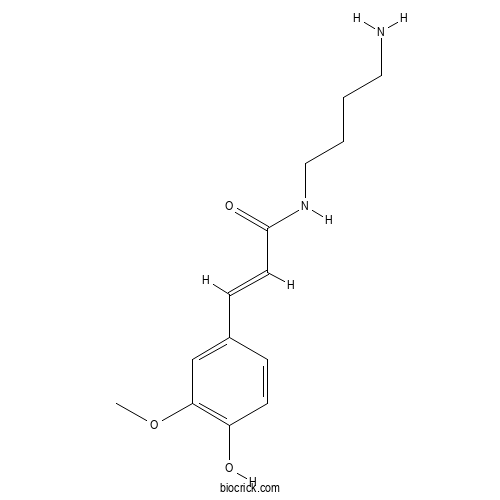
| Cas No. | 501-13-3 | SDF | File under preparation. |
| PubChem ID | 5281796.0 | Appearance | Powder |
| Formula | C14H20N2O3 | M.Wt | 264.3 |
| Type of Compound | N/A | Storage | Desiccate at -20°C |
| Solubility | Soluble in Chloroform,Dichloromethane,Ethyl Acetate,DMSO,Acetone,etc. | ||
| Chemical Name | (E)-N-(4-aminobutyl)-3-(4-hydroxy-3-methoxyphenyl)prop-2-enamide | ||
| SMILES | COC1=C(C=CC(=C1)C=CC(=O)NCCCCN)O | ||
| Standard InChIKey | SFUVCMKSYKHYLD-FNORWQNLSA-N | ||
| Standard InChI | InChI=1S/C14H20N2O3/c1-19-13-10-11(4-6-12(13)17)5-7-14(18)16-9-3-2-8-15/h4-7,10,17H,2-3,8-9,15H2,1H3,(H,16,18)/b7-5+ | ||
| General tips | For obtaining a higher solubility , please warm the tube at 37 ℃ and shake it in the ultrasonic bath for a while.Stock solution can be stored below -20℃ for several months. We recommend that you prepare and use the solution on the same day. However, if the test schedule requires, the stock solutions can be prepared in advance, and the stock solution must be sealed and stored below -20℃. In general, the stock solution can be kept for several months. Before use, we recommend that you leave the vial at room temperature for at least an hour before opening it. |
||
| About Packaging | 1. The packaging of the product may be reversed during transportation, cause the high purity compounds to adhere to the neck or cap of the vial.Take the vail out of its packaging and shake gently until the compounds fall to the bottom of the vial. 2. For liquid products, please centrifuge at 500xg to gather the liquid to the bottom of the vial. 3. Try to avoid loss or contamination during the experiment. |
||
| Shipping Condition | Packaging according to customer requirements(5mg, 10mg, 20mg and more). Ship via FedEx, DHL, UPS, EMS or other couriers with RT, or blue ice upon request. | ||
Quality Control & MSDS
3D structure
Package In Stock

Number of papers citing our products


Feruloylputrescine Dilution Calculator
Feruloylputrescine Molarity Calculator
-
 DiferuloylputrescineCatalog No.: BCX0380CAS No.: 42369-86-8
-
 (E)-N-CaffeoylputrescineCatalog No.: BCC8391CAS No.: 29554-26-5
-
 N-trans-Feruloyl-3-methoxytyramineCatalog No.: BCN4331CAS No.: 78510-19-7
-
 Cis-N-FeruloyltyramineCatalog No.: BCN3729CAS No.: 80510-09-4
-
 N-trans-FeruloyltyramineCatalog No.: BCN4213CAS No.: 66648-43-9
-
 CurcuminCatalog No.: BCN5504CAS No.: 458-37-7
| 1 mg | 5 mg | 10 mg | 20 mg | 25 mg | |
| 1 mM | 3.7836 mL | 18.9179 mL | 37.8358 mL | 75.6716 mL | 94.5895 mL |
| 5 mM | 0.7567 mL | 3.7836 mL | 7.5672 mL | 15.1343 mL | 18.9179 mL |
| 10 mM | 0.3784 mL | 1.8918 mL | 3.7836 mL | 7.5672 mL | 9.4589 mL |
| 50 mM | 0.0757 mL | 0.3784 mL | 0.7567 mL | 1.5134 mL | 1.8918 mL |
| 100 mM | 0.0378 mL | 0.1892 mL | 0.3784 mL | 0.7567 mL | 0.9459 mL |
| * Note: If you are in the process of experiment, it's necessary to make the dilution ratios of the samples. The dilution data above is only for reference. Normally, it's can get a better solubility within lower of Concentrations. | |||||
- Cistanoside D
Catalog No.:BCX2904
CAS No.:94492-21-4
- 4-Hepten-3-one, 1,7-diphenyl-, (4E)-
Catalog No.:BCX2903
CAS No.:170033-27-9
- 4-Hepten-3-one, 7-(4-hydroxy-3-methoxyphenyl)-1-phenyl-, (4E)
Catalog No.:BCX2902
CAS No.:478314-07-7
- 5-hydroxy-1,7-diphenyl-3-heptanone
Catalog No.:BCX2901
CAS No.:55836-43-6
- Cimiciphenone
Catalog No.:BCX2900
CAS No.:863604-14-2
- Castacrenin C
Catalog No.:BCX2899
CAS No.:173450-72-1
- Castacrenin B
Catalog No.:BCX2898
CAS No.:173429-80-6
- Castacrenin A
Catalog No.:BCX2897
CAS No.:173429-79-3
- Camptothecoside
Catalog No.:BCX2896
CAS No.:1914972-40-9
- Pseudostellarin G
Catalog No.:BCX2895
CAS No.:156525-71-2
- Interiorin B
Catalog No.:BCX2894
CAS No.:133442-66-7
- Tenuifoliose S
Catalog No.:BCX2893
CAS No.:1456888-64-4
- Bacogenin A4 (Ebelinlacton)
Catalog No.:BCX2906
CAS No.:3649-76-1
- Benzoic acid,2-(5,10-dihydro-2,3,7,8-tetrahydroxy...
Catalog No.:BCX2907
CAS No.:103744-88-3
- Podoverine A
Catalog No.:BCX2908
CAS No.:107882-43-9
- Osmanthuside B
Catalog No.:BCX2909
CAS No.:94492-23-6
- Benzoic acid,2-[(5,10-dihydro-3,7,8-trihydroxy-5,10-dioxo...
Catalog No.:BCX2910
CAS No.:60202-70-2
- 3'-O-Methylhesperidin
Catalog No.:BCX2251
CAS No.:28034-80-2
- Lyxose
Catalog No.:BCX2252
CAS No.:65-42-9
- 3''-Hydroxypyrrolezanthine
Catalog No.:BCX2253
CAS No.:2647391-04-4
- Scinamine C
Catalog No.:BCX2254
CAS No.:2184979-75-5
- Coniferyl acetate
Catalog No.:BCX2255
CAS No.:94930-81-1
- Tryptamine
Catalog No.:BCX2256
CAS No.:61-54-1
- Benzil
Catalog No.:BCX2257
CAS No.:134-81-6
Phytochemical Analysis Using LC-MS/MS and Anticancer Activity of Asphodelus tenuifolius Roots: Cell Cycle Arrest, Apoptosis, and In Silico Insights.[Pubmed:42773735]
Chem Biodivers. 2026 Sep;23(9):e71724.
Asphodelus tenuifolius Cav. (Asphodelaceae) is traditionally used in North African ethnomedicine for inflammatory and oxidative stress-related disorders. In this study, the hydroethanolic root extract was investigated by LC-HRMS/MS, leading to the identification of 58 metabolites, mainly flavonoids, anthraquinones, and cinnamic acid derivatives. Major constituents included luteolin, emodin, luteolin-7-O-beta-D-glucoside, subaphyllin (N-trans-Feruloylputrescine), and N-trans-feruloyltyramine. The extract showed moderate antiproliferative activity against MDA-MB-231 and PC-3 cells, while flow cytometry revealed pronounced apoptosis induction (up to 85%) and significant G0/G1 cell-cycle arrest. Molecular docking and target prediction suggested multitarget modulation of ERalpha, AR, AKT1, CDK2, and BCL-2, particularly by aglycone metabolites. ADMET analysis indicated favorable drug-likeness and safety profiles. These findings provide the first mechanistic evidence supporting the multitarget anticancer potential of A. tenuifolius roots and highlight their value as a source of bioactive anticancer scaffolds.
Phenolamide-driven alpha-glucosidase inhibitory activity in immature fruits of the Korean landrace-derived chili pepper Sumihyang.[Pubmed:42484719]
Plant Mol Biol. 2026 Jul 22;116(4):77.
Understanding the biochemical basis of alpha-glucosidase inhibitory (AGI) activity in chili peppers (Capsicum annuum L.) is essential for their development as functional food ingredients. This study evaluated AGI activity and phytochemical profiles across four ripening stages in three C. annuum cultivars: Sumihyang (a cultivar derived from the Korean landrace Subicho), Dangjo (a functional antidiabetic cultivar), and Olbokhap (a disease-resistant commercial cultivar). Enzyme assays revealed that AGI activity peaked at the immature stage in all cultivars, with Sumihyang consistently exhibiting the highest activity across two harvest periods. Untargeted metabolomic profiling at the immature and turning stages identified two phenolamides, caffeoylputrescine and Feruloylputrescine, that were selectively enriched in immature Sumihyang and strongly correlated with AGI activity (r > 0.92). While the AGI effect of caffeoylputrescine has been previously reported, Feruloylputrescine was evaluated here for the first time under this assay system. In vitro validation confirmed their inhibitory activities, with half maximal inhibitory concentration (IC(50)) values of 193 microM for caffeoylputrescine and 291 microM for Feruloylputrescine. These findings suggest that phenolamide composition, rather than total flavonoid content, is a key determinant of AGI activity in chili peppers. The selective accumulation of these phenolamides in immature Sumihyang highlights its potential as a genetic resource for developing antidiabetic functional foods.
Metabolic filtering as a putative mechanism linking soil metabolome and microbial community assembly along a lake expansion gradient.[Pubmed:42391940]
Microbiol Res. 2026 Oct;311:128601.
Climate-driven lake expansion across the Qinghai-Tibet Plateau induces profound edaphic shifts, but how these abiotic changes shape soil microbial assembly remains unclear. Soil metagenomics and metabolomics were integrated along a 0-10 km spatial gradient at Gahai. Redundancy analysis (RDA) identified moisture (NDWI) and salinity (SI) as primary ecosystem drivers. Structural equation modeling (SEM) provided exploratory evidence consistent with a mediation pathway (P = 0.64, CFI = 1, RMSEA = 0), in which environmental factors potentially influenced microbial community structure indirectly, via reshaping the soil metabolome rather than through a direct path. Moisture availability exerted a strong negative effect on soil metabolic profiles (lambda = -0.93), leading to a pronounced negative correlation between the metabolome and microbial community (lambda= -0.97). Multi-omics integration attributed this pattern to stress-induced accumulation of defensive metabolites, including Feruloylputrescine and 3-Methylthiopropyl-desulfoglucosinolate. These compounds showed significant negative correlations with dominant genera (e.g., Candidatus Kryptobacter). This "metabolic filtering" is hypothesized to selectively limit the presence of non-adapted taxa based solely on correlational SEM and network analyses, supporting our tentative hypothesis that increasing environmental stress may promote a transition from competitive interactions toward patterns consistent with stronger deterministic filtering. Our exploratory findings suggest that the soil metabolome acts as a functional interface mediating microbial adaptation and strategic resource allocation to lake expansion in this high-altitude saline-alkali system. However, due to regional heterogeneity, these patterns provide a theoretical baseline for plateau lake ecosystems and should be applied with caution to broader geographic areas.
Phenol amide regulator ZmPHT3 targets phloem protein ZmPP2-B8 to enhance maize broad-spectrum disease resistance.[Pubmed:41749462]
Plant Physiol. 2026 Jun 2;201(2):kiag091.
Phenol amides (PAs), a class of plant secondary metabolites, play crucial roles in plant defense, yet the genes regulating their biosynthesis and functional mechanisms against pathogens in maize remain poorly characterized. Here, we demonstrated that pathogen infection upregulates ZmPHT3, which encodes a BAHD acyltransferase essential for driving the accumulation of p-coumaroylputrescine (Cou-put), N-caffeoylputrescine (Caf-put), and N-Feruloylputrescine N-glucoside (Fer-put-glu). Overexpression of ZmPHT3 boosted the levels of these compounds, consequently suppressing hyphal growth and strengthening resistance. Conversely, disruption of ZmPHT3 diminished PA accumulation, leading to increased hyphal expansion and higher susceptibility. Exogenous application of Cou-put and Caf-put partially restored fungal growth restriction in zmpht3 mutants, confirming the antimicrobial function of PAs. Mechanistically, we found that ZmPHT3 modulates the phloem protein ZmPP2-B8 via 2 distinct pathways: (i) direct protein interaction and (ii) through the action of its enzymatic products. This model is supported by multiple lines of evidence: ZmPHT3 physically interacted with ZmPP2-B8; a catalytically inactive ZmPHT3 variant failed to promote ZmPP2-B8 protein accumulation; and treatment with Caf-put, Cou-put, or Fer-put elevated ZmPP2-B8 protein levels. Silencing ZmPP2-B8 impaired disease resistance, and silencing both ZmPHT3 and ZmPP2-B8 demonstrated that their encoded proteins act synergistically to promote immunity. Furthermore, ZmPHT3 and ZmPP2-B8 cooperatively upregulated lignin biosynthesis and cellulose synthase genes, enhancing cell wall fortification. Our findings unveil a defense mechanism in which pathogen-induced ZmPHT3 promotes accumulation of PAs that function dually as antimicrobial agents and ZmPP2-B8 stabilizers, forming a synergistic module that reinforces the cell wall and broadens the resistance spectrum in maize.
Exploitation of Host-Derived N-Feruloylputrescine by Fusarium graminearum Promotes DON Biosynthesis and Wheat Rachis Colonisation.[Pubmed:41721207]
Mol Plant Pathol. 2026 Feb;27(2):e70232.
Plants reprogramme their metabolism upon pathogen attack, producing compounds that can either enhance immunity or be exploited by pathogens. Metabolomic profiling of wheat during Fusarium graminearum infection revealed pronounced accumulation of phenolamides, driven by activation of their biosynthetic pathways. Notably, exogenous N-Feruloylputrescine (Ferput), a representative phenolamide, enhanced resistance to wheat stripe rust, powdery mildew and rice blast but increased susceptibility to Fusarium head blight. Ferput inhibited fungal infection in the lemma while promoting rachis colonisation, indicating pathogen- and tissue-specific effects. Mechanistic analyses showed that Ferput stimulates deoxynivalenol (DON) biosynthesis by inducing TRI gene expression, toxisome formation and DON-associated cellular differentiation, underlying the shift from lemma resistance to rachis susceptibility. Together, these findings highlight the context-dependent roles of phenolamide in plant-pathogen interactions and suggest that, under specific pathological contexts, defence-associated metabolites can be exploited by pathogens to enhance their virulence. This insight underscores the necessity of considering the dual functional roles of plant metabolites when engineering broad-spectrum disease resistance.
High Levels of Phenylpropanoid-Associated Metabolites Are Important Defence Mechanisms of Rice Against Phloem-Feeding Herbivores.[Pubmed:41587956]
Plant Cell Environ. 2026 May;49(5):2578-2594.
In rice, some varieties exhibit high resistance to planthoppers. However, the mechanisms underlying this superior resistance remain largely unknown. Here, we found that compared to the variety Yuefeng (YF), brown planthopper (BPH, Nilaparvata lugens) exhibited significantly less feeding and weight gain, slower development, and lower survival rate and fecundity on the variety JN08. JN08 plants had higher phosphorylation levels of constitutive and BPH-induced mitogen-activated protein kinase (MPK) 4 and 6 than YF plants. They also showed quicker and stronger jasmonic acid (JA) and jasmonoyl-isoleucine response to BPH at early stages of infestation as well as higher constitutive and/or BPH-elicited levels of H(2)O(2), most tested phenolamides and some tested flavonoids than YF plants. Bioassays showed that four of phenylamides, N-cinnamoylputrescine, N-p-coumaroylagmatine, N-p-coumaroyl-N'-Feruloylputrescine and N-feruloyltyramine, all of which had higher levels in JN08 plant than YF plants, had a significant effect on the survival and/or growth of BPH nymphs. Moreover, overexpressing OsPAL1 (phenylalanine ammonia-lyase1), a gene encoding a rate-limiting enzyme in the phenylpropanoid biosynthesis pathway, in rice significantly reduced BPH performance. These results demonstrate that phenylpropanoid-associated metabolites, such as phenylamides and flavonoids, probably regulated by OsMPK4/6-mediated JA and H(2)O(2) signalling pathways, play an important role in regulating rice resistance to BPH.
Temperature-relied defense: CsMYBs-CsHT9 modules activate N-feruloylputrescine biosynthesis against anthracnose in tea (Camellia sinensis).[Pubmed:41466198]
Plant J. 2026 Jan;125(1):e70650.
Tea (Camellia sinensis), a globally significant economic crop, is severely affected by anthracnose disease, impacting both yield and quality. Our previous research identified N-Feruloylputrescine (Fer-Put) as enhancing tea's disease resistance, with CsHT9 potentially crucial for Fer-Put biosynthesis. In this investigation, we observed that invasion by the anthracnose pathogen activates the expression of CsMYB175/114 and CsHT9. Through in vivo and in vitro experiments, we discovered that CsHT9 is involved in Fer-Put synthesis and is directly regulated by CsMYB175 and CsMYB114. These MYB transcription factors activate CsHT9 expression, elevate Fer-Put levels, induce reactive oxygen species accumulation, and enhance tea plant resistance to anthracnose. Interestingly, within the optimal temperature range for anthracnose, increased temperature upregulates CsMYB175 expression, enhancing its ability to activate CsHT9 downstream. This study elucidates the CsMYBs-CsHT9-Fer-Put resistance pathway in tea plants, offering insights for environmentally friendly disease control and the development of disease-resistant woody plants such as tea.
OsABCG37 mediates root development and the stress response by modulating feruloylputrescine levels.[Pubmed:41083912]
Plant Physiol. 2025 Oct 31;199(3):kiaf520.
Hydroxycinnamate amides (HCAAs) represent a major class of phenylpropanoid metabolites prevalent throughout the plant kingdom, garnering significant interest due to their roles in various biological processes. In this study, we identified a rice (Oryza sativa) ATP-binding cassette (ABC) transporter OsABCG37 that influences the level of Feruloylputrescine, a HCAA compound. Using the CRISPR/Cas9 system to mutate OsABCG37, we observed impaired development of lateral roots and root hairs. Interestingly, the loss of OsABCG37 function disrupted the emergence of lateral roots. Expression pattern analysis employing a reporter gene system showed that OsABCG37 is predominantly expressed in epidermal cells of the primary root at sites of lateral root emergence as well as in lateral roots and root hairs. The corresponding protein was located in the plasma membrane. RNA sequencing and HPLC/MS experiments revealed that the OsABCG37 mutation led to reduced levels of intracellular Feruloylputrescine and cell wall-associated ferulic acid, the latter serving as an indirect indicator of wall-bound Feruloylputrescine, compared to the wild type. Supplementing with exogenous Feruloylputrescine partially rescued the defects in lateral root and root hair development caused by the OsABCG37 mutation. In addition to defects in root development, mutants of OsABCG37 were sensitive to biotic and abiotic stresses. Collectively, our findings suggest a role for the OsABCG37 transporter in regulating root development and stress resistance by affecting Feruloylputrescine levels.
Planthopper-induced volatiles suppress rice plant defense by targeting Os4CL5-dependent phenolamide biosynthesis.[Pubmed:40639375]
Curr Biol. 2025 Jul 21;35(14):3440-3450.e4.
Plants typically respond to attacks by herbivorous arthropods by releasing specific blends of volatiles. A common effect of these herbivore-induced plant volatiles (HIPVs) is that they prime neighboring plants to become more resistant to the same herbivores. The brown planthopper (BPH) apparently has "turned the tables" on rice plants by inducing volatiles that make exposed plants more susceptible to BPH attack. Here, we uncover the molecular mechanism behind this counterintuitive response in rice plants. Exposure to BPH-induced volatiles was found to suppress jasmonic acid (JA) signaling in rice plants, impairing their chemical defenses and enhancing planthopper performance. Metabolomic analyses revealed a significant reduction in phenolamides, notably N-Feruloylputrescine, a JA-regulated compound with strong anti-BPH activity. We identify Os4CL5, a key gene in the phenylpropanoid-polyamine conjugate pathway, as a central node in this suppression. HIPV exposure markedly reduced Os4CL5 expression and N-Feruloylputrescine accumulation. Using a rice mutant, we confirmed that Os4CL5 is essential for both N-Feruloylputrescine production and resistance to BPH. By identifying Os4CL5 as the molecular target of BPH-induced volatiles and linking its suppression to reduced N-Feruloylputrescine biosynthesis, our study provides the first mechanistic insight into volatile-mediated defense disruption and opens a new avenue for enhancing rice pest resistance.
Eggplant Phenolamides: 2-Nonenal Scavenging and Skin Protection Against Aging Odor.[Pubmed:40430302]
Molecules. 2025 May 12;30(10):2129.
Eggplants are high in polyphenols, making them a powerful antioxidant food that is beneficial for health and has excellent anti-aging effects. As metabolism slows down with aging, lipid peroxides are generated, with 2-nonenal being the main cause of old-age odor, which has a detrimental effect on skin keratinocytes. In this study, the 2-nonenal scavenging ability of fruits, leaves, stems, and roots of eggplant was evaluated, and the active compound was identified as N-trans-Feruloylputrescine. Furthermore, we assessed whether the extracts and N-trans-Feruloylputrescine showed a protective effect against skin damage induced by 2-nonenal. The antioxidant activity of the eggplant extracts was evaluated using DPPH and ABTS assays, and the fruits exhibited stronger antioxidant activity compared to the other extracts. Additionally, it was found that the ROS levels increased by 2-nonenal were significantly reduced by eggplant fruits and roots, which also inhibited lipid peroxidation. These results suggest the possibility of inhibiting the production of 2-nonenal itself. These findings suggest that eggplant extracts and the N-trans-Feruloylputrescine can have a positive effect on preventing aging and maintaining skin health.
Ectropis obliqua-Induced Secondary Metabolites Are Regulated by Methyl Jasmonate in a Threshold-Dependent Manner.[Pubmed:40362484]
Int J Mol Sci. 2025 Apr 29;26(9):4248.
The jasmonic acid (JA) signaling pathway has been demonstrated to play a crucial role in plant defense against herbivorous insects. However, the relationship between Ectropis obliqua-induced defensive metabolites and the JA signaling pathway in tea plants remains poorly understood. In this study, we investigated seven key special metabolites, including p-coumaroylputrescine, Feruloylputrescine, prunin, naringenin, and three monolignols, to address this knowledge gap. Epicatechin was selected as a positive control based on its well-documented regulation through the JA signaling pathway. Notably, the content of all selected compounds was significantly increased by E. obliqua infestation. Furthermore, exogenous application of high-dose methyl jasmonate (MeJA) induced the accumulation of six of the eight compounds, excluding p-coumaryl alcohol and sinapyl alcohol, whereas low-dose MeJA failed to elicit their accumulation. To confirm the results, we screened two bioactive molecules, D-allose and L-theanine, which significantly increased the endogenous JA levels at low concentrations. Interestingly, neither D-allose nor L-theanine triggered the biosynthesis of these defensive compounds. Additionally, D-allose-treated tea leaves had no significant effect on the performance of E. obliqua larvae. These findings demonstrate that the metabolic accumulation induced by E. obliqua is mediated through a high-threshold JA signaling cascade. This study provides novel insights into the relationship between plant resistance and JA signaling pathway, advancing our understanding of special metabolites mediated plant-insect interactions.
Comparative HPLC-DAD-ESI-QTOF-HR-MS/MS analyses of phenolic compounds of authentic lemon, lime, orange, and grapefruit juices.[Pubmed:40286581]
Food Chem. 2025 Sep 1;485:144416.
Detailed knowledge about phenolic compounds of Citrus fruits and derived juices is important for investigations into Citrus product authentication as well as for their potential health benefits. We present an HPLC-DAD-ESI-QTOF-HR-MS/MS method for the identification and simultaneous quantitation of more than 50 compounds ranging from polar phenolic acids over flavonoid glycosides to apolar coumarins, psoralens, and polymethoxyflavones in lemon, lime, orange, and grapefruit juices. Hydroxycinnamic acid derivatives mainly comprised esters with aldaric acids, N-p-coumaroylputrescine, and N-Feruloylputrescine. Predominant flavonoids were flavone-C- and O-glycosides, flavonol- and flavanone-O-glycosides, and polymethoxyflavones. Mass fragmentations of flavone-C- and O-glycosides as well as limocitrin glycosides and their acylated derivatives carrying malonyl- and/or hydroxymethylglutaryl moieties are proposed. The presence of diverse phenolic compounds in juices from four Citrus species was confirmed and numerous novel constituents were assigned. Total levels of phenolic constituents in the aforementioned Citrus juices are presented.
Activation of Cryptic Secondary Metabolite Biosynthesis in Tobacco BY-2 Suspension Cells by Epigenetic Modifiers.[Pubmed:39560887]
Appl Biochem Biotechnol. 2025 Feb;197(2):1225-1241.
Cultured plant cells often biosynthesize secondary metabolites to a lesser extent relative to the mother plants. This phenomenon is associated with epigenetic alterations of the biosynthetic gene(s). Here we investigated the effectiveness of epigenetic modifiers, such as inhibitors of histone deacetylase (HDAC) and DNA methyltransferase (DNMT), to activate cryptic secondary metabolite biosynthesis in tobacco (Nicotiana tabacum) BY-2 cells. The BY-2 suspension cells cultured with an HDAC inhibitor, suberoyl bis-hydroxamic acid, exhibited strong biosynthesis of four compounds that were originally present at trace concentrations. The induced compounds were identified as caffeoylputrescine (1), 4-O-beta-D-glucopyranosylferulic acid (2), 5-O-caffeoylquinic acid (3), and Feruloylputrescine (4). Biosynthetic activation of compounds 1-4 was reproduced by two other HDAC inhibitors. Treatment of the cells with a DNMT inhibitor (zebularine) also activated the biosynthesis of compounds 1-4, but had a limited effectiveness relative to the HDAC inhibitors, indicating that histone acetylation levels are involved more than DNA methylation levels in the epigenetic regulation of the biosynthesis of compounds 1-4 in the BY-2 cells. Following our previous demonstration using cultured cells of a monocotyledonous plant, this study demonstrates the utility of epigenetic modifiers to activate cryptic secondary metabolite biosynthesis in cultured cells of a dicotyledonous plant.
Spatial chemistry of citrus reveals molecules bactericidal to Candidatus Liberibacter asiaticus.[Pubmed:39218988]
Sci Rep. 2024 Sep 2;14(1):20306.
Huanglongbing (HLB), associated with the psyllid-vectored phloem-limited bacterium, Candidatus Liberibacter asiaticus (CLas), is a disease threat to all citrus production worldwide. Currently, there are no sustainable curative or prophylactic treatments available. In this study, we utilized mass spectrometry (MS)-based metabolomics in combination with 3D molecular mapping to visualize complex chemistries within plant tissues to explore how these chemistries change in vivo in HLB-infected trees. We demonstrate how spatial information from molecular maps of branches and single leaves yields insight into the biology not accessible otherwise. In particular, we found evidence that flavonoid biosynthesis is disrupted in HLB-infected trees, and an increase in the polyamine, Feruloylputrescine, is highly correlated with an increase in disease severity. Based on mechanistic details revealed by these molecular maps, followed by metabolic modeling, we formulated and tested the hypothesis that CLas infection either directly or indirectly converts the precursor compound, ferulic acid, to Feruloylputrescine to suppress the antimicrobial effects of ferulic acid and biosynthetically downstream flavonoids. Using in vitro bioassays, we demonstrated that ferulic acid and bioflavonoids are indeed highly bactericidal to CLas, with the activity on par with a reference antibiotic, oxytetracycline, recently approved for HLB management. We propose these compounds should be evaluated as therapeutics alternatives to the antibiotics for HLB treatment. Overall, the utilized 3D metabolic mapping approach provides a promising methodological framework to identify pathogen-specific inhibitory compounds in planta for potential prophylactic or therapeutic applications.
Comprehensive analysis of silicon impact on defense and metabolic responses in rice exposed to herbivory stress.[Pubmed:38872888]
Front Plant Sci. 2024 May 30;15:1399562.
Silicon (Si) uptake is generally beneficial for plants that need protection from insect herbivores. In pursue of mechanisms involved in Si-mediated defense, we comprehensively explored the impact of Si on several defensive and metabolic traits in rice exposed to simulated and real herbivory of Mythimna loreyi Duponchel larvae. Hydroponic experiments showed that Si-deprived rice supplemented with Si 72 h prior to insect infestation were similarly resistant to larvae as plants continuously grown in Si-containing media. Both Si and herbivory altered primary metabolism in rice, including the levels of several sugars, amino acids, and organic acids. While the accumulation of sugars was generally positively correlated with Si presence, multiple amino acids showed a negative correlation trend with Si supplementation. The levels of secondary metabolites, including isopentylamine, p-coumaroylputrescine and Feruloylputrescine, were typically higher in the leaves of Si-supplemented plants exposed to herbivory stress compared to Si-deprived plants. In addition, simulated herbivory treatment in Si-supplemented plants induced more volatile emissions relative to Si-deprived plants, which was consistent with the increased transcripts of key genes involved in volatile biosynthesis. In ecological interactions, Si alone did not affect the oviposition choice of M. loreyi but gravid females showed a significant preference for simulated herbivory-treated/Si-deprived compared to Si-supplemented plants. Our data suggest that apart from mechanical defense, Si may affect rice metabolism in multiple ways that might enhance/modulate defense responses of rice under herbivory stress.

Calcutta University

University of Minnesota

University of Maryland School of Medicine

University of Illinois at Chicago

The Ohio State University

University of Zurich

Harvard University

Colorado State University

Auburn University

Yale University

Worcester Polytechnic Institute

Washington State University

Stanford University

University of Leipzig

Universidade da Beira Interior

The Institute of Cancer Research

Heidelberg University

University of Amsterdam

University of Auckland

TsingHua University

The University of Michigan

Miami University

DRURY University

Jilin University

Fudan University

Wuhan University

Sun Yat-sen University

Universite de Paris

Deemed University

Auckland University

The University of Tokyo

Korea University



