
5-hydroxy-1,7-diphenyl-3-heptanoneCAS# 55836-43-6 |
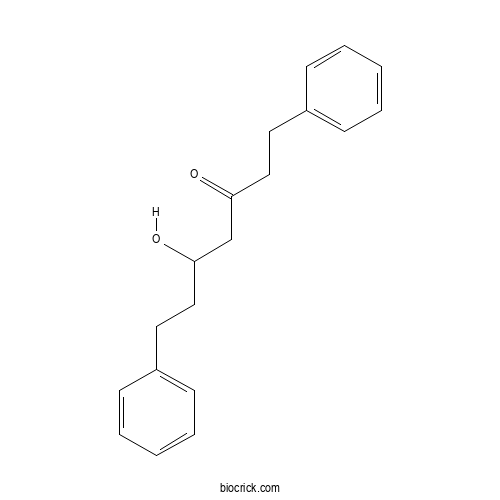
| Cas No. | 55836-43-6 | SDF | File under preparation. |
| PubChem ID | 562075.0 | Appearance | Powder |
| Formula | C19H22O2 | M.Wt | 282.4 |
| Type of Compound | N/A | Storage | Desiccate at -20°C |
| Solubility | Soluble in Chloroform,Dichloromethane,Ethyl Acetate,DMSO,Acetone,etc. | ||
| Chemical Name | 5-hydroxy-1,7-diphenylheptan-3-one | ||
| SMILES | C1=CC=C(C=C1)CCC(CC(=O)CCC2=CC=CC=C2)O | ||
| Standard InChIKey | CCNKTMMNRPJQHV-UHFFFAOYSA-N | ||
| Standard InChI | InChI=1S/C19H22O2/c20-18(13-11-16-7-3-1-4-8-16)15-19(21)14-12-17-9-5-2-6-10-17/h1-10,18,20H,11-15H2 | ||
| General tips | For obtaining a higher solubility , please warm the tube at 37 ℃ and shake it in the ultrasonic bath for a while.Stock solution can be stored below -20℃ for several months. We recommend that you prepare and use the solution on the same day. However, if the test schedule requires, the stock solutions can be prepared in advance, and the stock solution must be sealed and stored below -20℃. In general, the stock solution can be kept for several months. Before use, we recommend that you leave the vial at room temperature for at least an hour before opening it. |
||
| About Packaging | 1. The packaging of the product may be reversed during transportation, cause the high purity compounds to adhere to the neck or cap of the vial.Take the vail out of its packaging and shake gently until the compounds fall to the bottom of the vial. 2. For liquid products, please centrifuge at 500xg to gather the liquid to the bottom of the vial. 3. Try to avoid loss or contamination during the experiment. |
||
| Shipping Condition | Packaging according to customer requirements(5mg, 10mg, 20mg and more). Ship via FedEx, DHL, UPS, EMS or other couriers with RT, or blue ice upon request. | ||
Quality Control & MSDS
3D structure
Package In Stock

Number of papers citing our products


5-hydroxy-1,7-diphenyl-3-heptanone Dilution Calculator
5-hydroxy-1,7-diphenyl-3-heptanone Molarity Calculator
-
 (R)-5-Hydroxy-1,7-diphenyl-3-heptanoneCatalog No.: BCN3591CAS No.: 100761-20-4
-
 PlatyphyllonolCatalog No.: BCN5465CAS No.: 41137-85-3
-
 5-Hydroxy-7-(4'-hydroxy-3'-methoxyphenyl)-1-phenyl-3-heptanone (DHPA)Catalog No.: BCN8791CAS No.: 79559-61-8
-
 (R)-5-Hydroxy-7-(4-hydroxy-3-methoxyphenyl)-1-phenylheptan-3-oneCatalog No.: BCN0534CAS No.: 68622-73-1
-
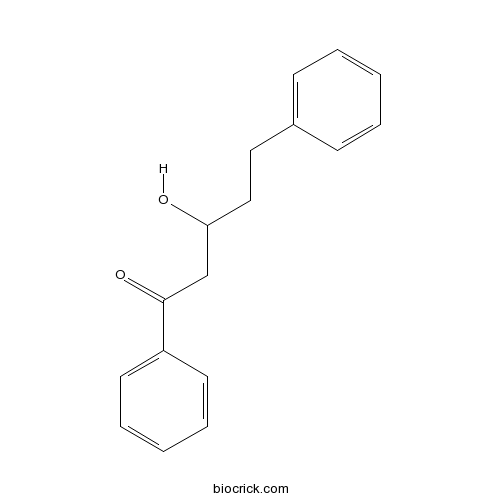 3-Hydroxy-1,5-diphenyl-1-pentanoneCatalog No.: BCN3536CAS No.: 60669-64-9
-
 (S)-3-Hydroxy-1,5-diphenylpentan-1-oneCatalog No.: BCX0187CAS No.: 163086-00-8
-
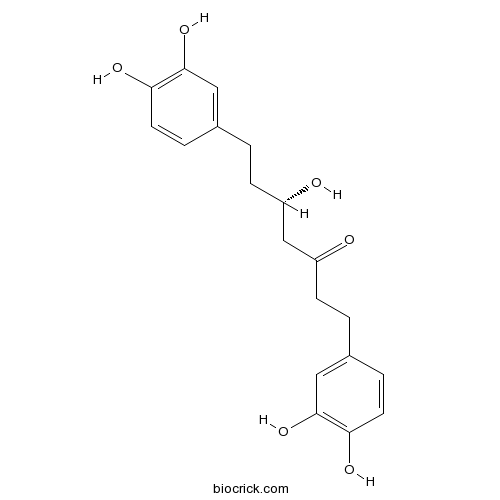 HirsutanonolCatalog No.: BCN5466CAS No.: 41137-86-4
| 1 mg | 5 mg | 10 mg | 20 mg | 25 mg | |
| 1 mM | 3.5411 mL | 17.7054 mL | 35.4108 mL | 70.8215 mL | 88.5269 mL |
| 5 mM | 0.7082 mL | 3.5411 mL | 7.0822 mL | 14.1643 mL | 17.7054 mL |
| 10 mM | 0.3541 mL | 1.7705 mL | 3.5411 mL | 7.0822 mL | 8.8527 mL |
| 50 mM | 0.0708 mL | 0.3541 mL | 0.7082 mL | 1.4164 mL | 1.7705 mL |
| 100 mM | 0.0354 mL | 0.1771 mL | 0.3541 mL | 0.7082 mL | 0.8853 mL |
| * Note: If you are in the process of experiment, it's necessary to make the dilution ratios of the samples. The dilution data above is only for reference. Normally, it's can get a better solubility within lower of Concentrations. | |||||
- Cimiciphenone
Catalog No.:BCX2900
CAS No.:863604-14-2
- Castacrenin C
Catalog No.:BCX2899
CAS No.:173450-72-1
- Castacrenin B
Catalog No.:BCX2898
CAS No.:173429-80-6
- Castacrenin A
Catalog No.:BCX2897
CAS No.:173429-79-3
- Camptothecoside
Catalog No.:BCX2896
CAS No.:1914972-40-9
- Pseudostellarin G
Catalog No.:BCX2895
CAS No.:156525-71-2
- Interiorin B
Catalog No.:BCX2894
CAS No.:133442-66-7
- Tenuifoliose S
Catalog No.:BCX2893
CAS No.:1456888-64-4
- Hirundigoside E
Catalog No.:BCX2892
CAS No.:2192292-95-6
- Kadsutherin F
Catalog No.:BCX2891
CAS No.:2692637-03-7
- Kadsutherin G
Catalog No.:BCX2890
CAS No.:2692637-23-1
- Angulasaponin B
Catalog No.:BCX2889
CAS No.:1628031-59-3
- 4-Hepten-3-one, 7-(4-hydroxy-3-methoxyphenyl)-1-phenyl-, (4E)
Catalog No.:BCX2902
CAS No.:478314-07-7
- 4-Hepten-3-one, 1,7-diphenyl-, (4E)-
Catalog No.:BCX2903
CAS No.:170033-27-9
- Cistanoside D
Catalog No.:BCX2904
CAS No.:94492-21-4
- Feruloylputrescine
Catalog No.:BCX2905
CAS No.:501-13-3
- Bacogenin A4 (Ebelinlacton)
Catalog No.:BCX2906
CAS No.:3649-76-1
- Benzoic acid,2-(5,10-dihydro-2,3,7,8-tetrahydroxy...
Catalog No.:BCX2907
CAS No.:103744-88-3
- Podoverine A
Catalog No.:BCX2908
CAS No.:107882-43-9
- Osmanthuside B
Catalog No.:BCX2909
CAS No.:94492-23-6
- Benzoic acid,2-[(5,10-dihydro-3,7,8-trihydroxy-5,10-dioxo...
Catalog No.:BCX2910
CAS No.:60202-70-2
- 3'-O-Methylhesperidin
Catalog No.:BCX2251
CAS No.:28034-80-2
- Lyxose
Catalog No.:BCX2252
CAS No.:65-42-9
- 3''-Hydroxypyrrolezanthine
Catalog No.:BCX2253
CAS No.:2647391-04-4
DPHC from Alpinia officinarum Hance specifically modulates the function of CENPU in the cell cycle and apoptosis to ameliorate hepatocellular carcinoma.[Pubmed:40058474]
J Ethnopharmacol. 2025 Apr 9;345:119598.
ETHNOPHARMACOLOGICAL RELEVANCE: Alpinia officinarum Hance (A. officinarum), a perennial herb used in the treatment of digestive system cancers, holds significant value for the Li people of Hainan as a traditional Chinese medicine. (R)-5-hydroxy-1,7-diphenyl-3-heptanone (DPHC), a diarylheptanoid component is derived from A. officinarum. Diarylheptanoids have demonstrated anti-proliferative effects on breast cancer cells, neuroblastoma cells, and other tumor cells. However, the pharmacological activity of DPHC in improving hepatocellular carcinoma (HCC) remains undefined. AIM OF THE STUDY: To elucidate the anti-HCC effects of DPHC derived from A. officinarum and explore its underlying mechanistic pathways both in vivo and in vitro. MATERIAL AND METHODS: The effects of DPHC on HCC cell lines were evaluated in vitro using cell counting kit-8, EdU cell proliferation assays, a wound healing assay, a three-dimensional tumor spheroid model, and flow cytometry. The ability of DPHC to ameliorate HCC was assessed in vivo via a nude mouse subcutaneous xenograft tumor model, serum biochemical marker detection, and hematoxylin-eosin staining. The molecular mechanism of DPHC in HCC was elucidated through a combination of transcriptome sequencing, cell transfection, immunohistochemistry assay, immunofluorescence staining, quantitative reverse transcription-PCR, and western blot analysis. RESULTS: DPHC induced significant G0/G1 phase arrest and apoptosis in HepG2 and HCCLM3 cells while also markedly inhibiting tumor growth in nude mice. Mechanically, DPHC directly interacted with centromere-associated protein U (CENPU) to suppress its expression. The reduced expression of CENPU results in decreased interaction with the transcription factor E2F6, thereby affecting the transcriptional activity of the transcription factor E2F1. This subsequently inhibits the expression of downstream cell cycle factors (CCND1, CDK4, and CDK1) and increases apoptosis factors (Caspase 3 and Caspase 9). CONCLUSIONS: DPHC from A. officinarum specifically modulates the function of CENPU in the cell cycle and apoptosis to ameliorate HCC. Our study revealed the anti-HCC effect and underlying mechanism of DPHC, offering new insights and potential targets for HCC treatment.

Calcutta University

University of Minnesota

University of Maryland School of Medicine

University of Illinois at Chicago

The Ohio State University

University of Zurich

Harvard University

Colorado State University

Auburn University

Yale University

Worcester Polytechnic Institute

Washington State University

Stanford University

University of Leipzig

Universidade da Beira Interior

The Institute of Cancer Research

Heidelberg University

University of Amsterdam

University of Auckland

TsingHua University

The University of Michigan

Miami University

DRURY University

Jilin University

Fudan University

Wuhan University

Sun Yat-sen University

Universite de Paris

Deemed University

Auckland University

The University of Tokyo

Korea University



