
Cistanoside DCAS# 94492-21-4 |
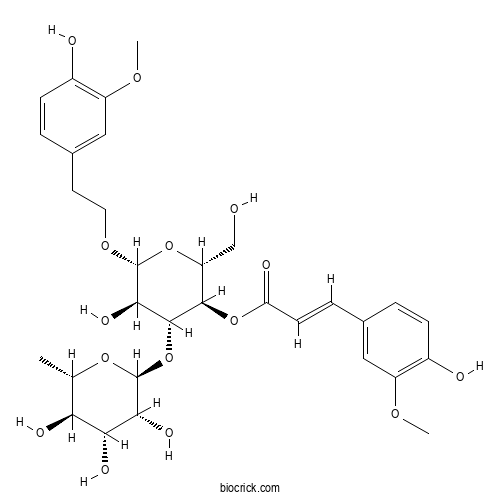
| Cas No. | 94492-21-4 | SDF | File under preparation. |
| PubChem ID | 5315930.0 | Appearance | Powder |
| Formula | C31H40O15 | M.Wt | 652.6 |
| Type of Compound | N/A | Storage | Desiccate at -20°C |
| Solubility | Soluble in Chloroform,Dichloromethane,Ethyl Acetate,DMSO,Acetone,etc. | ||
| Chemical Name | [(2R,3R,4R,5R,6R)-5-hydroxy-6-[2-(4-hydroxy-3-methoxyphenyl)ethoxy]-2-(hydroxymethyl)-4-[(2S,3R,4R,5R,6S)-3,4,5-trihydroxy-6-methyloxan-2-yl]oxyoxan-3-yl] (E)-3-(4-hydroxy-3-methoxyphenyl)prop-2-enoate | ||
| SMILES | CC1C(C(C(C(O1)OC2C(C(OC(C2OC(=O)C=CC3=CC(=C(C=C3)O)OC)CO)OCCC4=CC(=C(C=C4)O)OC)O)O)O)O | ||
| Standard InChIKey | RLGRBYHBNWLGER-CNMJWYMJSA-N | ||
| Standard InChI | InChI=1S/C31H40O15/c1-15-24(36)25(37)26(38)31(43-15)46-29-27(39)30(42-11-10-17-5-8-19(34)21(13-17)41-3)44-22(14-32)28(29)45-23(35)9-6-16-4-7-18(33)20(12-16)40-2/h4-9,12-13,15,22,24-34,36-39H,10-11,14H2,1-3H3/b9-6+/t15-,22+,24-,25+,26+,27+,28+,29+,30+,31-/m0/s1 | ||
| General tips | For obtaining a higher solubility , please warm the tube at 37 ℃ and shake it in the ultrasonic bath for a while.Stock solution can be stored below -20℃ for several months. We recommend that you prepare and use the solution on the same day. However, if the test schedule requires, the stock solutions can be prepared in advance, and the stock solution must be sealed and stored below -20℃. In general, the stock solution can be kept for several months. Before use, we recommend that you leave the vial at room temperature for at least an hour before opening it. |
||
| About Packaging | 1. The packaging of the product may be reversed during transportation, cause the high purity compounds to adhere to the neck or cap of the vial.Take the vail out of its packaging and shake gently until the compounds fall to the bottom of the vial. 2. For liquid products, please centrifuge at 500xg to gather the liquid to the bottom of the vial. 3. Try to avoid loss or contamination during the experiment. |
||
| Shipping Condition | Packaging according to customer requirements(5mg, 10mg, 20mg and more). Ship via FedEx, DHL, UPS, EMS or other couriers with RT, or blue ice upon request. | ||
Quality Control & MSDS
3D structure
Package In Stock

Number of papers citing our products


Cistanoside D Dilution Calculator
Cistanoside D Molarity Calculator
| 1 mg | 5 mg | 10 mg | 20 mg | 25 mg | |
| 1 mM | 1.5323 mL | 7.6617 mL | 15.3233 mL | 30.6466 mL | 38.3083 mL |
| 5 mM | 0.3065 mL | 1.5323 mL | 3.0647 mL | 6.1293 mL | 7.6617 mL |
| 10 mM | 0.1532 mL | 0.7662 mL | 1.5323 mL | 3.0647 mL | 3.8308 mL |
| 50 mM | 0.0306 mL | 0.1532 mL | 0.3065 mL | 0.6129 mL | 0.7662 mL |
| 100 mM | 0.0153 mL | 0.0766 mL | 0.1532 mL | 0.3065 mL | 0.3831 mL |
| * Note: If you are in the process of experiment, it's necessary to make the dilution ratios of the samples. The dilution data above is only for reference. Normally, it's can get a better solubility within lower of Concentrations. | |||||
- 4-Hepten-3-one, 1,7-diphenyl-, (4E)-
Catalog No.:BCX2903
CAS No.:170033-27-9
- 4-Hepten-3-one, 7-(4-hydroxy-3-methoxyphenyl)-1-phenyl-, (4E)
Catalog No.:BCX2902
CAS No.:478314-07-7
- 5-hydroxy-1,7-diphenyl-3-heptanone
Catalog No.:BCX2901
CAS No.:55836-43-6
- Cimiciphenone
Catalog No.:BCX2900
CAS No.:863604-14-2
- Castacrenin C
Catalog No.:BCX2899
CAS No.:173450-72-1
- Castacrenin B
Catalog No.:BCX2898
CAS No.:173429-80-6
- Castacrenin A
Catalog No.:BCX2897
CAS No.:173429-79-3
- Camptothecoside
Catalog No.:BCX2896
CAS No.:1914972-40-9
- Pseudostellarin G
Catalog No.:BCX2895
CAS No.:156525-71-2
- Interiorin B
Catalog No.:BCX2894
CAS No.:133442-66-7
- Tenuifoliose S
Catalog No.:BCX2893
CAS No.:1456888-64-4
- Hirundigoside E
Catalog No.:BCX2892
CAS No.:2192292-95-6
- Feruloylputrescine
Catalog No.:BCX2905
CAS No.:501-13-3
- Bacogenin A4 (Ebelinlacton)
Catalog No.:BCX2906
CAS No.:3649-76-1
- Benzoic acid,2-(5,10-dihydro-2,3,7,8-tetrahydroxy...
Catalog No.:BCX2907
CAS No.:103744-88-3
- Podoverine A
Catalog No.:BCX2908
CAS No.:107882-43-9
- Osmanthuside B
Catalog No.:BCX2909
CAS No.:94492-23-6
- Benzoic acid,2-[(5,10-dihydro-3,7,8-trihydroxy-5,10-dioxo...
Catalog No.:BCX2910
CAS No.:60202-70-2
- 3'-O-Methylhesperidin
Catalog No.:BCX2251
CAS No.:28034-80-2
- Lyxose
Catalog No.:BCX2252
CAS No.:65-42-9
- 3''-Hydroxypyrrolezanthine
Catalog No.:BCX2253
CAS No.:2647391-04-4
- Scinamine C
Catalog No.:BCX2254
CAS No.:2184979-75-5
- Coniferyl acetate
Catalog No.:BCX2255
CAS No.:94930-81-1
- Tryptamine
Catalog No.:BCX2256
CAS No.:61-54-1
Phytochemical Characterization and Cytotoxic Potential of the Ethyl Acetate Fraction of Schima superba Bark: An In Vitro and In Silico Investigation.[Pubmed:42513227]
Molecules. 2026 Jul 22;31(14):2550.
Natural products represent a valuable source of anticancer agents, although their mechanisms of action are often incompletely understood. In this study, we evaluated the cytotoxic effects of the ethyl acetate (EA) fraction derived from Schima superba bark. The EA fraction exhibited selective cytotoxicity against HepG2 and MCF-7 cancer cells, with minimal effects on normal HEK293 cells, and induced apoptosis as evidenced by time- and dose-dependent activation of caspase-3. Phytochemical profiling by UPLC-QTOF-MS/MS identified 18 major constituents, predominantly phenylethanoid glycosides and triterpenoids. To gain insight into the underlying mechanism, molecular docking, 200 ns molecular dynamics simulations, and MM-PBSA analyses were performed targeting poly (ADP-ribose) polymerase 1 (PARP1) and caspase-3. Among the identified compounds, Cistanoside D displayed favorable binding affinity toward both targets, but formed a more stable and energetically favorable complex with PARP1 during molecular dynamics simulations, whereas its interaction with caspase-3 was comparatively weak. These findings suggest that Cistanoside D may preferentially interact with PARP1, while the observed activation of caspase-3 is likely associated with downstream apoptotic processes rather than direct enzymatic modulation. This study provides an integrated evaluation of the phytochemical composition and anticancer potential of Schima superba bark extract, and identifies Cistanoside D as a promising candidate for further investigation. These results contribute to a better understanding of the molecular basis underlying the bioactivity of this medicinal plant and support its potential as a source of anticancer agents.
Identification of secondary metabolites from Crescentia cujete as promising antibacterial therapeutics targeting type 2A topoisomerases through molecular dynamics simulation.[Pubmed:35344868]
Comput Biol Med. 2022 Jun;145:105432.
The potential of fluoroquinolones as remarkable antibacterial agents evolved from their ability to generate 'poison' complexes between type IIA topoisomerases [topo2As (DNA gyrases and topoisomerases IV)] and DNA. However, the overuse of fluoroquinolones coupled with chromosomal mutations in topo2As has increased incidence of resistance and consequently undermined the application of the currently available fluoroquinolones in clinical practice. In this study, the molecular mechanism of interaction between the secondary metabolites of Crescentia cujete (an underutilized plant with proven anti-bacterial activity) and topo2As was investigated using computational methods. Through molecular docking, the top five compounds with the best affinity for each topo2A were identified and subjected to molecular dynamics simulation over a period of 100 ns. The results revealed that the identified compounds had higher binding energy values than the reference standards against the topo2As except for topoisomerase IV ParC, and this was consistent with the results of the structural stability and compactness of the resulting complexes. Specifically, Cistanoside D (-49.18 kcal/mol), chlorogenic acid (-55.55 kcal/mol), xylocaine (-33.08 kcal/mol), and naringenin (-35.48 kcal/mol) had the best affinity for DNA gyrase A, DNA gyrase B, topoisomerase IV ParC, and topoisomerase IV ParE, respectively. Of the constituents of C. cujete evaluated, only apigenin and luteolin had affinity for all the four targets. These observations are indicative of the identified compounds as potential inhibitors of topo2As as evidenced from the molecular interactions including hydrogen bonds established with the active site amino acids of the respective targets. This is the first in silico report on the antibacterial effect of C. cujete and the findings would guide structural modification of the identified compounds as novel inhibitors of topo2As for further in vitro and in vivo assessments.
Phenylpropanoid Glycoside and Phenolic Acid Profiles and Biological Activities of Biomass Extracts from Different Types of Verbena officinalis Microshoot Cultures and Soil-Grown Plant.[Pubmed:35204291]
Antioxidants (Basel). 2022 Feb 17;11(2):409.
Different types of microshoot cultures (agar, stationary liquid, agitated, and bioreactors) of Verbena officinalis were optimized for biomass growth and the production of phenylpropanoid glycosides and phenolic acids. Using ultra-high performance liquid chromatography with high-resolution time-of-flight mass spectrometry, the presence of verbascoside, isoverbascoside, leucoseptoside A/isomers, and Cistanoside D/isomer was confirmed in the methanolic extracts obtained from all types of in vitro cultures. The compound's content was determined by ultra-high-performance liquid chromatography. The main metabolites in biomass extracts were verbascoside and isoverbascoside (maximum 4881.61 and 451.80 mg/100 g dry weight (DW)). In the soil-grown plant extract, verbascoside was also dominated (1728.97 mg/100 g DW). The content of phenolic acids in the analyzed extracts was below 24 mg/100 g DW. The highest radical scavenging activity was found in the biomass extract from agitated cultures, the most effective reducing power in agar culture extract, and the highest chelating activity in extract from bioreactor cultures. The extracts showed significantly stronger bacteriostatic and bactericidal activity against Gram-positive bacteria (minimum inhibitory concentration (MIC) of 0.3-2.2 mg/mL and minimum bactericidal concentration (MBC) of 0.6-9 mg/mL) than against Gram-negative bacteria (MIC 0.6-9 mg/mL, MBC of 0.6-18 mg/mL). The biomass extract from liquid stationary culture showed the strongest antibacterial activity, while the extract from soil-grown herb had the lowest.
Development and validation of a rapid ultra-high performance liquid chromatography diode array detector method for Verbena officinalis L.[Pubmed:30096646]
J Pharm Biomed Anal. 2018 Oct 25;160:160-167.
This study presents a fast and validated ultra-high performance liquid chromatography diode array detector (UHPLC-DAD) method for the simultaneous determination of the major compounds in Verbena officinalis L. (Verbenaceae), a medicinal plant listed in the European, British, and, Chinese Pharmacopoeias. In order to get reference substances, nine compounds, belonging to iridoids, flavonoids, and phenylpropanoid glycosides, were isolated from the herb extract. Two of them, namely Cistanoside D and leucosceptoside A, were found in this plant species for the first time. Chromatographic separation was achieved in less than 7 min on a Kinetex 1.7 u XB-C18 (50 x 2.10 mm) column by using a solvent gradient of water-acetonitrile modified with 0.1% formic acid. Method validation confirmed the assays sensitivity, linearity (R(2) >/= 0.997), precision (intraday precision

Calcutta University

University of Minnesota

University of Maryland School of Medicine

University of Illinois at Chicago

The Ohio State University

University of Zurich

Harvard University

Colorado State University

Auburn University

Yale University

Worcester Polytechnic Institute

Washington State University

Stanford University

University of Leipzig

Universidade da Beira Interior

The Institute of Cancer Research

Heidelberg University

University of Amsterdam

University of Auckland

TsingHua University

The University of Michigan

Miami University

DRURY University

Jilin University

Fudan University

Wuhan University

Sun Yat-sen University

Universite de Paris

Deemed University

Auckland University

The University of Tokyo

Korea University



