Atherosclerosis Research
Atherosclerosis is a disease of the arterial system that is characterized by the accumulation of fatty deposits within arterial walls, known as 'atherosclerotic plaques'.
Atherosclerosis Research Products Targets
- PI 3-kinase (22)
- HMG-CoA Reductase (8)
- Matrix Metalloprotease (16)
- LXR-like Receptor (6)
- Elastase (1)
- Cell Adhesion Molecule (21)
- Lipoxygenase (8)
- Leukotriene and Related Receptor (13)
- Others (7)
- Cytokine Receptor (4)
- Cyclooxygenase (24)
- IRAK (1)
- PPARγ (16)
- PPARδ (5)
- PPARα (7)
- Angiotensin-Converting Enzyme (8)
- Chemokine CXC Receptor (9)
- Chemokine CC Receptor (13)
- NO donors and precursors (9)
- nNOS (5)
- iNOS (11)
- eNOS (1)
- Urotensin-II Receptor (8)
- Angiotensin AT2 Receptor (3)
- Angiotensin AT1 Receptor (9)
- SREBP (2)
- GPBA Receptor (3)
- Phospholipase (16)
- Prostanoid Receptor (24)
- Cytokine (15)
- Platelet-Activating Factor (PAF) Receptor (5)
Products for Atherosclerosis Research - Page 15
- Cat.No. Product Name Information/Activity
-
BCC7209
m-3M3FBS
200933-14-8

-
BCC7210
o-3M3FBS
313981-55-4

-
BCC3715
A66
A66 is a highly specific and selective p110α inhibitor with an IC50 of 32 nM.
-
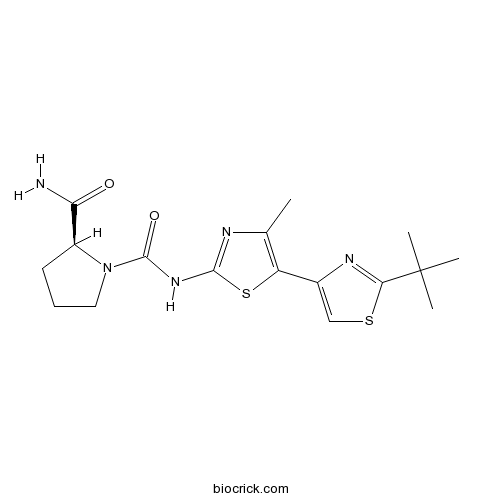
BCC4988
AS-252424
AS-252424 is a potent and selective PI3Kγ inhibitor with an IC50 of 30±10 nM.

-
BCC2495
AS-605240
AS-605240 is a specific and orally active inhibitor of the PI3Kγ, with an IC50 of 8 nM, and a Ki of 7.8 nM.

-
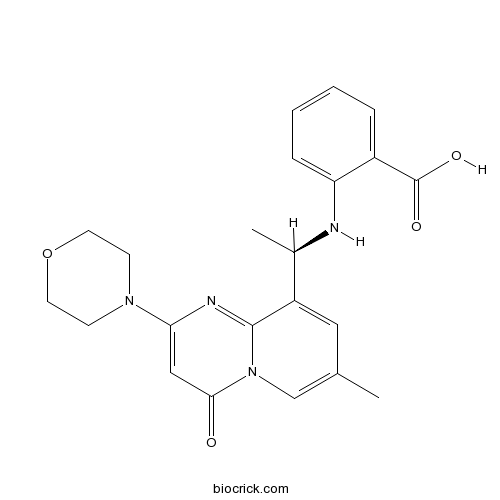
BCC2523
AZD6482
AZD 6482 (KIN-193) is a potent and selective p110β inhibitor with an IC50 of 0.69 nM.
-
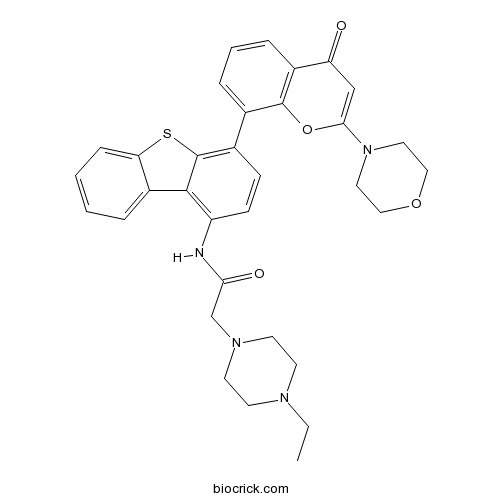
BCC1813
NVP-BAG956
NVP-BAG956 is an ATP-competitive PI3K inhibitor with IC50s of 34, 56, 112 and 444 nM for PI3Kδ, PI3Kα, PI3Kγ and PI3Kβ, respectively.

-
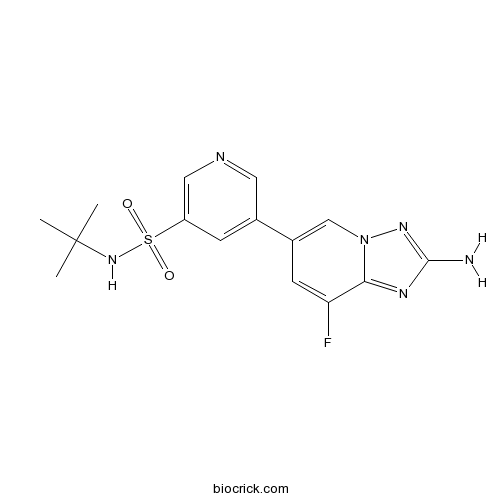
BCC1507
CZC24832
CZC24832 is a highly selective and potent PI3Kγ inhibitor (IC50=27 nM) with apparent dissociation constants (Kdapp) of 19 nM.
-
BCC4984
GSK1059615
GSK1059615 is a dual inhibitor of PI3Kα/β/δ/γ (reversible) and mTOR with IC50 of 0.4 nM/0.6 nM/2 nM/5 nM and 12 nM, respectively.

-
BCC1110
KU-0060648
KU-0060648 is a dual inhibitor of PI3K and DNA-PK with IC50s of 4 nM, 0.5 nM, 0.1 nM, 0.594 nM and 8.6 nM for PI3Kα, PI3Kβ, PI3Kγ, PI3Kδ and DNA-PK, respectively.