
Heterophyllin ACAS# 145459-18-3 |
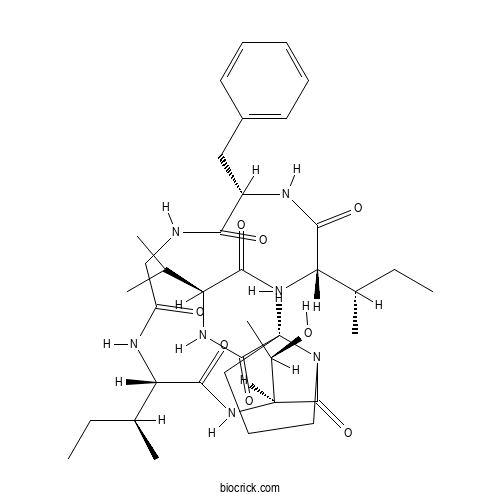
| Cas No. | 145459-18-3 | SDF | File under preparation. |
| PubChem ID | 163041584.0 | Appearance | Powder |
| Formula | C37H57N7O8 | M.Wt | 727.9 |
| Type of Compound | Amino Acids/Peptides | Storage | Desiccate at -20°C |
| Solubility | Soluble in Chloroform,Dichloromethane,Ethyl Acetate,DMSO,Acetone,etc. | ||
| Chemical Name | (3S,6S,12S,15S,18S,21S)-12-benzyl-6,15-bis[(2S)-butan-2-yl]-3-[(1R)-1-hydroxyethyl]-18-propan-2-yl-1,4,7,10,13,16,19-heptazabicyclo[19.3.0]tetracosane-2,5,8,11,14,17,20-heptone | ||
| SMILES | CCC(C)C1C(=O)NC(C(=O)N2CCCC2C(=O)NC(C(=O)NC(C(=O)NC(C(=O)NCC(=O)N1)CC3=CC=CC=C3)C(C)CC)C(C)C)C(C)O | ||
| Standard InChIKey | QGGGNYCMKLVXKB-SMEFXSQESA-N | ||
| Standard InChI | InChI=1S/C37H57N7O8/c1-8-21(5)29-36(51)43-31(23(7)45)37(52)44-17-13-16-26(44)33(48)41-28(20(3)4)34(49)42-30(22(6)9-2)35(50)39-25(18-24-14-11-10-12-15-24)32(47)38-19-27(46)40-29/h10-12,14-15,20-23,25-26,28-31,45H,8-9,13,16-19H2,1-7H3,(H,38,47)(H,39,50)(H,40,46)(H,41,48)(H,42,49)(H,43,51)/t21-,22-,23+,25-,26-,28-,29-,30-,31-/m0/s1 | ||
| General tips | For obtaining a higher solubility , please warm the tube at 37 ℃ and shake it in the ultrasonic bath for a while.Stock solution can be stored below -20℃ for several months. We recommend that you prepare and use the solution on the same day. However, if the test schedule requires, the stock solutions can be prepared in advance, and the stock solution must be sealed and stored below -20℃. In general, the stock solution can be kept for several months. Before use, we recommend that you leave the vial at room temperature for at least an hour before opening it. |
||
| About Packaging | 1. The packaging of the product may be reversed during transportation, cause the high purity compounds to adhere to the neck or cap of the vial.Take the vail out of its packaging and shake gently until the compounds fall to the bottom of the vial. 2. For liquid products, please centrifuge at 500xg to gather the liquid to the bottom of the vial. 3. Try to avoid loss or contamination during the experiment. |
||
| Shipping Condition | Packaging according to customer requirements(5mg, 10mg, 20mg and more). Ship via FedEx, DHL, UPS, EMS or other couriers with RT, or blue ice upon request. | ||
Quality Control & MSDS
3D structure
Package In Stock

Number of papers citing our products


Heterophyllin A Dilution Calculator
Heterophyllin A Molarity Calculator

| 1 mg | 5 mg | 10 mg | 20 mg | 25 mg | |
| 1 mM | 1.3738 mL | 6.8691 mL | 13.7382 mL | 27.4763 mL | 34.3454 mL |
| 5 mM | 0.2748 mL | 1.3738 mL | 2.7476 mL | 5.4953 mL | 6.8691 mL |
| 10 mM | 0.1374 mL | 0.6869 mL | 1.3738 mL | 2.7476 mL | 3.4345 mL |
| 50 mM | 0.0275 mL | 0.1374 mL | 0.2748 mL | 0.5495 mL | 0.6869 mL |
| 100 mM | 0.0137 mL | 0.0687 mL | 0.1374 mL | 0.2748 mL | 0.3435 mL |
| * Note: If you are in the process of experiment, it's necessary to make the dilution ratios of the samples. The dilution data above is only for reference. Normally, it's can get a better solubility within lower of Concentrations. | |||||
- Propinquain H
Catalog No.:BCX2886
CAS No.:1426059-47-3
- Prunasinamide
Catalog No.:BCX2885
CAS No.:151649-54-6
- Caesaljapin
Catalog No.:BCX2884
CAS No.:144161-80-8
- Luteolin-7-O-β-D-apiofuranosyl-(1→6)-β-D-glucopyransodie
Catalog No.:BCX2883
CAS No.:211561-67-0
- Anhydrohirundigenin
Catalog No.:BCX2882
CAS No.:20853-99-0
- 9 (10) -Z-α-trans-Bergamotenol
Catalog No.:BCX2881
CAS No.:88034-74-6
- L-γ-Glutamyl-S-(1E)-1-propen1-yl-L-cysteine
Catalog No.:BCX2880
CAS No.:134677-41-1
- Quercetin 3-O-β-D-(6’’-O-malonyl)galactopyranoside
Catalog No.:BCX2879
CAS No.:84392-08-5
- Azukisaponin II
Catalog No.:BCX2878
CAS No.:82793-03-1
- Citrinin
Catalog No.:BCX2877
CAS No.:518-75-2
- Cascaroside C
Catalog No.:BCX2876
CAS No.:53823-09-9
- Cascaroside D
Catalog No.:BCX2875
CAS No.:53861-35-1
- (25R)-12α-Hydroxyspirost-4-en-3-one
Catalog No.:BCX2888
CAS No.:50888-50-1
- Angulasaponin B
Catalog No.:BCX2889
CAS No.:1628031-59-3
- Kadsutherin G
Catalog No.:BCX2890
CAS No.:2692637-23-1
- Kadsutherin F
Catalog No.:BCX2891
CAS No.:2692637-03-7
- Hirundigoside E
Catalog No.:BCX2892
CAS No.:2192292-95-6
- Tenuifoliose S
Catalog No.:BCX2893
CAS No.:1456888-64-4
- Interiorin B
Catalog No.:BCX2894
CAS No.:133442-66-7
- Pseudostellarin G
Catalog No.:BCX2895
CAS No.:156525-71-2
- Camptothecoside
Catalog No.:BCX2896
CAS No.:1914972-40-9
- Castacrenin A
Catalog No.:BCX2897
CAS No.:173429-79-3
- Castacrenin B
Catalog No.:BCX2898
CAS No.:173429-80-6
- Castacrenin C
Catalog No.:BCX2899
CAS No.:173450-72-1
Study on the correlation between external traits and intrinsic quality of Pseudostellariae Radix based on intelligent sensory evaluation and DESI-MSI technology.[Pubmed:42202756]
J Pharm Biomed Anal. 2026 Oct 15;279:117584.
Currently, the quality analysis methods for Pseudostellariae Radix (PR) are often time-consuming, costly, and operationally complex, which hinders growers, distributors, and consumers from making rapid, preliminary judgments regarding its intrinsic quality. This study established methods for the objective quantification of external trait indicators of PR using an electronic tongue, a colorimeter, and an ultra-fast gas chromatography electronic nose (UF-GC-EN). The intrinsic quality of PR was evaluated using Heterophyllin A (HA), heterophyllin B (HB), pseudostellarin G (PG), total polysaccharides (TPS), total saponins (TSS), and water-soluble extractives (WSE) as key indicators. The spatial distribution of cyclic peptide active ingredients and plant hormones in the swollen parts of PR was visualized using desorption electrospray ionization-mass spectrometry imaging (DESI-MSI). The results showed that, from the 29 trait parameters, 12 key trait parameters with the potential for quality discrimination were identified: diameter at the thickest part (DTP), single root weight (SRW), number of roots per 50 g (NPG), saltiness, yellowness index (YI), lightness (L*), red-green axis (a*), yellow-blue axis (b*), chroma (C*), hue angle (h degrees ), and peaks P4 and P12. Specifically, a deeper yellow color of PR was associated with a higher WSE content. The degree of root tuber swelling showed a significant positive correlation with TPS content, while exhibiting significant negative correlations with the contents of HB, HA, PG, and TSS. The saltiness value displayed highly significant positive correlations with HA and PG contents, but a highly significant negative correlation with WSE content. In the odor component fingerprint, two chromatographic peaks, P4 and P12, were both identified as 1-Hexen-3-ol, which possesses a grassy odor, and their peak areas showed highly significant negative correlations with the contents of both HA and PG. HA, HB, and PG were distinctly distributed in the phloem and periderm of the swollen parts of PR, while zeatin was concentrated in the cambium. By analyzing and validating the correlations between traits and quality, this study provides a statistical reference and demonstrates potential application prospects for the rapid assessment of the intrinsic quality of raw medicinal materials, including PR.
Development of a hairy root transformation platform for enhanced cyclopeptide production and gene function analysis in Pseudostellaria heterophylla.[Pubmed:42139969]
Plant Physiol Biochem. 2026 Jun;235:111372.
Pseudostellaria heterophylla (Miq.) Pax ex Pax et Hoffm. is a widely used traditional Chinese medicinal herb in which cyclopeptides are the major bioactive constituents. However, naturally low cyclopeptide contents and a lack of an efficient genetic transformation system have hindered functional characterization of cyclopeptide biosynthetic genes. We establish a rapid and efficient Agrobacterium rhizogenes-mediated hairy root induction and transformation system for P. heterophylla. By combining in vitro embryo culture to overcome seed dormancy using a filter paper sandwich co-cultivation method, we achieve a hairy root induction rate of 73.43% at 18 d, and a transformation efficiency of 48.94% using A. rhizogenes strain K599. The system is validated by stable expression of DsRed2 and RUBY reporter genes. Metabolite profiling reveals hairy roots accumulate significantly higher levels of heterophyllins A and B, but lower levels of polysaccharides and saponins compared with normal roots, indicating selective activation of cyclopeptide biosynthesis. We also clone and functionally characterize the precursor gene PhPreHA-the overexpression of which in hairy roots leads to a marked increase in Heterophyllin A accumulation. This study pioneers a hairy root-based genetic transformation system in P. heterophylla and provides the first functional validation of a cyclopeptide precursor gene. In doing so, it offers a robust platform for pathway dissection and metabolic engineering of medicinal plants.

Calcutta University

University of Minnesota

University of Maryland School of Medicine

University of Illinois at Chicago

The Ohio State University

University of Zurich

Harvard University

Colorado State University

Auburn University

Yale University

Worcester Polytechnic Institute

Washington State University

Stanford University

University of Leipzig

Universidade da Beira Interior

The Institute of Cancer Research

Heidelberg University

University of Amsterdam

University of Auckland

TsingHua University

The University of Michigan

Miami University

DRURY University

Jilin University

Fudan University

Wuhan University

Sun Yat-sen University

Universite de Paris

Deemed University

Auckland University

The University of Tokyo

Korea University



