
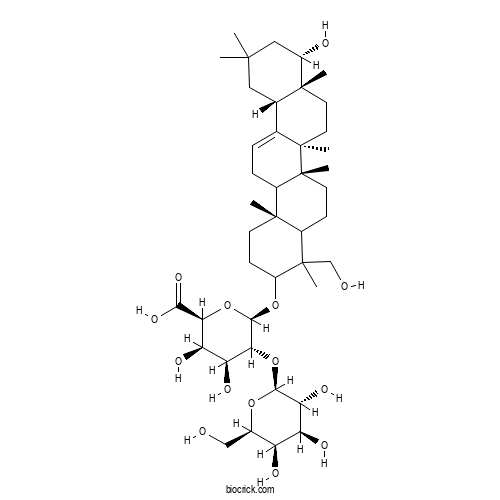
Azukisaponin IICAS# 82793-03-1 |
| Cas No. | 82793-03-1 | SDF | File under preparation. |
| PubChem ID | 71421424.0 | Appearance | Powder |
| Formula | C42H68O14 | M.Wt | 797.0 |
| Type of Compound | Triterpenoids | Storage | Desiccate at -20°C |
| Solubility | Soluble in Chloroform,Dichloromethane,Ethyl Acetate,DMSO,Acetone,etc. | ||
| Chemical Name | (2S,3R,4S,5R,6R)-6-[[(6aR,6bS,8aR,9S,12aS,14bR)-9-hydroxy-4-(hydroxymethyl)-4,6a,6b,8a,11,11,14b-heptamethyl-1,2,3,4a,5,6,7,8,9,10,12,12a,14,14a-tetradecahydropicen-3-yl]oxy]-3,4-dihydroxy-5-[(2S,3R,4S,5R,6R)-3,4,5-trihydroxy-6-(hydroxymethyl)oxan-2-yl]oxyoxane-2-carboxylic acid | ||
| SMILES | CC1(CC2C3=CCC4C5(CCC(C(C5CCC4(C3(CCC2(C(C1)O)C)C)C)(C)CO)OC6C(C(C(C(O6)C(=O)O)O)O)OC7C(C(C(C(O7)CO)O)O)O)C)C | ||
| Standard InChIKey | OKIHRVKXRCAJFQ-ZIGOFQGASA-N | ||
| Standard InChI | InChI=1S/C42H68O14/c1-37(2)16-21-20-8-9-24-39(4)12-11-26(40(5,19-44)23(39)10-13-42(24,7)41(20,6)15-14-38(21,3)25(45)17-37)54-36-33(30(49)29(48)32(55-36)34(51)52)56-35-31(50)28(47)27(46)22(18-43)53-35/h8,21-33,35-36,43-50H,9-19H2,1-7H3,(H,51,52)/t21-,22+,23?,24?,25-,26?,27-,28-,29+,30-,31+,32-,33+,35-,36+,38+,39-,40?,41+,42+/m0/s1 | ||
| General tips | For obtaining a higher solubility , please warm the tube at 37 ℃ and shake it in the ultrasonic bath for a while.Stock solution can be stored below -20℃ for several months. We recommend that you prepare and use the solution on the same day. However, if the test schedule requires, the stock solutions can be prepared in advance, and the stock solution must be sealed and stored below -20℃. In general, the stock solution can be kept for several months. Before use, we recommend that you leave the vial at room temperature for at least an hour before opening it. |
||
| About Packaging | 1. The packaging of the product may be reversed during transportation, cause the high purity compounds to adhere to the neck or cap of the vial.Take the vail out of its packaging and shake gently until the compounds fall to the bottom of the vial. 2. For liquid products, please centrifuge at 500xg to gather the liquid to the bottom of the vial. 3. Try to avoid loss or contamination during the experiment. |
||
| Shipping Condition | Packaging according to customer requirements(5mg, 10mg, 20mg and more). Ship via FedEx, DHL, UPS, EMS or other couriers with RT, or blue ice upon request. | ||
Quality Control & MSDS
3D structure
Package In Stock

Number of papers citing our products


Azukisaponin II Dilution Calculator
Azukisaponin II Molarity Calculator
-
 Soyasaponin BaCatalog No.: BCN2854CAS No.: 114590-20-4
-
 Soyasaponin BbCatalog No.: BCN2598CAS No.: 51330-27-9
-
 Soyasaponin IIICatalog No.: BCN0287CAS No.: 55304-02-4
-
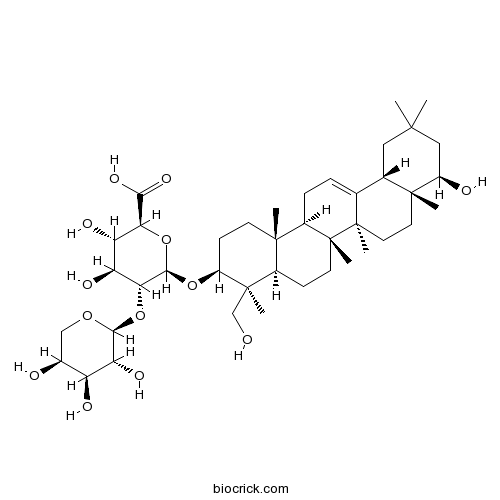 Soyasaponin IVCatalog No.: BCN1627CAS No.: 108906-97-4
-
 Soyasaponin A3Catalog No.: BCN0288CAS No.: 114077-04-2
-
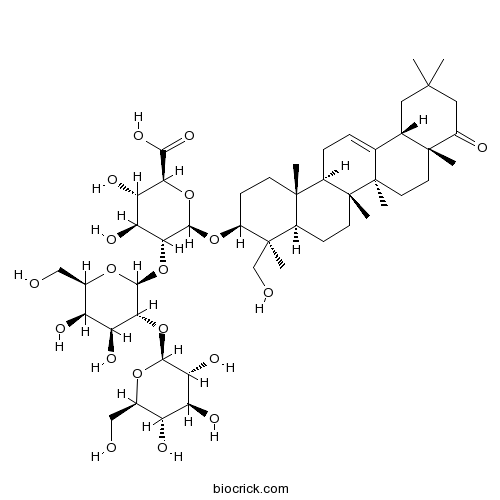 Soyasaponin BdCatalog No.: BCN2465CAS No.: 135272-91-2
-
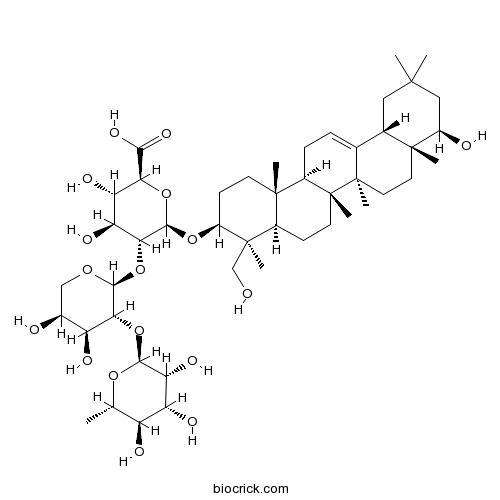 Soyasaponin IICatalog No.: BCN1418CAS No.: 55319-36-3
-
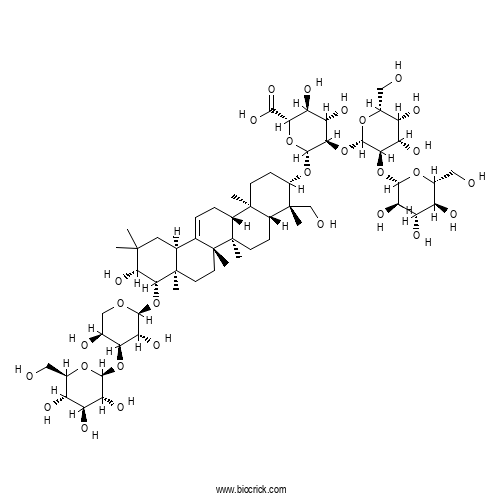 Soyasaponin A1Catalog No.: BCN0289CAS No.: 78693-94-4
-
 Soyasaponin BeCatalog No.: BCX1021CAS No.: 117210-14-7
-
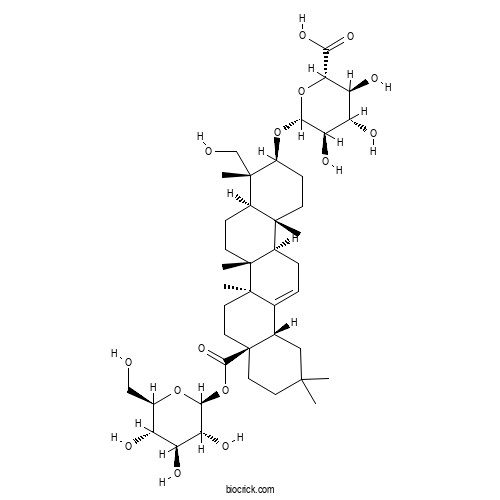 Ilexoside XLVIIICatalog No.: BCX1335CAS No.: 129095-76-7
-
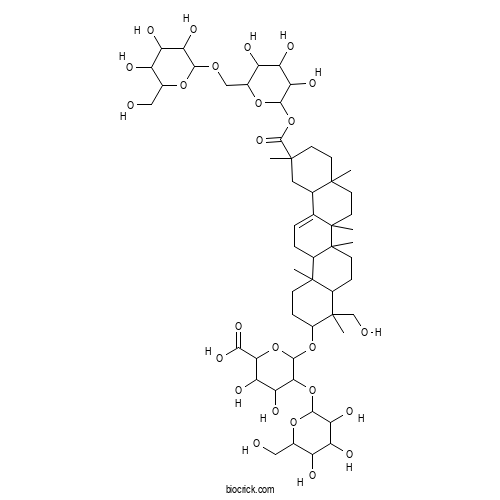 Azukisaponin VICatalog No.: BCX2861CAS No.: 82801-39-6
-
 Zingibroside R1Catalog No.: BCN3433CAS No.: 80930-74-1
-
 Aesculuside BCatalog No.: BCC8115CAS No.: 26339-92-4
| 1 mg | 5 mg | 10 mg | 20 mg | 25 mg | |
| 1 mM | 1.2547 mL | 6.2735 mL | 12.5471 mL | 25.0941 mL | 31.3676 mL |
| 5 mM | 0.2509 mL | 1.2547 mL | 2.5094 mL | 5.0188 mL | 6.2735 mL |
| 10 mM | 0.1255 mL | 0.6274 mL | 1.2547 mL | 2.5094 mL | 3.1368 mL |
| 50 mM | 0.0251 mL | 0.1255 mL | 0.2509 mL | 0.5019 mL | 0.6274 mL |
| 100 mM | 0.0125 mL | 0.0627 mL | 0.1255 mL | 0.2509 mL | 0.3137 mL |
| * Note: If you are in the process of experiment, it's necessary to make the dilution ratios of the samples. The dilution data above is only for reference. Normally, it's can get a better solubility within lower of Concentrations. | |||||
- Citrinin
Catalog No.:BCX2877
CAS No.:518-75-2
- Cascaroside C
Catalog No.:BCX2876
CAS No.:53823-09-9
- Cascaroside D
Catalog No.:BCX2875
CAS No.:53861-35-1
- Calendulaglycoside C
Catalog No.:BCX2874
CAS No.:26020-29-1
- Phanginin A
Catalog No.:BCX2873
CAS No.:1011528-58-7
- 3-(1-Carboxyvinyloxy)benzoic acid
Catalog No.:BCX2872
CAS No.:16929-37-6
- Esculentoside S
Catalog No.:BCX2871
CAS No.:156031-83-3
- Jasnudifloside B
Catalog No.:BCX2870
CAS No.:244230-40-8
- Rehmaglutin C
Catalog No.:BCX2869
CAS No.:103744-81-6
- Naringenin-7-O-(6′′-E-p-coumaroyl-β-D-glucopyranoside)
Catalog No.:BCX2868
CAS No.:96686-70-3
- Entagenic
Catalog No.:BCX2867
CAS No.:5951-41-7
- Calipteryxin
Catalog No.:BCX2866
CAS No.:14017-72-2
- Quercetin 3-O-β-D-(6’’-O-malonyl)galactopyranoside
Catalog No.:BCX2879
CAS No.:84392-08-5
- L-γ-Glutamyl-S-(1E)-1-propen1-yl-L-cysteine
Catalog No.:BCX2880
CAS No.:134677-41-1
- 9 (10) -Z-α-trans-Bergamotenol
Catalog No.:BCX2881
CAS No.:88034-74-6
- Anhydrohirundigenin
Catalog No.:BCX2882
CAS No.:20853-99-0
- Luteolin-7-O-β-D-apiofuranosyl-(1→6)-β-D-glucopyransodie
Catalog No.:BCX2883
CAS No.:211561-67-0
- Caesaljapin
Catalog No.:BCX2884
CAS No.:144161-80-8
- Prunasinamide
Catalog No.:BCX2885
CAS No.:151649-54-6
- Propinquain H
Catalog No.:BCX2886
CAS No.:1426059-47-3
- Heterophyllin A
Catalog No.:BCX2887
CAS No.:145459-18-3
- (25R)-12α-Hydroxyspirost-4-en-3-one
Catalog No.:BCX2888
CAS No.:50888-50-1
- Angulasaponin B
Catalog No.:BCX2889
CAS No.:1628031-59-3
- Kadsutherin G
Catalog No.:BCX2890
CAS No.:2692637-23-1
Dietary red bean seedlings extract alleviates obesity via activation of PPARalpha - AMPKalpha signaling in white adipose tissue of high-fat diet-fed obese mice.[Pubmed:40790657]
Food Res Int. 2025 Oct;218:116803.
With the global prevalence of obesity rising, there is an increasing need for the development of obesity treatments using natural substances with fewer side effects. The efficacy of germinated red bean extract and its bioactive compound, Azukisaponin II (AZ), on anti-obesity has been reported very little to date. This study aims to investigate the anti-obesity effects of red bean seedling extract (RS) and AZ, on PPARalpha and AMPKalpha signaling pathways in white adipose tissue. RS supplementation effectively reduced fat mass and improved lipid metabolism in HFD-induced obese mice. RS decreased body weight gain, reduced adipocyte size, and lowered plasma triglyceride, free fatty acids, and total cholesterol. RS also enhanced mitochondrial function and fatty acid oxidation by activating AMPKalpha signaling and upregulating PPARalpha expression in white adipose tissue. In particular, the levels of lipolysis-related factors (ATGL, HSL, and PLIN5) and proteins in the mitochondrial electron transport chain (NDUFB8, SDHB, UQCRC2, MTCO1, ATP5A) were increased in the RS200 and RS300 groups. RS and AZ treatments inhibited adipogenesis and promoted lipid metabolism in 3T3-L1 adipocytes. Additionally, we confirmed that treating PPARalpha-knockdown 3T3-L1 cells with RS and AZ alleviates lipid accumulation by activating PPARalpha-AMPKalpha signaling. RS supplementation effectively reduces obesity in HFD-induced mice by enhancing lipid metabolism and mitochondrial function through PPARalpha-AMPKalpha signaling. Additionally, RS and AZ decrease lipid accumulation and promote mitochondrial biogenesis in 3T3-L1 cells, indicating their potential for treating obesity and metabolic disorders with a favorable safety profile.
Rapid characterisation and comparison of saponin profiles in the seeds of Korean Leguminous species using ultra performance liquid chromatography with photodiode array detector and electrospray ionisation/mass spectrometry (UPLC-PDA-ESI/MS) analysis.[Pubmed:24176342]
Food Chem. 2014 Mar 1;146:270-7.
The present work was reported on investigation of saponin profiles in nine different legume seeds, including soybean, adzuki bean, cowpea, common bean, scarlet runner bean, lentil, chick pea, hyacinth bean, and broad bean using ultra performance liquid chromatography with photodiode array detector and electrospray ionisation/mass spectrometry (UPLC-PDA-ESI/MS) technique. A total of twenty saponins were characterised under rapid and simple conditions within 15min by the 80% methanol extracts of all species. Their chemical structures were elucidated as soyasaponin Ab (1), soyasaponin Ba (2), soyasaponin Bb (3), soyasaponin Bc (4), soyasaponin Bd (5), soyasaponin alphag (6), soyasaponin betag (7), soyasaponin betaa (8), soyasaponin gammag (9), soyasaponin gammaa (10), azukisaponin VI (11), azukisaponin IV (12), Azukisaponin II (13), AzII (14), AzIV (15), lablaboside E (16), lablaboside F (17), lablaboside D (18), chikusetusaponin IVa (19), and lablab saponin I (20). The individual and total saponin compositions exhibited remarkable differences in all legume seeds. In particular, soyasaponin betaa (8) was detected the predominant composition in soybean, cowpea, and lentil with various concentrations. Interestingly, soybean, adzuki bean, common bean, and scarlet runner bean had high saponin contents, while chick pea and broad bean showed low contents.
Saponins from Trifolium repens.[Pubmed:1368366]
Phytochemistry. 1992 May;31(5):1773-7.
From the whole plant of white clover, Trifolium repens, five new triterpenoid saponins, designated cloversaponins I-V, were isolated together with four known saponins, beta-D-glucoronopyranosylsoyasapogenol B, soyasaponin I, soyasaponin II and Azukisaponin II as their methyl esters. Their structures were determined by 2H NMR and 13C NMR spectroscopy and chemical evidence.

Calcutta University

University of Minnesota

University of Maryland School of Medicine

University of Illinois at Chicago

The Ohio State University

University of Zurich

Harvard University

Colorado State University

Auburn University

Yale University

Worcester Polytechnic Institute

Washington State University

Stanford University

University of Leipzig

Universidade da Beira Interior

The Institute of Cancer Research

Heidelberg University

University of Amsterdam

University of Auckland

TsingHua University

The University of Michigan

Miami University

DRURY University

Jilin University

Fudan University

Wuhan University

Sun Yat-sen University

Universite de Paris

Deemed University

Auckland University

The University of Tokyo

Korea University



