
EntagenicCAS# 5951-41-7 |
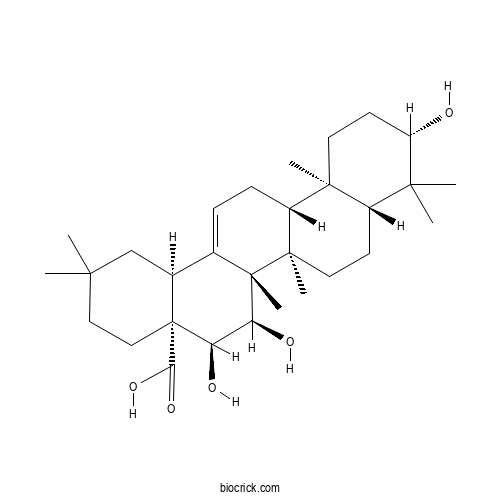
| Cas No. | 5951-41-7 | SDF | File under preparation. |
| PubChem ID | 21594206.0 | Appearance | Powder |
| Formula | C30H48O5 | M.Wt | 488.7 |
| Type of Compound | Triterpenoids | Storage | Desiccate at -20°C |
| Solubility | Soluble in Chloroform,Dichloromethane,Ethyl Acetate,DMSO,Acetone,etc. | ||
| Chemical Name | (4aR,5S,6R,6aR,6aS,6bR,8aR,10S,12aR,14bS)-5,6,10-trihydroxy-2,2,6a,6b,9,9,12a-heptamethyl-1,3,4,5,6,6a,7,8,8a,10,11,12,13,14b-tetradecahydropicene-4a-carboxylic acid | ||
| SMILES | CC1(CCC2(C(C1)C3=CCC4C5(CCC(C(C5CCC4(C3(C(C2O)O)C)C)(C)C)O)C)C(=O)O)C | ||
| Standard InChIKey | BUOLSBLQAQNNJC-ROVCOPEHSA-N | ||
| Standard InChI | InChI=1S/C30H48O5/c1-25(2)14-15-30(24(34)35)18(16-25)17-8-9-20-27(5)12-11-21(31)26(3,4)19(27)10-13-28(20,6)29(17,7)22(32)23(30)33/h8,18-23,31-33H,9-16H2,1-7H3,(H,34,35)/t18-,19-,20+,21-,22-,23+,27-,28+,29-,30+/m0/s1 | ||
| General tips | For obtaining a higher solubility , please warm the tube at 37 ℃ and shake it in the ultrasonic bath for a while.Stock solution can be stored below -20℃ for several months. We recommend that you prepare and use the solution on the same day. However, if the test schedule requires, the stock solutions can be prepared in advance, and the stock solution must be sealed and stored below -20℃. In general, the stock solution can be kept for several months. Before use, we recommend that you leave the vial at room temperature for at least an hour before opening it. |
||
| About Packaging | 1. The packaging of the product may be reversed during transportation, cause the high purity compounds to adhere to the neck or cap of the vial.Take the vail out of its packaging and shake gently until the compounds fall to the bottom of the vial. 2. For liquid products, please centrifuge at 500xg to gather the liquid to the bottom of the vial. 3. Try to avoid loss or contamination during the experiment. |
||
| Shipping Condition | Packaging according to customer requirements(5mg, 10mg, 20mg and more). Ship via FedEx, DHL, UPS, EMS or other couriers with RT, or blue ice upon request. | ||
Quality Control & MSDS
3D structure
Package In Stock

Number of papers citing our products


Entagenic Dilution Calculator
Entagenic Molarity Calculator


| 1 mg | 5 mg | 10 mg | 20 mg | 25 mg | |
| 1 mM | 2.0462 mL | 10.2312 mL | 20.4625 mL | 40.9249 mL | 51.1561 mL |
| 5 mM | 0.4092 mL | 2.0462 mL | 4.0925 mL | 8.185 mL | 10.2312 mL |
| 10 mM | 0.2046 mL | 1.0231 mL | 2.0462 mL | 4.0925 mL | 5.1156 mL |
| 50 mM | 0.0409 mL | 0.2046 mL | 0.4092 mL | 0.8185 mL | 1.0231 mL |
| 100 mM | 0.0205 mL | 0.1023 mL | 0.2046 mL | 0.4092 mL | 0.5116 mL |
| * Note: If you are in the process of experiment, it's necessary to make the dilution ratios of the samples. The dilution data above is only for reference. Normally, it's can get a better solubility within lower of Concentrations. | |||||
- Calipteryxin
Catalog No.:BCX2866
CAS No.:14017-72-2
- Staphylionoside D
Catalog No.:BCX2865
CAS No.:663919-93-5
- 1-Palmitin-2-Linolein-3-Olein
Catalog No.:BCX2864
CAS No.:2579-00-2
- (2R,3S)-2-(3,4-Dihydroxyphenyl)-3,4-dihydro-3,5,7-trihydroxy-2H-1-benzopyran -8-carboxaldehyde
Catalog No.:BCX2863
CAS No.:271593-64-7
- 1,3-Dioleyl-2-palmitoylglycerol
Catalog No.:BCX2862
CAS No.:1716-07-0
- Azukisaponin VI
Catalog No.:BCX2861
CAS No.:82801-39-6
- β-Sesquiphellandrene
Catalog No.:BCX2860
CAS No.:20307-83-9
- (-)-δ-Cadinene
Catalog No.:BCX2859
CAS No.:13061-82-0
- α-Calacorene
Catalog No.:BCX2858
CAS No.:21391-99-1
- (-)-Epigallocatechin 3'-O-methylether gallate
Catalog No.:BCX2857
CAS No.:298700-56-8
- Tenuifoliose Q
Catalog No.:BCX2856
CAS No.:662166-93-0
- (Z)-α-Santalol
Catalog No.:BCX2855
CAS No.:115-71-9
- Naringenin-7-O-(6′′-E-p-coumaroyl-β-D-glucopyranoside)
Catalog No.:BCX2868
CAS No.:96686-70-3
- Rehmaglutin C
Catalog No.:BCX2869
CAS No.:103744-81-6
- Jasnudifloside B
Catalog No.:BCX2870
CAS No.:244230-40-8
- Esculentoside S
Catalog No.:BCX2871
CAS No.:156031-83-3
- 3-(1-Carboxyvinyloxy)benzoic acid
Catalog No.:BCX2872
CAS No.:16929-37-6
- Phanginin A
Catalog No.:BCX2873
CAS No.:1011528-58-7
- Calendulaglycoside C
Catalog No.:BCX2874
CAS No.:26020-29-1
- Cascaroside D
Catalog No.:BCX2875
CAS No.:53861-35-1
- Cascaroside C
Catalog No.:BCX2876
CAS No.:53823-09-9
- Citrinin
Catalog No.:BCX2877
CAS No.:518-75-2
- Azukisaponin II
Catalog No.:BCX2878
CAS No.:82793-03-1
- Quercetin 3-O-β-D-(6’’-O-malonyl)galactopyranoside
Catalog No.:BCX2879
CAS No.:84392-08-5
Entagenic acid targets ASCC2 to ameliorate allergic contact dermatitis via repressing NF‑kappaB transactivation and chemokine expression.[Pubmed:42269183]
Phytomedicine. 2026 Aug;158:158374.
BACKGROUND: Allergic contact dermatitis (ACD) is an inflammatory skin disease triggered by allergen exposure. Entagenic acid (EA) is the main triterpene aglycone isolated from Entada phaseoloides, which has been documented to treat dermatitis, exhibits anti-inflammatory properties. However, its molecular mechanism in ACD remains unexplored. PURPOSE: This study aimed to investigate the therapeutic effect of EA against ACD and explore its underlying molecular target and mechanism. METHODS: The therapeutic effect of EA on ACD was evaluated in TNF-alpha/IFN-gamma-stimulated keratinocytes and Squaric acid dibutylester (SADBE)-induced ACD mouse models. Integrated approaches including DrugBAN, GraphDTA, and thermal proteome profiling identified Activating Signal Cointegrator 1 Complex Subunit 2 (ASCC2) as the direct target of EA, which was confirmed by CETSA and ITC. The mechanism of EA targeting ASCC2 to alleviate keratinocytes inflammation was elucidated through transcriptomics, co-immunoprecipitation, and RNA interference. In vivo, intradermal injection of rAAV.DJ-CMV-ASCC2 was used to verify the ASCC2-dependent therapeutic effect of EA in ACD mice. RESULTS: Our study revealed that EA suppressed the expression of CXCL10 and CCL2 in keratinocytes and alleviated ACD-like symptoms in mice. EA decreased the mRNA levels of chemokines and regulated the NF-kappaB pathway through interrupting the interaction between ASCC2 and p65 in keratinocytes. In vivo, we also demonstrated that the overexpression of ASCC2 on skin of ACD mice reduced the EA-induced therapeutic effect. CONCLUSION: Our findings demonstrate that EA directly binds to ASCC2, attenuates NF-kappaB pathway transactivation, reduces key chemokine expression, and suppresses ACD-like progression, highlighting its potential as a therapeutic candidate for ACD.
Antidiabetic activities of entagenic acid in type 2 diabetic db/db mice and L6 myotubes via AMPK/GLUT4 pathway.[Pubmed:28993280]
J Ethnopharmacol. 2018 Jan 30;211:366-374.
ETHNOPHARMACOLOGICAL RELEVANCE: Entada phaseoloides (L.) Merr., a traditional Chinese folk medicine, has been used in treating diabetes and other inflammatory disorders. Our previous study revealed that the triterpene saponins in E.Phaseoloides possessed an antidiabetic effect in type 2 diabetic rats by activating AMP-activated protein kinase (AMPK). Entagenic acid, the principal aglycon, isolated from the seed kernels of E. phaseoloides, has been proposed to possess a significant role in the antidiabetic effect, however, its actual effect and pertinent mechanisms are still unknown. AIM OF THE STUDY: The aim of the present study was to investigate the antidiabetic effect of Entagenic acid in a type 2 diabetic animal model (C57BIKsj db/db mice) and its role in the regulation of glucose uptake in L6 myotubes, and to explore the possible molecular mechanisms. MATERIALS AND METHODS: In vivo, average weekly body weight, daily water, food intake and postprandial blood glucose levels, the intraperitoneal insulin tolerance test, glucose tolerance test, serum lipid profiles and pancreatic histopathological changes in db/db mice treated with Entagenic acid orally at different doses (5, 10 and 20mg/kg) were assessed and compared with wild-type littermates or vehicle- and metformin-treated db/db mice. In vitro, effects of Entagenic acid on the glucose consumption and the phosphorylation of protein kinase B (AKT) and AMPK in L6 myotubes were evaluated. RESULTS: In vivo, Entagenic acid significantly lowered postprandial blood glucose levels but not the body weight, normalized the serum lipid imbalance, improved the impaired glucose tolerance, insulin resistance, as well as the pathological changes in pancreatic islets. In vitro, Entagenic acid dose-dependently promoted glucose utilization and enhanced the translocation and expression of glucose transporter 4 (GLUT4), and phosphorylation of AMPK but not AKT. CONCLUSIONS: The present study demonstrated that Entagenic acid can markedly maintain the glucose homeostasis, improve insulin resistance and ameliorate dyslipidemia. Its antihyperglycemic effect could be caused by promoting AMPK mediated cellular signaling and GLUT4 translocation in muscles.
Triterpene saponins with anti-inflammatory activity from the stems of Entada phaseoloides.[Pubmed:25759122]
Fitoterapia. 2015 Jun;103:33-45.
The phytochemical investigation of the ethanol extract from the stems of Entada phaseoloides (L.) Merr (also called "Guo Gang Long") led to the isolation of eleven triterpene saponins (1-11). Their structures were elucidated by extensive spectroscopic methods including 1D- ((1)H and (13)C) and 2D-NMR ((1)H-(1)H COSY, HSQC, HMBC, HSQC-TOCSY and ROESY) experiments as well as ESIMS analysis and hydrolysis. These saponins comprised Entagenic acid as the main aglycon, saccharide moieties at C-3 and C-28, and esterification of C-2 or C-3 hydroxyl group of the terminal beta-d-glucopyranose unit with a monoterpenic acid. To further explain the clinical applications of "Guo Gang Long" for its anti-inflammatory effect, the inhibitory activities on the production of NO of the saponins and the related aglycon, Entagenic acid (12), were evaluated in vitro. The compounds containing a free hydroxyl at C-3 of aglycon (1 and 4) and Entagenic acid showed significant activities against NO production in lipopolysaccharide-stimulated mouse macrophage RAW264.7 cells with IC50 values of 25.08, 20.13 and 23.48 muM, respectively. And the three compounds could also inhibit the release of pro-inflammatory cytokines, such as TNF-alpha, IL-1beta, IL-6 and IL-8.
Pursaethosides A-E, triterpene saponins from Entada pursaetha.[Pubmed:16124758]
J Nat Prod. 2005 Aug;68(8):1185-90.
Five new triterpenoid saponins, pursaethosides A-E (1-5), were isolated from the n-BuOH extract of the seed kernels of Entada pursaetha along with the known phaseoloidin. The structures of 1-5 were elucidated mainly by spectroscopic data interpretation and chemical degradation. Pursaethosides C-E (3-5) possess as a common structural feature Entagenic acid as aglycon, which is rare among triterpene saponins. Compounds 2-4 and phaesolidin were found to be not cytotoxic when tested against HCT 116 and HT-29 human colon cancer cells.

Calcutta University

University of Minnesota

University of Maryland School of Medicine

University of Illinois at Chicago

The Ohio State University

University of Zurich

Harvard University

Colorado State University

Auburn University

Yale University

Worcester Polytechnic Institute

Washington State University

Stanford University

University of Leipzig

Universidade da Beira Interior

The Institute of Cancer Research

Heidelberg University

University of Amsterdam

University of Auckland

TsingHua University

The University of Michigan

Miami University

DRURY University

Jilin University

Fudan University

Wuhan University

Sun Yat-sen University

Universite de Paris

Deemed University

Auckland University

The University of Tokyo

Korea University



