
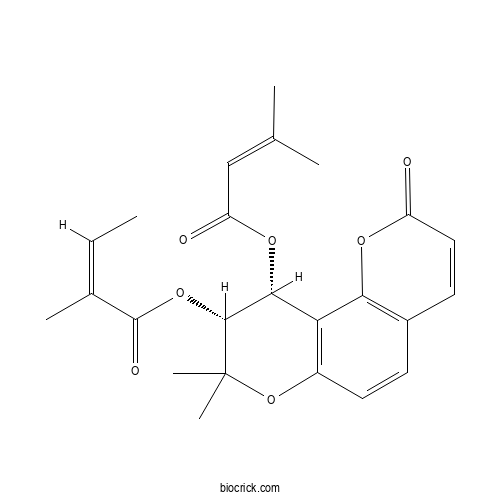
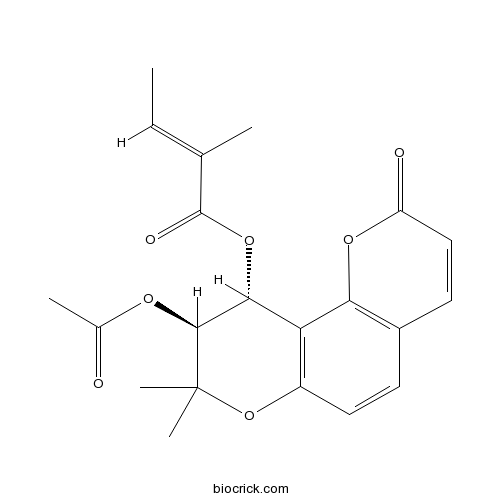
CalipteryxinCAS# 14017-72-2 |
| Cas No. | 14017-72-2 | SDF | File under preparation. |
| PubChem ID | 15945070.0 | Appearance | Powder |
| Formula | C24H26O7 | M.Wt | 426.5 |
| Type of Compound | N/A | Storage | Desiccate at -20°C |
| Solubility | Soluble in Chloroform,Dichloromethane,Ethyl Acetate,DMSO,Acetone,etc. | ||
| Chemical Name | [(9R,10R)-8,8-dimethyl-10-(3-methylbut-2-enoyloxy)-2-oxo-9,10-dihydropyrano[2,3-f]chromen-9-yl] (Z)-2-methylbut-2-enoate | ||
| SMILES | CC=C(C)C(=O)OC1C(C2=C(C=CC3=C2OC(=O)C=C3)OC1(C)C)OC(=O)C=C(C)C | ||
| Standard InChIKey | WKQRMUACBRBLQV-IULGZIFLSA-N | ||
| Standard InChI | InChI=1S/C24H26O7/c1-7-14(4)23(27)30-22-21(29-18(26)12-13(2)3)19-16(31-24(22,5)6)10-8-15-9-11-17(25)28-20(15)19/h7-12,21-22H,1-6H3/b14-7-/t21-,22-/m1/s1 | ||
| General tips | For obtaining a higher solubility , please warm the tube at 37 ℃ and shake it in the ultrasonic bath for a while.Stock solution can be stored below -20℃ for several months. We recommend that you prepare and use the solution on the same day. However, if the test schedule requires, the stock solutions can be prepared in advance, and the stock solution must be sealed and stored below -20℃. In general, the stock solution can be kept for several months. Before use, we recommend that you leave the vial at room temperature for at least an hour before opening it. |
||
| About Packaging | 1. The packaging of the product may be reversed during transportation, cause the high purity compounds to adhere to the neck or cap of the vial.Take the vail out of its packaging and shake gently until the compounds fall to the bottom of the vial. 2. For liquid products, please centrifuge at 500xg to gather the liquid to the bottom of the vial. 3. Try to avoid loss or contamination during the experiment. |
||
| Shipping Condition | Packaging according to customer requirements(5mg, 10mg, 20mg and more). Ship via FedEx, DHL, UPS, EMS or other couriers with RT, or blue ice upon request. | ||
Quality Control & MSDS
3D structure
Package In Stock

Number of papers citing our products


Calipteryxin Dilution Calculator
Calipteryxin Molarity Calculator
-
 Praeruptorin BCatalog No.: BCN4988CAS No.: 81740-07-0
-
 Praeruptorin DCatalog No.: BCN4990CAS No.: 73069-28-0
-
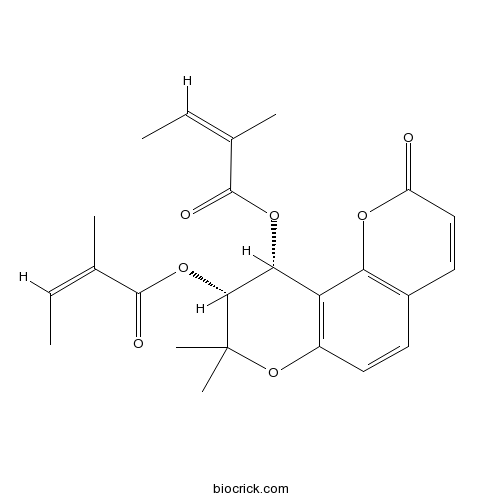 (-)-Praeruptorin BCatalog No.: BCN7665CAS No.: 4970-26-7
-
 Praeruptorin ACatalog No.: BCN4987CAS No.: 73069-25-7
-
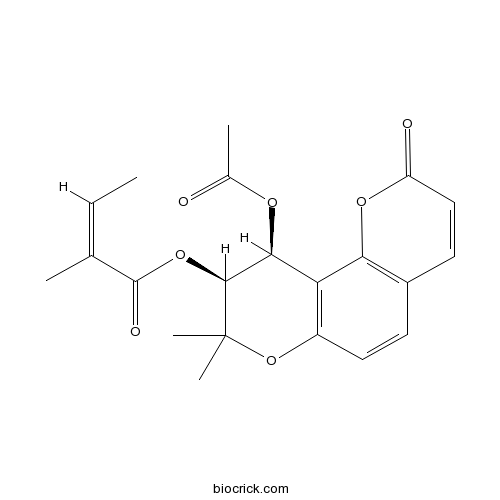 (+)-Praeruptorin ACatalog No.: BCN4989CAS No.: 73069-27-9
-
 (-)-Praeruptorin ACatalog No.: BCN7664CAS No.: 14017-71-1
-
 SamidinCatalog No.: BCN6665CAS No.: 477-33-8
-
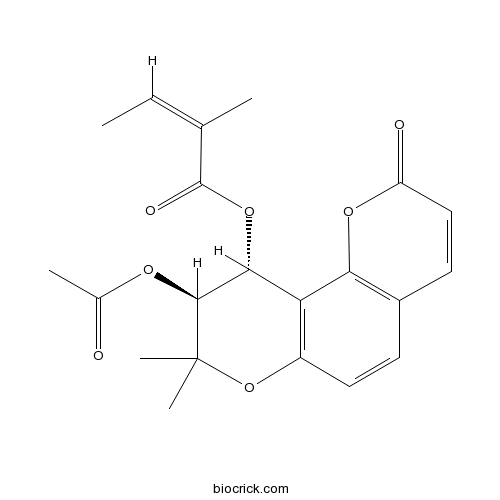 Peucedanocoumarin IICatalog No.: BCN3435CAS No.: 130464-56-1
-
 Peucedanocoumarin IIICatalog No.: BCN3471CAS No.: 130464-57-2
-
 (+)-PteryxinCatalog No.: BCN3470CAS No.: 13161-75-6
-
 d-LaserpitinCatalog No.: BCN3616CAS No.: 134002-17-8
-
 Qianhucoumarin ACatalog No.: BCN3615CAS No.: 150135-35-6
-
 Praeruptorin ECatalog No.: BCN2591CAS No.: 78478-28-1
-
 Praeruptorin CCatalog No.: BCN4991CAS No.: 72463-77-5
-
 Hyuganin DCatalog No.: BCN7679CAS No.: 77331-76-1
| 1 mg | 5 mg | 10 mg | 20 mg | 25 mg | |
| 1 mM | 2.3447 mL | 11.7233 mL | 23.4467 mL | 46.8933 mL | 58.6166 mL |
| 5 mM | 0.4689 mL | 2.3447 mL | 4.6893 mL | 9.3787 mL | 11.7233 mL |
| 10 mM | 0.2345 mL | 1.1723 mL | 2.3447 mL | 4.6893 mL | 5.8617 mL |
| 50 mM | 0.0469 mL | 0.2345 mL | 0.4689 mL | 0.9379 mL | 1.1723 mL |
| 100 mM | 0.0234 mL | 0.1172 mL | 0.2345 mL | 0.4689 mL | 0.5862 mL |
| * Note: If you are in the process of experiment, it's necessary to make the dilution ratios of the samples. The dilution data above is only for reference. Normally, it's can get a better solubility within lower of Concentrations. | |||||
- Staphylionoside D
Catalog No.:BCX2865
CAS No.:663919-93-5
- 1-Palmitin-2-Linolein-3-Olein
Catalog No.:BCX2864
CAS No.:2579-00-2
- (2R,3S)-2-(3,4-Dihydroxyphenyl)-3,4-dihydro-3,5,7-trihydroxy-2H-1-benzopyran -8-carboxaldehyde
Catalog No.:BCX2863
CAS No.:271593-64-7
- 1,3-Dioleyl-2-palmitoylglycerol
Catalog No.:BCX2862
CAS No.:1716-07-0
- Azukisaponin VI
Catalog No.:BCX2861
CAS No.:82801-39-6
- β-Sesquiphellandrene
Catalog No.:BCX2860
CAS No.:20307-83-9
- (-)-δ-Cadinene
Catalog No.:BCX2859
CAS No.:13061-82-0
- α-Calacorene
Catalog No.:BCX2858
CAS No.:21391-99-1
- (-)-Epigallocatechin 3'-O-methylether gallate
Catalog No.:BCX2857
CAS No.:298700-56-8
- Tenuifoliose Q
Catalog No.:BCX2856
CAS No.:662166-93-0
- (Z)-α-Santalol
Catalog No.:BCX2855
CAS No.:115-71-9
- 4-Hydroxy-3-butylphthalide
Catalog No.:BCX2854
CAS No.:74459-23-7
- Entagenic
Catalog No.:BCX2867
CAS No.:5951-41-7
- Naringenin-7-O-(6′′-E-p-coumaroyl-β-D-glucopyranoside)
Catalog No.:BCX2868
CAS No.:96686-70-3
- Rehmaglutin C
Catalog No.:BCX2869
CAS No.:103744-81-6
- Jasnudifloside B
Catalog No.:BCX2870
CAS No.:244230-40-8
- Esculentoside S
Catalog No.:BCX2871
CAS No.:156031-83-3
- 3-(1-Carboxyvinyloxy)benzoic acid
Catalog No.:BCX2872
CAS No.:16929-37-6
- Phanginin A
Catalog No.:BCX2873
CAS No.:1011528-58-7
- Calendulaglycoside C
Catalog No.:BCX2874
CAS No.:26020-29-1
- Cascaroside D
Catalog No.:BCX2875
CAS No.:53861-35-1
- Cascaroside C
Catalog No.:BCX2876
CAS No.:53823-09-9
- Citrinin
Catalog No.:BCX2877
CAS No.:518-75-2
- Azukisaponin II
Catalog No.:BCX2878
CAS No.:82793-03-1
The medicinal plant Peucedanum japonicum Thunberg: A review of traditional use, phytochemistry, and pharmacology.[Pubmed:39442677]
Fitoterapia. 2024 Dec;179:106270.
Peucedanum japonicum (the family Umbelliferae) is a perennial herbaceous plant with various crucial traditional values for coughs, colds, headaches, and inflammatory responses. For drug developments, the current research aims to offer an overview of the previous results in the three main aspects of traditional use, phytochemistry, pharmacological values, and molecular mechanisms regarding this medicinal species. By chromatographic analysis and separation, more than 120 isolated compounds have been obtained. Khellactone-type coumarins and phenolic compounds are the primary phytochemical classes with some coumarins, such as Calipteryxin, praerutorin A, and pteryxin, being the main metabolites. Pharmacological activities of P. japonicum constituents included anticancer, antioxidative, antimicrobial, antiviral, antiplatelet, and tyrosine inhibitory activities, especially anti-inflammation and anti-obesity. It is worth mentioning that the obtained constituents joined to protect the neurons, bone, and urine systems, and exerted vasorelaxant. In general, the underlying mechanism of anti-inflammatory action can be explained by mitogen-activated protein kinase/nuclear factor-kappa B (MAPK/NF-kappaB) signaling pathway, whereas anti-obesity activity is deduced from regulating lipid metabolism-related genes. It also noted that pteryxin is the most active compound, but the clinical studies and synthesis of new derivatives containing enhanced medicinal values have been still limited, which should be improved.
Pharmacological mechanism underlying anti-inflammatory properties of two structurally divergent coumarins through the inhibition of pro-inflammatory enzymes and cytokines.[Pubmed:26221081]
J Inflamm (Lond). 2015 Jul 29;12:47.
BACKGROUND: The aim of the present study is to investigate the effects of two structurally divergent coumarins, Calipteryxin (1) and (3'S,4'S)-3',4'-disenecioyloxy-3',4'-dihydroseselin (2) from Seseli recinosum, in lipopolysaccharide (LPS)-stimulated murine macrophages. METHODS: The nitrite production was evaluated using Griess reagent. The protein and mRNA expression levels were investigated through Western blot and quantitative real time-PCR analyses. The NF-kappaB and AP-1 DNA-binding activities were assessed using an electrophoretic mobility shift assay. The docking studies were performed with Glide XP in Schrodinger suite (version 2013). RESULTS: The results of the present study revealed that Calipteryxin (1) and (3'S,4'S)-3',4'-disenecioyloxy-3',4'-dihydroseselin (2) treatment showed potent inhibitory effects on pro-inflammatory enzymes and cytokines associated with molecular signaling pathways. Treatment with Calipteryxin and (3'S,4'S)-3',4'-disenecioyloxy-3',4'-dihydroseselin also decreased the production of nitric oxide (NO), tumor necrosis factor alpha (TNF-alpha) and interleukin-1 beta (IL-1beta) in a dose-dependent manner. Additionally, both coumarins inhibited the LPS-induced protein and mRNA expression levels of nitric oxide synthase (iNOS) and cyclooxygenase-2 (COX-2) in RAW264.7 cells. To explore the potential mechanisms underlying the inhibitory activity of coumarin derivatives, the protein signaling pathways for NF-kappaB, mitogen-activated protein kinase (MAPK) and Akt were examined. Calipteryxin and (3'S,4'S)-3',4'-disenecioyloxy-3',4'-dihydroseselin markedly reduced the LPS-stimulated phosphorylation of IKKalpha/beta, p-IkappaBalpha and IkappaBalpha degradation as well as the nuclear translocation of the p65 subunit of pro-inflammatory transcription factor NF-kappaB. In addition, Calipteryxin and (3'S,4'S)-3',4'-disenecioyloxy-3',4'-dihydroseselin) considerably inhibited the LPS-induced expression of ERK, c-Jun N-terminal kinase (JNK), p38 and Akt proteins. Furthermore, both coumarins significantly inhibited c-Jun expression in the nucleus. CONCLUSIONS: Taken together, these results support the therapeutic potential and molecular mechanism of Calipteryxin and (3'S,4'S)-3',4'-disenecioyloxy-3',4'-dihydroseselin associated with inflammatory diseases.
Application of stepwise gradients in counter-current chromatography: a rapid and economical strategy for the one-step separation of eight coumarins from Seseli resinosum.[Pubmed:23992840]
J Chromatogr A. 2013 Oct 4;1310:66-73.
The targeted purification of compounds with a broad polarity range from traditional medicinal plants is a big challenge for counter-current chromatography (CCC). Gradient elution was introduced in CCC to address this problem. However, once a suitable solvent system is selected, the separation process requires optimization of operational parameters. The present study was conducted to optimize various operational parameters to integrate the flow rate and solvent gradients for the rapid isolation of eight coumarins from Seseli resinosum in a single run. An increase in the system temperature from 15 degrees C to 35 degrees C increased the stationary phase retention and solubility of the sample, whereas the operation time and viscosity of the system were decreased. The high purity of each compound was ensured by collecting the fractions from the main peaks while all the shoulder peaks were mixed and separated under the same conditions with semi-preparative CCC. GC-FID was used to analyze the components of each phase, which was prepared without presaturation to save the time and solvent consumption. Finally, eight coumarins were purified, including (1) d-laserpitin, (2) (3'S,4'S)-3'-angeloyloxy-4'-hydroxy-3',4'-dihydroseselin, (3) (+)-samidin, (4) (3'S,4'S)-3'-acetoxy-4'-angeloyloxy-3',4'-dihydroseselin, (5) deltoin (6), Calipteryxin, (7) (3'S,4'S)-3',4'-disenecioyloxy-3',4'-dihydroseselin, and (8) (-)-anomalin. The present technique has successfully accomplished the goal of one-step separation of these compounds with high purity and recovery in an economic and time efficient manner.

Calcutta University

University of Minnesota

University of Maryland School of Medicine

University of Illinois at Chicago

The Ohio State University

University of Zurich

Harvard University

Colorado State University

Auburn University

Yale University

Worcester Polytechnic Institute

Washington State University

Stanford University

University of Leipzig

Universidade da Beira Interior

The Institute of Cancer Research

Heidelberg University

University of Amsterdam

University of Auckland

TsingHua University

The University of Michigan

Miami University

DRURY University

Jilin University

Fudan University

Wuhan University

Sun Yat-sen University

Universite de Paris

Deemed University

Auckland University

The University of Tokyo

Korea University



