
Calendulaglycoside CCAS# 26020-29-1 |
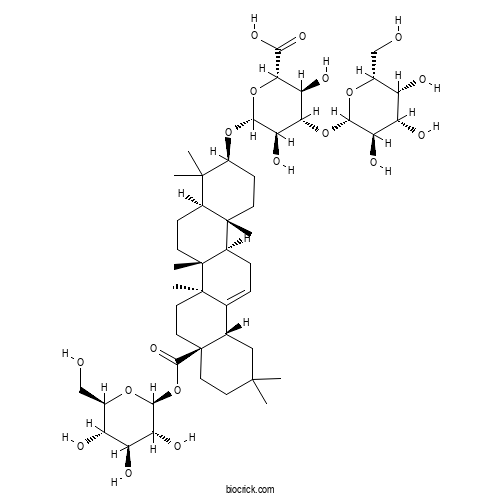
| Cas No. | 26020-29-1 | SDF | File under preparation. |
| PubChem ID | 44566500.0 | Appearance | Powder |
| Formula | C48H76O19 | M.Wt | 957.1 |
| Type of Compound | Triterpenoids | Storage | Desiccate at -20°C |
| Solubility | Soluble in Chloroform,Dichloromethane,Ethyl Acetate,DMSO,Acetone,etc. | ||
| Chemical Name | (2S,3S,4S,5R,6R)-6-[[(3S,4aR,6aR,6bS,8aS,12aS,14aR,14bR)-4,4,6a,6b,11,11,14b-heptamethyl-8a-[(2S,3R,4S,5S,6R)-3,4,5-trihydroxy-6-(hydroxymethyl)oxan-2-yl]oxycarbonyl-1,2,3,4a,5,6,7,8,9,10,12,12a,14,14a-tetradecahydropicen-3-yl]oxy]-3,5-dihydroxy-4-[(2S,3R,4S,5R,6R)-3,4,5-trihydroxy-6-(hydroxymethyl)oxan-2-yl]oxyoxane-2-carboxylic acid | ||
| SMILES | CC1(CCC2(CCC3(C(=CCC4C3(CCC5C4(CCC(C5(C)C)OC6C(C(C(C(O6)C(=O)O)O)OC7C(C(C(C(O7)CO)O)O)O)O)C)C)C2C1)C)C(=O)OC8C(C(C(C(O8)CO)O)O)O)C | ||
| Standard InChIKey | QZMAEZWZCGBZFK-AOJWCAIYSA-N | ||
| Standard InChI | InChI=1S/C48H76O19/c1-43(2)14-16-48(42(61)67-40-33(56)31(54)29(52)24(20-50)63-40)17-15-46(6)21(22(48)18-43)8-9-26-45(5)12-11-27(44(3,4)25(45)10-13-47(26,46)7)64-41-35(58)36(34(57)37(66-41)38(59)60)65-39-32(55)30(53)28(51)23(19-49)62-39/h8,22-37,39-41,49-58H,9-20H2,1-7H3,(H,59,60)/t22-,23+,24+,25-,26+,27-,28-,29+,30-,31-,32+,33+,34-,35+,36-,37-,39-,40-,41+,45-,46+,47+,48-/m0/s1 | ||
| General tips | For obtaining a higher solubility , please warm the tube at 37 ℃ and shake it in the ultrasonic bath for a while.Stock solution can be stored below -20℃ for several months. We recommend that you prepare and use the solution on the same day. However, if the test schedule requires, the stock solutions can be prepared in advance, and the stock solution must be sealed and stored below -20℃. In general, the stock solution can be kept for several months. Before use, we recommend that you leave the vial at room temperature for at least an hour before opening it. |
||
| About Packaging | 1. The packaging of the product may be reversed during transportation, cause the high purity compounds to adhere to the neck or cap of the vial.Take the vail out of its packaging and shake gently until the compounds fall to the bottom of the vial. 2. For liquid products, please centrifuge at 500xg to gather the liquid to the bottom of the vial. 3. Try to avoid loss or contamination during the experiment. |
||
| Shipping Condition | Packaging according to customer requirements(5mg, 10mg, 20mg and more). Ship via FedEx, DHL, UPS, EMS or other couriers with RT, or blue ice upon request. | ||
Quality Control & MSDS
3D structure
Package In Stock

Number of papers citing our products


Calendulaglycoside C Dilution Calculator
Calendulaglycoside C Molarity Calculator
| 1 mg | 5 mg | 10 mg | 20 mg | 25 mg | |
| 1 mM | 1.0448 mL | 5.2241 mL | 10.4482 mL | 20.8965 mL | 26.1206 mL |
| 5 mM | 0.209 mL | 1.0448 mL | 2.0896 mL | 4.1793 mL | 5.2241 mL |
| 10 mM | 0.1045 mL | 0.5224 mL | 1.0448 mL | 2.0896 mL | 2.6121 mL |
| 50 mM | 0.0209 mL | 0.1045 mL | 0.209 mL | 0.4179 mL | 0.5224 mL |
| 100 mM | 0.0104 mL | 0.0522 mL | 0.1045 mL | 0.209 mL | 0.2612 mL |
| * Note: If you are in the process of experiment, it's necessary to make the dilution ratios of the samples. The dilution data above is only for reference. Normally, it's can get a better solubility within lower of Concentrations. | |||||
- Phanginin A
Catalog No.:BCX2873
CAS No.:1011528-58-7
- 3-(1-Carboxyvinyloxy)benzoic acid
Catalog No.:BCX2872
CAS No.:16929-37-6
- Esculentoside S
Catalog No.:BCX2871
CAS No.:156031-83-3
- Jasnudifloside B
Catalog No.:BCX2870
CAS No.:244230-40-8
- Rehmaglutin C
Catalog No.:BCX2869
CAS No.:103744-81-6
- Naringenin-7-O-(6′′-E-p-coumaroyl-β-D-glucopyranoside)
Catalog No.:BCX2868
CAS No.:96686-70-3
- Entagenic
Catalog No.:BCX2867
CAS No.:5951-41-7
- Calipteryxin
Catalog No.:BCX2866
CAS No.:14017-72-2
- Staphylionoside D
Catalog No.:BCX2865
CAS No.:663919-93-5
- 1-Palmitin-2-Linolein-3-Olein
Catalog No.:BCX2864
CAS No.:2579-00-2
- (2R,3S)-2-(3,4-Dihydroxyphenyl)-3,4-dihydro-3,5,7-trihydroxy-2H-1-benzopyran -8-carboxaldehyde
Catalog No.:BCX2863
CAS No.:271593-64-7
- 1,3-Dioleyl-2-palmitoylglycerol
Catalog No.:BCX2862
CAS No.:1716-07-0
- Cascaroside D
Catalog No.:BCX2875
CAS No.:53861-35-1
- Cascaroside C
Catalog No.:BCX2876
CAS No.:53823-09-9
- Citrinin
Catalog No.:BCX2877
CAS No.:518-75-2
- Azukisaponin II
Catalog No.:BCX2878
CAS No.:82793-03-1
- Quercetin 3-O-β-D-(6’’-O-malonyl)galactopyranoside
Catalog No.:BCX2879
CAS No.:84392-08-5
- L-γ-Glutamyl-S-(1E)-1-propen1-yl-L-cysteine
Catalog No.:BCX2880
CAS No.:134677-41-1
- 9 (10) -Z-α-trans-Bergamotenol
Catalog No.:BCX2881
CAS No.:88034-74-6
- Anhydrohirundigenin
Catalog No.:BCX2882
CAS No.:20853-99-0
- Luteolin-7-O-β-D-apiofuranosyl-(1→6)-β-D-glucopyransodie
Catalog No.:BCX2883
CAS No.:211561-67-0
- Caesaljapin
Catalog No.:BCX2884
CAS No.:144161-80-8
- Prunasinamide
Catalog No.:BCX2885
CAS No.:151649-54-6
- Propinquain H
Catalog No.:BCX2886
CAS No.:1426059-47-3
Authentication of saffron spice accessions from its common substitutes via a multiplex approach of UV/VIS fingerprints and UPLC/MS using molecular networking and chemometrics.[Pubmed:34371278]
Food Chem. 2022 Jan 15;367:130739.
Saffron is a spice revered for its unique flavor and health attributes often subjected to fraudulence. In this study, molecular networking as a visualization tool for UPLC/MS dataset of saffron and its common substitutes i.e. safflower and calendula (n = 21) was employed for determining genuineness of saffron and detecting its common substitutes i.e. safflower and calendula. Saffron was abundant in flavonol-O-glycosides and crocetin esters versus richness of flavanones/chalcones glycosides in safflower and cinnamates/terpenes in calendula. OPLS-DA identified differences in UPLC/MS profiles of different saffron accessions where oxo-hydroxy-undecenoic acid-O-hexoside was posed as saffron authentication marker and aided in discrimination between Spanish saffron of high quality from its inferior grade i.e. Iranian saffron along with crocetin di-O-gentiobiosyl ester and kaempferol-O-sophoroside. Kaempferol-O-neohesperidoside and N,N,N,-p-coumaroyl spermidine were characteristic safflower metabolites, whereas, Calendulaglycoside C and di-O-caffeoyl quinic acid were unique to calendula. UV/VIS fingerprint spectral regions of picrocrocin (230-260 nm) and crocin derivatives (400-470 nm) were posed as being discriminatory of saffron authenticity and suggestive it can replace UPLC/MS in saffrom quality determination.
Anti-Inflammatory and anti-proliferative oleanane-type triterpene glycosides from the vine of Momordica cochinchinensis.[Pubmed:31533481]
Nat Prod Res. 2021 Aug;35(16):2707-2714.
This research isolated two new oleanane-type triterpene glycosides, named mocochinosides A (1) and B (2), together with ten known compounds as chikusetsusaponin IVa ethyl ester (3), momordin Ib (4), momordin IIb (5), momordin II (6), calenduloside G (7), calenduloside H (8), elatoside A (9), elatoside C (10), Calendulaglycoside C 6'-O-7-butyl ester (11), and hederagenin 3-O-beta-D-glucuronopyranoside (12) and characterized them from the vines of Momordica cochinchinensis. The new structures of both glycosides 1-2 were elucidated by spectroscopic analysis including 2 D NMR and MS, followed by an analysis of their anti-inflammatory and cytotoxic activities. Compounds 1, 4, and 11 showed moderate inhibitions for NO production on RAW264.7 macrophages induced by LPS at IC(50) 5.41 approximately 11.28 muM. Compounds 3, 4, and 7 (IC(50) 8.42 approximately 19.74 muM) exhibited potential anti-proliferative activities against both of WiDr and MCF-7 human tumor cell lines.
Anti-inflammatory, anti-tumor-promoting, and cytotoxic activities of constituents of marigold (Calendula officinalis) flowers.[Pubmed:17190444]
J Nat Prod. 2006 Dec;69(12):1692-6.
Ten oleanane-type triterpene glycosides, 1-10, including four new compounds, calendulaglycoside A 6'-O-methyl ester (2), calendulaglycoside A 6'-O-n-butyl ester (3), calendulaglycoside B 6'-O-n-butyl ester (5), and Calendulaglycoside C 6'-O-n-butyl ester (8), along with five known flavonol glycosides, 11-15, were isolated from the flowers of marigold (Calendula officinalis). Upon evaluation of compounds 1-9 for inhibitory activity against 12-O-tetradecanoylphorbol-13-acetate (TPA)-induced inflammation (1 microg/ear) in mice, all of the compounds, except for 1, exhibited marked anti-inflammatory activity, with ID50 values of 0.05-0.20 mg per ear. In addition, when 1-15 were evaluated against the Epstein-Barr virus early antigen (EBV-EA) activation induced by TPA, compounds 1-10 exhibited moderate inhibitory effects (IC50 values of 471-487 mol ratio/32 pmol TPA). Furthermore, upon evaluation of the cytotoxic activity against human cancer cell lines in vitro in the NCI Developmental Therapeutics Program, two triterpene glycosides, 9 and 10, exhibited their most potent cytotoxic effects against colon cancer, leukemia, and melanoma cells.

Calcutta University

University of Minnesota

University of Maryland School of Medicine

University of Illinois at Chicago

The Ohio State University

University of Zurich

Harvard University

Colorado State University

Auburn University

Yale University

Worcester Polytechnic Institute

Washington State University

Stanford University

University of Leipzig

Universidade da Beira Interior

The Institute of Cancer Research

Heidelberg University

University of Amsterdam

University of Auckland

TsingHua University

The University of Michigan

Miami University

DRURY University

Jilin University

Fudan University

Wuhan University

Sun Yat-sen University

Universite de Paris

Deemed University

Auckland University

The University of Tokyo

Korea University



