
CitrininCAS# 518-75-2 |
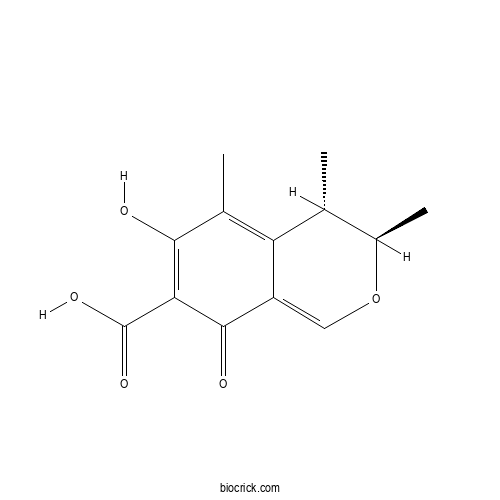
| Cas No. | 518-75-2 | SDF | File under preparation. |
| PubChem ID | 54680783.0 | Appearance | Powder |
| Formula | C13H14O5 | M.Wt | 250.2 |
| Type of Compound | Other Phenolic Compounds | Storage | Desiccate at -20°C |
| Solubility | Soluble in Chloroform,Dichloromethane,Ethyl Acetate,DMSO,Acetone,etc. | ||
| Chemical Name | (3R,4S)-6-hydroxy-3,4,5-trimethyl-8-oxo-3,4-dihydroisochromene-7-carboxylic acid | ||
| SMILES | CC1C(OC=C2C1=C(C(=C(C2=O)C(=O)O)O)C)C | ||
| Standard InChIKey | CBGDIJWINPWWJW-IYSWYEEDSA-N | ||
| Standard InChI | InChI=1S/C13H14O5/c1-5-7(3)18-4-8-9(5)6(2)11(14)10(12(8)15)13(16)17/h4-5,7,14H,1-3H3,(H,16,17)/t5-,7-/m1/s1 | ||
| General tips | For obtaining a higher solubility , please warm the tube at 37 ℃ and shake it in the ultrasonic bath for a while.Stock solution can be stored below -20℃ for several months. We recommend that you prepare and use the solution on the same day. However, if the test schedule requires, the stock solutions can be prepared in advance, and the stock solution must be sealed and stored below -20℃. In general, the stock solution can be kept for several months. Before use, we recommend that you leave the vial at room temperature for at least an hour before opening it. |
||
| About Packaging | 1. The packaging of the product may be reversed during transportation, cause the high purity compounds to adhere to the neck or cap of the vial.Take the vail out of its packaging and shake gently until the compounds fall to the bottom of the vial. 2. For liquid products, please centrifuge at 500xg to gather the liquid to the bottom of the vial. 3. Try to avoid loss or contamination during the experiment. |
||
| Shipping Condition | Packaging according to customer requirements(5mg, 10mg, 20mg and more). Ship via FedEx, DHL, UPS, EMS or other couriers with RT, or blue ice upon request. | ||
Quality Control & MSDS
3D structure
Package In Stock

Number of papers citing our products


Citrinin Dilution Calculator
Citrinin Molarity Calculator
| 1 mg | 5 mg | 10 mg | 20 mg | 25 mg | |
| 1 mM | 3.9968 mL | 19.984 mL | 39.968 mL | 79.9361 mL | 99.9201 mL |
| 5 mM | 0.7994 mL | 3.9968 mL | 7.9936 mL | 15.9872 mL | 19.984 mL |
| 10 mM | 0.3997 mL | 1.9984 mL | 3.9968 mL | 7.9936 mL | 9.992 mL |
| 50 mM | 0.0799 mL | 0.3997 mL | 0.7994 mL | 1.5987 mL | 1.9984 mL |
| 100 mM | 0.04 mL | 0.1998 mL | 0.3997 mL | 0.7994 mL | 0.9992 mL |
| * Note: If you are in the process of experiment, it's necessary to make the dilution ratios of the samples. The dilution data above is only for reference. Normally, it's can get a better solubility within lower of Concentrations. | |||||
- Cascaroside C
Catalog No.:BCX2876
CAS No.:53823-09-9
- Cascaroside D
Catalog No.:BCX2875
CAS No.:53861-35-1
- Calendulaglycoside C
Catalog No.:BCX2874
CAS No.:26020-29-1
- Phanginin A
Catalog No.:BCX2873
CAS No.:1011528-58-7
- 3-(1-Carboxyvinyloxy)benzoic acid
Catalog No.:BCX2872
CAS No.:16929-37-6
- Esculentoside S
Catalog No.:BCX2871
CAS No.:156031-83-3
- Jasnudifloside B
Catalog No.:BCX2870
CAS No.:244230-40-8
- Rehmaglutin C
Catalog No.:BCX2869
CAS No.:103744-81-6
- Naringenin-7-O-(6′′-E-p-coumaroyl-β-D-glucopyranoside)
Catalog No.:BCX2868
CAS No.:96686-70-3
- Entagenic
Catalog No.:BCX2867
CAS No.:5951-41-7
- Calipteryxin
Catalog No.:BCX2866
CAS No.:14017-72-2
- Staphylionoside D
Catalog No.:BCX2865
CAS No.:663919-93-5
- Azukisaponin II
Catalog No.:BCX2878
CAS No.:82793-03-1
- Quercetin 3-O-β-D-(6’’-O-malonyl)galactopyranoside
Catalog No.:BCX2879
CAS No.:84392-08-5
- L-γ-Glutamyl-S-(1E)-1-propen1-yl-L-cysteine
Catalog No.:BCX2880
CAS No.:134677-41-1
- 9 (10) -Z-α-trans-Bergamotenol
Catalog No.:BCX2881
CAS No.:88034-74-6
- Anhydrohirundigenin
Catalog No.:BCX2882
CAS No.:20853-99-0
- Luteolin-7-O-β-D-apiofuranosyl-(1→6)-β-D-glucopyransodie
Catalog No.:BCX2883
CAS No.:211561-67-0
- Caesaljapin
Catalog No.:BCX2884
CAS No.:144161-80-8
- Prunasinamide
Catalog No.:BCX2885
CAS No.:151649-54-6
- Propinquain H
Catalog No.:BCX2886
CAS No.:1426059-47-3
- Heterophyllin A
Catalog No.:BCX2887
CAS No.:145459-18-3
- (25R)-12α-Hydroxyspirost-4-en-3-one
Catalog No.:BCX2888
CAS No.:50888-50-1
- Angulasaponin B
Catalog No.:BCX2889
CAS No.:1628031-59-3
Fungi and mycotoxins during conventional and improved postharvest processing and storage of local rice in Nigeria.[Pubmed:42837051]
Mycotoxin Res. 2026 Oct 6;42(4):73.
This study applied a polyphasic characterization approach and LC-MS/MS analysis to elucidate fungal and mycotoxin contamination dynamics during conventional (CPRP) and improved (IPRP) postharvest processing and a 90-day storage of rice in Nigeria. Three hundred and twenty-five fungal isolates belonging to 21 genera (10 moulds, one crust fungus, 10 yeasts) and 54 species were recovered from rice across both processing chains. The CPRP chain had greater diversity of fungal genera compared to the IPRP chain. Aspergillus predominated both processing chains while yeasts occurred only in the CPRP chain. Species belonging to Aspergillus sections Aspergillus, Candidi, Flavi and Nidulantes, and Penicillium section Citrina predominated in stored rice in the two processing chains. A total of 106 extrolites including several uncommon extrolites and potential species markers were identified in agar cultures of 38 strains from 19 mould species. Fifteen mycotoxins were detected in rice along the processing and storage chains. Processing of rice in the IPRP chain and hermetic storage for 90 days reduced total aflatoxins by 9% compared to non-reduction in CPRP chain. Conventionally processed and stored rice in jute bags after 90 days recorded at least twice higher percentage reductions of total fumonisin, nivalenol and tenuazonic acid compared to hermetically stored rice from the IPRP chain. However, Citrinin+dihydrocitrinone levels in rice from the two storage types increased progressively during the 90-day storage period. This study highlights the critical control points in the two rice process chains and provides insights into possible mycotoxin control approaches along the chain including in storage.
Discovery and semisynthesis of coniochaetones N-P: antimicrobial and antioxidant heterocyclics from an Antarctic-derived fungus Penicillium sp. S2014503.[Pubmed:42832636]
J Asian Nat Prod Res. 2026 Oct 5:1-14.
Penicillium sp. S2014503 is a fungus found in the Antarctic. Herein, we report a new heterocyclic (1) and two semi-synthesized ones (2-3) derived from Citrinin (4), the main product of S2014503. Absolute configurations of 1 and 4 were deduced by single crystal X-ray diffraction analyses. Compound 2 was analyzed to be a diastereomeric mixture. The structure of compound 3 was determined by NMR and X-ray diffraction analyses. Compounds 2 and 3 showed strong antibacterial activity. Furthermore, compounds 1-4 exhibited excellent synergistic effects against Candida albicans SC5314 by inhibiting its mycelia formation. Compound 3 also displayed significant antioxidant activities.
Biodegradation characteristics and mechanism of citrinin by Rhodotorula mucilaginosa LWJJ06 from metabolomic and transcriptomic perspectives.[Pubmed:42766111]
Arch Microbiol. 2026 Sep 21;208(12):650.
Liupao tea, a type of dark tea produced through pile fermentation, is susceptible to contamination by mycotoxin Citrinin (CIT), posing significant health risks due to its nephrotoxic and hepatotoxic properties. In this study, Rhodotorula mucilaginosa LWJJ06, isolated from Liupao tea fermentation samples, completely degraded 10~ 100 microg/mL of CIT within 48 h under optimized conditions (28 degrees C, pH: 4.0, inoculum size: 1 x 10(7) CFU/mL). Metabolomic and transcriptomic analyses suggested that extensive metabolic adjustments accompanied CIT degradation, including apparent reallocation of energy resources, responses indicative of oxidative stress, and changes in membrane lipid profiles potentially linked to toxin transport. Two key degradation products, dihydroCitrinin and dihydrocitrinone, were tentatively identified, and the degradation pathway was preliminarily elucidated with reduced cytotoxicity confirmed. The cell counting kit-8 cytotoxicity assay demonstrated that the degradation products were significantly less toxic to alpha mouse liver 12 cells than CIT. These findings highlighted the potential of Rhodotorula mucilaginosa LWJJ06 as a probiotic agent for mycotoxin mitigation in food systems, offering a sustainable strategy and theoretical basis for controlling mycotoxin in Liupao tea.
Chromosome-Scale Genome Analysis Reveals Locus-Specific Disruption of the Citrinin-Associated Region in a Furu-Derived Monascus ruber Strain BC20.[Pubmed:42737335]
Foods. 2026 Aug 31;15(17):3091.
Monascus species are widely used in traditional fermented foods for pigment and flavor formation, but Citrinin contamination remains a major safety concern that limits broader food applications. Therefore, this study aimed to evaluate the Citrinin risk of a furu-derived Monascus ruber strain, BC20, by integrating phenotypic screening across food-relevant matrices with genome-resolved analysis. After 14 days of cultivation across eight matrices, including fungal media as well as dairy-, cereal-, and bran-based substrates, Citrinin was not detected by immunoaffinity cleanup combined with HPLC-FLD (LOD, 4 mug/kg; LOQ, 12 mug/kg). To investigate the genetic basis of this phenotype, we generated a chromosome-scale genome assembly for BC20 and conducted comparative analyses across a total of 19 Monascus genomes. ANI analysis and phylogenomic inference consistently placed BC20 within the ruber-pilosus clade. Comparative synteny analysis showed that the Citrinin-associated locus in BC20 no longer retained an intact cluster configuration but instead exhibited a remnant-locus architecture, and similar patterns were also observed in several related genomes from the same clade. By contrast, the monacolin K (mk) locus remained syntenically conserved in BC20, supporting locus-specific structural disturbance rather than assembly-derived pseudo-absence. Additionally, its antifungal susceptibility was determined. Overall, BC20 represents a M. ruber candidate strain with undetectable Citrinin, and this study provides a practical analytical framework for Citrinin risk screening in food-related Monascus isolates.
Functional dissection of the smi1 regulator delineates its pivotal roles in modulating cellular physiology, Monascus pigments production and citrinin accumulation in Monascus purpureus.[Pubmed:42735761]
Int J Biol Macromol. 2026 Sep 14;382(Pt 2):154500.
beta-1,3-glucan, a polysaccharide and a major structural component of the fungal cell wall, is crucial for microbial growth and secondary metabolism, yet its role in Monascus purpureus remains unclear. In this study, we identified the smi1 gene in M. purpureus, which encodes a cell wall assembly regulator. Recombinant strains were then constructed to investigate the role of the Smi1 protein in beta-1,3-glucan biosynthesis, cell growth and secondary metabolism. Results showed that the overexpression strain exhibited total Monascus pigments (MPs) production increased by 76.02%, whereas the extracellular MPs enhanced by 71.95% in the knockout strain compared with that produced by the parent strain. Morphological analysis revealed that smi1 overexpression significantly thickened the cell wall and induced surface wrinkling, whereas knockout resulted in thinner walls and smoother surfaces, indicating Smi1's essential role in cell wall integrity and morphological regulation. Furthermore, smi1 overexpression upregulated beta-1,3-glucan precursor synthesis genes and increased beta-1,3-glucan synthase activity by 37.37% and 30.58% on days 3 and 6, respectively, whereas it decreased significantly in the knockout strain. Comparative transcriptomic analysis revealed that both overexpression and deletion of smi1 induced significant changes involved in beta-1,3-glucan synthesis, chitin synthesis, the biosynthesis of MPs and Citrinin, as well as fatty acid and amino acid metabolism. These results indicate that smi1 not only participates in cell wall biosynthesis and morphological regulation in M. purpureus, but also potentially regulates the synthesis of MPs and Citrinin by affecting central and secondary metabolic networks.
Effects of nonionic surfactants on the production of extracellular polysaccharides, citrinin synthesis, physicochemical structural characteristics, and in vitro hypoglycaemic activity of Monascus purpureus YY-1.[Pubmed:42735587]
Int J Biol Macromol. 2026 Sep 14;382(Pt 1):154502.
Monascus extracellular polysaccharides exhibit diverse bioactivities, including antioxidant, antitumor, and immunomodulatory effects. Nevertheless, their low native yield restricts practical applications. To improve the fermentation yield and functional properties of EPS, Monascus purpureus YY-1 was employed as the experimental strain in this study. We systematically investigated the regulatory effects of three nonionic surfactants (Triton X-100, Brij 35, and Span 60) on EPS production, Citrinin accumulation, physicochemical structures of polysaccharides, and their in vitro hypoglycemic activity of the strain. The results demonstrated that nonionic surfactants significantly elevated EPS yields by enhancing fungal cell membrane permeability, achieving an overall increase of 10%-20% relative to the blank control group. Meanwhile, these surfactants effectively inhibited the biosynthesis and accumulation of Citrinin during fermentation, improving product safety. Among these, the polysaccharides (T-EPS) obtained with Triton X-100 exhibit higher total sugar content, a more favorable galactose-to-mannose ratio, lower average molecular weight and particle size, and display a typical triple-helix conformation and a loose, porous micro-morphology. These favorable physicochemical structural features confer T-EPS with stronger inhibitory activities against alpha-amylase and alpha-glucosidase, as well as superior glucose adsorption capacity. This study confirms that nonionic surfactants (especially Triton X-100 with optimal performance) can synergistically enhance the yield, safety, and hypoglycemic activity of Monascus EPS. It provides important theoretical support for the development and application of functional polysaccharides from Monascus in the field of hypoglycemic functional foods.
Chronic exposure to aflatoxin B1, ochratoxin A, and citrinin in women and children and associated health risk characterization: blood biomonitoring evidence from rural Bangladesh.[Pubmed:42728599]
Environ Health. 2026 Sep 2;25(1):75.
Dietary exposure to mycotoxins-including aflatoxins (AFs), ochratoxin A (OTA), and Citrinin (CIT)-represents an important health risk, particularly in low-resource settings with widespread food contamination. This study investigates mycotoxin exposure among 719 participants (433 women and 286 children) of a cluster-randomized trial in rural Bangladesh, using residual blood samples collected during the 2019 endline survey. A total of 712 whole blood and 578 serum samples were analyzed by ultra-high-performance liquid chromatography-tandem mass spectrometry (UHPLC-MS/MS). Serum aflatoxin B1 (AFB(1))-lysine adducts were quantified following enzymatic digestion and solid-phase extraction. To evaluate potential health risks, we estimated probable daily intake (PDI) from blood concentrations of frequently detected mycotoxins. All whole blood samples contained at least two mycotoxins, and 84% of participants were co-exposed to at least three mycotoxins. Biomarkers for the main blood-relevant mycotoxins were frequently detected, with OTA detected in 100% of whole blood samples and its isomer, 2'R-ochratoxin A (2'R-OTA), detected in 98%, CIT in 91%, and Enniatin B (EnB) in 92%, while AFB(1)-lysine-a biomarker of chronic exposure to the potent carcinogen AFB(1)-was detected in nearly one-quarter of women and 4% of children with serum samples. Beauvericin was detected in 6% of samples. The PDI of OTA exceeded health-based guidance values in 80% of women and 99% of children, while the PDI of CIT was of concern for 12% of women and 27% of children. These findings demonstrate widespread co-exposure to multiple mycotoxins, with OTA, CIT, and AFB(1) posing notable risks, underscoring the urgent need for targeted interventions to protect vulnerable populations.
Integrated functional, metabolomic, and biotransformation profiling of mycotoxin hepatotoxicity in 2D and 3D human hepatic models.[Pubmed:42716368]
Environ Pollut. 2026 Sep 9;410:129017.
Mycotoxins pose a major risk to food safety and human health, yet their hepatotoxic mechanisms remain incompletely characterized due to limitations in conventional in vitro models. In this study, we systematically compared mycotoxin-induced hepatotoxicity and metabolomic profiling across two human hepatic models cultured under 2D monolayer and 3D spheroid conditions. The various mycotoxins (Aflatoxin B1, Citrinin, Deoxynivalenol, Ochratoxin A, Patulin, and Zearalenone) exhibit distinct metabolic signatures, thereby serving as an appropriate panel for comprehensively evaluating diverse hepatotoxic mechanisms. Mycotoxin exposure induced concentration-dependent hepatotoxicity accompanied by functional impairment and structural disruption in hepatic models. Metabolomic profiling revealed distinctive regulatory patterns between 2D and 3D hepatic models, with 3D spheroids showing consistent down-regulation across multiple intracellular metabolic pathways and altered extracellular metabolite release, whereas 2D monolayers predominantly exhibited global metabolic activation. In silico-assisted MS/MS analysis further demonstrated that Phase I biotransformation was largely conserved across models, whereas Phase II conjugation reactions were more frequently detected and exhibited greater model specificity in 3D spheroids. Overall, these findings indicate that 3D hepatic spheroids capture more integrated and coordinated hepatotoxic and metabolic responses to mycotoxins compared with 2D monolayer systems. These distinctive regulatory dynamics support their value as a physiologically relevant platform for toxicity assessment and mechanistic investigation.
Dietary exposure to mycotoxins for children aged 3-11 years from a Dutch Total Diet Study.[Pubmed:42716241]
Food Chem Toxicol. 2026 Sep 9;218:116383.
In 2022, a total diet study was conducted in the Netherlands in which mycotoxins were analysed in foods and beverages consumed by children aged 3-11 years. These mycotoxins were aflatoxins, Alternaria toxins, beauvericin, Citrinin, 4,15-diacetoxyscirpenol, enniatins, ergot alkaloids, fumonisins, moniliformin, mycophenolic acid, ochratoxin A, penicillic acid, roquefortine C, sterigmatocystin, trichothecenes, and zearalenone. Long-term exposure was calculated by combining concentrations in foods and beverages with their consumed amounts. Analysed foods and beverages with a concentration below the limit of quantification that could contain the mycotoxin were assigned a concentration equal to zero or this limit value. The 95th percentiles of long-term exposure were compared with a toxicological reference value or a margin of exposure was calculated. Exposure to aflatoxins, alternariol, alternariol monomethyl ether, ochratoxin A and T-2/HT-2 sum showed that a health concern cannot be excluded. Foods that contributed most to the exposure to these mycotoxins were bread, breakfast cereals, chocolates, fruit juices, oils and fats, nuts and tomatoes and tomato products.
The role of MpMag in the magnetic field regulation of biosynthesis of Monascus pigments and citrinin in Monascus purpureus.[Pubmed:42710279]
Microbiol Res. 2026 Sep 5;314:128722.
We constructed MpMag overexpression (MpMag(+)) and knockout (DeltaMpMag) strains to investigate the role of MpMag in regulating the synthesis of Monascus pigment (MPs) and Citrinin (CIT) in Monascus purpureus. After 9 days of cultivation, notable differences in the colony phenotype and the number of cleistothecia on PDA medium were observed between the wild-type (WT), MpMag(+) and DeltaMpMag strains. The MpMag(+) strain exhibited a significantly higher production of MPs and notably lower levels of CIT compared to the WT. In contrast, the DeltaMpMag strain exhibited an opposite pattern. Exposure to both 0.9 mT and 1.6 mT low-frequency magnetic fields (LF-MF) significantly promoted the production of MPs in the WT and MpMag(+) strains, while also reducing CIT production in the WT. Only the 0.9 mT LF-MF exposure decreased CIT levels in the MpMag(+) strain. The intracellular iron content in the MpMag(+) strain was significantly lower than in the WT. Exposure to 1.6 mT LF-MF significantly reduced the intracellular iron content in both the WT and MpMag(+) strains on the 6th day of fermentation. Furthermore, the LF-MF exposure and the differential expression of the MpMag gene collaboratively regulate the expression levels of genes involved in iron-sulfur cluster assembly, iron homeostasis, regulation of MPs and CIT synthesis. These results imply that the MpMag as a magnetic field-responsive protein regulates the uptake and utilization of iron ions, thereby altering intracellular iron content and influencing the expression of genes related to the synthesis of MPs and CIT in M. purpureus.
Verification and application of a HPLC-FLD method with immunoaffinity column cleanup for the analysis of citrinin in rice.[Pubmed:42693791]
J Environ Sci Health B. 2026 Sep 4:1-9.
This preliminary study aimed to verify an analytical method for the detection and quantification of Citrinin (CIT) in commercial rice samples using high-performance liquid chromatography with fluorescence detection (HPLC-FLD). Ten rice samples of various origins were extracted, purified by immunoaffinity column (IAC), and analyzed by HPLC-FLD. The method showed excellent linearity (r(2) = 0.999), with a LOD of 0.031 microg/mL and a LOQ of 0.103 microg/mL. Satisfactory precision was achieved (CV: 1.59-8.65%). Standard solution recovery was approximately 97%. Chromatographic peaks corresponding to CIT, identified by retention-time matching with the analytical standard following IAC cleanup, were observed in all samples. Putative CIT concentrations ranged from 126 to 229 microg/kg, mean 192 +/- 35 microg/kg. To our knowledge, this is the first report of potential CIT contamination in rice from Turkiye. However, given the limited sample size, non-representative sampling design, and identification based on HPLC-FLD retention-time matching without LC-MS/MS confirmation, these findings are preliminary and should not be generalized beyond the rice samples analyzed in this study. Although CIT is a globally recognized mycotoxin, no specific limits exist for conventional rice. These findings support the need for larger monitoring studies, confirmatory LC-MS/MS analysis, and regulatory consideration for CIT in rice.
Computer-assisted hapten design enables aptamer and hybrid aptamer-antibody rapid assays for detection of citrinin in red yeast rice.[Pubmed:42685423]
Food Chem. 2026 Aug 29;527:150914.
Citrinin (CTN), a nephrotoxic and hepatotoxic mycotoxin frequently found in red yeast rice, requires rapid and reliable detection. Here, six CTN haptens were rationally designed using computational chemistry, and two optimal structures were selected for generating CTN-specific aptamers via systematic evolution of ligands by exponential enrichment (SELEX). Based on these aptamers (Apts), four analytical platforms were developed, including enzyme-linked aptamer sorbent assay (ELASA), aptamer-based lateral flow strip (Apt-LFS), hybrid enzyme-linked aptamer-antibody assay (ELAAA), and hybrid lateral flow strip (Hybrid-LFS). The limits of detection were 1.9, 500, 10, and 250 ng/mL, respectively. In spiked red yeast rice samples, ELASA and ELAAA showed average recoveries of 102% and 104%. Analysis of 15 commercial samples showed excellent consistency with HPLC, while Apt-LFS and Hybrid-LFS identified four positive samples according to Taiwan Food and Drug Administration (TFDA) limits. This study provides a sensitive and practical strategy for CTN monitoring in complex food matrices.
Physicochemical characterization and OECD-guided toxicological evaluation of a beer extract supplemented with Monascus ruber-fermented Rice.[Pubmed:42680332]
Food Res Int. 2026 Oct 31;242(Pt 3):120039.
This study investigated the physicochemical characteristics and performed an initial toxicological evaluation of a freeze-dried beer extract supplemented with Monascus ruber-fermented rice (BEMR). Two Pilsner-style beers were produced and characterized according to European Brewery Convention (EBC) analytical methods, including pH, density, bitterness, and color measurements (SRM and CIELAB). The freeze-dried extract was subsequently evaluated in Wistar rats using acute (OECD Test Guideline 423) and repeated-dose 28-day oral toxicity (OECD Test Guideline 407) protocols. No mortality, treatment-related clinical signs, or gross organ abnormalities were observed following acute administration up to 2000 mg/kg or repeated oral administration up to 1000 mg/kg/day. Hepatic, renal, and hematological parameters remained largely within physiological ranges throughout the study. Treated animals exhibited reduced body-weight gain without significant changes in feed or water intake. Modest increases in serum creatinine and reductions in creatine kinase activity were observed in the absence of corresponding clinical or pathological findings. Physicochemical analyses confirmed that incorporation of Monascus-fermented rice markedly modified beer color while maintaining the principal brewing parameters within acceptable ranges for the beer style. Under the experimental conditions evaluated, BEMR was well tolerated in both acute and repeated-dose toxicity screening assays. The biological significance of the observed physiological responses remains to be clarified through additional studies incorporating targeted chemical characterization (e.g., Citrinin and monacolin contents), histopathological evaluation, and longer-term repeated-dose investigations.
Microbial diversity, functional activities, and safety risks in fermented tea: a comprehensive review.[Pubmed:42680317]
Food Res Int. 2026 Oct 31;242(Pt 3):120020.
Microbial fermented teas are gaining global popularity due to their unique sensory profiles and health benefits. The quality and safety of these products are governed by complex microbial ecosystems that orchestrate the biotransformation of tea leaf components. This review addresses a critical paradox in the field: the same microbial activities that generate desirable bioactive metabolites, such as theabrownins and organic acids, also create ecological niches for mycotoxigenic fungi, posing significant health risks from contaminants like ochratoxin A, Citrinin, and aflatoxins. While extensive research has cataloged the microbial diversity in these systems, a comprehensive framework linking processing environments to microbial community assembly, functional outcomes, and quantifiable safety risks remains elusive. This review systematically bridges this gap by synthesizing current knowledge on the microbial consortia-dominated by Aspergillus, Penicillium, Bacillus, and Lactiplantibacillus species-that drive tea fermentation. We critically analyze their functional roles in enhancing flavor, bioactivity, and potential probiotic activity while simultaneously evaluating the mechanisms of mycotoxin production and accumulation. By integrating microbial ecology, biochemistry, and food safety, we propose a forward-looking perspective focused on transitioning the industry from traditional, spontaneous fermentation to modern, controlled biotechnological processes. This approach, centered on the use of defined starter cultures, predictive modeling, and active biocontrol strategies, provides a roadmap for ensuring the consistent quality and safety of fermented tea products, ultimately unlocking their full potential as high-quality functional foods.
Role of IscA1 in Low-Frequency Magnetic Field-Associated Changes in Monascus Pigments and Citrinin Levels in Monascus purpureus.[Pubmed:42646112]
J Fungi (Basel). 2026 Aug 7;12(8):585.
We constructed IscA1 overexpression (IscA1(+)) and RNA interference (RNAi-IscA1) strains to investigate the role of IscA1 in regulating the synthesis of Monascus pigments (MPs) and Citrinin (CIT) in Monascus purpureus under low-frequency magnetic field (LF-MF) exposure. Both IscA1(+) and RNAi-IscA1 strains exhibited altered nutritional growth and sexual reproduction; however, asexual reproduction, the ultrastructure of spores and mycelia, and biomass in liquid fermentation, remained unaffected. The production of yellow and orange pigments increased in the IscA1(+) strain, while the production of red pigments decreased in the RNAi-IscA1 strain. The expression level of the IscA1 was shown to determine intracellular iron ion content in M. purpureus. Exposure to 1.6 mT LF-MF did not impact biomass but significantly enhanced MPs and decreased intracellular iron content on the 6th day of fermentation in both IscA1(+) and RNAi-IscA1 strains, while increasing CIT production in the IscA1(+) strain. The interplay between IscA1 gene expression and LF-MF exposure jointly regulates the expression of genes related to iron-sulfur cluster assembly, iron homeostasis, and the synthesis of MPs and CIT. These results suggest that LF-MF enhances the expression of the IscA1 gene in M. purpureus, promotes iron-sulfur cluster assembly, regulates intracellular iron distribution, and influences the synthesis of MPs and CIT.

Calcutta University

University of Minnesota

University of Maryland School of Medicine

University of Illinois at Chicago

The Ohio State University

University of Zurich

Harvard University

Colorado State University

Auburn University

Yale University

Worcester Polytechnic Institute

Washington State University

Stanford University

University of Leipzig

Universidade da Beira Interior

The Institute of Cancer Research

Heidelberg University

University of Amsterdam

University of Auckland

TsingHua University

The University of Michigan

Miami University

DRURY University

Jilin University

Fudan University

Wuhan University

Sun Yat-sen University

Universite de Paris

Deemed University

Auckland University

The University of Tokyo

Korea University



