
Esculentoside SCAS# 156031-83-3 |
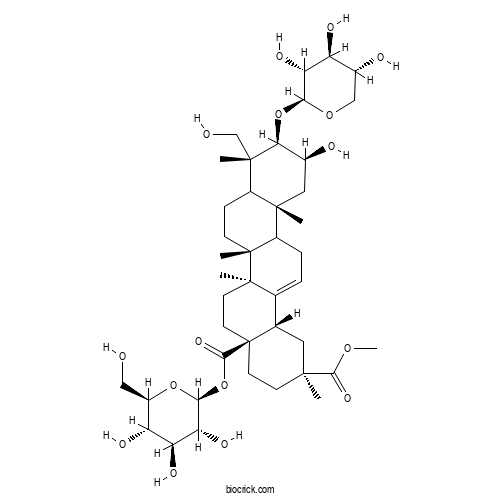
| Cas No. | 156031-83-3 | SDF | File under preparation. |
| PubChem ID | 23786378.0 | Appearance | Powder |
| Formula | C42H66O16 | M.Wt | 827.0 |
| Type of Compound | Triterpenoids | Storage | Desiccate at -20°C |
| Solubility | Soluble in Chloroform,Dichloromethane,Ethyl Acetate,DMSO,Acetone,etc. | ||
| Chemical Name | 2-O-methyl 4a-O-[(2S,3R,4S,5S,6R)-3,4,5-trihydroxy-6-(hydroxymethyl)oxan-2-yl] (2S,4aR,6aS,6bR,9R,10R,11S,12aR,14bS)-11-hydroxy-9-(hydroxymethyl)-2,6a,6b,9,12a-pentamethyl-10-[(2S,3R,4S,5R)-3,4,5-trihydroxyoxan-2-yl]oxy-1,3,4,5,6,6a,7,8,8a,10,11,12,13,14b-tetradecahydropicene-2,4a-dicarboxylate | ||
| SMILES | CC1(CCC2(CCC3(C(=CCC4C3(CCC5C4(CC(C(C5(C)CO)OC6C(C(C(CO6)O)O)O)O)C)C)C2C1)C)C(=O)OC7C(C(C(C(O7)CO)O)O)O)C(=O)OC | ||
| Standard InChIKey | XPZGXZBKRPZWMJ-NSUQAVABSA-N | ||
| Standard InChI | InChI=1S/C42H66O16/c1-37(35(52)54-6)11-13-42(36(53)58-34-31(51)29(49)28(48)24(17-43)56-34)14-12-40(4)20(21(42)15-37)7-8-26-38(2)16-22(45)32(57-33-30(50)27(47)23(46)18-55-33)39(3,19-44)25(38)9-10-41(26,40)5/h7,21-34,43-51H,8-19H2,1-6H3/t21-,22-,23+,24+,25?,26?,27-,28+,29-,30+,31+,32-,33-,34-,37-,38-,39-,40+,41+,42-/m0/s1 | ||
| General tips | For obtaining a higher solubility , please warm the tube at 37 ℃ and shake it in the ultrasonic bath for a while.Stock solution can be stored below -20℃ for several months. We recommend that you prepare and use the solution on the same day. However, if the test schedule requires, the stock solutions can be prepared in advance, and the stock solution must be sealed and stored below -20℃. In general, the stock solution can be kept for several months. Before use, we recommend that you leave the vial at room temperature for at least an hour before opening it. |
||
| About Packaging | 1. The packaging of the product may be reversed during transportation, cause the high purity compounds to adhere to the neck or cap of the vial.Take the vail out of its packaging and shake gently until the compounds fall to the bottom of the vial. 2. For liquid products, please centrifuge at 500xg to gather the liquid to the bottom of the vial. 3. Try to avoid loss or contamination during the experiment. |
||
| Shipping Condition | Packaging according to customer requirements(5mg, 10mg, 20mg and more). Ship via FedEx, DHL, UPS, EMS or other couriers with RT, or blue ice upon request. | ||
Quality Control & MSDS
3D structure
Package In Stock

Number of papers citing our products


Esculentoside S Dilution Calculator
Esculentoside S Molarity Calculator
-
 Esculentoside HCatalog No.: BCN2795CAS No.: 66656-92-6
-
 Esculentoside DCatalog No.: BCN5013CAS No.: 89808-50-4
-
 Esculentoside ACatalog No.: BCN5010CAS No.: 65497-07-6
-
 Esculentoside BCatalog No.: BCN5011CAS No.: 60820-94-2
-
 Lucyoside BCatalog No.: BCN7811CAS No.: 91174-19-5
-
 Polygalasaponin FCatalog No.: BCN2317CAS No.: 882664-74-6
-
 Esculentoside LCatalog No.: BCX2818CAS No.: 130364-33-9
-
 Esculentoside FCatalog No.: BCX2831CAS No.: 95263-31-3
-
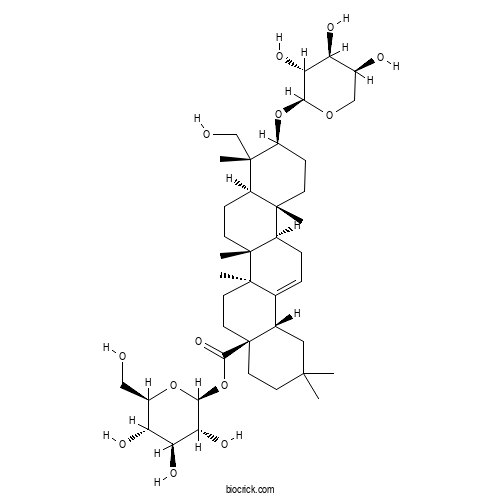 HN saponin FCatalog No.: BCX2544CAS No.: 39524-13-5
-
 Esculentoside ECatalog No.: BCN5014CAS No.: 65649-36-7
-
 Arjunglucoside IICatalog No.: BCN6395CAS No.: 62369-72-6
-
 Bayogenin 3-O-beta-D-glucopyranosideCatalog No.: BCN7868CAS No.: 104513-86-2
-
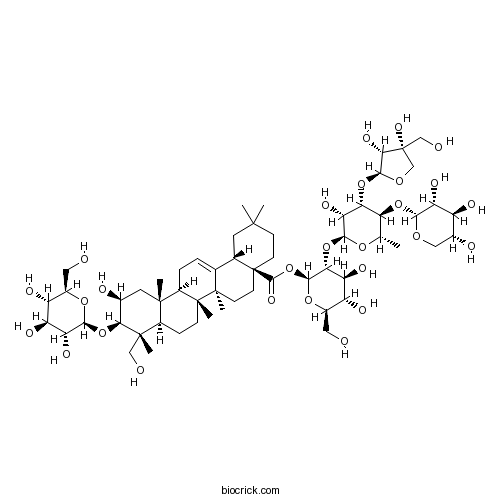 Polygalasaponin VCatalog No.: BCN2790CAS No.: 162857-65-0
-
 Asperosaponin VICatalog No.: BCN1256CAS No.: 39524-08-8
| 1 mg | 5 mg | 10 mg | 20 mg | 25 mg | |
| 1 mM | 1.2092 mL | 6.0459 mL | 12.0919 mL | 24.1838 mL | 30.2297 mL |
| 5 mM | 0.2418 mL | 1.2092 mL | 2.4184 mL | 4.8368 mL | 6.0459 mL |
| 10 mM | 0.1209 mL | 0.6046 mL | 1.2092 mL | 2.4184 mL | 3.023 mL |
| 50 mM | 0.0242 mL | 0.1209 mL | 0.2418 mL | 0.4837 mL | 0.6046 mL |
| 100 mM | 0.0121 mL | 0.0605 mL | 0.1209 mL | 0.2418 mL | 0.3023 mL |
| * Note: If you are in the process of experiment, it's necessary to make the dilution ratios of the samples. The dilution data above is only for reference. Normally, it's can get a better solubility within lower of Concentrations. | |||||
- Jasnudifloside B
Catalog No.:BCX2870
CAS No.:244230-40-8
- Rehmaglutin C
Catalog No.:BCX2869
CAS No.:103744-81-6
- Naringenin-7-O-(6′′-E-p-coumaroyl-β-D-glucopyranoside)
Catalog No.:BCX2868
CAS No.:96686-70-3
- Entagenic
Catalog No.:BCX2867
CAS No.:5951-41-7
- Calipteryxin
Catalog No.:BCX2866
CAS No.:14017-72-2
- Staphylionoside D
Catalog No.:BCX2865
CAS No.:663919-93-5
- 1-Palmitin-2-Linolein-3-Olein
Catalog No.:BCX2864
CAS No.:2579-00-2
- (2R,3S)-2-(3,4-Dihydroxyphenyl)-3,4-dihydro-3,5,7-trihydroxy-2H-1-benzopyran -8-carboxaldehyde
Catalog No.:BCX2863
CAS No.:271593-64-7
- 1,3-Dioleyl-2-palmitoylglycerol
Catalog No.:BCX2862
CAS No.:1716-07-0
- Azukisaponin VI
Catalog No.:BCX2861
CAS No.:82801-39-6
- β-Sesquiphellandrene
Catalog No.:BCX2860
CAS No.:20307-83-9
- (-)-δ-Cadinene
Catalog No.:BCX2859
CAS No.:13061-82-0
- 3-(1-Carboxyvinyloxy)benzoic acid
Catalog No.:BCX2872
CAS No.:16929-37-6
- Phanginin A
Catalog No.:BCX2873
CAS No.:1011528-58-7
- Calendulaglycoside C
Catalog No.:BCX2874
CAS No.:26020-29-1
- Cascaroside D
Catalog No.:BCX2875
CAS No.:53861-35-1
- Cascaroside C
Catalog No.:BCX2876
CAS No.:53823-09-9
- Citrinin
Catalog No.:BCX2877
CAS No.:518-75-2
- Azukisaponin II
Catalog No.:BCX2878
CAS No.:82793-03-1
- Quercetin 3-O-β-D-(6’’-O-malonyl)galactopyranoside
Catalog No.:BCX2879
CAS No.:84392-08-5
- L-γ-Glutamyl-S-(1E)-1-propen1-yl-L-cysteine
Catalog No.:BCX2880
CAS No.:134677-41-1
- 9 (10) -Z-α-trans-Bergamotenol
Catalog No.:BCX2881
CAS No.:88034-74-6
- Anhydrohirundigenin
Catalog No.:BCX2882
CAS No.:20853-99-0
- Luteolin-7-O-β-D-apiofuranosyl-(1→6)-β-D-glucopyransodie
Catalog No.:BCX2883
CAS No.:211561-67-0
Traditional uses, botanical description, phytochemistry, and pharmacological activities of Phytolacca acinosa: a review.[Pubmed:39850573]
Front Pharmacol. 2025 Jan 9;15:1480034.
BACKGROUND: Phytolacca acinosa is an herbaceous herb belonging to the Phytolaccaceae family. The plant has a long history of usage in traditional medicine for treating a variety of ailments including infectious diseases, edema, inflammation, gastric, and abdominal distress. The traditional use, phytochemistry, and pharmacological properties of Phytolacca acinosa are outlined in this article. MAIN TEXT: To date, few bioactive molecules have been identified and isolated from the plant, such as phytolacacinoside A, esculentoside H, jaligonic acid and esculentoside B, phytolaccanol and epiacetyl aleuritolic acid, esculentoside A, esculentoside C, esculentoside D, esculentoside T, Esculentoside S, sitosterol. The literature related some of the reported ethnomedicinal uses of the plant to these compounds found in different parts of the plant. CONCLUSION: The in-depth knowledge about the significance of Phytolacca acinosa presented in this review may open up opportunities for research development in drug discovery and a better comprehension of the therapeutic advantages of the plant.

Calcutta University

University of Minnesota

University of Maryland School of Medicine

University of Illinois at Chicago

The Ohio State University

University of Zurich

Harvard University

Colorado State University

Auburn University

Yale University

Worcester Polytechnic Institute

Washington State University

Stanford University

University of Leipzig

Universidade da Beira Interior

The Institute of Cancer Research

Heidelberg University

University of Amsterdam

University of Auckland

TsingHua University

The University of Michigan

Miami University

DRURY University

Jilin University

Fudan University

Wuhan University

Sun Yat-sen University

Universite de Paris

Deemed University

Auckland University

The University of Tokyo

Korea University



