
Staphylionoside DCAS# 663919-93-5 |
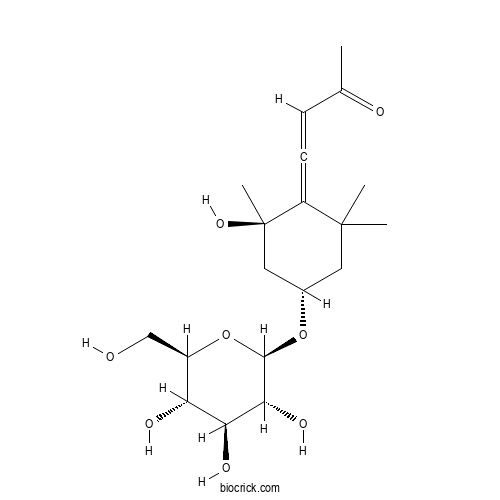
| Cas No. | 663919-93-5 | SDF | File under preparation. |
| PubChem ID | 15628136.0 | Appearance | Powder |
| Formula | C19H30O8 | M.Wt | 386.4 |
| Type of Compound | N/A | Storage | Desiccate at -20°C |
| Solubility | Soluble in Chloroform,Dichloromethane,Ethyl Acetate,DMSO,Acetone,etc. | ||
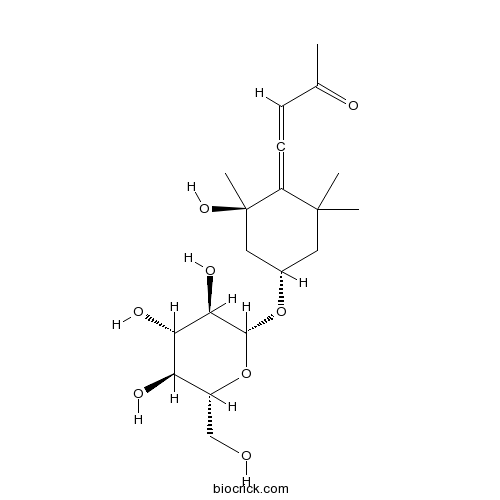
| Chemical Name | 4-[(2R,4S)-2-hydroxy-2,6,6-trimethyl-4-[(2R,3R,4S,5S,6R)-3,4,5-trihydroxy-6-(hydroxymethyl)oxan-2-yl]oxycyclohexylidene]but-3-en-2-one | ||
| SMILES | CC(=O)C=C=C1C(CC(CC1(C)O)OC2C(C(C(C(O2)CO)O)O)O)(C)C | ||
| Standard InChIKey | OSUSRWMGHUUXBY-YARXSPMZSA-N | ||
| Standard InChI | InChI=1S/C19H30O8/c1-10(21)5-6-13-18(2,3)7-11(8-19(13,4)25)26-17-16(24)15(23)14(22)12(9-20)27-17/h5,11-12,14-17,20,22-25H,7-9H2,1-4H3/t6?,11-,12+,14+,15-,16+,17+,19+/m0/s1 | ||
| General tips | For obtaining a higher solubility , please warm the tube at 37 ℃ and shake it in the ultrasonic bath for a while.Stock solution can be stored below -20℃ for several months. We recommend that you prepare and use the solution on the same day. However, if the test schedule requires, the stock solutions can be prepared in advance, and the stock solution must be sealed and stored below -20℃. In general, the stock solution can be kept for several months. Before use, we recommend that you leave the vial at room temperature for at least an hour before opening it. |
||
| About Packaging | 1. The packaging of the product may be reversed during transportation, cause the high purity compounds to adhere to the neck or cap of the vial.Take the vail out of its packaging and shake gently until the compounds fall to the bottom of the vial. 2. For liquid products, please centrifuge at 500xg to gather the liquid to the bottom of the vial. 3. Try to avoid loss or contamination during the experiment. |
||
| Shipping Condition | Packaging according to customer requirements(5mg, 10mg, 20mg and more). Ship via FedEx, DHL, UPS, EMS or other couriers with RT, or blue ice upon request. | ||
Quality Control & MSDS
3D structure
Package In Stock

Number of papers citing our products


Staphylionoside D Dilution Calculator
Staphylionoside D Molarity Calculator

| 1 mg | 5 mg | 10 mg | 20 mg | 25 mg | |
| 1 mM | 2.588 mL | 12.94 mL | 25.8799 mL | 51.7598 mL | 64.6998 mL |
| 5 mM | 0.5176 mL | 2.588 mL | 5.176 mL | 10.352 mL | 12.94 mL |
| 10 mM | 0.2588 mL | 1.294 mL | 2.588 mL | 5.176 mL | 6.47 mL |
| 50 mM | 0.0518 mL | 0.2588 mL | 0.5176 mL | 1.0352 mL | 1.294 mL |
| 100 mM | 0.0259 mL | 0.1294 mL | 0.2588 mL | 0.5176 mL | 0.647 mL |
| * Note: If you are in the process of experiment, it's necessary to make the dilution ratios of the samples. The dilution data above is only for reference. Normally, it's can get a better solubility within lower of Concentrations. | |||||
- 1-Palmitin-2-Linolein-3-Olein
Catalog No.:BCX2864
CAS No.:2579-00-2
- (2R,3S)-2-(3,4-Dihydroxyphenyl)-3,4-dihydro-3,5,7-trihydroxy-2H-1-benzopyran -8-carboxaldehyde
Catalog No.:BCX2863
CAS No.:271593-64-7
- 1,3-Dioleyl-2-palmitoylglycerol
Catalog No.:BCX2862
CAS No.:1716-07-0
- Azukisaponin VI
Catalog No.:BCX2861
CAS No.:82801-39-6
- β-Sesquiphellandrene
Catalog No.:BCX2860
CAS No.:20307-83-9
- (-)-δ-Cadinene
Catalog No.:BCX2859
CAS No.:13061-82-0
- α-Calacorene
Catalog No.:BCX2858
CAS No.:21391-99-1
- (-)-Epigallocatechin 3'-O-methylether gallate
Catalog No.:BCX2857
CAS No.:298700-56-8
- Tenuifoliose Q
Catalog No.:BCX2856
CAS No.:662166-93-0
- (Z)-α-Santalol
Catalog No.:BCX2855
CAS No.:115-71-9
- 4-Hydroxy-3-butylphthalide
Catalog No.:BCX2854
CAS No.:74459-23-7
- (-)-3-O -Acetylcatechin
Catalog No.:BCX2853
CAS No.:116935-88-7
- Calipteryxin
Catalog No.:BCX2866
CAS No.:14017-72-2
- Entagenic
Catalog No.:BCX2867
CAS No.:5951-41-7
- Naringenin-7-O-(6′′-E-p-coumaroyl-β-D-glucopyranoside)
Catalog No.:BCX2868
CAS No.:96686-70-3
- Rehmaglutin C
Catalog No.:BCX2869
CAS No.:103744-81-6
- Jasnudifloside B
Catalog No.:BCX2870
CAS No.:244230-40-8
- Esculentoside S
Catalog No.:BCX2871
CAS No.:156031-83-3
- 3-(1-Carboxyvinyloxy)benzoic acid
Catalog No.:BCX2872
CAS No.:16929-37-6
- Phanginin A
Catalog No.:BCX2873
CAS No.:1011528-58-7
- Calendulaglycoside C
Catalog No.:BCX2874
CAS No.:26020-29-1
- Cascaroside D
Catalog No.:BCX2875
CAS No.:53861-35-1
- Cascaroside C
Catalog No.:BCX2876
CAS No.:53823-09-9
- Citrinin
Catalog No.:BCX2877
CAS No.:518-75-2
UPLC-MS/MS and chemometrics analyses reveal chemical profile and anti-inflammatory activity of Bienertia cycloptera Bunge fractions.[Pubmed:39311058]
Phytochem Anal. 2025 Apr;36(3):603-617.
INTRODUCTION: Bienertia cycloptera is a species belonging to the Chenopodiaceae family. According to earlier reports, a unique research study on the phytochemistry and biological analysis of that species was conducted. OBJECTIVE: This study presents an integrated metabolomics investigation combined with multivariate analysis of various extractive fractions of B. cycloptera aerial parts. This study is the first attempt to explore the anti-inflammatory metabolites from B. cycloptera, showing its significance as a valuable traditional medicine. METHODOLOGY: By comparing retention times, quasi-molecular ions, and MS/MS fragment ions with databases and literature references, metabolite annotation was accomplished using ultra performance liquid chromatography (UPLC)/triple quadrupole mass spectrometry (MS). Moreover, the effects of the studied samples on the gene expression of the four pro-inflammatory cytokines (IL-1beta, IL-6, TNF-alpha, and INF-gamma) using polymerase chain reaction (PCR) and comparing their results by those caused by piroxicam were tested to determine their anti-inflammatory efficacy. RESULTS: Chemical profiling revealed diverse metabolites, with 62 chromatographic peaks identified across various chemical classes. UPLC-MS/MS of different B. cycloptera fractions unveiled distinct chemical profiles. Results showed distinct chemical compositions in each fraction, with petroleum ether fraction enriched in sterols and fatty acids; methylene chloride fraction in alkaloids, sterols, and cardenolides; ethyl acetate fraction in alkaloids, flavonoids, cardenolides, and phenolic acids; and n-butanol fraction in flavonoids, alkaloids, and phenolic acids. Multivariate data analysis illustrated clustering patterns among petroleum ether, methylene chloride, ethyl acetate, and n-butanol fractions. OPLS-DA models were constructed to discern inter-class differences, identifying discriminatory metabolites. In vitro cytotoxicity and anti-inflammatory assays demonstrated the safety and efficacy of B. cycloptera fractions, with significant downregulation of pro-inflammatory markers. Further analysis revealed specific metabolites associated with anti-inflammatory effects, such as p-hydroxybenzoic acid, vanillic acid, tachioside, ferulic acid, Staphylionoside D, humilixanthin, bergaptol, vulgaxanthin I, and portulacaxanthin III. CONCLUSION: The findings of this study provide valuable insights into the chemical composition and bioactivity of B. cycloptera fractions, suggesting their potential as therapeutic agents and warranting further investigation.
A new sesquiterpenoid with cytotoxic and anti-inflammatory activity from the leaves of Datura metel L.[Pubmed:30919660]
Nat Prod Res. 2021 Feb;35(4):607-613.
A new sesquiterpenoid glycoside, consisting of one vetispirane-type, dmetelisproside A (1), together with two known megastigmane sesquiterpenoids, citroside A (2) and Staphylionoside D (3) were isolated from the leaves of Datura metel L. The structures were determined by analysis of their MS and NMR data as well as by comparison with literature values. All isolates were evaluated for cytotoxicity toward SGC-7901, Hepg2, HeLa, MCF-7, and MDA-MB-231 cancer cell lines, and anti-inflammatory activity against nitric oxide (NO) in RAW 264.7 cells in vitro. Compounds 1 and 2 exhibited pronounced cytotoxicity against SGC-7901 and HeLa cells with IC(50) values in the range of 21.43 to 29.51 mum. All three compounds displayed potential effects against NO production with IC(50) values of 31.10, 34.25, and 44.31 mum, respectively. Thus, these isolated compounds in the leaves of Datura metel L were subjected to bioactivity substances for future studies on medicinal application.
[Water soluble constituents from the twigs of Litsea cubeba].[Pubmed:29098825]
Zhongguo Zhong Yao Za Zhi. 2017 Jul;42(14):2704-2713.
Twenty five known aromatic glycosides (1-25) and three known sesquiterpene glycosides (26-28) have been isolated from the twigs of Litsea cubeba by using various chromatographic techniques. Their structures were identified by spectroscopic data analysis (MS, IR, 1D and 2D NMR) as (7S,8R)-dehydrodiconiferyl alcohol 4,9'-di-O-beta-D-glucopyranoside(1),(7S,8R)-5-methoxydihydrodehydrodiconiferyl alcohol 4-O-beta-D-glucopyranoside(2), (7S,8R)-urolignoside(3), (7R,8S)-dihydrodehydrodiconiferyl alcohol 4-O-beta-D-glucopyranoside(4), saposide B(5), lanicepside A(6), matairesinol-4-O-beta-D-glucopyranoside (7), tyraxjaponoside B(8), (+)-lyoniresinol-9'-O-beta-D-glucopyranoside (9), alaschanisoside A (10), syringin (11), psoralenoside (12), isopsoralenoside (13), scopolin(14), 2,6-dimethoxy-4-hydroxyphenol-1-O-beta-D-glucopyranoside (15), 3-hydroxy-4,5-dimethoxyphenyl-beta-D-glucopyranoside (16), 2-(3,4-dihydroxyphenyl)ethyl-beta-D-glucopyrnoside (17), 2-(4-dihydroxyphenyl)ethyl-beta-D-glucopyranoside (18), (+)-catechin-7-O-beta-D-glucopyranoside (19), 3'-O-methylepicatechin-7-O-beta-D-glucopyranoside (20), kaempferitrin (21), quercetin-3-O-alpha-L-rhamnopyranside (22), kaempferol-3-O-beta-D-glucopyranoside (23), kaempferol 3-O-beta-D-glucopyranosyl(1-->2)-O-beta-D-galactopyr anoside-7-O-alpha-L-rhamnopyranoside (24), quercetin 3-O-alpha-L-rhamnopyranosyl(1-->6)-O-beta-D-glucopyranosyl(1-->3)-O-alpha-L-rhamnopyranosyl(1-->2)-O-beta-D-glucopyranoside (25), Staphylionoside D(26), vomifoliol 9-O-beta-D-glucopyranoside (27), dihydrovomifoliol-O-beta-D-glucopyranoside (28). Compounds 1-21 and 24-28 were obtained from this genus for the first time.
[The compounds from n-butanol fraction of Alpinia oxyphylla].[Pubmed:25757283]
Yao Xue Xue Bao. 2014 Nov;49(11):1569-73.
Nine compounds were isolated from the n-butanol fraction of 95% ethanol extract of the fruit of Alpinia oxyphylla Miq. with a combination of various chromatographic approaches, including MDS resin, silica gel, reverse phase C18 and preparative HPLC. On the basis of spectroscopic data analysis, they were elucidated as (1R, 4R, 10R)-1beta, 4alpha-dihydroxy-11, 12, 13-trinor-5, 6-eudesmen-7-one (1), 1beta, 4beta-dihydroxy-11, 12, 13-trinor-8, 9-eudesmen-7-one (2), oxyphyllenone A (3), oxyphyllenone B (4), rhamnocitrin (5), Staphylionoside D (6), benzyl-1-O-beta-D-glucopyranoside (7), 2-O-beta-D-glucopyranosyl-(1S)-phenylethylene glycol (8), and (S)-1-phenylethyl-beta-D-glucopyranoside (9). Among them, compound 1 is a new sesquiterpene, named as oxyphyllenone C; compounds 8 and 9 are new natural products; compounds 2 and 6 were isolated from the genus Alpinia for the first time, and compound 7 was isolated from A. oxyphylla for the first time.
Chemotaxonomic value of magastigmane glucosides of Cichorium calvum.[Pubmed:24689202]
Nat Prod Commun. 2014 Mar;9(3):311-2.
Morphological characters and molecular analyses of Cichorium calvum and C. pumilum do not allow clear discrimination between these closely related wild species. Therefore, the aim of this study was to characterize the secondary metabolites of C. calvum and to select chemical markers which are unique to this species. From roots of C. calvum, ten sesquiterpene lactones were isolated, including seven lactucin-type guaianolides reported earlier from C. pumilum. Aerial parts also afforded secondary metabolites common to both species, along with the megastigmane glucosides Staphylionoside D, saussureoside B and komaroveside A. This is the first report of the occurrence of these norisoprenoids in Cichorium species and the second record of their isolation from plants. Therefore, chemical discrimination of C. calvum is possible on the basis of its norisoprenoid composition.
5-Alkylresorcinol glucosides from the leaves of Grevillea robusta Allan Cunningham.[Pubmed:20506042]
J Nat Med. 2010 Oct;64(4):474-7.
From the 1-BuOH-soluble fraction of a MeOH extract of the leaves of Grevillea robusta Allan Cunningham, two 5-alkylresorcinol glucosides, named grevillosides G and H (1, 2), and grevilloside E methyl ester (3) were isolated, along with one known megastigmane glucoside, Staphylionoside D (4). The structures of the new compounds were elucidated by means of spectroscopic analyses. The structure of the related phenolic glucoside (1a) isolated from Veronica thymoides subsp. pseudocinerea was reported to be the same as that of 1. However, as judged on the close inspection of the spectroscopic data, its structure (1a) must be revised to 3,4-dihydroxyphenylethanol 3-O-glucoside.

Calcutta University

University of Minnesota

University of Maryland School of Medicine

University of Illinois at Chicago

The Ohio State University

University of Zurich

Harvard University

Colorado State University

Auburn University

Yale University

Worcester Polytechnic Institute

Washington State University

Stanford University

University of Leipzig

Universidade da Beira Interior

The Institute of Cancer Research

Heidelberg University

University of Amsterdam

University of Auckland

TsingHua University

The University of Michigan

Miami University

DRURY University

Jilin University

Fudan University

Wuhan University

Sun Yat-sen University

Universite de Paris

Deemed University

Auckland University

The University of Tokyo

Korea University



