
Phanginin ACAS# 1011528-58-7 |
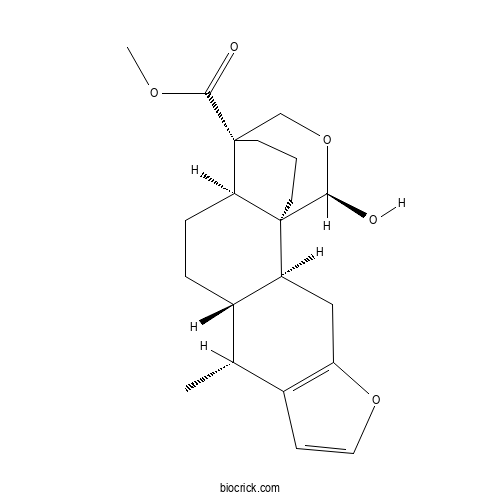
| Cas No. | 1011528-58-7 | SDF | File under preparation. |
| PubChem ID | 24854205.0 | Appearance | Powder |
| Formula | C21H28O5 | M.Wt | 360.4 |
| Type of Compound | Diterpenoids | Storage | Desiccate at -20°C |
| Solubility | Soluble in Chloroform,Dichloromethane,Ethyl Acetate,DMSO,Acetone,etc. | ||
| Chemical Name | methyl (1S,2S,9R,10S,13R,14R,17R)-17-hydroxy-9-methyl-5,16-dioxapentacyclo[12.3.3.01,13.02,10.04,8]icosa-4(8),6-diene-14-carboxylate | ||
| SMILES | CC1C2CCC3C4(CCCC3(C2CC5=C1C=CO5)C(OC4)O)C(=O)OC | ||
| Standard InChIKey | FBOCRPKLWNKMFW-YCBSRJOKSA-N | ||
| Standard InChI | InChI=1S/C21H28O5/c1-12-13-4-5-17-20(18(22)24-2)7-3-8-21(17,19(23)26-11-20)15(13)10-16-14(12)6-9-25-16/h6,9,12-13,15,17,19,23H,3-5,7-8,10-11H2,1-2H3/t12-,13+,15+,17+,19-,20+,21+/m1/s1 | ||
| General tips | For obtaining a higher solubility , please warm the tube at 37 ℃ and shake it in the ultrasonic bath for a while.Stock solution can be stored below -20℃ for several months. We recommend that you prepare and use the solution on the same day. However, if the test schedule requires, the stock solutions can be prepared in advance, and the stock solution must be sealed and stored below -20℃. In general, the stock solution can be kept for several months. Before use, we recommend that you leave the vial at room temperature for at least an hour before opening it. |
||
| About Packaging | 1. The packaging of the product may be reversed during transportation, cause the high purity compounds to adhere to the neck or cap of the vial.Take the vail out of its packaging and shake gently until the compounds fall to the bottom of the vial. 2. For liquid products, please centrifuge at 500xg to gather the liquid to the bottom of the vial. 3. Try to avoid loss or contamination during the experiment. |
||
| Shipping Condition | Packaging according to customer requirements(5mg, 10mg, 20mg and more). Ship via FedEx, DHL, UPS, EMS or other couriers with RT, or blue ice upon request. | ||
Quality Control & MSDS
3D structure
Package In Stock

Number of papers citing our products


Phanginin A Dilution Calculator
Phanginin A Molarity Calculator
| 1 mg | 5 mg | 10 mg | 20 mg | 25 mg | |
| 1 mM | 2.7747 mL | 13.8735 mL | 27.7469 mL | 55.4939 mL | 69.3674 mL |
| 5 mM | 0.5549 mL | 2.7747 mL | 5.5494 mL | 11.0988 mL | 13.8735 mL |
| 10 mM | 0.2775 mL | 1.3873 mL | 2.7747 mL | 5.5494 mL | 6.9367 mL |
| 50 mM | 0.0555 mL | 0.2775 mL | 0.5549 mL | 1.1099 mL | 1.3873 mL |
| 100 mM | 0.0277 mL | 0.1387 mL | 0.2775 mL | 0.5549 mL | 0.6937 mL |
| * Note: If you are in the process of experiment, it's necessary to make the dilution ratios of the samples. The dilution data above is only for reference. Normally, it's can get a better solubility within lower of Concentrations. | |||||
- 3-(1-Carboxyvinyloxy)benzoic acid
Catalog No.:BCX2872
CAS No.:16929-37-6
- Esculentoside S
Catalog No.:BCX2871
CAS No.:156031-83-3
- Jasnudifloside B
Catalog No.:BCX2870
CAS No.:244230-40-8
- Rehmaglutin C
Catalog No.:BCX2869
CAS No.:103744-81-6
- Naringenin-7-O-(6′′-E-p-coumaroyl-β-D-glucopyranoside)
Catalog No.:BCX2868
CAS No.:96686-70-3
- Entagenic
Catalog No.:BCX2867
CAS No.:5951-41-7
- Calipteryxin
Catalog No.:BCX2866
CAS No.:14017-72-2
- Staphylionoside D
Catalog No.:BCX2865
CAS No.:663919-93-5
- 1-Palmitin-2-Linolein-3-Olein
Catalog No.:BCX2864
CAS No.:2579-00-2
- (2R,3S)-2-(3,4-Dihydroxyphenyl)-3,4-dihydro-3,5,7-trihydroxy-2H-1-benzopyran -8-carboxaldehyde
Catalog No.:BCX2863
CAS No.:271593-64-7
- 1,3-Dioleyl-2-palmitoylglycerol
Catalog No.:BCX2862
CAS No.:1716-07-0
- Azukisaponin VI
Catalog No.:BCX2861
CAS No.:82801-39-6
- Calendulaglycoside C
Catalog No.:BCX2874
CAS No.:26020-29-1
- Cascaroside D
Catalog No.:BCX2875
CAS No.:53861-35-1
- Cascaroside C
Catalog No.:BCX2876
CAS No.:53823-09-9
- Citrinin
Catalog No.:BCX2877
CAS No.:518-75-2
- Azukisaponin II
Catalog No.:BCX2878
CAS No.:82793-03-1
- Quercetin 3-O-β-D-(6’’-O-malonyl)galactopyranoside
Catalog No.:BCX2879
CAS No.:84392-08-5
- L-γ-Glutamyl-S-(1E)-1-propen1-yl-L-cysteine
Catalog No.:BCX2880
CAS No.:134677-41-1
- 9 (10) -Z-α-trans-Bergamotenol
Catalog No.:BCX2881
CAS No.:88034-74-6
- Anhydrohirundigenin
Catalog No.:BCX2882
CAS No.:20853-99-0
- Luteolin-7-O-β-D-apiofuranosyl-(1→6)-β-D-glucopyransodie
Catalog No.:BCX2883
CAS No.:211561-67-0
- Caesaljapin
Catalog No.:BCX2884
CAS No.:144161-80-8
- Prunasinamide
Catalog No.:BCX2885
CAS No.:151649-54-6
Activation of SIK1 in the paraventricular nucleus by phanginin A induces antidepressant-like actions in male mice via suppressing hyperactivity of the hypothalamus-pituitary-adrenal axis.[Pubmed:41512561]
Biomed Pharmacother. 2026 Feb;195:118979.
BACKGROUND: Current monoaminergic antidepressants demonstrate limited efficacy and delayed onset, necessitating novel treatment strategies. Previous studies have identified salt-inducible kinase 1 (SIK1) in the paraventricular nucleus (PVN) as an important regulator of depression pathogenesis by controlling nuclear translocation of cAMP response element-binding protein (CREB)-regulated transcription coactivator 1 (CRTC1) and activity of the hypothalamus-pituitary-adrenal (HPA) axis. The current study investigated the antidepressant-like efficacy of Phanginin A, a newly discovered potent SIK1 activator, in male C57BL/6 J mice. METHODS: Two well-validated depression models (chronic social defeat stress and chronic unpredictable mild stress) were established to examine the efficacy of Phanginin A treatment against chronic stress-induced HPA hyperactivity and depression-like behaviors including desperate mood, anhedonia, and social avoidance. Western blotting, immunofluorescence, and co-immunoprecipitation were then conducted to evaluate the biological changes in not only the SIK1-CRTC1 signaling in PVN neurons but also the hippocampal brain derived neurotrophic factor (BDNF) signaling and adult neurogenesis among all groups. To further determine the antidepressant mechanism of Phanginin A, model mice were re-examined following genetic knockdown of SIK1 in the PVN. RESULTS: Phanginin A administration suppressed depression-like behaviors in both models, normalized chronic stress-induced alteration in the SIK1-CRTC1 signaling in PVN neurons, and rescued chronic stress-induced impairments in hippocampal BDNF signaling and adult neurogenesis. Knockdown of SIK1 in the PVN abrogated the antidepressant-like actions of Phanginin A in male mice. CONCLUSION: Our findings further establish SIK1 in the PVN as an antidepressant target and support Phanginin A as a potential antidepressant candidate.
Activation of SIK1 by phanginin A regulates skeletal muscle glucose uptake by phosphorylating HADC4/5/7 and enhancing GLUT4 expression and translocation.[Pubmed:40192973]
Nat Prod Bioprospect. 2025 Apr 7;15(1):24.
Salt-inducible kinase 1 (SIK1) participates in various physiological processes, yet its involvement in regulating skeletal muscle glucose uptake remains unclear. Previously, we showed that Phanginin A, a natural compound isolated from Caesalpinia sappan Linn, activated SIK1 to suppress gluconeogenesis in hepatocytes. Here, we aimed to elucidate the effects of SIK1 on skeletal muscle glucose uptake by using Phanginin A. The C2C12 myotubes were incubated with Phanginin A and then glucose uptake, mRNA levels, membrane GLUT4 content, phosphorylation levels of proteins in SIK1/HDACs and Akt/AS160 signaling pathways were determined. Phanginin A significantly promoted glucose uptake, while the pan-SIK inhibitor or knocking down SIK1 expression abolished the promotion. Further exploration showed that Phanginin A enhanced GLUT4 mRNA levels by increasing histone deacetylase (HDAC) 4/5 phosphorylation and MEF2a mRNA and protein level, and knocking down SIK1 blocked these effects. Additionally, Phanginin A induced HDAC7 phosphorylation, upregulated the junction plakoglobin (JUP) expression and Akt/AS160 phosphorylation. Knocking down JUP or SIK1 both attenuated the Phanginin A-induced Akt/AS160 signaling and glucose uptake, suggesting that activation of SIK1 by Phanginin A inactivated HDAC7 to increase JUP expression and Akt/AS160 phosphorylation, led to upregulation of GLUT4 translocation and glucose uptake. In vivo study showed that Phanginin A increased phosphorylation levels of SIK1, HDAC4/5/7, Akt/AS160, and gene expression of MEF2a, GLUT4 and JUP, accompanied by elevated membrane GLUT4 and glycogen content in gastrocnemius muscle of C57BL/6 J mice, indicating enhanced glucose utilization. These findings reveal a novel mechanism that SIK1 activation by Phanginin A stimulates skeletal muscle glucose uptake through phosphorylating HADC4/5/7 and the subsequent enhancement of GLUT4 expression and translocation.
Design, synthesis and structural-activity relationship studies of phanginin A derivatives for regulating SIK1-cAMP/CREB signaling to suppress hepatic gluconeogenesis.[Pubmed:35152093]
Eur J Med Chem. 2022 Mar 15;232:114171.
Persistent activation of hepatic gluconeogenesis is a main cause of fasting hyperglycemia in patients with type 2 diabetes (T2D), and the salt-induced kinase 1 (SIK1) acts as a key modulator in regulating hepatic gluconeogenesis. Recently, we first reported Phanginin A (PA, 1), a natural cassane diterpenoid isolated from the seeds of Caesalpinia sappan, exhibited potent anti-diabetic effect through activation of SIK1 and increasing PDE4 activity to inhibit hepatic gluconeogenesis pathway by suppressing the cAMP/PKA/CREB pathway in the liver. In present study, we designed and prepared 25 PA derivatives and their structure-activity relationship (SAR) for gluconeogenesis inhibitory activity were established. Among them, compound 7 exhibited remarkable inhibitory activity on hepatic gluconeogenesis by enhancing the SIK1 phosphorylation and ameliorated the hyperglyceamia of type 2 diabetic mice. Our results supported that compound 7 could be served as a potential candidate for the treatment of T2D.
Activation of SIK1 by phanginin A inhibits hepatic gluconeogenesis by increasing PDE4 activity and suppressing the cAMP signaling pathway.[Pubmed:32599076]
Mol Metab. 2020 Nov;41:101045.
OBJECTIVE: Salt-induced kinase 1 (SIK1) acts as a key modulator in many physiological processes. However, the effects of SIK1 on gluconeogenesis and the underlying mechanisms have not been fully elucidated. In this study, we found that a natural compound Phanginin A could activate SIK1 and further inhibit gluconeogenesis. The mechanisms by which Phanginin A activates SIK1 and inhibits gluconeogenesis were explored in primary mouse hepatocytes, and the effects of Phanginin A on glucose homeostasis were investigated in ob/ob mice. METHODS: The effects of Phanginin A on gluconeogenesis and SIK1 phosphorylation were examined in primary mouse hepatocytes. Pan-SIK inhibitor and siRNA-mediated knockdown were used to elucidate the involvement of SIK1 activation in Phanginin A-reduced gluconeogenesis. LKB1 knockdown was used to explore how Phanginin A activated SIK1. SIK1 overexpression was used to evaluate its effect on gluconeogenesis, PDE4 activity, and the cAMP pathway. The acute and chronic effects of Phanginin A on metabolic abnormalities were observed in ob/ob mice. RESULTS: Phanginin A significantly increased SIK1 phosphorylation through LKB1 and further suppressed gluconeogenesis by increasing PDE4 activity and inhibiting the cAMP/PKA/CREB pathway in primary mouse hepatocytes, and this effect was blocked by pan-SIK inhibitor HG-9-91-01 or siRNA-mediated knockdown of SIK1. Overexpression of SIK1 in hepatocytes increased PDE4 activity, reduced cAMP accumulation, and thereby inhibited gluconeogenesis. Acute treatment with Phanginin A reduced gluconeogenesis in vivo, accompanied by increased SIK1 phosphorylation and PDE4 activity in the liver. Long-term treatment of Phanginin A profoundly reduced blood glucose levels and improved glucose tolerance and dyslipidemia in ob/ob mice. CONCLUSION: We discovered an unrecognized effect of Phanginin A in suppressing hepatic gluconeogenesis and revealed a novel mechanism that activation of SIK1 by Phanginin A could inhibit gluconeogenesis by increasing PDE4 activity and suppressing the cAMP/PKA/CREB pathway in the liver. We also highlighted the potential value of Phanginin A as a lead compound for treating type 2 diabetes.
Cassane diterpenes from the seed kernels of Caesalpinia sappan.[Pubmed:26769396]
Phytochemistry. 2016 Feb;122:286-293.
Eight structurally diverse cassane diterpenes named tomocins A-H were isolated from the seed kernels of Vietnamese Caesalpinia sappan Linn. Their structures were determined by extensive NMR and CD spectroscopic analysis. Among the isolated compounds, tomocin A, Phanginin A, F, and H exhibited mild preferential cytotoxicity against PANC-1 human pancreatic cancer cells under nutrition-deprived condition without causing toxicity in normal nutrient-rich conditions.
Phanginin A-K, diterpenoids from the seeds of Caesalpinia sappan Linn.[Pubmed:18178229]
Phytochemistry. 2008 Mar;69(5):1242-9.
The first chemical study on the seeds of Caesalpinia sappan Linn. led to isolation of 11 cassane-type diterpenes, named Phanginin A-K (1-11). The skeleton present in compounds 1-8 is rather unusual, consisting of a cassane-type diterpene with an ether bridge between C-19/C-20 in compounds 1-6 and C-11/C-20 in compounds 7 and 8. Their structures were elucidated on the basis of spectroscopic techniques. In addition, the X-ray structure of Phanginin A (1) is reported. Only phanginin I (9) exhibited cytotoxic effect against KB cell line with IC50 value of 4.4 microg/ml.

Calcutta University

University of Minnesota

University of Maryland School of Medicine

University of Illinois at Chicago

The Ohio State University

University of Zurich

Harvard University

Colorado State University

Auburn University

Yale University

Worcester Polytechnic Institute

Washington State University

Stanford University

University of Leipzig

Universidade da Beira Interior

The Institute of Cancer Research

Heidelberg University

University of Amsterdam

University of Auckland

TsingHua University

The University of Michigan

Miami University

DRURY University

Jilin University

Fudan University

Wuhan University

Sun Yat-sen University

Universite de Paris

Deemed University

Auckland University

The University of Tokyo

Korea University



