
3-Hydroxy-5-methoxybenzoic acidCAS# 19520-75-3 |
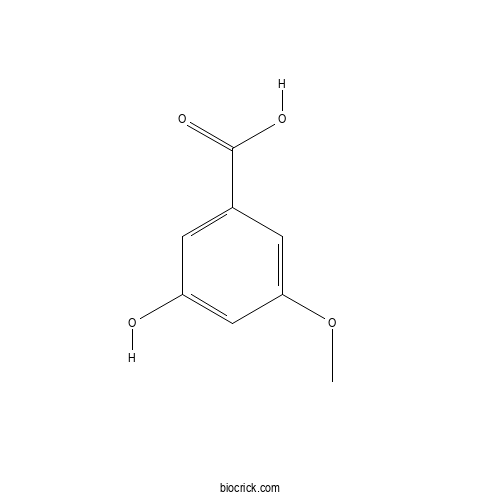
| Cas No. | 19520-75-3 | SDF | File under preparation. |
| PubChem ID | 7472024.0 | Appearance | Powder |
| Formula | C8H8O4 | M.Wt | 168.2 |
| Type of Compound | N/A | Storage | Desiccate at -20°C |
| Solubility | Soluble in Chloroform,Dichloromethane,Ethyl Acetate,DMSO,Acetone,etc. | ||
| Chemical Name | 3-hydroxy-5-methoxybenzoic acid | ||
| SMILES | COC1=CC(=CC(=C1)O)C(=O)O | ||
| Standard InChIKey | TUUBOHWZSQXCSW-UHFFFAOYSA-N | ||
| Standard InChI | InChI=1S/C8H8O4/c1-12-7-3-5(8(10)11)2-6(9)4-7/h2-4,9H,1H3,(H,10,11) | ||
| General tips | For obtaining a higher solubility , please warm the tube at 37 ℃ and shake it in the ultrasonic bath for a while.Stock solution can be stored below -20℃ for several months. We recommend that you prepare and use the solution on the same day. However, if the test schedule requires, the stock solutions can be prepared in advance, and the stock solution must be sealed and stored below -20℃. In general, the stock solution can be kept for several months. Before use, we recommend that you leave the vial at room temperature for at least an hour before opening it. |
||
| About Packaging | 1. The packaging of the product may be reversed during transportation, cause the high purity compounds to adhere to the neck or cap of the vial.Take the vail out of its packaging and shake gently until the compounds fall to the bottom of the vial. 2. For liquid products, please centrifuge at 500xg to gather the liquid to the bottom of the vial. 3. Try to avoid loss or contamination during the experiment. |
||
| Shipping Condition | Packaging according to customer requirements(5mg, 10mg, 20mg and more). Ship via FedEx, DHL, UPS, EMS or other couriers with RT, or blue ice upon request. | ||
Quality Control & MSDS
3D structure
Package In Stock

Number of papers citing our products


3-Hydroxy-5-methoxybenzoic acid Dilution Calculator
3-Hydroxy-5-methoxybenzoic acid Molarity Calculator


| 1 mg | 5 mg | 10 mg | 20 mg | 25 mg | |
| 1 mM | 5.9453 mL | 29.7265 mL | 59.453 mL | 118.9061 mL | 148.6326 mL |
| 5 mM | 1.1891 mL | 5.9453 mL | 11.8906 mL | 23.7812 mL | 29.7265 mL |
| 10 mM | 0.5945 mL | 2.9727 mL | 5.9453 mL | 11.8906 mL | 14.8633 mL |
| 50 mM | 0.1189 mL | 0.5945 mL | 1.1891 mL | 2.3781 mL | 2.9727 mL |
| 100 mM | 0.0595 mL | 0.2973 mL | 0.5945 mL | 1.1891 mL | 1.4863 mL |
| * Note: If you are in the process of experiment, it's necessary to make the dilution ratios of the samples. The dilution data above is only for reference. Normally, it's can get a better solubility within lower of Concentrations. | |||||
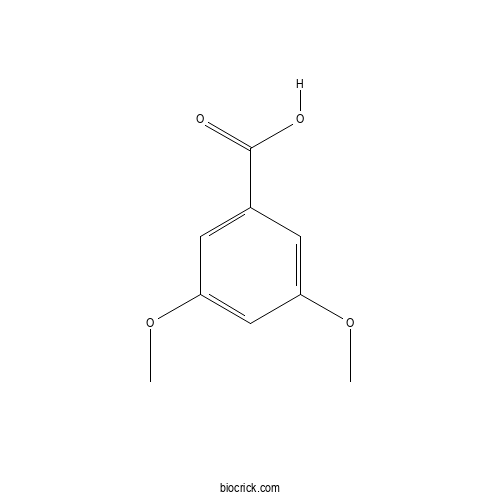
- 3,5-Dimethoxybenzoic acid
Catalog No.:BCX2490
CAS No.:1132-21-4
- 3,4-O-Dimethylgallic acid
Catalog No.:BCX2489
CAS No.:1916-08-1
- 2-Oxoglutaric acid
Catalog No.:BCX2488
CAS No.:328-50-7
- 3'-Hydroxyphenylacetic acid
Catalog No.:BCX2487
CAS No.:621-37-4
- Coclaurine hydrochloride
Catalog No.:BCX2486
CAS No.:3422-42-2
- α-Isopropylmalate
Catalog No.:BCX2485
CAS No.:3237-44-3
- Rhodomollein I
Catalog No.:BCX2484
CAS No.:126223-68-5
- Queretaroic acid 28-O-β-D-glucopyranosyl ester
Catalog No.:BCX2483
CAS No.:1389354-39-5
- Ampelopsin BF
Catalog No.:BCX2482
CAS No.:482304-83-6
- cis-Upunaphenol K
Catalog No.:BCX2481
CAS No.:879897-47-9
- Viniferol E
Catalog No.:BCX2480
CAS No.:870555-67-2
- Vitisin C
Catalog No.:BCX2479
CAS No.:180580-73-8
- Schottenol
Catalog No.:BCX2492
CAS No.:521-03-9
- Uridine 5′-diphosphate arabinoside disodium
Catalog No.:BCX2493
CAS No.:15839-78-8
- 3-Hydroxy-7,8,9-trimethoxypterocarpan
Catalog No.:BCX2494
CAS No.:2472377-49-2
- Hebeirubescensin I
Catalog No.:BCX2495
CAS No.:887333-31-5
- Chrysin 5-methyl ether
Catalog No.:BCX2496
CAS No.:33554-47-1
- Cincholic acid 3-O-β-D-quinovopyranoside
Catalog No.:BCX2497
CAS No.:111665-41-9
- Rubescensin J
Catalog No.:BCX2498
CAS No.:760948-09-2
- Indole-3-acetic acid N-β-D-xylopyranoside
Catalog No.:BCX2499
CAS No.:2506519-33-9
- N-(2-Hydroxy-3-methylbutyl)adenosine
Catalog No.:BCX2500
CAS No.:22662-01-7
- Obovatin methyl ether
Catalog No.:BCX2501
CAS No.:69640-78-4
- Xerophilusin XVI
Catalog No.:BCX2502
CAS No.:1316032-06-0
- Maoyecrystal G
Catalog No.:BCX2503
CAS No.:675603-40-4
Resveratrol derivatives from Commiphora africana (A. Rich.) Endl. display cytotoxicity and selectivity against several human cancer cell lines.[Pubmed:30346066]
Phytother Res. 2019 Jan;33(1):159-166.
Commiphora africana (A. Rich.) Endl. (Burseraceae) is a medicinal plant widely used in Nigerian ethnomedicine. The in vitro cytotoxicity of the stem bark extract of C. africana and isolated cytotoxic compounds was investigated. Three resveratrol derivatives: (E)-resveratrol 3-O-rutinoside (1), 5-methoxy-(E)-resveratrol 3-O-rutinoside (2), and pinostilbene (3), together with 3-Hydroxy-5-methoxybenzoic acid (4) were isolated from the methanol fraction of C. africana. Their structures were determined by extensive analysis of their HREIMS and NMR spectra. The cytotoxicity of the isolated compounds against four human carcinoma cells was determined using the MTT assay. Compound 1 displayed the highest antiproliferative effect on the cell lines, with IC(50) values of 16.80, 21.74, 17.89, and 17.44 muM, against MCF7, A549, PC3, and HepG2 human cancer cell lines, respectively. In addition, compounds 1-3 showed low toxicity against normal human prostate cell line, with selectivity indices greater than five across the carcinoma cells, indicating that the compounds possess potential in the development of low-toxicity chemotherapeutic agents. These results support the traditional use of this plant in the treatment of cancer.
Glycosides and xanthine oxidase inhibitors from Conyza bonariensis.[Pubmed:11576616]
Phytochemistry. 2001 Oct;58(4):645-51.
Fractionation of the xanthine oxidase inhibitory methanol extract of Conyza bonariensis afforded three glycosides, in addition to nine known compounds including amyrin, beta-sitostero1 daucosterol, syringic acid 3-Hydroxy-5-methoxybenzoic acid, eugenol 4-O-glucopyranoside, and luteolin, apigenin and takakin 8-O-glucuronide. The structures of the glycosides were established by a combination of spectroscopic methods (IR, MS, 1H and 13C NMR, DEPT, COSY, HMQC and HMBC) as 4-hydroxypyridin-3-carboxylic acid 4-O-glucopyranoside, 8-hydroxy-6,7-dihydrolinalool 8-O-glucopyranoside and bonaroside [viz. 1,3,4,12-tetrahydroxy-2-(9-hexadecenoylamino)octadecane 1-O-glucopyranoside]. The in vitro enzyme assay showed that syringic acid and takakin 8-O-glucuronide displayed weak inhibitory activity against xanthine oxidase with IC50 values of 500+/-41 microM and 170+/-12 microM, respectively.

Calcutta University

University of Minnesota

University of Maryland School of Medicine

University of Illinois at Chicago

The Ohio State University

University of Zurich

Harvard University

Colorado State University

Auburn University

Yale University

Worcester Polytechnic Institute

Washington State University

Stanford University

University of Leipzig

Universidade da Beira Interior

The Institute of Cancer Research

Heidelberg University

University of Amsterdam

University of Auckland

TsingHua University

The University of Michigan

Miami University

DRURY University

Jilin University

Fudan University

Wuhan University

Sun Yat-sen University

Universite de Paris

Deemed University

Auckland University

The University of Tokyo

Korea University



