
2-Oxoglutaric acidCAS# 328-50-7 |
| Cas No. | 328-50-7 | SDF | File under preparation. |
| PubChem ID | 51.0 | Appearance | Powder |
| Formula | C5H6O5 | M.Wt | 146.1 |
| Type of Compound | N/A | Storage | Desiccate at -20°C |
| Solubility | Soluble in Chloroform,Dichloromethane,Ethyl Acetate,DMSO,Acetone,etc. | ||
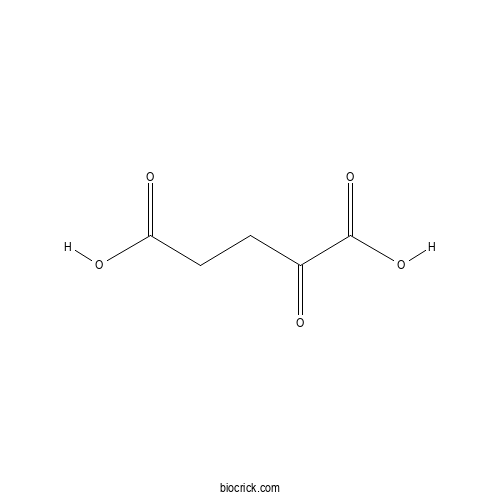
| Chemical Name | 2-oxopentanedioic acid | ||
| SMILES | C(CC(=O)O)C(=O)C(=O)O | ||
| Standard InChIKey | KPGXRSRHYNQIFN-UHFFFAOYSA-N | ||
| Standard InChI | InChI=1S/C5H6O5/c6-3(5(9)10)1-2-4(7)8/h1-2H2,(H,7,8)(H,9,10) | ||
| General tips | For obtaining a higher solubility , please warm the tube at 37 ℃ and shake it in the ultrasonic bath for a while.Stock solution can be stored below -20℃ for several months. We recommend that you prepare and use the solution on the same day. However, if the test schedule requires, the stock solutions can be prepared in advance, and the stock solution must be sealed and stored below -20℃. In general, the stock solution can be kept for several months. Before use, we recommend that you leave the vial at room temperature for at least an hour before opening it. |
||
| About Packaging | 1. The packaging of the product may be reversed during transportation, cause the high purity compounds to adhere to the neck or cap of the vial.Take the vail out of its packaging and shake gently until the compounds fall to the bottom of the vial. 2. For liquid products, please centrifuge at 500xg to gather the liquid to the bottom of the vial. 3. Try to avoid loss or contamination during the experiment. |
||
| Shipping Condition | Packaging according to customer requirements(5mg, 10mg, 20mg and more). Ship via FedEx, DHL, UPS, EMS or other couriers with RT, or blue ice upon request. | ||
Quality Control & MSDS
3D structure
Package In Stock

Number of papers citing our products


2-Oxoglutaric acid Dilution Calculator
2-Oxoglutaric acid Molarity Calculator
| 1 mg | 5 mg | 10 mg | 20 mg | 25 mg | |
| 1 mM | 6.8446 mL | 34.2231 mL | 68.4463 mL | 136.8925 mL | 171.1157 mL |
| 5 mM | 1.3689 mL | 6.8446 mL | 13.6893 mL | 27.3785 mL | 34.2231 mL |
| 10 mM | 0.6845 mL | 3.4223 mL | 6.8446 mL | 13.6893 mL | 17.1116 mL |
| 50 mM | 0.1369 mL | 0.6845 mL | 1.3689 mL | 2.7379 mL | 3.4223 mL |
| 100 mM | 0.0684 mL | 0.3422 mL | 0.6845 mL | 1.3689 mL | 1.7112 mL |
| * Note: If you are in the process of experiment, it's necessary to make the dilution ratios of the samples. The dilution data above is only for reference. Normally, it's can get a better solubility within lower of Concentrations. | |||||
- 3'-Hydroxyphenylacetic acid
Catalog No.:BCX2487
CAS No.:621-37-4
- Coclaurine hydrochloride
Catalog No.:BCX2486
CAS No.:3422-42-2
- α-Isopropylmalate
Catalog No.:BCX2485
CAS No.:3237-44-3
- Rhodomollein I
Catalog No.:BCX2484
CAS No.:126223-68-5
- Queretaroic acid 28-O-β-D-glucopyranosyl ester
Catalog No.:BCX2483
CAS No.:1389354-39-5
- Ampelopsin BF
Catalog No.:BCX2482
CAS No.:482304-83-6
- cis-Upunaphenol K
Catalog No.:BCX2481
CAS No.:879897-47-9
- Viniferol E
Catalog No.:BCX2480
CAS No.:870555-67-2
- Vitisin C
Catalog No.:BCX2479
CAS No.:180580-73-8
- Kuwanon X
Catalog No.:BCX2478
CAS No.:96819-92-0
- Albafuran C
Catalog No.:BCX2477
CAS No.:84323-16-0
- Moracenin D
Catalog No.:BCX2476
CAS No.:78277-79-9
- 3,4-O-Dimethylgallic acid
Catalog No.:BCX2489
CAS No.:1916-08-1
- 3,5-Dimethoxybenzoic acid
Catalog No.:BCX2490
CAS No.:1132-21-4
- 3-Hydroxy-5-methoxybenzoic acid
Catalog No.:BCX2491
CAS No.:19520-75-3
- Schottenol
Catalog No.:BCX2492
CAS No.:521-03-9
- Uridine 5′-diphosphate arabinoside disodium
Catalog No.:BCX2493
CAS No.:15839-78-8
- 3-Hydroxy-7,8,9-trimethoxypterocarpan
Catalog No.:BCX2494
CAS No.:2472377-49-2
- Hebeirubescensin I
Catalog No.:BCX2495
CAS No.:887333-31-5
- Chrysin 5-methyl ether
Catalog No.:BCX2496
CAS No.:33554-47-1
- Cincholic acid 3-O-β-D-quinovopyranoside
Catalog No.:BCX2497
CAS No.:111665-41-9
- Rubescensin J
Catalog No.:BCX2498
CAS No.:760948-09-2
- Indole-3-acetic acid N-β-D-xylopyranoside
Catalog No.:BCX2499
CAS No.:2506519-33-9
- N-(2-Hydroxy-3-methylbutyl)adenosine
Catalog No.:BCX2500
CAS No.:22662-01-7
Integrative analysis of rumen microbiome and host metabolism reveals adaptive strategies of Boer goats to high-altitude environments.[Pubmed:42713482]
Front Microbiol. 2026 Aug 25;17:1897971.
The transition to high-altitude environments presents significant metabolic challenges for livestock, primarily due to hypoxia and altered dietary resources. Understanding the adaptive strategies involving the rumen microbiome and host metabolism is crucial for improving animal health and productivity in these regions. This study investigated the adaptive responses of Boer goats to high-altitude exposure by integrating ruminal fermentation, ruminal and fecal microbiota, and serum metabolomics. The results demonstrated that high-altitude exposure markedly reshaped ruminal fermentation, microbiota composition, and serum metabolome of Boer goats. Concomitant with the elevational shift, the ruminal pH increased, whereas acetic acid concentration and the acetate-to-propionate ratio decreased; however, fecal volatile fatty acid concentrations remained unchanged. Microbial alpha diversity was reduced in both ruminal and fecal samples. The high-altitude rumen of Boer goats was characterized by an enrichment of fiber-degradation-associated taxa, accompanied by significantly elevated relative abundances of Firmicutes_A, Ruminococcus_E, as well as a heightened Firmicutes-to-Bacteroidetes ratio; in contrast, the relative abundances of fecal Patescibacteria, Faecousia, and Phocaeicola_A were decreased. Serum metabolomics profiling revealed that the acclimatization of Boer goats to high altitudes was characterized by profound alterations in energy and amino acid metabolism, coupled with hydromineral regulation and neuroactive metabolite pathways. Notably, energy-related metabolites, including 2-Oxoglutaric acid, 3-hydroxybutyric acid, and L-malic acid, were elevated in the high-altitude cohort and positively correlated with fibrolytic taxa such as Fibrobacterota, Fibrobacter and Ruminococcus_E. In summary, the metabolic synergy between the rumen microbiome and the host likely contributes to maintaining energy homeostasis in Boer goats in high-altitude environments. These findings provide a useful reference for developing targeted nutritional strategies to improve goat farming in plateau regions.
Circulating Organic Acid Profiles in Non-Ischaemic Cardiomyopathy: A Case-Control Study.[Pubmed:42645821]
J Cardiovasc Dev Dis. 2026 Jul 27;13(8):350.
Metabolic remodeling is increasingly recognized as a key component of cardiomyopathy, yet the circulating organic acid profile associated with this condition remains incompletely characterized. In this case-control study, we investigated differences in circulating organic acid profiles between patients with cardiomyopathy and control participants using targeted liquid chromatography-tandem mass spectrometry (LC-MS/MS). A total of 160 participants were enrolled, including 80 patients with cardiomyopathy and 80 age- and sex-comparable control participants. Circulating organic acids were quantitatively analyzed, and between-group differences were assessed using the two-sided Mann-Whitney U test with Benjamini-Hochberg false discovery rate correction; effect sizes were estimated using Cliff's delta. Detection rates were also examined because several metabolites included values below the assay limit of detection. Sixteen metabolites remained significant after correction. Among these, 3-hydroxyisovaleric acid demonstrated the largest increase, followed by 2-Oxoglutaric acid and 2-methylcitric acid. Additional elevations were observed in citric acid, malic acid, N-acetylaspartic acid, fumaric acid, and suberic acid, whereas 2-oxoadipic acid was reduced. These alterations are consistent with perturbations in mitochondrial intermediary metabolism, branched-chain amino acid catabolism, ketone body metabolism, and tricarboxylic acid cycle-related pathways. However, because comorbidities, renal function, glycemic status, and medication use differed between groups, the findings should be interpreted as phenotype-associated metabolic signals rather than cardiomyopathy-specific causal effects or validated diagnostic biomarkers. In conclusion, targeted LC-MS/MS-based organic acid profiling reveals an altered circulating metabolic pattern in cardiomyopathy, although further prospective studies with individual-level adjustment and external validation are required to determine its clinical relevance.

Calcutta University

University of Minnesota

University of Maryland School of Medicine

University of Illinois at Chicago

The Ohio State University

University of Zurich

Harvard University

Colorado State University

Auburn University

Yale University

Worcester Polytechnic Institute

Washington State University

Stanford University

University of Leipzig

Universidade da Beira Interior

The Institute of Cancer Research

Heidelberg University

University of Amsterdam

University of Auckland

TsingHua University

The University of Michigan

Miami University

DRURY University

Jilin University

Fudan University

Wuhan University

Sun Yat-sen University

Universite de Paris

Deemed University

Auckland University

The University of Tokyo

Korea University



