
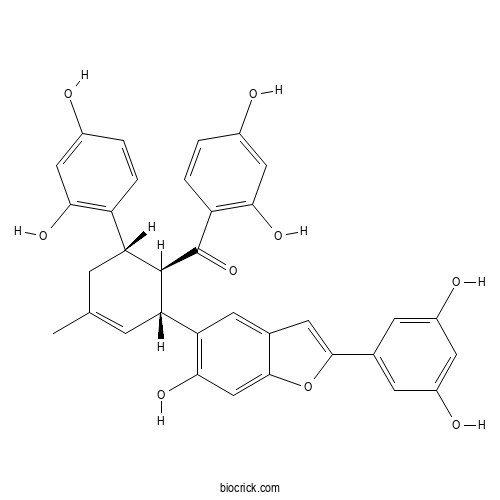
Albafuran CCAS# 84323-16-0 |
| Cas No. | 84323-16-0 | SDF | File under preparation. |
| PubChem ID | 11273224.0 | Appearance | Powder |
| Formula | C34H28O9 | M.Wt | 580.6 |
| Type of Compound | N/A | Storage | Desiccate at -20°C |
| Solubility | Soluble in Chloroform,Dichloromethane,Ethyl Acetate,DMSO,Acetone,etc. | ||
| Chemical Name | (2,4-dihydroxyphenyl)-[(1R,2R,6S)-6-(2,4-dihydroxyphenyl)-2-[2-(3,5-dihydroxyphenyl)-6-hydroxy-1-benzofuran-5-yl]-4-methylcyclohex-3-en-1-yl]methanone | ||
| SMILES | CC1=CC(C(C(C1)C2=C(C=C(C=C2)O)O)C(=O)C3=C(C=C(C=C3)O)O)C4=C(C=C5C(=C4)C=C(O5)C6=CC(=CC(=C6)O)O)O | ||
| Standard InChIKey | SEUPIEHHWMMMQG-OEYLZLLESA-N | ||
| Standard InChI | InChI=1S/C34H28O9/c1-16-6-26(23-4-2-19(35)13-28(23)39)33(34(42)24-5-3-20(36)14-29(24)40)27(7-16)25-10-18-11-31(43-32(18)15-30(25)41)17-8-21(37)12-22(38)9-17/h2-5,7-15,26-27,33,35-41H,6H2,1H3/t26-,27+,33-/m1/s1 | ||
| General tips | For obtaining a higher solubility , please warm the tube at 37 ℃ and shake it in the ultrasonic bath for a while.Stock solution can be stored below -20℃ for several months. We recommend that you prepare and use the solution on the same day. However, if the test schedule requires, the stock solutions can be prepared in advance, and the stock solution must be sealed and stored below -20℃. In general, the stock solution can be kept for several months. Before use, we recommend that you leave the vial at room temperature for at least an hour before opening it. |
||
| About Packaging | 1. The packaging of the product may be reversed during transportation, cause the high purity compounds to adhere to the neck or cap of the vial.Take the vail out of its packaging and shake gently until the compounds fall to the bottom of the vial. 2. For liquid products, please centrifuge at 500xg to gather the liquid to the bottom of the vial. 3. Try to avoid loss or contamination during the experiment. |
||
| Shipping Condition | Packaging according to customer requirements(5mg, 10mg, 20mg and more). Ship via FedEx, DHL, UPS, EMS or other couriers with RT, or blue ice upon request. | ||
Quality Control & MSDS
3D structure
Package In Stock

Number of papers citing our products


Albafuran C Dilution Calculator
Albafuran C Molarity Calculator

| 1 mg | 5 mg | 10 mg | 20 mg | 25 mg | |
| 1 mM | 1.7224 mL | 8.6118 mL | 17.2236 mL | 34.4471 mL | 43.0589 mL |
| 5 mM | 0.3445 mL | 1.7224 mL | 3.4447 mL | 6.8894 mL | 8.6118 mL |
| 10 mM | 0.1722 mL | 0.8612 mL | 1.7224 mL | 3.4447 mL | 4.3059 mL |
| 50 mM | 0.0344 mL | 0.1722 mL | 0.3445 mL | 0.6889 mL | 0.8612 mL |
| 100 mM | 0.0172 mL | 0.0861 mL | 0.1722 mL | 0.3445 mL | 0.4306 mL |
| * Note: If you are in the process of experiment, it's necessary to make the dilution ratios of the samples. The dilution data above is only for reference. Normally, it's can get a better solubility within lower of Concentrations. | |||||
- Moracenin D
Catalog No.:BCX2476
CAS No.:78277-79-9
- Phytolaccagenic acid 28-O-β-D-glucopyranosyl ester
Catalog No.:BCX2475
CAS No.:288303-32-2
- Rhodojaponin VI
Catalog No.:BCX2474
CAS No.:37720-87-9
- 2-Hydroxy-2-(2-methylpropyl)butanedioic acid
Catalog No.:BCX2473
CAS No.:60924-65-4
- 11-Deoxymogrol
Catalog No.:BCX2472
CAS No.:2654048-89-0
- Propionic acid
Catalog No.:BCX2471
CAS No.:1979-09-4
- 2-Ethylhexanoic acid
Catalog No.:BCX2470
CAS No.:149-57-5
- 2-Ethylbutyric acid
Catalog No.:BCX2469
CAS No.:1988-09-5
- 5-(4-Hydroxyphenyl)pentanoic acid
Catalog No.:BCX2468
CAS No.:4654-08-4
- Azadirachtin B
Catalog No.:BCX2467
CAS No.:106500-25-8
- Pyruvic acid
Catalog No.:BCX2466
CAS No.:127-17-3
- Isofouquierol
Catalog No.:BCX2465
CAS No.:53822-99-4
- Kuwanon X
Catalog No.:BCX2478
CAS No.:96819-92-0
- Vitisin C
Catalog No.:BCX2479
CAS No.:180580-73-8
- Viniferol E
Catalog No.:BCX2480
CAS No.:870555-67-2
- cis-Upunaphenol K
Catalog No.:BCX2481
CAS No.:879897-47-9
- Ampelopsin BF
Catalog No.:BCX2482
CAS No.:482304-83-6
- Queretaroic acid 28-O-β-D-glucopyranosyl ester
Catalog No.:BCX2483
CAS No.:1389354-39-5
- Rhodomollein I
Catalog No.:BCX2484
CAS No.:126223-68-5
- α-Isopropylmalate
Catalog No.:BCX2485
CAS No.:3237-44-3
- Coclaurine hydrochloride
Catalog No.:BCX2486
CAS No.:3422-42-2
- 3'-Hydroxyphenylacetic acid
Catalog No.:BCX2487
CAS No.:621-37-4
- 2-Oxoglutaric acid
Catalog No.:BCX2488
CAS No.:328-50-7
- 3,4-O-Dimethylgallic acid
Catalog No.:BCX2489
CAS No.:1916-08-1
Prenylated phenolics from Morus alba against MRSA infections as a strategy for wound healing.[Pubmed:36532741]
Front Pharmacol. 2022 Nov 30;13:1068371.
Antimicrobial resistance is a public health threat and the increasing number of multidrug-resistant bacteria is a major concern worldwide. Common antibiotics are becoming ineffective for skin infections and wounds, making the search for new therapeutic options increasingly urgent. The present study aimed to investigate the antibacterial potential of prenylated phenolics in wound healing. Phenolic compounds isolated from the root bark of Morus alba L. were investigated for their antistaphylococcal potential both alone and in combination with commonly used antibiotics. The minimum inhibitory concentration (MIC) and the minimum bactericidal concentration (MBC) were determined by microdilution and agar method. Synergy was investigated using the checkerboard titration technique. Membrane-disrupting activity and efflux pump inhibition were evaluated to describe the potentiating effect. Prenylated phenolics inhibited bacterial growth of methicillin-resistant Staphylococcus aureus (MRSA) at lower concentrations (MIC 2-8 mug/ml) than commonly used antibiotics. The combination of active phenolics with kanamycin, oxacillin, and ciprofloxacin resulted in a decrease in the MIC of the antimicrobial agent. Kuwanon C, E, T, morusin, and Albafuran C showed synergy (FICi 0.375-0.5) with oxacillin and/or kanamycin. Prenylated phenolics disrupted membrane permeability statistically significantly (from 28 +/- 16.48% up to 73 +/- 2.83%), and membrane disruption contributes to the complex antibacterial activity against MRSA. In addition, kuwanon C could be considered an efflux pump inhibitor. Despite the antibacterial effect on MRSA and the multiple biological activities, the prenylated phenolics at microbially significant concentrations have a minor effect on human keratinocyte (HaCaT) viability. In conclusion, prenylated phenolics in combination with commonly used antibiotics are promising candidates for the treatment of MRSA infections and wound healing, although further studies are needed.
Antiproliferative activity of stilbene derivatives and other constituents from the stem bark of Morus nigra L.[Pubmed:30822142]
Nat Prod Res. 2020 Dec;34(24):3506-3513.
The antiproliferative activities of 2',3,4',5,5'-pentahydroxy-cis-stilbene 1, resveratrol 2, oxyresveratrol 3, norartocarpetin 4, kuwanon C 5, morusin 6, cudraflavone A7, kuwanon G 8, Albafuran C 9, mulberrofuran G 10, 3-acetyl-O-alpha-amyrin 11, 3-acetyl-O-beta-amyrin 12, ursolic acid-3-O-acetate 13 and uvaol 14, previously identified from the barks of Morus nigra L., were investigated against HepG2 and MCF-7 cell lines. In addition, a series of methylated stilbenes 15-19 were prepared using compounds 1-3 and their antiproliferative effects were similarly investigated. The structure of a new 2',3,4'-trimethoxy-5-hydroxy-trans-stilbene 19 was elucidated using spectroscopic techniques. It showed remarkable activity against MCF-7 cells with IC(50) 12.5 muM. However, kuwanon C (5) showed the highest antiproliferative activity with IC(50) 3.92 and 9.54 muM against MCF-7 and HepG2, respectively.
Fluorescence resonance energy transfer assay for high-throughput screening of ADAMTS1 inhibitors.[Pubmed:22186957]
Molecules. 2011 Dec 20;16(12):10709-21.
A disintegrin and metalloprotease with thrombospondin type I motifs-1 (ADAMTS1) plays a crucial role in inflammatory joint diseases and its inhibitors are potential candidates for anti-arthritis drugs. For the purposes of drug discovery, we reported the development and validation of fluorescence resonance energy transfer (FRET) assay for high-throughput screening (HTS) of the ADAMTS1 inhibitors. A FRET substrate was designed for a quantitative assay of ADAMTS1 activity and enzyme kinetics studies. The assay was developed into a 50-microL, 384-well assay format for high throughput screening of ADAMTS1 inhibitors with an overall Z' factor of 0.89. ADAMTS1 inhibitors were screened against a diverse library of 40,960 total compounds with the established HTS system. Four structurally related hits, naturally occurring compounds, kuwanon P, kuwanon X, Albafuran C and mulberrofuran J, extracted from the Chinese herb Morus alba L., were identified for further investigation. The results suggest that this FRET assay is an excellent tool, not only for measurement of ADAMTS1 activity but also for discovery of novel ADAMTS1 inhibitors with HTS.
Three new compounds from Morus nigra L.[Pubmed:20552479]
J Asian Nat Prod Res. 2010 Jun;12(6):431-7.
A new 2-arylbenzofuran derivative, mornigrol D (1), along with two new flavones, mornigrol G (2) and mornigrol H (3), and six known compounds, norartocarpetin (4), dihydrokaempferol (5), albanin A (6), albanin E (7), moracin M (8), and Albafuran C (9), were isolated from the barks of Morus nigra. Their structures were elucidated by spectroscopic analysis. Compounds 1 and 9 showed antioxidative activities in vitro with inhibition ratios of 98 and 99% at the concentration of 10(-4) mol/l, and of 74 and 75% at the concentration of 10(-5) mol/l. In addition, compounds 1 and 4 showed potent anti-inflammatory activities (inhibition of release of beta-glucuronidase from rat polymorphonuclear leucocytes induced by platelet activating factor) with inhibitory ratios of 65.9% (P < 0.01) and 67.7% (P < 0.01) at a concentration of 10(-5) mol/l.
Bioactive diels-alder type adducts from the stem bark of Morus macroura.[Pubmed:15368673]
Planta Med. 2004 Aug;70(8):758-63.
Five new compounds, named guangsangons A (1), B (5), C (6), D (7), and E (8), along with four known compounds, Albafuran C (2), kuwanon X (3), kuwanon P (4), and kuwanon Y (9) were isolated from Morus macroura Miq.. Their structures were determined by means of spectroscopic analyses and chemical methods. These compounds were regarded biogenetically as Diels-Al-der type adducts, and 1H-NMR variable temperature experience suggested that they all existed as an equilibrium mixture of conformational isomers in solution. Compounds 1-3 and 5-9 showed good anti-oxidation activity, with the inhibitory rate of malondialdehyde being from 90.1% to 102.7% at a concentration of 10(-4) mol/L and from 70.9% to 88.1% at a concentration of 10(-5) mol/L. Compounds 1, 5, and 7 showed anti-inflammation activity, with the inhibitory rates of release of lysosome enzyme from polymorphonuclear leukocytes of rats being 19.0% (P > 0.05), 57.3% (P < 0.001) and 24.3% (P < 0.05) at concentrations of 10(-5) mol/L, respectively.

Calcutta University

University of Minnesota

University of Maryland School of Medicine

University of Illinois at Chicago

The Ohio State University

University of Zurich

Harvard University

Colorado State University

Auburn University

Yale University

Worcester Polytechnic Institute

Washington State University

Stanford University

University of Leipzig

Universidade da Beira Interior

The Institute of Cancer Research

Heidelberg University

University of Amsterdam

University of Auckland

TsingHua University

The University of Michigan

Miami University

DRURY University

Jilin University

Fudan University

Wuhan University

Sun Yat-sen University

Universite de Paris

Deemed University

Auckland University

The University of Tokyo

Korea University



