
Pyruvic acidCAS# 127-17-3 |
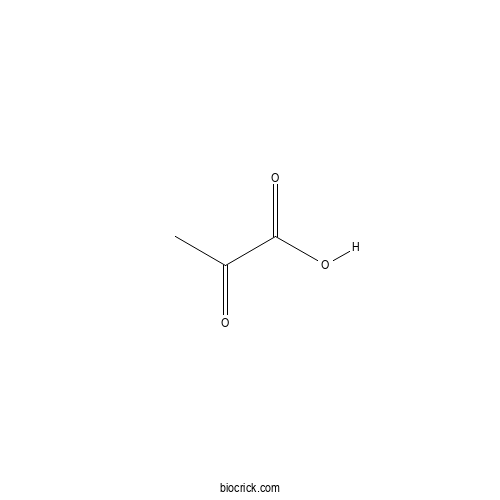
| Cas No. | 127-17-3 | SDF | File under preparation. |
| PubChem ID | 1060.0 | Appearance | Liquid |
| Formula | C3H4O3 | M.Wt | 88.1 |
| Type of Compound | N/A | Storage | Desiccate at -20°C |
| Solubility | Soluble in Chloroform,Dichloromethane,Ethyl Acetate,DMSO,Acetone,etc. | ||
| Chemical Name | 2-oxopropanoic acid | ||
| SMILES | CC(=O)C(=O)O | ||
| Standard InChIKey | LCTONWCANYUPML-UHFFFAOYSA-N | ||
| Standard InChI | InChI=1S/C3H4O3/c1-2(4)3(5)6/h1H3,(H,5,6) | ||
| General tips | For obtaining a higher solubility , please warm the tube at 37 ℃ and shake it in the ultrasonic bath for a while.Stock solution can be stored below -20℃ for several months. We recommend that you prepare and use the solution on the same day. However, if the test schedule requires, the stock solutions can be prepared in advance, and the stock solution must be sealed and stored below -20℃. In general, the stock solution can be kept for several months. Before use, we recommend that you leave the vial at room temperature for at least an hour before opening it. |
||
| About Packaging | 1. The packaging of the product may be reversed during transportation, cause the high purity compounds to adhere to the neck or cap of the vial.Take the vail out of its packaging and shake gently until the compounds fall to the bottom of the vial. 2. For liquid products, please centrifuge at 500xg to gather the liquid to the bottom of the vial. 3. Try to avoid loss or contamination during the experiment. |
||
| Shipping Condition | Packaging according to customer requirements(5mg, 10mg, 20mg and more). Ship via FedEx, DHL, UPS, EMS or other couriers with RT, or blue ice upon request. | ||
Quality Control & MSDS
3D structure
Package In Stock

Number of papers citing our products


Pyruvic acid Dilution Calculator
Pyruvic acid Molarity Calculator
| 1 mg | 5 mg | 10 mg | 20 mg | 25 mg | |
| 1 mM | 11.3507 mL | 56.7537 mL | 113.5074 mL | 227.0148 mL | 283.7684 mL |
| 5 mM | 2.2701 mL | 11.3507 mL | 22.7015 mL | 45.403 mL | 56.7537 mL |
| 10 mM | 1.1351 mL | 5.6754 mL | 11.3507 mL | 22.7015 mL | 28.3768 mL |
| 50 mM | 0.227 mL | 1.1351 mL | 2.2701 mL | 4.5403 mL | 5.6754 mL |
| 100 mM | 0.1135 mL | 0.5675 mL | 1.1351 mL | 2.2701 mL | 2.8377 mL |
| * Note: If you are in the process of experiment, it's necessary to make the dilution ratios of the samples. The dilution data above is only for reference. Normally, it's can get a better solubility within lower of Concentrations. | |||||
- Isofouquierol
Catalog No.:BCX2465
CAS No.:53822-99-4
- Arecoline
Catalog No.:BCX2464
CAS No.:63-75-2
- (22R)-Hydroxycholesterol
Catalog No.:BCX2463
CAS No.:17954-98-2
- (±)-Tropic acid
Catalog No.:BCX2462
CAS No.:552-63-6
- 8-Methoxynaringenin
Catalog No.:BCX2461
CAS No.:94884-92-1
- Escin IVc
Catalog No.:BCX2460
CAS No.:249921-71-9
- Galangin 5-methyl ether
Catalog No.:BCX2459
CAS No.:104594-69-6
- Maltol glucoside
Catalog No.:BCX2458
CAS No.:20847-13-6
- Swertiajaponin 2''-O-rhamnoside
Catalog No.:BCX2457
CAS No.:75474-16-7
- Escin IVf
Catalog No.:BCX2456
CAS No.:249922-20-1
- Bisphenol A bis(2,3-dihydroxypropyl)ether
Catalog No.:BCX2455
CAS No.:5581-32-8
- Isodonhenrin D
Catalog No.:BCX2454
CAS No.:1392194-87-4
- Azadirachtin B
Catalog No.:BCX2467
CAS No.:106500-25-8
- 5-(4-Hydroxyphenyl)pentanoic acid
Catalog No.:BCX2468
CAS No.:4654-08-4
- 2-Ethylbutyric acid
Catalog No.:BCX2469
CAS No.:1988-09-5
- 2-Ethylhexanoic acid
Catalog No.:BCX2470
CAS No.:149-57-5
- Propionic acid
Catalog No.:BCX2471
CAS No.:1979-09-4
- 11-Deoxymogrol
Catalog No.:BCX2472
CAS No.:2654048-89-0
- 2-Hydroxy-2-(2-methylpropyl)butanedioic acid
Catalog No.:BCX2473
CAS No.:60924-65-4
- Rhodojaponin VI
Catalog No.:BCX2474
CAS No.:37720-87-9
- Phytolaccagenic acid 28-O-β-D-glucopyranosyl ester
Catalog No.:BCX2475
CAS No.:288303-32-2
- Moracenin D
Catalog No.:BCX2476
CAS No.:78277-79-9
- Albafuran C
Catalog No.:BCX2477
CAS No.:84323-16-0
- Kuwanon X
Catalog No.:BCX2478
CAS No.:96819-92-0
Complementary TCA cycle precursor supply enhances ammonia assimilation and nitrogen retention during vegetable waste composting.[Pubmed:42830181]
Environ Res. 2026 Oct 4:125853.
Reactive nitrogen loss reduces nutrient recovery efficiency and the environmental performance of organic waste composting. Citric acid and Pyruvic acid were evaluated separately and in combination as complementary tricarboxylic acid cycle precursors during vegetable waste composting. All treatments received the same amount of exogenous carbon and were adjusted to the same initial pH. Precursor amendments reduced cumulative NH(3) emissions by 60%-76%. The combined treatment produced the lowest final nitrogen loss and increased final glutamate content and humic substance content by 25.2% and 31.7%, respectively, relative to the control. Metabolite profiles showed coordinated alpha-ketoglutarate and NADPH availability, providing the carbon skeleton and reducing power required for ammonium incorporation through glutamate dehydrogenase (GDH) and the glutamine synthetase (GS) - glutamate synthase (GOGAT) pathways. The combined treatment also produced the strongest coordination among ammonia assimilation gene abundances, enzyme activities, and bacterial and fungal succession. Bacterial communities were more closely associated with ammonia assimilation indicators, whereas fungal communities were more strongly associated with precursor turnover and reducing power availability. Integrated analyses further supported cross-domain coordination between carbon turnover and ammonia assimilation. Collectively, complementary TCA cycle precursor supply directed more ammonium toward glutamate and organic nitrogen formation, enhanced nitrogen retention and humification, and reduced the ammoniacal nitrogen available for NH(3) volatilization. This metabolic regulation provides a strategy for improving nutrient recovery during vegetable waste composting.
The In Situ Electrochemical-Chemical Cascade Strategy for Pyruvic Acid Synthesis.[Pubmed:42801667]
Adv Sci (Weinh). 2026 Sep 27:e77880.
Hydrogen peroxide (H(2)O(2)), as a green oxidizing medium, can be generated and utilized in situ via an electrochemical-chemical cascade, enabling organic transformations while enhancing efficiency and selectivity. However, balancing high H(2)O(2) production, efficient activation, and selective substrate conversion remains challenging. Herein, a series of transition metal-doped CeO(2) catalysts were developed for electrocatalytic H(2)O(2) generation and its subsequent use in converting alpha-hydroxy acids to pyruvate. Among them, Ni-CeO(2) exhibited the best performance, achieving a pyruvate production rate of 19.9 mmol g(-1) h(-1) and a Faradaic efficiency of 55.3%. Mechanistic studies revealed that transition metal doping regulates the local coordination environment and oxygen vacancy concentration, thereby optimizing the adsorption strength of the *OOH intermediate, which governs the two-electron oxygen reduction reaction pathway and H(2)O(2) generation and release. Furthermore, in situ generated H(2)O(2) was selectively activated on the catalyst surface to form a reactive oxygen species network dominated by hydroxyl radicals (.OH) and assisted by singlet oxygen ((1)O(2)). Among these, .OH showed the lowest energy barrier for alpha-C horizontal line H bond activation and subsequent electron rearrangement, making it the key species for pyruvate formation. This work provides a new strategy for the preparation of value-added chemicals.
Hydration Effects in a Guanidine Hydrochloride-Pyruvic Acid Low-Transition-Temperature Mixture: Physicochemical Insights.[Pubmed:42799213]
ACS Phys Chem Au. 2026 Sep 4;6(5):1349-1362.
A low-transition-temperature mixture (LTTM) composed of guanidine hydrochloride (GUC) and Pyruvic acid (PA) in a 1:2 molar ratio was prepared, and the effect of water on its physicochemical, electrochemical, and structural properties was investigated. To the best of our knowledge, this is the first report of a GUC-PA-based LTTM. Density (rho), speed of sound (u), and conductivity (kappa) were measured over the temperature range of 293.15-323.15 K. The excess molar volume (V (E)) of the pseudo-binary GUC-PA/water system was calculated and correlated using the third-order Redlich-Kister equation. Density decreased with increasing temperature, whereas the thermal expansion coefficient (alpha (P) ) increased. The variation of conductivity with temperature and water composition was correlated using the VFT and Casteel-Amis equations. Water addition significantly enhanced conductivity, reaching a maximum at an LTTM mole fraction of 0.1170 +/- 0.002, indicating improved ionic transport upon dilution. Cyclic voltammetry revealed that the neat GUC-PA LTTM and the system containing an LTTM mole fraction of 0.2314 +/- 0.002 exhibited comparable electrochemical behavior. The neat LTTM displayed an electrochemical stability window of -0.45 to +1.35 V (vs Ag). Nile Red solvatochromic studies revealed that the neat LTTM provides a highly polar microenvironment than water, and water addition induces only a small hypsochromic shift ( approximately 6 nm). SAXS measurements showed that water progressively weakens intermolecular correlations while preserving the local liquid structure. Density functional theory (DFT) analysis was performed to evaluate the interaction energies and frontier molecular orbitals (FMOs), providing valuable insights into the intermolecular interactions within the GUC-PA. Collectively, these results demonstrate that the GUC-PA LTTM retains its characteristic hydrogen-bonded structure up to an LTTM mole fraction of 0.2298 +/- 0.002, beyond which the network progressively weakens. These findings provide fundamental insight into the effect of water on the structure and physicochemical properties of LTTM.
Physiological Responses in the Hepatopancreas of Litopenaeus vannamei to Carbonate Alkalinity Stress and Subsequent Recovery: Integration of Antioxidant, Immune, and Metabolic Profiles.[Pubmed:42792092]
Antioxidants (Basel). 2026 Aug 23;15(9):1052.
High carbonate alkalinity (CA) is a major constraint on shrimp culture in saline-alkaline waters. The hepatopancreas is central to shrimp immunity and metabolic regulation. Litopenaeus vannamei underwent a 7-day exposure period to 5 mmol/L CA, followed by a subsequent 7-day recovery phase after removal of the stressor. The physiological regulatory mechanism of the hepatopancreas during CA stress and recovery was investigated by integrating multiple biological levels including histomorphology, antioxidant and immune indices, energy metabolism, and metabolite profiles. Results showed that CA stress induced structural changes in the hepatopancreas and triggered stress responses. Specifically, a significant upregulation was observed in genes involved in antioxidation (romo1, nrf2, gpx, hsp70), apoptosis (casp-9, casp-3), endoplasmic reticulum (ER) stress (ire1, xbp1), immune defense (alf, crus, pen-3, lys, propo), and detoxification (cyp450). CA stress also increased osmoregulatory genes (ccp, nhe, ca, aqp, vatp, nka-beta, nka-alpha), whereas clc and tip4 were suppressed. CA stress reduced the levels of energy-metabolism-related biochemical indicators, including glucose (GLU), Pyruvic acid (PYR), lactic acid (LAC) and triglycerides (TG), while markedly inducing the expression of genes involved in carbohydrate metabolism (ldh, pdh, hk, pk), lipid metabolism (ampk, srebp, fas), the tricarboxylic acid (TCA) cycle (mdh, cs, idh, odh, sdh, fh), and the electron transport chain (ETC) (ndh, cytc, coi, cco, atph). Moreover, the hepatopancreatic metabolic profile was remodeled, especially "phenylalanine, tyrosine and tryptophan biosynthesis" and the metabolism of beta-alanine, arachidonic acid, linoleic acid, and sphingolipids being substantially altered during both the stress and recovery phases. Several functional metabolites linked to stress responses were further pinpointed. Following stress relief, some physiological parameters partially recovered, yet overall function failed to return to normal. Collectively, CA stress compromised hepatopancreatic homeostasis by damaging morphological integrity, eliciting stress and immune responses, and perturbing energy metabolism and metabolite homeostasis; these adverse effects were not readily reversible in the short term.
Genome-wide analysis of the mango YUCCA family and overexpression of MiYUCCA10A/B confers early flowering and stress tolerance in transgenic Arabidopsis and tomato.[Pubmed:42782530]
Plant Cell Rep. 2026 Sep 24;45(10):304.
Auxin is a fundamental phytohormone that orchestrates developmental processes in plants. Flavin monooxygenase (YUCCA) serves as the rate-limiting enzyme in the indole-3-Pyruvic acid pathway (IPA) pathway, and its main function is to convert IPA into IAA. In this study, 12 members of the MiYUCCA gene family were mined and identified from the genomic data of mango (Mangifera indica). Phylogenetic tree analysis classified mango YUCCA into five categories. Cis-elements analysis of the promoter indicated that the promoter region contained a large number of hormone response elements and abiotic elements. Expression analysis revealed that the majority of MiYUCCA gene family members displayed high expression abundance at the early developmental stages of fruits, and their expression decreased or even remained unexpressed with the fruit growth and development. MiYUCCA10A and MiYUCCA10B were selected for functional verification. Overexpression of MiYUCCA10A and MiYUCCA10B promoted the early flowering in transgenic Arabidopsis and tomato, enhanced the salt and drought resistance, and also increased the content of IAA in transgenic plants. In addition, MiYUCCA10A and MiYUCCA10B significantly reduced the seed number of transgenic Arabidopsis and tomato plants, exerted no effect on the pod length of Arabidopsis, but markedly decreased the fruit size of tomato. The interaction of MiYUCCA10A/B with the SHORT VEGETATIVE PHASE 1/2/3/4/5 (MiSVP1/2/3/4/5) and FLOWERING LOCUS C (MiFLC) was revealed using both yeast two-hybrid (Y2H) and bimolecular fluorescence complementation (BiFC) analyses. These results indicate that the MiYUCCA10A/B were not only involved in flowering, but also related to stress tolerance and fruit development.
Multi-omics reveals the associations between cecal candidate bacteria and muscle fatty acid composition variations in Daheng and Luning chickens.[Pubmed:42741071]
Front Microbiol. 2026 Aug 31;17:1907226.
INTRODUCTION: Accumulating evidence underscores the profound impact of the gastrointestinal ecosystem on skeletal muscle lipid dynamics. METHODS: This study was designed to investigate the systemic associations connecting the gut microbiota, intermediate metabolomes, and intramuscular fatty acid (FA) deposition in chicken. RESULTS: Phenotypic and lipophilic profiling revealed distinct FA compositions between Daheng chickens (DHC) and Luning chickens (LNC), with DHC exhibiting significantly higher concentrations of 26 distinct FAs including flavor-precursor MUFAs (C18:1n9c) and functional omega-3 (n-3) PUFAs (C20:5n3 and C22:5n3) within the leg muscle. High-throughput metagenomic sequencing subsequently identified positive correlations between dominant cecal bacterial taxa and these specific muscle FAs. Concurrently, multi-compartment metabolomics mapped a spectrum of differential metabolites spanning the cecum, serum, and leg muscle, which were fundamentally enriched in the "cysteine and methionine metabolism" and "pantothenate and CoA biosynthesis" pathways. Through an integrative multi-omics framework paired with statistical mediation modeling, we identified a candidate functional axis: the Agathobaculum-Collinsella-Enorma consortium strongly co-varies with muscle FA deposition, a process bridged by key intermediate nodes including Pyruvic acid, S-adenosylmethionine, and Spermine. CONCLUSION: Collectively, these findings suggest that the gut microbiota is closely coupled with muscle lipid composition via a structured gut-metabolite-muscle axis, offering candidate microbial markers for precision management of meat quality in poultry production.
Combined Metabolomic and Transcriptomic Analysis Identifies Metabolic Signatures and Networks Associated with Semen Quality in Geese.[Pubmed:42738551]
Animals (Basel). 2026 Sep 2;16(17):2763.
Semen quality is a critical determinant of male fertility in poultry, yet the testicular metabolic and molecular mechanisms underlying seminal traits in geese remain poorly understood. This study aimed to characterize the testicular metabolomic and transcriptomic profiles of Zhedong white geese with divergent semen quality, and to identify key regulatory pathways and candidate genes influencing semen quality. Untargeted metabolomics and RNA sequencing were performed on testicular tissues from geese with high (H) and low (L) semen quality. Serum hormone measurements revealed significantly increased testosterone (T) and decreased follicle-stimulating hormone (FSH) levels in the H group compared with the L group (p < 0.05). Metabolomic analysis identified 207 differential metabolites (DEMs), which were significantly enriched in glycosylphosphatidylinositol (GPI)-anchor biosynthesis, the citrate (TCA) cycle, and alanine, aspartate, and glutamate metabolism. Integrated transcriptomic and metabolomic analyses, combined with KEGG Markup Language (KGML) network analysis, revealed a candidate regulatory network involving potential metabolites (arachidonic acid, Pyruvic acid, fumaric acid, malic acid and beta-alanine), signaling pathways (the citrate (TCA) cycle, arginine biosynthesis, ABC transporters, glycine/serine/threonine metabolism, and efferocytosis), and candidate genes (PLCB1, PLCB2, NT5C1A, TAT, LOC106042968 and ABCG8). Notably, PLCB1, which was significantly up-regulated in the H group, emerged as a candidate gene of particular interest that may be implicated in the regulation of metabolic pathways underlying semen quality in ganders. These findings provide novel insights into the testicular metabolic and transcriptomic determinants of semen quality in geese, and implicate PLCB1 and associated pathways as potential targets for improving male fertility in poultry.
Metabolic engineering of Lacticaseibacillus paracasei alleviates post-acidification and reshapes metabolite profiles in probiotic yogurt.[Pubmed:42733735]
Food Chem X. 2026 Sep 3;39:104386.
Post-acidification during storage limits the use of multiple probiotics in fermented dairy products. In this study, the ldh gene was deleted in Lacticaseibacillus paracasei Zhang (LCZ), resulting in 45% reduction in lactic acid production. Co-fermentation of the engineered strain with commercial starters effectively controlled post-acidification, maintained a stable pH (4.5-4.3) over 28 d, and increased production of volatile compounds (acetoin, decanoic acid, and dodecanoic acid) and bioactive metabolites (acetic and succinic acids). Metabolic analysis revealed that ldh deletion activated acetoin biosynthesis (750 ng/mL) and redirected carbon flux toward malic, and acetic acids. The modification also promoted amino acid catabolism (L-alanine, L-cysteine, and L-asparagine) to Pyruvic acid, enabling nitrogen-carbon co-utilization. This study presents a promising solution for developing stable probiotic dairy products and provides new insights into probiotic metabolic engineering.
Mangiferin monosodium salt attenuates metabolic and alcohol-associated liver disease via a novel insight into cuproptosis and improving gut microbiota.[Pubmed:42732783]
Toxicol Appl Pharmacol. 2026 Nov;516:118035.
Alcoholic liver disease (ALD) is a major global health burden. Cuproptosis, a form of regulated cell death, plays a critical role in multiple liver diseases, yet its role and mechanisms in ALD remain largely unknown. This study explored the preventive and therapeutic roles of mangiferin monosodium salt (MG-Na) against ALD and the associated gut-liver axis mechanisms. ALD was induced in rats via chronic alcohol administration, with or without MG-Na treatment. Liver function and intestinal barrier integrity were assessed. Next, gut microbial composition and ALD-associated metabolic alterations were assessed by 16S rRNA gene sequencing and fecal metabolomics. Proteins and factors involved in alcohol metabolism, the TCA cycle, cuproptosis, and inflammation were subsequently analyzed using Western blotting, qRT-PCR, ICP-MS, immunohistochemistry, and ELISA. The results showed that MG-Na improved liver function and intestinal barrier integrity, and ameliorated alcohol metabolic dysfunction, TCA cycle impairment, cuproptosis, and alcoholic hepatitis. Also, MG-Na markedly affected gut microbiota diversity and community richness. Meanwhile, MG-Na reduced the production of fecal metabolites in ALD rats, such as (R)-lipoic acid and Pyruvic acid. Notably, MG-Na downregulated proteins involved in alcohol metabolism (ADH1, CYP2E1), cuproptosis (FDX1, DLAT), cGAS-STING and TLR4/NF-kappaB/NLRP3 pathways, while increasing TCA cycle-related enzyme activity and metabolite levels in the liver, though some changes were not statistically significant. And, MG-Na administration can also significantly decrease the levels of pro-inflammatory cytokines (IFN-beta, TNF-alpha, IL-1beta and IL-6) and increase the anti-inflammatory cytokine (IL-10) level. Together, these results suggested that MG-Na can attenuate metabolic and alcoholic hepatitis by modulating gut microbiota, inhibiting cuproptosis, and suppressing inflammatory responses.
Heating duration alters the low-molecular-weight compound profile of fish muscle, with pyruvic acid as a potential marker of thermal history.[Pubmed:42731129]
Biosci Biotechnol Biochem. 2026 Sep 12:zbag139.
This study used gas chromatography-mass spectrometry (GC-MS)-based metabolic profiling to assess the effects of heating duration on low-molecular-weight compound profiles in fish muscle from yellowtail, chum salmon, Alaska pollock, and Pacific herring and to identify species-independent heating history markers. Heated samples were analyzed by GC-MS, followed by compound annotation and semi-quantification. Orthogonal partial least squares regression analysis indicated that heating and extended heating altered the low-molecular-weight compound profiles of fish muscle. Pyruvic acid and glycolic acid, which showed high variable importance in prediction scores, were identified as candidate heating history markers. Quantitative analysis showed that both compounds increased with heating duration. Notably, Pyruvic acid showed coefficients of determination to be >/= 0.8 for all four fish species, supporting its potential as an effective species-independent marker of fish muscle heating history.

Calcutta University

University of Minnesota

University of Maryland School of Medicine

University of Illinois at Chicago

The Ohio State University

University of Zurich

Harvard University

Colorado State University

Auburn University

Yale University

Worcester Polytechnic Institute

Washington State University

Stanford University

University of Leipzig

Universidade da Beira Interior

The Institute of Cancer Research

Heidelberg University

University of Amsterdam

University of Auckland

TsingHua University

The University of Michigan

Miami University

DRURY University

Jilin University

Fudan University

Wuhan University

Sun Yat-sen University

Universite de Paris

Deemed University

Auckland University

The University of Tokyo

Korea University



