
Propionic acidCAS# 1979-09-4 |
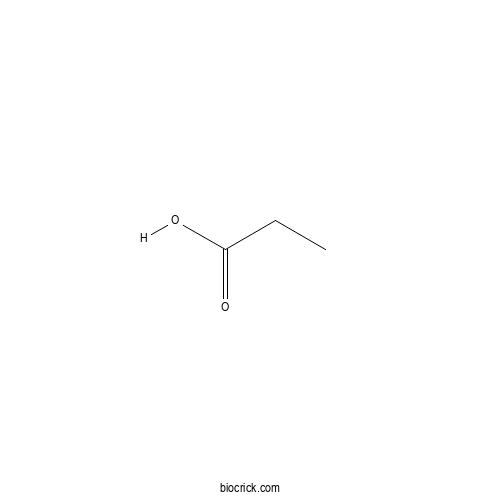
| Cas No. | 1979-09-4 | SDF | File under preparation. |
| PubChem ID | 1032.0 | Appearance | Liquid |
| Formula | C3H6O2 | M.Wt | 74.1 |
| Type of Compound | N/A | Storage | Desiccate at -20°C |
| Solubility | Soluble in Chloroform,Dichloromethane,Ethyl Acetate,DMSO,Acetone,etc. | ||
| Chemical Name | propanoic acid | ||
| SMILES | CCC(=O)O | ||
| Standard InChIKey | XBDQKXXYIPTUBI-UHFFFAOYSA-N | ||
| Standard InChI | InChI=1S/C3H6O2/c1-2-3(4)5/h2H2,1H3,(H,4,5) | ||
| General tips | For obtaining a higher solubility , please warm the tube at 37 ℃ and shake it in the ultrasonic bath for a while.Stock solution can be stored below -20℃ for several months. We recommend that you prepare and use the solution on the same day. However, if the test schedule requires, the stock solutions can be prepared in advance, and the stock solution must be sealed and stored below -20℃. In general, the stock solution can be kept for several months. Before use, we recommend that you leave the vial at room temperature for at least an hour before opening it. |
||
| About Packaging | 1. The packaging of the product may be reversed during transportation, cause the high purity compounds to adhere to the neck or cap of the vial.Take the vail out of its packaging and shake gently until the compounds fall to the bottom of the vial. 2. For liquid products, please centrifuge at 500xg to gather the liquid to the bottom of the vial. 3. Try to avoid loss or contamination during the experiment. |
||
| Shipping Condition | Packaging according to customer requirements(5mg, 10mg, 20mg and more). Ship via FedEx, DHL, UPS, EMS or other couriers with RT, or blue ice upon request. | ||
Quality Control & MSDS
3D structure
Package In Stock

Number of papers citing our products


Propionic acid Dilution Calculator
Propionic acid Molarity Calculator
| 1 mg | 5 mg | 10 mg | 20 mg | 25 mg | |
| 1 mM | 13.4953 mL | 67.4764 mL | 134.9528 mL | 269.9055 mL | 337.3819 mL |
| 5 mM | 2.6991 mL | 13.4953 mL | 26.9906 mL | 53.9811 mL | 67.4764 mL |
| 10 mM | 1.3495 mL | 6.7476 mL | 13.4953 mL | 26.9906 mL | 33.7382 mL |
| 50 mM | 0.2699 mL | 1.3495 mL | 2.6991 mL | 5.3981 mL | 6.7476 mL |
| 100 mM | 0.135 mL | 0.6748 mL | 1.3495 mL | 2.6991 mL | 3.3738 mL |
| * Note: If you are in the process of experiment, it's necessary to make the dilution ratios of the samples. The dilution data above is only for reference. Normally, it's can get a better solubility within lower of Concentrations. | |||||
- 2-Ethylhexanoic acid
Catalog No.:BCX2470
CAS No.:149-57-5
- 2-Ethylbutyric acid
Catalog No.:BCX2469
CAS No.:1988-09-5
- 5-(4-Hydroxyphenyl)pentanoic acid
Catalog No.:BCX2468
CAS No.:4654-08-4
- Azadirachtin B
Catalog No.:BCX2467
CAS No.:106500-25-8
- Pyruvic acid
Catalog No.:BCX2466
CAS No.:127-17-3
- Isofouquierol
Catalog No.:BCX2465
CAS No.:53822-99-4
- Arecoline
Catalog No.:BCX2464
CAS No.:63-75-2
- (22R)-Hydroxycholesterol
Catalog No.:BCX2463
CAS No.:17954-98-2
- (±)-Tropic acid
Catalog No.:BCX2462
CAS No.:552-63-6
- 8-Methoxynaringenin
Catalog No.:BCX2461
CAS No.:94884-92-1
- Escin IVc
Catalog No.:BCX2460
CAS No.:249921-71-9
- Galangin 5-methyl ether
Catalog No.:BCX2459
CAS No.:104594-69-6
- 11-Deoxymogrol
Catalog No.:BCX2472
CAS No.:2654048-89-0
- 2-Hydroxy-2-(2-methylpropyl)butanedioic acid
Catalog No.:BCX2473
CAS No.:60924-65-4
- Rhodojaponin VI
Catalog No.:BCX2474
CAS No.:37720-87-9
- Phytolaccagenic acid 28-O-β-D-glucopyranosyl ester
Catalog No.:BCX2475
CAS No.:288303-32-2
- Moracenin D
Catalog No.:BCX2476
CAS No.:78277-79-9
- Albafuran C
Catalog No.:BCX2477
CAS No.:84323-16-0
- Kuwanon X
Catalog No.:BCX2478
CAS No.:96819-92-0
- Vitisin C
Catalog No.:BCX2479
CAS No.:180580-73-8
- Viniferol E
Catalog No.:BCX2480
CAS No.:870555-67-2
- cis-Upunaphenol K
Catalog No.:BCX2481
CAS No.:879897-47-9
- Ampelopsin BF
Catalog No.:BCX2482
CAS No.:482304-83-6
- Queretaroic acid 28-O-β-D-glucopyranosyl ester
Catalog No.:BCX2483
CAS No.:1389354-39-5
ROS-responsive hydrogel delivering liposomal indole-3-propionic acid promotes spinal cord injury repair by enhancing CX3CL1-CX3CR1 mediated neuron-microglia communication.[Pubmed:42825088]
Mater Today Bio. 2026 Sep 17;41:103661.
Spinal cord injury (SCI) is a devastating neurological disorder characterized by excessive neuroinflammation and limited regenerative capacity. Here, we developed a reactive oxygen species (ROS)-responsive hydrogel for localized delivery of liposomal indole-3-Propionic acid (IPA), a gut microbiota-derived metabolite with neuroprotective potential. The hydrogel exhibited favorable injectability, self-healing capability, and ROS-responsive degradation, enabling sustained release and prolonged retention of IPA at the lesion site. In vitro, IPA-loaded liposomes effectively attenuated lipopolysaccharide-induced inflammation and promoted axonal regeneration with favorable biosafety. In the rat SCI model, localized delivery of liposomal IPA significantly improved locomotor recovery, electrophysiological function, and tissue preservation while reducing cavity formation and secondary injury. Moreover, IPA promoted neuronal survival, enhanced axonal integrity, and shifted microglia toward a pro-repair phenotype. Single-nucleus RNA sequencing identified enhanced CX3CL1-CX3CR1 mediated neuron-microglia communication following IPA treatment, accompanied by enrichment of PI3K/AKT signaling pathway in both neurons and microglia. In addition, IPA facilitated microglial migration toward the lesion core, suggesting coordinated modulation of the neuroinflammatory microenvironment after SCI. Collectively, our study identifies a previously unrecognized therapeutic role of IPA in spinal cord repair and presents a ROS-responsive nanoplatform for localized metabolite delivery to regulate neuron-microglia crosstalk and promote functional recovery after SCI.
A kinetic model for polyhydroxyalkanoates production by Cupriavidus necator using dark fermentation effluents.[Pubmed:42814149]
Biodegradation. 2026 Sep 30;37(5):155.
Polyhydroxyalkanoates (PHAs) represent a family of biodegradable polymers that are precursors of bioplastics, offering a sustainable alternative to plastics derived from fossil fuels, within a circular economy framework. This study investigates the production of PHAs by the Cupriavidus necator bacterium, using as carbon sources synthetic media with volatile fatty acids (VFAs) and real effluents from dark fermentation (DFE) of seaweed wastes, which contain this type of acids. Experimental results indicate that, when acids are fermented singly, Propionic acid yields a lower polymer quantity than acetic or butyric acids. However, when VFAs are supplied in mixtures, synergistic effects are observed. The kinetic models actually published fail to account for the increasing alkalinity of the medium during the VFA consumption, which frequently leads to biomass growth inhibition, and do not incorporate pH-dependent growth equations or consider the deleterious impact of alkaline conditions on the polymer stability. Thus, a novel kinetic model is proposed, based on the Monod equation, but integrating the inhibitory effects of pH in the biomass growth and the alkaline polymer degradation, with only nine fitting parameters. The new model allow for the robust prediction of the PHA production, the substrate consumption and the biomass growth, in the experimental conditions applied, which are typical of the PHA fermentations of DFE. The overall regression coefficient of theoretical curves (R(2)) is over 0.92, thus facilitating the designing and optimization of the industrial-scale processes.
Dietary inclusion of a fermented rapeseed-seaweed blend alters immunity and intestinal microbial activity but not Ascaridia galli burden in laying hens.[Pubmed:42813250]
Br Poult Sci. 2026 Sep 30:1-12.
1. Dietary components that are pre-fermented with lactic acid bacteria have recently attracted attention and may positively affect performance and gut health in poultry. This study investigated whether a commercial feed ingredient (EP199), containing fermented rapeseed meal, wheat bran and seaweed, could control worm burden, intestinal microbiota profiles and intestinal fermentation patterns, as well as immune profiles of layers infected with Ascaridia galli.2. A total of 192, 20 week old Bovans Brown laying hens were randomly allocated into four treatment groups; control diet vs. EP199 diet and experimentally infected (EXP) vs. naturally infected (NAT). The EP199 diet partly replaced rapeseed cake at 6%. The infected hens were either naturally exposed to A. galli contaminated litter or received oral administration of 764 embryonated A. galli eggs per hen at 20 weeks of age for 12 weeks.3. Performance was unaffected by EP199 or infection. However, hens fed the EP199 diet had a significantly lower egg production 3-12 weeks post-infection (pi) compared to the control group (86.1% vs. 90.1%, P=0.044). There was no effect on intestinal worm burden (x=7.98 worms per hen) or immune competence, as assessed by mitogen activation of peripheral blood mononuclear cells (PBMC). Despite similar nutrient profiles of the two diets, the hens fed the EP199 diet had significantly higher caecal levels of specific short chain fatty acids: acetic acid (79.8 vs. 71.0 mmol/kg digesta; P=0.020), Propionic acid (35.0 vs. 30.1 mmol/kg digesta; P=0.005) and n-butyric acid (17.3 vs. 14.7 mmol/kg digesta; P=0.015).4. Compared to the control group, hens fed EP199 had a lower humoral A. galli-specific immune response, in terms of IgY serum titres at 10 weeks (2812 vs. 5291; P=0.002) and 12 weeks (10546 vs. 17668; P=0.025) pi. Hens fed the EP199 diet showed a significantly higher frequency of activated CD4+CD8+ T cells (28.7% vs. 21.9%; P=0.045).5. Feeding EP199 at 6% did not have an effect on severity of A. galli infection. However, EP199 showed an immunomodulatory effect and altered caecal microbial activity. Infection method (experimental vs. natural) influenced both the worm burden and immune parameters.
Discovery of plasma metabolomic biomarkers and a predictive model for immune checkpoint inhibitor-associated myocarditis: a pilot case-control study.[Pubmed:42812380]
Front Immunol. 2026 Sep 15;17:1915039.
BACKGROUND: Immune checkpoint inhibitor (ICI)-associated myocarditis is a rare but potentially fatal immune-related adverse event lacking reliable biomarkers for risk stratification. This exploratory pilot case-control study aimed to characterize baseline plasma metabolomic profiles in patients who developed ICI-associated myocarditis and to evaluate a metabolite-based predictive model. METHODS: Baseline plasma samples from 15 patients with ICI-associated myocarditis and 15 matched controls were analyzed by untargeted metabolomics using UHPLC-Q/Orbitrap HRMS. Differential metabolites were identified by OPLS-DA and univariate analysis. A metabolite-derived PC1 was used in logistic regression models (clinical-only, metabolite-only, combined), with performance assessed by AUC. RESULTS: Ten differential metabolites were identified, implicating glutathione metabolism, phenylalanine metabolism, and histidine metabolism pathways. Key alterations included elevated phenylpyruvic acid, 1-methylpseudouridine, cinnamoylglycine, pyroglutamic acid and spermine, with decreased ceramide, cyclo-prolylglycine, Propionic acid, glycolic acid, and histamine. A clinical model incorporating three baseline laboratory variables (lymphocyte ratio, monocyte ratio, and eosinophil ratio) achieved an AUC of 0.618. The metabolite PC1 model alone attained an AUC of 0.964, outperforming the clinical model. The combined clinical-metabolite model reached a fitted AUC of 0.973 (cross-validated AUC 0.925). Decision curve analysis indicated that the combined model provided potential net benefit within the 20%-40% threshold range, marginally exceeding the metabolite-only model. CONCLUSION: This exploratory study identified baseline plasma metabolites potentially associated with ICI-associated myocarditis risk, implicating oxidative stress, immune modulation, and gut microbiota-host interactions. The metabolite-based model showed preliminary discriminative ability, but prospective validation in independent cohorts is required.
Microbial-Derived Exerkines as a Model of Drug Discovery.[Pubmed:42809711]
Am J Physiol Cell Physiol. 2026 Sep 29.
There has been a growing interest in the utilization of the gut microbiome as a therapeutic tool. The relationship between the gut microbiome and exercise provides a unique opportunity to maximize the therapeutic capacity of the gut microbiome. Here, we summarize the potential of leveraging the gut microbiome to confer the health benefits of exercise through a novel class of microbial metabolites termed microbial-derived exerkines (MDEs). We identify multiple candidate and established MDEs described in the literature (e.g., pipecolic acid, succinate, short-chain fatty acids, indole-3-Propionic acid, 3-hydroxyphenylacetic acid) and explore their implications in conditions such as inflammatory bowel disease, aging, skeletal muscle atrophy, cancer, diabetes, cardiovascular disease, and Alzheimer's disease. Given the beneficial effects of exercise on numerous diseases, we anticipate MDEs will be a productive avenue for drug discovery and therapeutic progress.
Multifunctional chitosan modified waterborne polyurethane films: An integrated experimental and molecular docking study for structure interaction correlation.[Pubmed:42805543]
Int J Biol Macromol. 2026 Sep 28;383(Pt 2):154680.
Chitosan-modified waterborne polyurethane (CS@WBP) films were synthesized through a prepolymer approach using butanediol (BDO), isophorone diisocyanate (IPDI), and dimethylol Propionic acid (DMPA), followed by the incorporation of chitosan to introduce additional functional amino and hydroxyl groups. A conventional BDO-chain-extended waterborne polyurethane (BDO@WBP) was also prepared as a reference system to distinguish the effects of conventional diol chain extension from those associated with CS incorporation. The resulting system (CS@WBP) formed homogeneous aqueous dispersions and uniform, defect-free films, demonstrating good compatibility between CS and the polyurethane matrix. FTIR and NMR analyses confirmed the successful formation of the polyurethane network and the incorporation of CS through intermolecular interactions. DLS analysis revealed an average hydrodynamic particle size of approximately 188.5 nm with a reasonably uniform particle size distribution, indicating satisfactory dispersion characteristics. Morphological analyses (OM and FE-SEM) showed homogeneous, continuous film surfaces, while XRD confirmed a semi-crystalline structure. The films exhibited moderate hydrophilicity (contact angle ~43-49 degrees ) and enhanced thermal stability with increased char formation (~10-12%). Mechanical analysis indicated that the developed films are soft and flexible (Young's modulus: 2.11 MPa; elongation at break: 22.4%), making them suitable for functional film applications. In comparison, the BDO@WBP reference exhibited a slightly larger hydrodynamic particle size (210.3 nm) and lower film-forming integrity under the investigated formulation conditions, with the film fracturing during specimen preparation for tensile testing. Molecular docking studies demonstrated favorable interactions with selected bacterial target proteins, particularly DNA gyrase (-6.9 kcal mol(-1)), providing theoretical support for potential antimicrobial functionality. Unlike conventional studies focusing solely on material characterization, this work integrates comprehensive experimental characterization with molecular docking to establish a structure-interaction relationship at the molecular level. Overall, the developed CS@WBP films represent a promising multifunctional polymer system for sustainable applications. However, further experimental antimicrobial evaluation is required to validate the computational predictions and establish their practical biological performance.
Therapeutic Potential of Pioglitazone in a Propionic Acid-Induced Rat Model of Autism Spectrum Disorder: The Role of the SIRT1/PPAR-gamma Axis.[Pubmed:42802007]
Int J Dev Neurosci. 2026 Oct;86(6):e70180.
Autism spectrum disorder (ASD) is a complex neurodevelopmental condition characterized by social communication deficits and repetitive behaviours. Emerging evidence highlights neuroinflammation, oxidative stress and mitochondrial dysfunction in its pathogenesis. Propionic acid (PPA), an enteric short-chain fatty acid, is frequently utilized to replicate ASD-like phenotypes in rodents. This study investigated the therapeutic efficacy of pioglitazone, a peroxisome proliferator-activated receptor gamma (PPAR-gamma) agonist known for its neuroprotective and anti-inflammatory properties, in a PPA-induced rat model of ASD. Thirty male Wistar rats were randomly assigned to control, PPA + saline or PPA + pioglitazone (15 mg/kg/day, orally) groups. Neurobehavioural profiling utilized the sociability, open-field and passive avoidance learning tests. Furthermore, cerebral tissues were analysed for tumour necrosis factor-alpha (TNF-alpha), brain-derived neurotrophic factor (BDNF), sirtuin-1 (SIRT1), galectin-3 and malondialdehyde (MDA), alongside comprehensive histopathological evaluations of the hippocampus and cerebellum. Pioglitazone significantly improved social interaction, associative memory retention and spontaneous locomotor activity. Biochemically, the treatment significantly suppressed inflammatory and oxidative stress markers (TNF-alpha, galectin-3 and MDA) while increasing cerebral BDNF and SIRT1 levels. Histological assessments confirmed these neuroprotective benefits, demonstrating preserved neuronal architecture and decreased glial fibrillary acidic protein (GFAP) immunoreactivity, indicative of reduced reactive astrogliosis. These findings indicate that pioglitazone ameliorates behavioural, biochemical and histopathological alterations in the PPA-induced rat model of ASD. The concurrent restoration of cerebral SIRT1 levels suggests that SIRT1-related signalling may contribute to the observed neuroprotective effects.
Gut Microbiota and SCFA Changes After Alendronate-Calcitriol Therapy in Postmenopausal Osteoporosis.[Pubmed:42801217]
Int J Womens Health. 2026 Sep 22;18:636595.
BACKGROUND: Postmenopausal osteoporosis (PMO) is driven primarily by estrogen deficiency, and gut microbiota-derived metabolites may participate in bone remodeling. The intestinal effects of conventional anti-osteoporosis therapy remain unclear. We investigated gut microbial and short-chain fatty acid (SCFA) changes associated with alendronate-calcitriol therapy in PMO. METHODS: Forty-one postmenopausal women were enrolled, including 21 healthy controls and 20 patients with PMO. PMO patients received oral alendronate plus calcitriol for six months, with paired fecal samples collected before and after treatment. Shotgun metagenomic sequencing was used to assess microbial taxonomy, KEGG pathways, and CAZy profiles. Fecal SCFAs were quantified by gas chromatography-mass spectrometry. RESULTS: After treatment, lumbar spine BMD T-score improved from -2.98 to -2.65, and femoral neck BMD T-score increased from -2.40 to -2.12, and all measured bone turnover markers (BALP, TRACP-5b, PINP and osteocalcin) decreased significantly (P < 0.05). Global microbial diversity did not differ significantly among groups, but treatment was accompanied by shifts in specific taxa. Roseburia, Megamonas, Dialister, and unclassified Lactobacillaceae increased, whereas Enterobacter, Salmonella, Raoultella, Serratia, and Rahnella decreased. Functional profiles showed treatment-associated shifts in propanoate metabolism, pyruvate metabolism, the TCA cycle, and selected carbohydrate-active enzyme patterns. Overall fecal SCFA composition remained relatively stable; however, Propionic acid concentration increased significantly after treatment (FDR-adjusted P = 0.021). Correlation analyses linked selected commensal taxa and SCFAs with BMD and bone turnover markers. CONCLUSION: Alendronate-calcitriol therapy was associated with improved bone metabolism and treatment-associated shifts in gut microbial composition, microbial functional potential, and propionate-related SCFA profiles. These findings provide preliminary evidence for microecological changes accompanying conventional PMO therapy.
Plasma indole-3-propionic acid is a gut-derived metabolite and is associated with type 2 diabetes and cardiometabolic outcomes: Evidence from a human antibiotic intervention.[Pubmed:42799756]
Gut Microbes. 2026 Dec 31;18(1):2736321.
The gut microbiota influences host metabolism through diverse metabolites, many of which have been linked to glucose homeostasis and type 2 diabetes (T2D). Understanding microbial contributions to metabolite biosynthesis is essential for developing dietary and microbiota-targeted T2D prevention and treatment strategies. We performed targeted plasma metabolomics in individuals with T2D and healthy controls, all receiving histidine supplementation, before and after gut microbiota suppression using 7-day broad-spectrum antibiotic treatment. Associations between pre-antibiotic metabolite levels and fecal metagenomics-derived gut microbiota composition were examined using co-abundance network analysis and Random Forest modeling. Indole-3-Propionic acid (IPA) was the only gut-derived metabolite differing between groups before antibiotics, with lower levels in T2D and higher levels associated with reduced T2D odds. Antibiotic treatment reduced IPA to near-undetectable levels in both groups, confirming its predominantly microbial origin. Beyond established inverse associations with BMI and glycemic markers, we found a novel inverse correlation between IPA and glycemic variability, consistent with a protective association with T2D. Plasma IPA was associated with gut microbiota beta diversity. IPA-associated species clustered within a single co-abundance module, but did not include known IPA producers, suggesting plasma IPA is influenced by broader microbial community composition rather than IPA-producing capacity of individual taxa alone. This study provides direct human evidence that plasma IPA is virtually exclusively gut microbiota-derived in individuals with T2D, extending prior findings in healthy populations. It highlights IPA's relevance to metabolic health and T2D, and guides future research on dietary and microbiota-targeted strategies to modulate IPA, advancing T2D prevention and treatment.
Blastocystis spp. Positivity Is Associated with Altered Fecal Bacterial Communities and Reduced Short-Chain Fatty Acid Concentrations in Diarrheic Yaks.[Pubmed:42797945]
Vet Sci. 2026 Sep 4;13(9):910.
Yaks (Bos grunniens) are important livestock on the Qinghai-Tibetan Plateau, but the relationship between Blastocystis positivity, fecal bacterial communities, and microbial metabolites remains unclear. This cross-sectional study compared fecal bacterial profiles and short-chain fatty acid (SCFA) concentrations in six Blastocystis-positive and six Blastocystis-negative diarrheic yaks from Lhasa, Tibet Autonomous Region, China. Bacterial communities were characterized by 16S rRNA gene amplicon sequencing, and fecal SCFAs were quantified by gas chromatography-mass spectrometry. Compared with negative yaks, positive yaks had lower concentrations of acetic acid (p < 0.01), Propionic acid (p < 0.01), butyric acid (p = 0.000381), valeric acid (p < 0.01), caproic acid (p = 0.00359), and isobutyric acid (p < 0.01), whereas isovaleric acid did not differ between groups (p = 0.310). A total of 2,751,028 raw sequences were generated, of which 2,620,949 passed quality filtering. ACE (p = 0.0068), Chao1 (p = 0.0071), Faith's phylogenetic diversity (p = 0.0019), observed ASVs (p = 0.0064), Pielou's evenness (p = 0.011), Shannon diversity (p = 0.008), and Simpson diversity (p = 0.037) were lower in positive yaks. The groups also differed in bacterial community composition, and several taxa previously associated with fiber degradation or SCFA formation had lower relative abundances in positive yaks. PICRUSt2 indicated differences in predicted microbial functional potential. These findings indicate that Blastocystis positivity was associated with altered fecal bacterial communities and reduced concentrations of several SCFAs in diarrheic yaks. Because of the small sample size, cross-sectional design, and potential confounding by diarrhea and other unmeasured factors, causal relationships cannot be established.
Relevant Probiotic and Functional Properties of Lactic Acid Bacteria Isolated from Aquaculture Environments on the Ivory Coast for Potential Aquaponic Applications.[Pubmed:42795491]
Microorganisms. 2026 Aug 28;14(9):1906.
Aquaponics combines aquaculture and hydroponics, offering an integrated and sustainable food production system. This study investigated the probiotic properties, plant growth-promoting (PGP) activity, and nitrifying capacity of twelve lactic acid bacteria (LAB) strains isolated from an aquaculture farm environment on the Ivory Coast for their potential application in aquaponic systems. All isolates demonstrated antagonistic activity against key pathogenic indicator strains, except Vibrio cholerae, and displayed varying levels of surface hydrophobicity (5.50 +/- 0.70% to 22.83 +/- 1.17%) and auto-aggregation (32.50 +/- 0.08% to 52.89 +/- 0.39%) after 24 h. Antioxidant activity was significantly higher in cell-free supernatants (~71-79%) than in intact cells (~30-33%). Bile salt tolerance (0.3%, 4 h) ranged from 2.13 +/- 0.76% to 40.87 +/- 2.12%, and survival under pH 1.5 with pepsin for 3 h varied from 4.84 +/- 0.26% to 53.98 +/- 13.28%. All isolates produced lactic, acetic, citric, malic, and Propionic acid and exhibited amylase and cellulase activity; none showed hemolytic activity. Only LAB 11 produced indole-3-acetic acid (17.72 +/- 0.06 mug/mL), siderophores, and phosphate-solubilization activity for PGP traits, and this group significantly enhanced maize seed germination (86.66 +/- 5.77%) and radicle length (7.00 +/- 0.52 mm) compared to the control (63.33 +/- 32.14% and 4.94 +/- 1.52 mm), respectively. LAB 1 and LAB 10 demonstrated the highest ammonia-oxidizing capacity in vitro and in trout pond water. LAB 1, LAB 10, and LAB 11 were confirmed by whole genome sequencing analysis to be Enterococcus faecalis strains with a favorable-safety genomic profile and probiotic characteristics. These three strains therefore represent promising candidates for consortium-based applications in aquaponics systems.
Monochromatic Blue Light Enhances Antioxidant Status and Remodels the Gut Microbiome in Association with Increased Plasma Melatonin in Broiler Chickens.[Pubmed:42792243]
Antioxidants (Basel). 2026 Sep 20;15(9):1204.
The intestinal microbiome of broiler chickens has potential to regulate host health and growth performance. Although previous studies have revealed that the intestinal microbiota composition is affected by different factors including monochromatic light, the underlying mechanisms remain poorly understood, particularly regarding the causal role of light-sensitive hormones such as melatonin. To address this gap, a 2 x 4 factorial design was adopted in the present study, with two surgical treatments (sham-operation or pinealectomy) and four light conditions (white, blue, green, and red light), to investigate whether blue light modulates gut microbiota and antioxidant status through melatonin-dependent pathways. Broilers were reared under different monochromatic light conditions. On day 3 post-hatching, we ablated circulating melatonin production by conducting a pinealectomy or control sham-operation model. Accordingly, the broilers were assigned to eight groups: white light + sham-operation (WL), white light + pinealectomy (WP), blue light + sham-operation (BL), blue light + pinealectomy (BP), green light + sham-operation (GL), green light + pinealectomy (GP), red light + sham-operation (RL), and red light + pinealectomy (RP). On day 35, blue light was found to most effectively elevate plasma melatonin, which activated the Mel 1a/Nrf2/NQO1 pathway to reduce oxidative stress and remodel the jejunal microbiota. Metagenomic analysis identified Akkermansia muciniphila, Bifidobacterium longum and Ligilactobacillus aviarius as key bacteria enriched in blue light. Consequently, classes of microbiota-derived metabolites like stearidonic acid and indole Propionic acid triggered the variation of tryptophan, bile acid and lipid metabolism, which contributed to broiler growth promotion. Moreover, pinealectomy accompanied by plasma melatonin deprivation significantly nullified the blue-light-induced effects. These insights confirm blue light is more effective in microbiota modulation by inducing melatonin secretion and providing a new strategy for light management in the broiler industry.
Guanidinoacetic Acid and Cysteamine Hydrochloride Improve Beef Cattle Growth and Antioxidant Capacity via Fecal Microbiome and Serum Metabolome.[Pubmed:42792217]
Antioxidants (Basel). 2026 Sep 16;15(9):1178.
Balancing muscle growth and antioxidant/anti-inflammatory homeostasis is a core requirement for modern beef production. This study investigated whether cysteamine hydrochloride (CSH) co-supplementation with guanidinoacetic acid (GAA) enhances growth and antioxidant status through fecal microbiome and serum metabolome modulation in Simmental beef cattle. A 60-day trial randomly assigned 45 10-month-old cattle to control (CON), GAA-supplemented, and GAA + CSH-supplemented groups (n = 15 per group). Growth performance was recorded throughout the trial. Fecal samples were collected for 16S rRNA sequencing, and serum samples for non-targeted metabolomics. Both GAA and GAA + CSH (GCSH) improved growth performance versus CON (p < 0.05), with no differences between supplemented groups. However, GCSH uniquely elevated antioxidant enzymes and reduced malondialdehyde (p < 0.05). GCSH treatment was associated with higher abundance of Adlercreutzia, Anaerofustis, and Monoglobus, alongside elevated indole-3-Propionic acid and salicylsulfuric acid. In contrast, GAA reduced phenylacetyl-L-glutamine and indole-3-acetic acid. iCAMP analysis revealed that GCSH relieved homogenizing selection while enhancing heterogeneous selection, promoting beneficial taxa colonization. GAA primarily enhances nitrogen utilization, while CSH enriches beneficial microbiota and antioxidant metabolites. These findings suggest that GAA and CSH co-supplementation improves growth and antioxidant homeostasis through complementary mechanisms.
Glycerol Monolaurate Supplementation in Extruded Diets Enhances Immune Function and Antioxidant Capacity and Alters the Gut Microbiota and Fecal Metabolome in Cats.[Pubmed:42792208]
Antioxidants (Basel). 2026 Sep 15;15(9):1169.
This study evaluated the effects of dietary glycerol monolaurate (GML) supplementation on feline growth performance and intestinal health. Twenty-four adult British Shorthair cats (3.03 +/- 0.07 kg) were initially enrolled. Following a 56-day pre-feeding period, 18 eligible cats were allocated to two dietary groups, of which 12 cats were prespecified for final sample collection and statistical analysis (n = 6): a control group (CON, basal diet) and an experimental group (EXP, basal diet + 2000 mg/kg GML product) for a 28-day trial. Dietary GML significantly increased the average daily feed intake. GML supplementation significantly increased the changes in fecal score and fecal pH, and a significant GML x day interaction was observed for the change in fecal pH. GML improved the apparent digestibility of dry matter, gross energy, crude fat, and crude protein. Furthermore, serum albumin increased within the normal range. Cats in the EXP group showed elevated antioxidant enzyme activities, alongside lower malondialdehyde concentrations. GML also elevated serum immunoglobulin A and reduced pro-inflammatory cytokines. Fecal analyses showed reduced acetic acid and total volatile fatty acids, but elevated Propionic acid. Microbiome and metabolomic profiling revealed that GML decreased the relative abundance of Streptococcus and metabolites such as Linoleic Acid and 12,13-Epome, while increasing the relative abundances of Collinsella, Peptoclostridium, Clostridium, and (-)-Jasmonic Acid. These findings provide a theoretical foundation for applying GML in pet foods to optimize companion animal extruded diets.
Structural Characterization of Acidic Polysaccharides from Scutellaria baicalensis Georgi and Its Protection Against Acute Lung Injury.[Pubmed:42792096]
Antioxidants (Basel). 2026 Aug 24;15(9):1056.
Acute lung injury (ALI) seriously impairs health and well-being. Although Scutellaria baicalensis Georgi (SBG) extract has been shown to alleviate ALI, the effects of SBG acidic polysaccharides on ALI have not been revealed. In this study, a homogeneous acidic polysaccharide (SBGP1) was purified and characterized, and its impact on ALI was evaluated. Our findings illustrated that the average molecular weight of SBGP1 was 40764.6 Da, and it was mainly composed of GalA (53.14%), Ara (26.99%), Gal (7.75%), Glc (5.95%), and Rha (6.17%). The main chain of SBGP1 consisted of -->4)-alpha-GalpA-6-OMe-(1--> and -->4)-alpha-GalpA-(1-->. Furthermore, SBGP1 exhibited a significant alleviating effect on ALI, as evidenced by decreased levels of TNF-alpha, IL-1beta, IL-6, GSSG, and MDA, and increased levels of IL-4, IL-10, GSH, and SOD. Mechanistically, SBGP1's role in alleviating ALI may be associated with the activation of the Rap1 signaling pathway. SBGP1 improved intestinal homeostasis, manifested as increased abundance of beneficial bacteria (Lactobacillus and norank_f_Muribaculaceae) and decreased abundance of harmful bacteria (Adlercreutzia, Ligilactobacillus, Massiliomicrobiota, and Mucispirillum). Interestingly, SBGP1-derived Lactobacillus johnsonii and Propionic acid evidently improved the inflammatory response and oxidative stress in ALI mice. Overall, this study provides novel insights into SBGP1 as a potential therapeutic option for ALI.

Calcutta University

University of Minnesota

University of Maryland School of Medicine

University of Illinois at Chicago

The Ohio State University

University of Zurich

Harvard University

Colorado State University

Auburn University

Yale University

Worcester Polytechnic Institute

Washington State University

Stanford University

University of Leipzig

Universidade da Beira Interior

The Institute of Cancer Research

Heidelberg University

University of Amsterdam

University of Auckland

TsingHua University

The University of Michigan

Miami University

DRURY University

Jilin University

Fudan University

Wuhan University

Sun Yat-sen University

Universite de Paris

Deemed University

Auckland University

The University of Tokyo

Korea University



