
Rhodojaponin VICAS# 37720-87-9 |
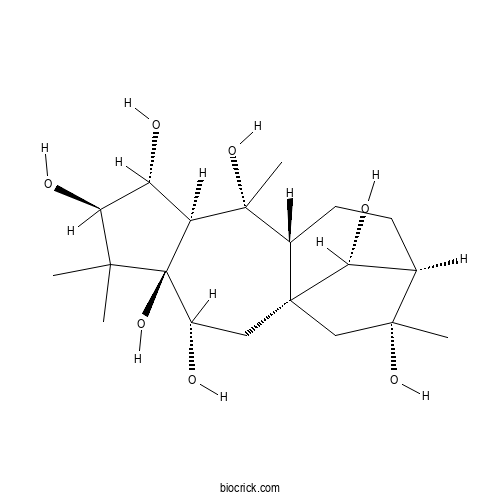
| Cas No. | 37720-87-9 | SDF | File under preparation. |
| PubChem ID | 11581815.0 | Appearance | Powder |
| Formula | C20H34O7 | M.Wt | 386.5 |
| Type of Compound | Diterpenoids | Storage | Desiccate at -20°C |
| Solubility | Soluble in Chloroform,Dichloromethane,Ethyl Acetate,DMSO,Acetone,etc. | ||
| Chemical Name | (1S,3R,4R,6R,7R,8S,9R,10R,13R,14R,16R)-5,5,9,14-tetramethyltetracyclo[11.2.1.01,10.04,8]hexadecane-3,4,6,7,9,14,16-heptol | ||
| SMILES | CC1(C(C(C2C1(C(CC34CC(C(C3O)CCC4C2(C)O)(C)O)O)O)O)O)C | ||
| Standard InChIKey | OIRQCTPPDJLTNN-IVXIYUMGSA-N | ||
| Standard InChI | InChI=1S/C20H34O7/c1-16(2)15(24)12(22)13-18(4,26)10-6-5-9-14(23)19(10,8-17(9,3)25)7-11(21)20(13,16)27/h9-15,21-27H,5-8H2,1-4H3/t9-,10+,11-,12-,13+,14-,15+,17-,18-,19+,20-/m1/s1 | ||
| General tips | For obtaining a higher solubility , please warm the tube at 37 ℃ and shake it in the ultrasonic bath for a while.Stock solution can be stored below -20℃ for several months. We recommend that you prepare and use the solution on the same day. However, if the test schedule requires, the stock solutions can be prepared in advance, and the stock solution must be sealed and stored below -20℃. In general, the stock solution can be kept for several months. Before use, we recommend that you leave the vial at room temperature for at least an hour before opening it. |
||
| About Packaging | 1. The packaging of the product may be reversed during transportation, cause the high purity compounds to adhere to the neck or cap of the vial.Take the vail out of its packaging and shake gently until the compounds fall to the bottom of the vial. 2. For liquid products, please centrifuge at 500xg to gather the liquid to the bottom of the vial. 3. Try to avoid loss or contamination during the experiment. |
||
| Shipping Condition | Packaging according to customer requirements(5mg, 10mg, 20mg and more). Ship via FedEx, DHL, UPS, EMS or other couriers with RT, or blue ice upon request. | ||
Quality Control & MSDS
3D structure
Package In Stock

Number of papers citing our products


Rhodojaponin VI Dilution Calculator
Rhodojaponin VI Molarity Calculator
| 1 mg | 5 mg | 10 mg | 20 mg | 25 mg | |
| 1 mM | 2.5873 mL | 12.9366 mL | 25.8732 mL | 51.7464 mL | 64.6831 mL |
| 5 mM | 0.5175 mL | 2.5873 mL | 5.1746 mL | 10.3493 mL | 12.9366 mL |
| 10 mM | 0.2587 mL | 1.2937 mL | 2.5873 mL | 5.1746 mL | 6.4683 mL |
| 50 mM | 0.0517 mL | 0.2587 mL | 0.5175 mL | 1.0349 mL | 1.2937 mL |
| 100 mM | 0.0259 mL | 0.1294 mL | 0.2587 mL | 0.5175 mL | 0.6468 mL |
| * Note: If you are in the process of experiment, it's necessary to make the dilution ratios of the samples. The dilution data above is only for reference. Normally, it's can get a better solubility within lower of Concentrations. | |||||
- 2-Hydroxy-2-(2-methylpropyl)butanedioic acid
Catalog No.:BCX2473
CAS No.:60924-65-4
- 11-Deoxymogrol
Catalog No.:BCX2472
CAS No.:2654048-89-0
- Propionic acid
Catalog No.:BCX2471
CAS No.:1979-09-4
- 2-Ethylhexanoic acid
Catalog No.:BCX2470
CAS No.:149-57-5
- 2-Ethylbutyric acid
Catalog No.:BCX2469
CAS No.:1988-09-5
- 5-(4-Hydroxyphenyl)pentanoic acid
Catalog No.:BCX2468
CAS No.:4654-08-4
- Azadirachtin B
Catalog No.:BCX2467
CAS No.:106500-25-8
- Pyruvic acid
Catalog No.:BCX2466
CAS No.:127-17-3
- Isofouquierol
Catalog No.:BCX2465
CAS No.:53822-99-4
- Arecoline
Catalog No.:BCX2464
CAS No.:63-75-2
- (22R)-Hydroxycholesterol
Catalog No.:BCX2463
CAS No.:17954-98-2
- (±)-Tropic acid
Catalog No.:BCX2462
CAS No.:552-63-6
- Phytolaccagenic acid 28-O-β-D-glucopyranosyl ester
Catalog No.:BCX2475
CAS No.:288303-32-2
- Moracenin D
Catalog No.:BCX2476
CAS No.:78277-79-9
- Albafuran C
Catalog No.:BCX2477
CAS No.:84323-16-0
- Kuwanon X
Catalog No.:BCX2478
CAS No.:96819-92-0
- Vitisin C
Catalog No.:BCX2479
CAS No.:180580-73-8
- Viniferol E
Catalog No.:BCX2480
CAS No.:870555-67-2
- cis-Upunaphenol K
Catalog No.:BCX2481
CAS No.:879897-47-9
- Ampelopsin BF
Catalog No.:BCX2482
CAS No.:482304-83-6
- Queretaroic acid 28-O-β-D-glucopyranosyl ester
Catalog No.:BCX2483
CAS No.:1389354-39-5
- Rhodomollein I
Catalog No.:BCX2484
CAS No.:126223-68-5
- α-Isopropylmalate
Catalog No.:BCX2485
CAS No.:3237-44-3
- Coclaurine hydrochloride
Catalog No.:BCX2486
CAS No.:3422-42-2
Analgesic Grayanane-Derived Diterpenoids from the Flowers of Rhododendron molle.[Pubmed:40067880]
J Nat Prod. 2025 Mar 28;88(3):671-681.
Ten new grayanane-derived diterpenoids, rhodomollein LVII-LXVI (1-10), along with the known compound rhodomollein XLIII (11), were isolated from the flowers of Rhododendron molle. Their structures were elucidated by detailed spectroscopic analysis, X-ray diffraction crystallography, and ECD calculations. Rhodomollein LVII-LIX (1-3) are the first-discovered 3-O-(E)-p-coumaroylquinic acid, nicotinic acid, and 2-furoic acid derivatives of grayanane diterpenoids, respectively. In an acetic acid-induced writhing test, compounds 1 and 3 demonstrated significant antinociceptive effects with writhing inhibition rates of 77.2% and 71.5%, respectively, at a dose of 0.2 mg/kg. Compound 1 was found to be twice as potent as morphine, exhibiting significantly lower toxicity (LD(50) = 130.90 mg/kg, i.p.) compared to Rhodojaponin VI (LD(50) = 1.79 mg/kg, i.p.).
Rhodojaponin VI ameliorates podocyte injury related with MDM2/Notch1 pathway in rat experimental membranous nephropathy.[Pubmed:39011853]
Nephrology (Carlton). 2024 Sep;29(9):555-564.
AIM: Rhodojaponin VI (R-VI) is the key compound of Rhododendron molle G. Don (Ericaceae) (RM) with effective clinical application in rheumatoid arthritis and chronic glomerulonephritis. In our study, we tried to explore the effect of R-VI on the rat model of membranous nephropathy. METHODS: The rat model of passive heymann nephritis (PHN) was established by injecting sheep anti-rat Fx1A serum at a single dose through the tail. The rats were orally administered R-VI (0.02 mg/kg) or FK506 (1 mg/kg) 1 day before PHN induction, which was kept for 4 weeks. Urine and blood samples as well as kidney tissue were collected for analysis. C5b-9-induced human podocyte cell (HPC) was employed for experiments in vitro. RESULTS: R-VI could alleviate glomerulonephritis progression and podocyte injury in PHN rats, as indicated by the decreased proteinuria and the elevated level of albumin, accompanied with reduced immune deposits, reversed podocyte injury in the kidneys. Furthermore, R-VI suppressed murine double minute 2 (MDM2) expression without the alteration in the protein level of p53 and decreased Notch1 expression independent of Numb regulation. Pre-treatment with R-VI in C5b-9-induced HPC blocked MDM2/Notch1 signalling pathway. CONCLUSION: Thus, R-VI ameliorates podocyte injury in rats with PHN, which was probably related with MDM2/Notch1 signalling pathway.
Evaluation of Rhododendri Mollis Flos and its representative component as a potential analgesic.[Pubmed:38668831]
J Nat Med. 2024 Jun;78(3):753-767.
Rhododendri Mollis Flos (R. mole Flos), the dried flowers of Rhododendron mole G. Don, have the ability to relieve pain, dispel wind and dampness, and dissolve blood stasis, but they are highly poisonous. The significance of this study is to explore the analgesic application potential of R. mole Flos and its representative component. According to the selected processing methods recorded in ancient literature, the analgesic activities of wine- and vinegar-processed R. mole Flos, as well as the raw product, were evaluated in a writhing test with acetic acid and a formalin-induced pain test. Subsequently, the HPLC-TOP-MS technique was utilized to investigate the changes in active components before and after processing once the variations in activities were confirmed. Based on the results, Rhodojaponin VI (RJ-Vl) was chosen for further study. After processing, especially in vinegar, R. mole Flos did not only maintain the anti-nociception but also showed reduced toxicity, and the chemical composition corresponding to these effects also changed significantly. Further investigation of its representative components revealed that RJ-VI has considerable anti-nociceptive activity, particularly in inflammatory pain (0.3 mg/kg) and peripheral neuropathic pain (0.6 mg/kg). Its toxicity was about three times lower than that of rhodojaponin III, which is another representative component of R. mole Flos. Additionally, RJ-VI mildly inhibits several subtypes of voltage-gated sodium channels (IC(50) > 200 muM) that are associated with pain or cardiotoxicity. In conclusion, the chemical substances and biological effects of R. mole Flos changed significantly before and after processing, and the representative component RJ-VI has the potential to be developed into an effective analgesic.
Discovery of highly functionalized grayanane diterpenoids from the flowers of Rhododendron molle as potent analgesics.[Pubmed:37922768]
Bioorg Chem. 2024 Jan;142:106928.
A systematical investigation on the chemical constituents of the flowers of Rhododendron molle (Ericaceae) led to the isolation and characterization of thirty-eight highly functionalized grayanane diterpenoids (1-38), including twelve novel analogues molleblossomins A-L (1-12). Their structures were elucidated by comprehensive methods, including 1D and 2D NMR analysis, calculated ECD, (13)C NMR calculations with DP4+ probability analysis, and single crystal X-ray diffraction. Molleblossomins A (1), B (2), and E (5) are the first representatives of 2beta,3beta:9beta,10beta-diepoxygrayanane, 2,3-epoxygrayan-9(11)-ene, and 5,9-epoxygrayan-1(10),2(3)-diene diterpenoids, respectively. Molleblossomins G (7) and H (8) represent the first examples of 1,3-dioxolane-grayanane conjugates furnished with the acetaldehyde and 4-hydroxylbenzylidene acetal moieties, respectively. All grayanane diterpenoids 1-38 were screened for their analgesic activities in the acetic acid-induced writhing model, and all of them exhibited significant analgesic activities. Diterpenoids 6, 13, 14, 17, 20, and 25 showed more potent analgesic effects than morphine at a lower dose of 0.2 mg/kg, with the inhibition rates of 51.4%, 68.2%, 94.1%, 66.9%, 97.7%, and 60.0%, respectively. More importantly, even at the lowest dose of 0.04 mg/kg, rhodomollein X (14), Rhodojaponin VI (20), and Rhodojaponin VII (22) still significantly reduced the number of writhes in the acetic acid-induced pain model with the percentages of 61.7%, 85.8%, and 64.6%, respectively. The structure-activity relationship was summarized and might provide some hints to design novel analgesics based on the functionalized grayanane diterpenoids.
Rhodojaponin VI indirectly targets Cav2.2 channels via N-ethylmaleimide-sensitive fusion protein to alleviate neuropathic pain.[Pubmed:36970201]
Acta Pharm Sin B. 2023 Mar;13(3):1326-1336.
Neuropathic pain is a chronic disease that severely afflicts the life and emotional status of patients, but currently available treatments are often ineffective. Novel therapeutic targets for the alleviation of neuropathic pain are urgently needed. Rhodojaponin VI, a grayanotoxin from Rhododendron molle, showed remarkable antinociceptive efficacy in models of neuropathic pain, but its biotargets and mechanisms are unknown. Given the reversible action of Rhodojaponin VI and the narrow range over which its structure can be modified, we perforwmed thermal proteome profiling of the rat dorsal root ganglion to determine the protein target of Rhodojaponin VI. N-Ethylmaleimide-sensitive fusion (NSF) was confirmed as the key target of Rhodojaponin VI through biological and biophysical experiments. Functional validation showed for the first time that NSF facilitated trafficking of the Cav2.2 channel to induce an increase in Ca(2+) current intensity, whereas Rhodojaponin VI reversed the effects of NSF. In conclusion, Rhodojaponin VI represents a unique class of analgesic natural products targeting Cav2.2 channels via NSF.
Anti-rheumatoid arthritis potential of diterpenoid fraction derived from Rhododendron molle fruits.[Pubmed:33781451]
Chin J Nat Med. 2021 Mar;19(3):181-187.
Rhododendron molle G. Don is first recorded in Shengnong's Herbal Classic, and its fruits, which are termed as Liuzhouzi, are often used to treat rheumatoid arthritis in Chinese folk. During our ongoing investigation to develop a safer and potential new arthritis therapy, a process for the preparation of diterpenoid fraction from Rhododendron mollefruits was established. In order to evaluate the main components and the anti-rheumatoid arthritis effect of the diterpenoid fraction, phytochemical and pharmacological experiments were used. As the result, the main components of diterpenoid fraction were identified as rhodojaponin III (1), Rhodojaponin VI (2), 2-O-methylrhodojaponin (3), and 5'-beta-D-glucopyranosy-loxyjasmonic acid (4). These four components constitute greater than 95% of diterpenoid fraction using area normalization method of HPLC-ELSD. The results of CIA rat experiment showed that high dose of diterpenoid fraction (0.6 mg.kg(-1).d(-1)) significantly alleviated the symptoms of rheumatoid arthritis, similar to tripterygium polyglycosides, an effective RA therapy. Preliminary mechanism studies indicated that diterpenoid fraction significantly inhibited the abnormal proliferation of T and B lymphocytes, and remarkably reduced the levels of pro-inflammatory cytokines IL-6, IL-1beta and TNF-alpha. Overall, our findings may provide a more effective and safe alternative treatment for RA using common clinical Chinese medicines like tripterygium polyglycosides.
Antinociceptive Grayanane Diterpenoids from the Leaves of Pieris japonica.[Pubmed:31809052]
J Nat Prod. 2019 Dec 27;82(12):3330-3339.
Thirteen new grayanane diterpenoids (1-13) and 15 known analogues (14-28) were isolated from a leaf extract of Pieris japonica. Their structures were determined by spectrometric and spectroscopic methods, including HRESIMS, NMR, IR, and UV. The absolute configurations of 1, 3, 7-9, and 16 were defined by single-crystal X-ray diffraction analysis. 17-Hydroxygrayanotoxin XIX (1) represents the first example of a 17-hydroxygrayan-15(16)-ene diterpenoid. Diterpenoids 1-28 were evaluated for their antinociceptive activities, and 4, 9, 13, 21, and 26-28 displayed significant antinociceptive activities at a dose of 5.0 mg/kg (ip) in the HOAc-induced writhing test in mice. 17-Hydroxygrayanotoxin XIX (1) exhibited potent antinociceptive effects with writhe inhibition rates of 56.3% and 64.8% at doses of 0.04 and 0.2 mg/kg, respectively, which were almost equivalent to the positive control, morphine. Rhodomollein X (26) and Rhodojaponin VI (27) showed more potent antinociceptive effects than morphine at doses of 0.04 and 0.2 mg/kg. A preliminary structure-activity relationship for the antinociceptive effects of diterpenoids 1-28 is discussed.
Tandem solid-phase extraction followed by HPLC-ESI/QTOF/MS/MS for rapid screening and structural identification of trace diterpenoids in flowers of Rhododendron molle.[Pubmed:24453183]
Phytochem Anal. 2014 May-Jun;25(3):255-65.
INTRODUCTION: 'Naoyanghua', composed of the flowers of Rhododendron molle G. Don, is a traditional Chinese medicine that is widely known for its toxicity. Grayanane-type diterpenoids are the main active ingredients in R. molle, as well as possibly their toxicity: they are, however, difficult to isolate and analyse using common chromatographic methods, due to their small amounts and absence of conjugated groups, such as phenyl and alpha, beta-unsaturated ketone. OBJECTIVE: To establish a highly sensitive, selective and reliable method for the qualitative evaluation of trace diterpenoids in the flowers of R. molle by using tandem solid-phase extraction followed by high-performance liquid chromatography with electrospray ionisation quadrupole-time-of-flight mass spectrometry (HPLC-ESI/QTOF/MS/MS). METHODS: Tandem solid phase extraction (SPE) was undertaken using a polyamide cartridge and a C18E cartridge in succession to enrich the trace diterpenoids. HPLC-ESI/QTOF/MS/MS was used to determine the fragmentation patterns of diterpenoids and to tentatively characterise their fragmentation pathways. RESULTS: HPLC-ESI/QTOF/MS/MS detected a total of 14 diterpenoids, eight of which were identified by comparison with literature sources and six based on fragmentation analysis. Among the latter six, Rhodojaponin VI-3-glucoside was tentatively identified as a new diterpenoid glycoside and Rhodojaponin VII, rhodojaponin IV and rhodojaponin I were reported from R. molle for the first time. CONCLUSION: By qualitative research of diterpenoids in this plant by HPLC-ESI/QTOF/MS/MS, a reliable methodology for the analysis of these active constituents of R. molle was established for the first time.

Calcutta University

University of Minnesota

University of Maryland School of Medicine

University of Illinois at Chicago

The Ohio State University

University of Zurich

Harvard University

Colorado State University

Auburn University

Yale University

Worcester Polytechnic Institute

Washington State University

Stanford University

University of Leipzig

Universidade da Beira Interior

The Institute of Cancer Research

Heidelberg University

University of Amsterdam

University of Auckland

TsingHua University

The University of Michigan

Miami University

DRURY University

Jilin University

Fudan University

Wuhan University

Sun Yat-sen University

Universite de Paris

Deemed University

Auckland University

The University of Tokyo

Korea University



