
Azadirachtin BCAS# 106500-25-8 |
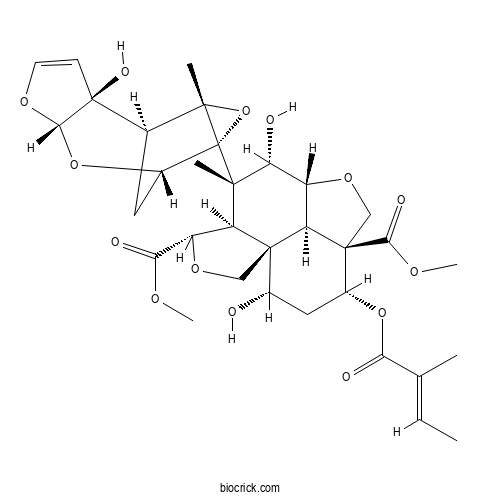
| Cas No. | 106500-25-8 | SDF | File under preparation. |
| PubChem ID | 21725521.0 | Appearance | Powder |
| Formula | C33H42O14 | M.Wt | 662.7 |
| Type of Compound | N/A | Storage | Desiccate at -20°C |
| Solubility | Soluble in Chloroform,Dichloromethane,Ethyl Acetate,DMSO,Acetone,etc. | ||
| Chemical Name | dimethyl (1S,4S,5R,6S,7S,8R,11S,12R,14S,15R)-7,14-dihydroxy-6-[(1S,2S,6S,8S,9R,11S)-2-hydroxy-11-methyl-5,7,10-trioxatetracyclo[6.3.1.02,6.09,11]dodec-3-en-9-yl]-6-methyl-12-[(E)-2-methylbut-2-enoyl]oxy-3,9-dioxatetracyclo[6.6.1.01,5.011,15]pentadecane-4,11-dicarboxylate | ||
| SMILES | CC=C(C)C(=O)OC1CC(C23COC(C2C(C(C4C3C1(CO4)C(=O)OC)O)(C)C56C7CC(C5(O6)C)C8(C=COC8O7)O)C(=O)OC)O | ||
| Standard InChIKey | USRBWQQLHKQWAV-ZGKQVQOISA-N | ||
| Standard InChI | InChI=1S/C33H42O14/c1-7-14(2)24(36)45-17-11-16(34)30-12-44-20(25(37)40-5)21(30)28(3,23(35)19-22(30)31(17,13-43-19)26(38)41-6)33-18-10-15(29(33,4)47-33)32(39)8-9-42-27(32)46-18/h7-9,15-23,27,34-35,39H,10-13H2,1-6H3/b14-7+/t15-,16+,17-,18+,19-,20+,21+,22-,23-,27+,28+,29+,30-,31+,32+,33+/m1/s1 | ||
| General tips | For obtaining a higher solubility , please warm the tube at 37 ℃ and shake it in the ultrasonic bath for a while.Stock solution can be stored below -20℃ for several months. We recommend that you prepare and use the solution on the same day. However, if the test schedule requires, the stock solutions can be prepared in advance, and the stock solution must be sealed and stored below -20℃. In general, the stock solution can be kept for several months. Before use, we recommend that you leave the vial at room temperature for at least an hour before opening it. |
||
| About Packaging | 1. The packaging of the product may be reversed during transportation, cause the high purity compounds to adhere to the neck or cap of the vial.Take the vail out of its packaging and shake gently until the compounds fall to the bottom of the vial. 2. For liquid products, please centrifuge at 500xg to gather the liquid to the bottom of the vial. 3. Try to avoid loss or contamination during the experiment. |
||
| Shipping Condition | Packaging according to customer requirements(5mg, 10mg, 20mg and more). Ship via FedEx, DHL, UPS, EMS or other couriers with RT, or blue ice upon request. | ||
Quality Control & MSDS
3D structure
Package In Stock

Number of papers citing our products


Azadirachtin B Dilution Calculator
Azadirachtin B Molarity Calculator

| 1 mg | 5 mg | 10 mg | 20 mg | 25 mg | |
| 1 mM | 1.509 mL | 7.5449 mL | 15.0898 mL | 30.1796 mL | 37.7245 mL |
| 5 mM | 0.3018 mL | 1.509 mL | 3.018 mL | 6.0359 mL | 7.5449 mL |
| 10 mM | 0.1509 mL | 0.7545 mL | 1.509 mL | 3.018 mL | 3.7724 mL |
| 50 mM | 0.0302 mL | 0.1509 mL | 0.3018 mL | 0.6036 mL | 0.7545 mL |
| 100 mM | 0.0151 mL | 0.0754 mL | 0.1509 mL | 0.3018 mL | 0.3772 mL |
| * Note: If you are in the process of experiment, it's necessary to make the dilution ratios of the samples. The dilution data above is only for reference. Normally, it's can get a better solubility within lower of Concentrations. | |||||
- Pyruvic acid
Catalog No.:BCX2466
CAS No.:127-17-3
- Isofouquierol
Catalog No.:BCX2465
CAS No.:53822-99-4
- Arecoline
Catalog No.:BCX2464
CAS No.:63-75-2
- (22R)-Hydroxycholesterol
Catalog No.:BCX2463
CAS No.:17954-98-2
- (±)-Tropic acid
Catalog No.:BCX2462
CAS No.:552-63-6
- 8-Methoxynaringenin
Catalog No.:BCX2461
CAS No.:94884-92-1
- Escin IVc
Catalog No.:BCX2460
CAS No.:249921-71-9
- Galangin 5-methyl ether
Catalog No.:BCX2459
CAS No.:104594-69-6
- Maltol glucoside
Catalog No.:BCX2458
CAS No.:20847-13-6
- Swertiajaponin 2''-O-rhamnoside
Catalog No.:BCX2457
CAS No.:75474-16-7
- Escin IVf
Catalog No.:BCX2456
CAS No.:249922-20-1
- Bisphenol A bis(2,3-dihydroxypropyl)ether
Catalog No.:BCX2455
CAS No.:5581-32-8
- 5-(4-Hydroxyphenyl)pentanoic acid
Catalog No.:BCX2468
CAS No.:4654-08-4
- 2-Ethylbutyric acid
Catalog No.:BCX2469
CAS No.:1988-09-5
- 2-Ethylhexanoic acid
Catalog No.:BCX2470
CAS No.:149-57-5
- Propionic acid
Catalog No.:BCX2471
CAS No.:1979-09-4
- 11-Deoxymogrol
Catalog No.:BCX2472
CAS No.:2654048-89-0
- 2-Hydroxy-2-(2-methylpropyl)butanedioic acid
Catalog No.:BCX2473
CAS No.:60924-65-4
- Rhodojaponin VI
Catalog No.:BCX2474
CAS No.:37720-87-9
- Phytolaccagenic acid 28-O-β-D-glucopyranosyl ester
Catalog No.:BCX2475
CAS No.:288303-32-2
- Moracenin D
Catalog No.:BCX2476
CAS No.:78277-79-9
- Albafuran C
Catalog No.:BCX2477
CAS No.:84323-16-0
- Kuwanon X
Catalog No.:BCX2478
CAS No.:96819-92-0
- Vitisin C
Catalog No.:BCX2479
CAS No.:180580-73-8
Evaluation of Apoptosis and Autophagy Inducing Potential of Berberis aristata, Azadirachta indica, and Their Synergistic Combinations in Parental and Resistant Human Osteosarcoma Cells.[Pubmed:29312880]
Front Oncol. 2017 Dec 11;7:296.
Cancer is a multifactorial disease and hence can be effectively overcome by a multi-constituently therapeutic strategy. Medicinal plant extracts represent a perfect example of such stratagem. However, minimal studies have been done till date that portray the effect of extraction techniques on the phyto-constituent profile of plant extracts and its impact on anticancer activity. In the present study, we have evaluated the anticancer potential of methanolic extracts of Berberis aristata root and Azadirachta indica seeds prepared by various extraction techniques in human osteosarcoma (HOS) cells. Soxhlation extract of B. aristata (BAM-SX) and sonication extract of A. indica (AIM-SO) were most effective in inducing apoptosis in parental drug sensitive, as well as resistant cell type developed by repeated drug exposure. Generation of reactive oxygen species and cell cycle arrest preceded caspase-mediated apoptosis in HOS cells. Interestingly, inhibition of autophagy enhanced cell death suggesting the cytoprotective role of autophagy. Combination studies of different methanolic extracts of BAM and AIM were performed, among which, the combination of BAM-SO and AIM-SO (BAAISO) was found to show synergism (IC(50) 10.27 microg/ml) followed by combination of BAM-MC and AIM-MC (BAAIMC) with respect to other combinations in the ratio of 1:1. BAAISO also showed synergism when it was added to cisplatin-resistant HOS cells (HCR). Chromatographic profiling of BAM-SX and AIM-SO by high performance thin layer chromatography resulted in identification of berberine (R(f) 0.55), palmitine (R(f) 0.50) in BAM-SX and azadirachtin A (R(f) 0.36), Azadirachtin B (R(f) 0.56), nimbin (R(f) 0.80), and nimbolide (R(f) 0.43) in AIM-SO. The cytotoxic sensitivity obtained can be attributed to the above compounds. Our results highlight the importance of extraction technique and subsequent mechanism of action of multi-constituential B. aristata and A. indica against both sensitive and drug refractory HOS cells.
Azadirachta indica triterpenoids promote osteoblast differentiation and mineralization in vitro and in vivo.[Pubmed:27317644]
Bioorg Med Chem Lett. 2016 Aug 1;26(15):3719-24.
Terpenoids were isolated using chromatographic purification through solvent purification technique and identified as Azadirone (1), Epoxyazadiradione (2) Azadiradione (3) Gedunin (4) Nimbin (5) Salannin (6) Azadirachtin A (7) and Azadirachtin B (8) from Azadirachta indica. Out of eight compounds, only three compounds had osteogenic activity and enhanced osteoblast proliferation, differentiation and mineralization in osteoblast cells. Active compounds stimulated osteogenic genes ALP, RunX-2 and OCN expressions in vitro, but Azadirachtin A had a maximum ability to stimulate osteoblast differentiation and mineralization compared to other two active compounds. For in vivo study, Azadirachtin A injected subcutaneously in pups, which enhanced osteogenic gene expressions and promoted bone formation rate significantly. Here, we conclude that active compounds of Azadirachta indica have osteogenic activity and Azadirachtin A has a beneficial effects on bone.
Melanogenesis inhibitory, anti-inflammatory, and chemopreventive effects of limonoids from the seeds of Azadirachta indicia A. Juss. (neem).[Pubmed:19844073]
J Oleo Sci. 2009;58(11):581-94.
Thirty-one nortriterpenoids, including 28 limonoids (1-28) and 3 degraded limonoids (29-31), and one diterpenoid (32), were isolated from the seed extract of Azadirachta indica (neem). Among these, six were new compounds and their structures were established to be 15-hydroxyazadiradione (3), 7-benzoyl-17-hydroxynimbocinol (5), 23-deoxyazadironolide (12), limocin E (13), 23-epilimocin E (14), and 7alpha-acetoxy-3-oxoisocopala-1,13-dien-15-oic acid (32). Upon evaluation of compounds 1-32 on the melanogenesis in the B16 melanoma cells, five compounds, 20, 26, 27, 29, and 31, exhibited marked inhibitory effect (74-91% reduction of melanin content at 25 microg/mL) with no or almost no toxicity to the cells. Seven compounds, 1, 6, 9, 10, 18, 20, and 26, on evaluation for their inhibitory effect against 12-O-tetradecanoylphorbol-13-acetate (TPA)-induced inflammation (1 microg/ear) in mice, exhibited, except for compound 26, marked anti-inflammatory activity (ID(50) values 0.09-0.26 mg/ear). In addition, all of the 32 compounds exhibited moderate or potent inhibitory effects (IC(50) values of 230-501 mol ratio/32 pmol TPA) against the Epstein-Barr virus early antigen (EBV-EA) activation induced by TPA. Furthermore, on evaluation of Azadirachtin B (21) for its anti-tumor-initiating activity on the two-stage carcinogenesis of mouse skin tumor induced by peroxynitrite (ONOO-; PN) as an initiator and TPA as a promoter, this exhibited marked inhibitory activity.
Purification of the seven tetranortriterpenoids in neem (Azadirachta indica) seed by counter-current chromatography sequentially followed by isocratic preparative reversed-phase high-performance liquid chromatography.[Pubmed:17428489]
J Chromatogr A. 2007 Jun 1;1151(1-2):203-10.
Counter-current chromatography (CCC) sequentially followed by isocratic preparative reversed-phase high-performance liquid chromatography was used to isolate the seven bio-actives (azadirachtin A, Azadirachtin B, azadirachtin H, desacetylnimbin, desacetylsalannin, nimbin and salannin) from the seed concentrate (NSC) of the neem tree (Azadirachta indica A. Juss). Reproducible, narrow polarity range, high purity fractions were obtained from repeated injections of the NSC (700 mg loadings/injection), on to a relatively small volume CCC coil (116 mL). The CCC biphasic solvent system chosen was hexane:butanol:methanol:water (1:0.9:1:0.9, v/v). A mass balance of injected material showed that 95+% were recovered.
Residues and persistence of neem formulations on strawberry after field treatment.[Pubmed:17177537]
J Agric Food Chem. 2006 Dec 27;54(26):10026-32.
Azadirachtoids were determined by liquid chromatography/mass spectrometry (LC/MS) in five methanolic seed extracts of the neem tree and in a commercial formulation. On average, seed extracts contain azadirachtin A (10.9%), Azadirachtin B (3.5%), nimbin (10.4%), and large quantities of salannin (19.0%). The composition of the commercial formulations may present different azadirachtoids contents depending on the natural extracts used in the preparation. Because these compounds may also show insecticide activity, the efficacy on field of these formulations may be very different. Photodegradation of pure azadirachtoids was also studied. Azadirachtins and related compounds are very sensitive to sunlight, degrading rapidly, with half-lives of the order of 11.3 h for azadirachtin A and 5.5 h for Azadirachtin B and few minutes for the other limonoids compounds studied. The residues of azadirachtins and the main constituents, e.g., salannin, nimbin, deacetylnimbin, and deacetylsalannin, of the neem seed extract were determined on strawberries after field treatment using two different formulations. This residue study on strawberry was carried out to assess not only the azadirachtin content but also the main azadirachtoids contents. Three days after field application at five times the dose recommended by the manufacturer, residues of azadirachtin A and B were 0.03 and 0.01 mg/kg, respectively, while residues of salannin (LOQ 0.01 mg/kg) and nimbin (LOQ 0.5 mg/kg) were not detectable.
Soil application of azadirachtin and 3-tigloyl-azadirachtol to control western flower thrips, Frankliniella occidentalis (Thysanoptera: Thripidae): translocation and persistence in bean plants.[Pubmed:16752388]
Pest Manag Sci. 2006 Aug;62(8):759-67.
To study the systemic effects of active neem ingredients, the substrate of bean plants was treated with a 170 g kg(-1) azadirachtin (NeemAzal-U; Trifolio-M GmbH, Lahnau, Germany, registration pending). This product was used at a dose rate of 10 mg AZA (azadirachtin a) and 1.2 mg 3-tigloyl-azadirachtol (Azadirachtin B) per treated bean plant. Afterwards, the translocation and persistence of AZA and 3-tigloyl-azadirachtol and the effects on western flower thrips, Frankliniella occidentalis (Pergande), were studied. Residues of AZA and 3-tigloyl-azadirachtol from substrates with different contents of organic matter [pure culture substrate (CS), CS-sand mixture] and from various plant parts were quantified by high-performance liquid chromatography-mass spectrometry (HPLC-MS). The dissipation trends of AZA and 3-tigloyl-azadirachtol were similar within the same substrates. A slower decline of both active ingredients was measured with CS than with CS-sand mixture. Residue analysis of the bean plants showed that only small proportions of the initial amounts of AZA and 3-tigloyl-azadirachtol applied to the substrate were present in the plant (0.3-8.1%). Variable amounts of residues of the active components in relation to plant parts and time of analysis indicated a different translocation pattern for the two active ingredients. Higher residues of the active ingredients were found in roots and stems after neem application using CS, whereas higher residues were found in leaves after CS-sand mixture treatments. Mortality of F. occidentalis after NeemAzal-U soil applications reached up to 95% on CS-sand mixture, compared with 86% in CS.
Azadirachtin derivatives from seed kernels of Azadirachta excelsa.[Pubmed:16038546]
J Nat Prod. 2005 Jul;68(7):1047-50.
Three new azadirachtin derivatives, named azadirachtins O-Q (1-3), along with the known Azadirachtin B (4), azadirachtin L (5), azadirachtin M (6) 11alpha-azadirachtin H (7), 11beta-azadirachtin H (8), and azadirachtol (9) were isolated from seed kernels of Azadirachta excelsa. Their structures were established by spectroscopic techniques, and the structure of 3 was confirmed by X-ray analysis. Compounds 1-7 and 9 exhibited toxicity to the diamondback moth (Plutella xylostella) with an LD50 of 0.75-1.92 microg/g body weight, in 92 h.
Fate and effects of azadirachtin in aquatic mesocosms--1: fate in water and bottom sediments.[Pubmed:15327874]
Ecotoxicol Environ Saf. 2004 Oct;59(2):186-93.
The fate and effects of azadirachtin were examined using in situ enclosures deployed in a typical forest pond of northern Ontario. A commercial azadirachtin-based insecticide formulation, Neemix 4.5, was applied as the test substance. Fate studies were conducted to determine kinetics and persistence of azadirachtin isomers A and B in the aqueous phase and whether either isomer partitioned significantly to bottom sediments or pore water. Aqueous azadirachtin residues dissipated following slow linear kinetics with time to 50% dissipation of 25, 45, and 30 days for azadirachtin A, Azadirachtin B, and total residues, respectively. Sediment pore water concentrations increased slowly, reaching low-level equilibrium with the overlying water column toward the end of the summer season. No significant sorption to bottom sediments was observed. Results demonstrated that fate and dissipation of azadirachtin residues are consistent from year to year and that biota may be chronically exposed to diminishing levels of azadirachtins A and B in aqueous phase under conditions of a typical forest pond environment.

Calcutta University

University of Minnesota

University of Maryland School of Medicine

University of Illinois at Chicago

The Ohio State University

University of Zurich

Harvard University

Colorado State University

Auburn University

Yale University

Worcester Polytechnic Institute

Washington State University

Stanford University

University of Leipzig

Universidade da Beira Interior

The Institute of Cancer Research

Heidelberg University

University of Amsterdam

University of Auckland

TsingHua University

The University of Michigan

Miami University

DRURY University

Jilin University

Fudan University

Wuhan University

Sun Yat-sen University

Universite de Paris

Deemed University

Auckland University

The University of Tokyo

Korea University



