
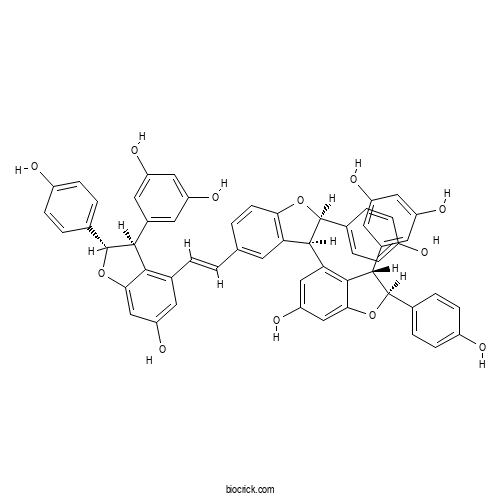
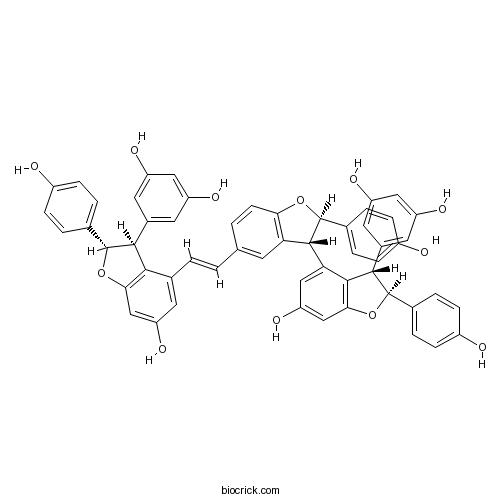
Vitisin CCAS# 180580-73-8 |
| Cas No. | 180580-73-8 | SDF | File under preparation. |
| PubChem ID | 16145527.0 | Appearance | Powder |
| Formula | C56H42O12 | M.Wt | 906.9 |
| Type of Compound | N/A | Storage | Desiccate at -20°C |
| Solubility | Soluble in Chloroform,Dichloromethane,Ethyl Acetate,DMSO,Acetone,etc. | ||
| Chemical Name | 5-[(2S,3S)-4-[(E)-2-[(2R,3S)-3-[(2S,3S)-3-(3,5-dihydroxyphenyl)-6-hydroxy-2-(4-hydroxyphenyl)-2,3-dihydro-1-benzofuran-4-yl]-2-(4-hydroxyphenyl)-2,3-dihydro-1-benzofuran-5-yl]ethenyl]-6-hydroxy-2-(4-hydroxyphenyl)-2,3-dihydro-1-benzofuran-3-yl]benzene-1,3-diol | ||
| SMILES | C1=CC(=CC=C1C2C(C3=C(C=C(C=C3O2)O)C=CC4=CC5=C(C=C4)OC(C5C6=C7C(C(OC7=CC(=C6)O)C8=CC=C(C=C8)O)C9=CC(=CC(=C9)O)O)C1=CC=C(C=C1)O)C1=CC(=CC(=C1)O)O)O | ||
| Standard InChIKey | WZKKRZSJTLGPHH-WHSOPTDBSA-N | ||
| Standard InChI | InChI=1S/C56H42O12/c57-35-10-4-29(5-11-35)54-50(33-19-38(60)23-39(61)20-33)49-32(18-42(64)26-47(49)67-54)3-1-28-2-16-46-44(17-28)52(56(66-46)31-8-14-37(59)15-9-31)45-25-43(65)27-48-53(45)51(34-21-40(62)24-41(63)22-34)55(68-48)30-6-12-36(58)13-7-30/h1-27,50-52,54-65H/b3-1+/t50-,51-,52+,54+,55+,56-/m0/s1 | ||
| General tips | For obtaining a higher solubility , please warm the tube at 37 ℃ and shake it in the ultrasonic bath for a while.Stock solution can be stored below -20℃ for several months. We recommend that you prepare and use the solution on the same day. However, if the test schedule requires, the stock solutions can be prepared in advance, and the stock solution must be sealed and stored below -20℃. In general, the stock solution can be kept for several months. Before use, we recommend that you leave the vial at room temperature for at least an hour before opening it. |
||
| About Packaging | 1. The packaging of the product may be reversed during transportation, cause the high purity compounds to adhere to the neck or cap of the vial.Take the vail out of its packaging and shake gently until the compounds fall to the bottom of the vial. 2. For liquid products, please centrifuge at 500xg to gather the liquid to the bottom of the vial. 3. Try to avoid loss or contamination during the experiment. |
||
| Shipping Condition | Packaging according to customer requirements(5mg, 10mg, 20mg and more). Ship via FedEx, DHL, UPS, EMS or other couriers with RT, or blue ice upon request. | ||
Quality Control & MSDS
3D structure
Package In Stock

Number of papers citing our products


Vitisin C Dilution Calculator
Vitisin C Molarity Calculator
-
 Vitisin BCatalog No.: BCN6697CAS No.: 142449-90-9
-
 cis-Miyabenol CCatalog No.: BCN3347CAS No.: 168037-22-7
-
 epsilon-ViniferinCatalog No.: BCN4151CAS No.: 62218-08-0
-
 ViniferinCatalog No.: BCN3757CAS No.: 253435-07-3
-
 cis-ε-ViniferinCatalog No.: BCN0640CAS No.: 62250-12-8
-
 Vitisin ACatalog No.: BCN9557CAS No.: 142449-89-6
-
 Gnetin DCatalog No.: BCN3380CAS No.: 84870-53-1
| 1 mg | 5 mg | 10 mg | 20 mg | 25 mg | |
| 1 mM | 1.1027 mL | 5.5133 mL | 11.0266 mL | 22.0531 mL | 27.5664 mL |
| 5 mM | 0.2205 mL | 1.1027 mL | 2.2053 mL | 4.4106 mL | 5.5133 mL |
| 10 mM | 0.1103 mL | 0.5513 mL | 1.1027 mL | 2.2053 mL | 2.7566 mL |
| 50 mM | 0.0221 mL | 0.1103 mL | 0.2205 mL | 0.4411 mL | 0.5513 mL |
| 100 mM | 0.011 mL | 0.0551 mL | 0.1103 mL | 0.2205 mL | 0.2757 mL |
| * Note: If you are in the process of experiment, it's necessary to make the dilution ratios of the samples. The dilution data above is only for reference. Normally, it's can get a better solubility within lower of Concentrations. | |||||
- Kuwanon X
Catalog No.:BCX2478
CAS No.:96819-92-0
- Albafuran C
Catalog No.:BCX2477
CAS No.:84323-16-0
- Moracenin D
Catalog No.:BCX2476
CAS No.:78277-79-9
- Phytolaccagenic acid 28-O-β-D-glucopyranosyl ester
Catalog No.:BCX2475
CAS No.:288303-32-2
- Rhodojaponin VI
Catalog No.:BCX2474
CAS No.:37720-87-9
- 2-Hydroxy-2-(2-methylpropyl)butanedioic acid
Catalog No.:BCX2473
CAS No.:60924-65-4
- 11-Deoxymogrol
Catalog No.:BCX2472
CAS No.:2654048-89-0
- Propionic acid
Catalog No.:BCX2471
CAS No.:1979-09-4
- 2-Ethylhexanoic acid
Catalog No.:BCX2470
CAS No.:149-57-5
- 2-Ethylbutyric acid
Catalog No.:BCX2469
CAS No.:1988-09-5
- 5-(4-Hydroxyphenyl)pentanoic acid
Catalog No.:BCX2468
CAS No.:4654-08-4
- Azadirachtin B
Catalog No.:BCX2467
CAS No.:106500-25-8
- Viniferol E
Catalog No.:BCX2480
CAS No.:870555-67-2
- cis-Upunaphenol K
Catalog No.:BCX2481
CAS No.:879897-47-9
- Ampelopsin BF
Catalog No.:BCX2482
CAS No.:482304-83-6
- Queretaroic acid 28-O-β-D-glucopyranosyl ester
Catalog No.:BCX2483
CAS No.:1389354-39-5
- Rhodomollein I
Catalog No.:BCX2484
CAS No.:126223-68-5
- α-Isopropylmalate
Catalog No.:BCX2485
CAS No.:3237-44-3
- Coclaurine hydrochloride
Catalog No.:BCX2486
CAS No.:3422-42-2
- 3'-Hydroxyphenylacetic acid
Catalog No.:BCX2487
CAS No.:621-37-4
- 2-Oxoglutaric acid
Catalog No.:BCX2488
CAS No.:328-50-7
- 3,4-O-Dimethylgallic acid
Catalog No.:BCX2489
CAS No.:1916-08-1
- 3,5-Dimethoxybenzoic acid
Catalog No.:BCX2490
CAS No.:1132-21-4
- 3-Hydroxy-5-methoxybenzoic acid
Catalog No.:BCX2491
CAS No.:19520-75-3
Wood Metabolomic Responses of Wild and Cultivated Grapevine to Infection with Neofusicoccum parvum, a Trunk Disease Pathogen.[Pubmed:32512855]
Metabolites. 2020 Jun 4;10(6):232.
Grapevine trunk diseases (GTDs), which are associated with complex of xylem-inhabiting fungi, represent one of the major threats to vineyard sustainability currently. Botryosphaeria dieback, one of the major GTDs, is associated with wood colonization by Botryosphaeriaceae fungi, especially Neofusicoccum parvum. We used GC-MS and HPLC-MS to compare the wood metabolomic responses of the susceptible Vitis vinifera subsp. vinifera (V.v. subsp. vinifera) and the tolerant Vitis vinifera subsp. sylvestris (V.v. subsp. sylvestris) after artificial inoculation with Neofusicoccum parvum (N. parvum). N. parvum inoculation triggered major changes in both primary and specialized metabolites in the wood. In both subspecies, infection resulted in a strong decrease in sugars (fructose, glucose, sucrose), whereas sugar alcohol content (mannitol and arabitol) was enhanced. Concerning amino acids, N. parvum early infection triggered a decrease in aspartic acid, serine, and asparagine, and a strong increase in alanine and -alanine. A trend for more intense primary metabolism alteration was observed in V.v. subsp. sylvestris compared to V. v. subsp. vinifera. N. parvum infection also triggered major changes in stilbene and flavonoid compounds. The content in resveratrol and several resveratrol oligomers increased in the wood of both subspecies after infection. Interestingly, we found a higher induction of resveratrol oligomer (putative E-miyabenol C, Vitisin C, hopeaphenol, ampelopsin C) contents after wood inoculation in V.v. subsp. sylvestris.
Effects of the oligostilbenes from Iris lactea Pall. var. chinensis (Fisch.) Koidz on the adipocytes differentiation of 3T3-L1 cells.[Pubmed:29442012]
Pharmazie. 2018 Feb 1;73(2):98-103.
The dried seeds of Iris lactea Pall. var. chinensis (Fisch.) Koidz, an important traditional Chinese medicine, are regarded to have effects of clearing heat, eliminating dampness and pharyngitis and so on. It has been used in the treatment of jaundice, diarrhea, leucorrhea and carbuncles. Previous phytochemical studies of Iris species showed the presence of flavones, isoflavones, triterpenes and stilbenes. In our previous research, we isolated five known oligostilbenes, vitisin A, vitisin B, Vitisin C, vitisin D, and cis-vitisin A were successfully isolated from Iris lactea for the first time. The aim of this study was to assess the effects of these oligostilbenes on the differentiation and adipogenes in 3T3-L1 cells. Our results showed that vitisin A, vitisin B, cis-vitisin A significantly inhibited adipocytes differentiation and reduced lipid accumulation in 3T3-L1 cells. In addition, vitisin A, vitisin B, cis-vitisin A strongly suppressed the expression levels of adipocyte-specific genes including peroxisome proliferator activated receptor-gamma (PPARgamma), CCAAT/enhancer binding protein-alpha (C/EBPalpha) and adipocyte fatty acid binding protein 4 (FABP4). In contrast, Vitisin C and vitisin D significantly promoted adipogenesis and increased intracellular lipid accumulation, while the two oligostilbenes markedly increased the expression of adipocyte marker genes. In the present study, we found that vitisin A, vitisin B and cis-vitisin A inhibit the adipogenesis and adipocytes differentiation by their influence on the expression of PPARgamma, which leads to subsequenet downregulation of PPARgamma mediated adipocyte-specific gene during adipogenesis.
Separation and purification of four oligostilbenes from Iris lactea Pall. var. chinensis (Fisch.) Koidz by high-speed counter-current chromatography.[Pubmed:25770790]
J Chromatogr B Analyt Technol Biomed Life Sci. 2015 Apr 15;988:127-34.
A method of using high-speed counter-current chromatography (HSCCC) for preparative isolation and purification of oligostilbenes from the ethanol extracts of seed kernel of Iris lactea Pall. var. chinensis (Fisch.) Koidz was established in this study. Four oligostilbenes were successfully separated and purified by HSCCC with two sets of two-phase solvent system, n-hexane-ethyl acetate-methanol-water (3:6:4.2:5.5, v/v/v/v) in the head-to-tail elution mode for the first separation to mainly isolate vitisin A (58 mg), varepsilon-viniferin (76 mg) and peak II (43 mg) from 300 mg of the crude ethanol extracts, and then light petroleum-ethyl acetate-methanol-water (5:5:3:6, v/v/v/v) in the tail-to-head elution mode for the second separation to isolate vitisin B (52 mg) and Vitisin C (11 mg) from 100mg of peak II. The purities of the isolated four oligostilbenes were all over 95.0% as determined by HPLC. Vitisin A, vitisin B and Vitisin C, resveratrol tetramers, were isolated from Iris lactea for the first time. The preparation of crude sample was simple and the HSCCC method for the isolation and purification of four oligostilbenes was rapid, efficient and economical.
Development of hybrid elution systems for efficient purification of stilbenoids using centrifugal partition chromatography coupled to mass spectrometry.[Pubmed:21470613]
J Chromatogr A. 2011 Sep 9;1218(36):6079-84.
The phytochemical study of the root extract of the stilbenoid-rich Vitis ripariaxVitis berlandieri grapevine was carried out by centrifugal partition chromatography (CPC). For this reason, we developed a new elution mode we named back-step, which allowed us to obtain cleaner fractions and a more efficient separation process when used in conjunction with a classical elution approach. Three hydroxystilbenes: (E)-resveratrol, (E)-varepsilon-viniferin and (E)-Vitisin C, with greater than 90% purity were thus obtained through such process, with minimal sample handling and purification steps. Online coupling of CPC to ESI mass spectrometry was used for optimization of the separation parameters and to facilitate the characterization of the stilbenoids. This study details the first phytochemical investigation of stilbenoids from the hybrid species together with a new elution mode able to widen the range of ARIZONA biphasic systems.
Neuroprotective effects of resveratrol derivatives from the roots of Vitis thunbergii var. sinuate against glutamate-induced neurotoxicity in primary cultured rat cortical cells.[Pubmed:21084527]
Hum Exp Toxicol. 2011 Sep;30(9):1404-8.
We observed that an aqueous extract of this medicinal plant exhibited significant neuroprotection against glutamate-induced toxicity in primary cultured rat cortical cells from methanol extracts of the roots of Vitis thunbergii var. sinuate (Vitaceae). To further clarify the underlying neuroprotective mechanisms of this observed effect, we isolated and identified various active fractions and components. By using such fractionation procedures, five resveratrol derivatives - vitisinols A (1), B (2), C (3), (+)-vitisin A (4), and (+)-Vitisin C (5) - were isolated from the methanol extracts from the roots of V. thunbergii var. sinuate. Among these five resveratrol derivatives, 3 exhibited most significant neuroprotective activity against glutamate-induced neurotoxicity, as indicated by a cell viability of approximately 75%-85%, at concentrations ranging from 0.1 muM to 10 muM. These findings indicate that the neuroprotective effects of V. thunbergii var. sinuate might be due to the inhibition of glutamate-induced toxicity by resveratrol derivatives present in the plant.
Preparative purification of antiamyloidogenic stilbenoids from Vitis vinifera (Chardonnay) stems by centrifugal partition chromatography.[Pubmed:19249252]
J Chromatogr B Analyt Technol Biomed Life Sci. 2009 Apr 1;877(10):1000-4.
Five stilbenoids, E-resveratrol, E-piceatannol, (+) E-(epsilon)-viniferin, (+)-ampelopsin A and Vitisin C were isolated from methyl tert-butyl ether (MtBE) stem extract of Vitis vinifera (Chardonnay cv). Their purification on a preparative scale was obtained by centrifugal partition chromatography (CPC) using quaternary Arizona solvent systems composed of n-heptane/ethyl acetate/methanol/water. We tested 23 Arizona solvent systems to partition the extract and found that systems K and M (Hept/EtOAc/MeOH/water, 1:2:1:2 and 5:6:5:6, respectively; v/v) were the best to separate the stilbenes mentioned above. This support-free liquid-liquid chromatographic procedure made it possible to isolate ampelopsin A from V. vinifera for the first time. The antiamyloidogenic activity of the isolated stilbenes was evaluated versus beta-amyloid fibrils. E-resveratrol and (+)-ampelopsin A were found to be the most active compounds with 63 and 46% inhibition at 10microM, respectively. These findings suggest that E-resveratrol and (+)-ampelopsin A may function as attractive new candidates for protecting against brain cell dysfunction in vivo in AD by inhibiting the aggregation of Abeta.
Resveratrol derivatives from the roots of Vitis thunbergii.[Pubmed:15730246]
J Nat Prod. 2005 Feb;68(2):217-20.
Investigating the constituents of the roots of Vitis thunbergii led to the isolation of four new resveratrol derivatives, vitisinols A-D (1-4), together with (+)-epsilon-viniferin, (-)-viniferal, ampelopsin C, miyabenol A, (+)-vitisin A, and (+)-Vitisin C. The structures of these 10 compounds were established by spectroscopic (NMR and MS) analyses. All of the isolated compounds, except 1, were tested for their antiplatelet and antioxidative activities.
Endothelium-dependent vasodilatory effect of vitisin C, a novel plant oligostilbene from Vitis plants (Vitaceae), in rabbit aorta.[Pubmed:12605596]
Clin Sci (Lond). 2003 Jul;105(1):73-9.
We investigated the pharmacological properties of Vitisin C, a novel plant oligostilbene from Vitis plants. Vitisin C (1-10 microM) dose-dependently inhibited the contractile responses of endothelium-intact rabbit thoracic aorta induced by phenylephrine (1 microM). These inhibitory effects were abolished in the presence of N (G)-nitro-L-arginine methyl ester (L-NAME; 300 microM), a potent inhibitor of nitric oxide synthase, but not atropine (1 microM), a non-selective muscarinic cholinoceptor antagonist. In endothelium-denuded rabbit aorta, Vitisin C was ineffective in attenuating phenylephrine-induced contraction. Moreover, Vitisin C (10 microM) increased cGMP production in endothelium-intact, but not endothelium-denuded, aorta, and this increase was abolished in the presence of L-NAME (300 microM). To assess Ca(2+) movement across the endothelial cell membrane induced by Vitisin C, we further investigated (45)Ca(2+) influx into cultured rabbit aortic endothelial cells in the presence of Vitisin C (3 microM), carbachol (1 microM) or A23187 (10 nM). Vitisin C and carbachol significantly enhanced (45)Ca(2+) influx, which was inhibited by nifedipine (10 microM), a blocker of L-type Ca(2+) channels. In the presence of SK&F96365, a blocker of receptor-operated Ca(2+) channels, (45)Ca(2+) influx induced by carbachol was significantly inhibited, whereas that induced by Vitisin C was not affected. On the other hand, A23187 enhanced (45)Ca(2+) influx in the presence and absence of nifedipine and SK&F96365. These results suggest that Vitisin C evokes endothelium-dependent vasorelaxation through enhancing nitric oxide release, which is facilitated by Ca(2+) influx into endothelial cells via nifedipine-sensitive Ca(2+) channels.

Calcutta University

University of Minnesota

University of Maryland School of Medicine

University of Illinois at Chicago

The Ohio State University

University of Zurich

Harvard University

Colorado State University

Auburn University

Yale University

Worcester Polytechnic Institute

Washington State University

Stanford University

University of Leipzig

Universidade da Beira Interior

The Institute of Cancer Research

Heidelberg University

University of Amsterdam

University of Auckland

TsingHua University

The University of Michigan

Miami University

DRURY University

Jilin University

Fudan University

Wuhan University

Sun Yat-sen University

Universite de Paris

Deemed University

Auckland University

The University of Tokyo

Korea University



