
3,4-O-Dimethylgallic acidCAS# 1916-08-1 |
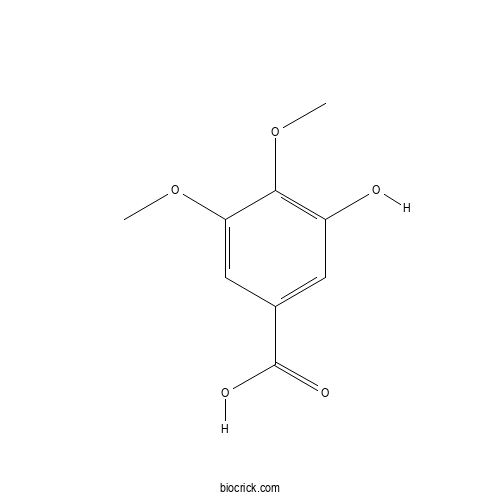
| Cas No. | 1916-08-1 | SDF | File under preparation. |
| PubChem ID | 74709.0 | Appearance | Powder |
| Formula | C9H10O5 | M.Wt | 198.2 |
| Type of Compound | N/A | Storage | Desiccate at -20°C |
| Solubility | Soluble in Chloroform,Dichloromethane,Ethyl Acetate,DMSO,Acetone,etc. | ||
| Chemical Name | 3-hydroxy-4,5-dimethoxybenzoic acid | ||
| SMILES | COC1=CC(=CC(=C1OC)O)C(=O)O | ||
| Standard InChIKey | WFIBQVFJXGQICQ-UHFFFAOYSA-N | ||
| Standard InChI | InChI=1S/C9H10O5/c1-13-7-4-5(9(11)12)3-6(10)8(7)14-2/h3-4,10H,1-2H3,(H,11,12) | ||
| General tips | For obtaining a higher solubility , please warm the tube at 37 ℃ and shake it in the ultrasonic bath for a while.Stock solution can be stored below -20℃ for several months. We recommend that you prepare and use the solution on the same day. However, if the test schedule requires, the stock solutions can be prepared in advance, and the stock solution must be sealed and stored below -20℃. In general, the stock solution can be kept for several months. Before use, we recommend that you leave the vial at room temperature for at least an hour before opening it. |
||
| About Packaging | 1. The packaging of the product may be reversed during transportation, cause the high purity compounds to adhere to the neck or cap of the vial.Take the vail out of its packaging and shake gently until the compounds fall to the bottom of the vial. 2. For liquid products, please centrifuge at 500xg to gather the liquid to the bottom of the vial. 3. Try to avoid loss or contamination during the experiment. |
||
| Shipping Condition | Packaging according to customer requirements(5mg, 10mg, 20mg and more). Ship via FedEx, DHL, UPS, EMS or other couriers with RT, or blue ice upon request. | ||
Quality Control & MSDS
3D structure
Package In Stock

Number of papers citing our products


3,4-O-Dimethylgallic acid Dilution Calculator
3,4-O-Dimethylgallic acid Molarity Calculator
-
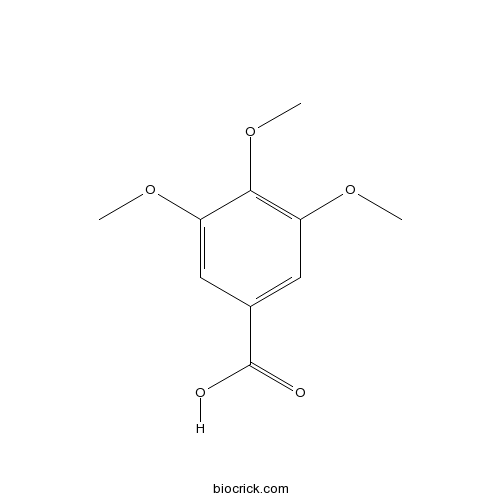 Trimethylgallic acidCatalog No.: BCN3424CAS No.: 118-41-2
-
 3,5-Dihydroxy-4-methoxybenzoic acidCatalog No.: BCN9776CAS No.: 4319-02-2
-
 Methyl 3-hydroxy-4,5-dimethoxybenzoateCatalog No.: BCN1337CAS No.: 83011-43-2
-
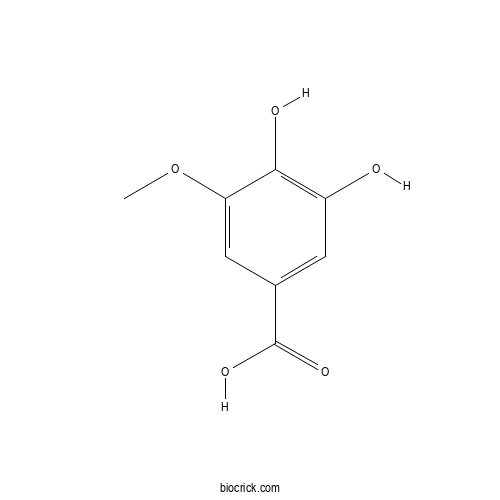 3,4-Dihydroxy-5-methoxybenzoic acidCatalog No.: BCN0076CAS No.: 3934-84-7
-
 Syringic acidCatalog No.: BCN5699CAS No.: 530-57-4
-
 4-Acetoxy-3,5-dimethoxybenzoic acidCatalog No.: BCN5364CAS No.: 6318-20-3
| 1 mg | 5 mg | 10 mg | 20 mg | 25 mg | |
| 1 mM | 5.0454 mL | 25.227 mL | 50.4541 mL | 100.9082 mL | 126.1352 mL |
| 5 mM | 1.0091 mL | 5.0454 mL | 10.0908 mL | 20.1816 mL | 25.227 mL |
| 10 mM | 0.5045 mL | 2.5227 mL | 5.0454 mL | 10.0908 mL | 12.6135 mL |
| 50 mM | 0.1009 mL | 0.5045 mL | 1.0091 mL | 2.0182 mL | 2.5227 mL |
| 100 mM | 0.0505 mL | 0.2523 mL | 0.5045 mL | 1.0091 mL | 1.2614 mL |
| * Note: If you are in the process of experiment, it's necessary to make the dilution ratios of the samples. The dilution data above is only for reference. Normally, it's can get a better solubility within lower of Concentrations. | |||||
- 2-Oxoglutaric acid
Catalog No.:BCX2488
CAS No.:328-50-7
- 3'-Hydroxyphenylacetic acid
Catalog No.:BCX2487
CAS No.:621-37-4
- Coclaurine hydrochloride
Catalog No.:BCX2486
CAS No.:3422-42-2
- α-Isopropylmalate
Catalog No.:BCX2485
CAS No.:3237-44-3
- Rhodomollein I
Catalog No.:BCX2484
CAS No.:126223-68-5
- Queretaroic acid 28-O-β-D-glucopyranosyl ester
Catalog No.:BCX2483
CAS No.:1389354-39-5
- Ampelopsin BF
Catalog No.:BCX2482
CAS No.:482304-83-6
- cis-Upunaphenol K
Catalog No.:BCX2481
CAS No.:879897-47-9
- Viniferol E
Catalog No.:BCX2480
CAS No.:870555-67-2
- Vitisin C
Catalog No.:BCX2479
CAS No.:180580-73-8
- Kuwanon X
Catalog No.:BCX2478
CAS No.:96819-92-0
- Albafuran C
Catalog No.:BCX2477
CAS No.:84323-16-0
- 3,5-Dimethoxybenzoic acid
Catalog No.:BCX2490
CAS No.:1132-21-4
- 3-Hydroxy-5-methoxybenzoic acid
Catalog No.:BCX2491
CAS No.:19520-75-3
- Schottenol
Catalog No.:BCX2492
CAS No.:521-03-9
- Uridine 5′-diphosphate arabinoside disodium
Catalog No.:BCX2493
CAS No.:15839-78-8
- 3-Hydroxy-7,8,9-trimethoxypterocarpan
Catalog No.:BCX2494
CAS No.:2472377-49-2
- Hebeirubescensin I
Catalog No.:BCX2495
CAS No.:887333-31-5
- Chrysin 5-methyl ether
Catalog No.:BCX2496
CAS No.:33554-47-1
- Cincholic acid 3-O-β-D-quinovopyranoside
Catalog No.:BCX2497
CAS No.:111665-41-9
- Rubescensin J
Catalog No.:BCX2498
CAS No.:760948-09-2
- Indole-3-acetic acid N-β-D-xylopyranoside
Catalog No.:BCX2499
CAS No.:2506519-33-9
- N-(2-Hydroxy-3-methylbutyl)adenosine
Catalog No.:BCX2500
CAS No.:22662-01-7
- Obovatin methyl ether
Catalog No.:BCX2501
CAS No.:69640-78-4
LC-ESI-QTOF-MS/MS Characterization of Phenolic Compounds in the Stem, Roots, and Leaves of Syzygium cumini and Their Antioxidant Potential.[Pubmed:40171557]
Food Sci Nutr. 2025 Apr 1;13(4):e70112.
Syzygium cumini, commonly known as Jamun or Indian Blackberry, is a fruit-bearing tree native to the Indian subcontinent, revered for its medicinal uses, and characterized by a rich phytochemical profile abundant in polyphenols. This study aimed to characterize various fractions, including the roots, stem, and leaves of S. cumini (SC). Purposefully, conventional extraction was carried out by using ethanol (70%) with formic acid (1%) to extract the phytochemicals. The resultant extracts were subjected to phenolic contents (TPC, TFC, TTC) and antioxidant activity estimation (DPPH, FRAP, ABTS RPA, OH, FICA, and TAC). Further, LC-ESI-QTOF-MS/MS identification of phenolics was also performed. The outcomes showed that S. cumini leaf exhibited the highest phenolic content and antioxidant activity among different fractions compared to stem and root. The recorded TPC, TFC, and TTC in the leaf were 52.17 +/- 1.60 mg GAE/g, 2.76 +/- 0.054 mg QE/g, and 17.22 +/- 0.43 mg ce/g, respectively. Correlation analysis revealed a strong positive correlation (0.50 < r < 0.80, p < 0.01) between TPC, TFC, and TTC. The LC-ESI-QTOF-MS/MS screening showed the presence of 12 compounds in the stem, leaf, and root of S. cumini, showing the diversity of phenolics between different parts. The majority of the compounds belonged to flavonoids (4), phenolic acids (3), other polyphenols (3) and lignans (2). Among the notable compounds, naringin 4'-O-glucoside, 3,4-O-Dimethylgallic acid, scutellarein, and demethyloleuropein were identified, highlighting the therapeutic potential of different fractions of S. cumini. In conclusion, the results indicated that SC fractions contained a considerable amount of phenolics, thus showcasing higher antioxidant activity. Moreover, the concentration of different phenolics varied among fractions, as confirmed through a Venn diagram.
Biotransformation of gallic acid by Beauveria sulfurescens ATCC 7159.[Pubmed:17111140]
Appl Microbiol Biotechnol. 2007 Mar;74(3):659-66.
Preparative-scale fermentation of gallic acid (3,4,5-trihydroxybenzoic acid) (1) with Beauveria sulfurescens ATCC 7159 gave two new glucosidated compounds, 4-(3,4-dihydroxy-6-hydroxymethyl-5-methoxy-tetrahydro-pyran-2-yloxy)-3-hydroxy-5-methoxy-benzoic acid (4), 3-hydroxy-4,5-dimethoxy-benzoic acid 3,4-dihydroxy-6-hydroxymethyl-5-methoxy-tetrahydro-pyran-2-yl ester (7), along with four known compounds, 3-O-methylgallic acid (2), 4-O-methylgallic acid (3), 3,4-O-Dimethylgallic acid (5), and 3,5-O-dimethylgallic acid (6). The new metabolite genistein 7-O-beta-D-4''-O-methyl-glucopyranoside (8) was also obtained as a byproduct due to the use of soybean meal in the fermentation medium. The structural elucidation of the metabolites was based primarily on 1D-, 2D-NMR, and HRFABMS analyses. Among these compounds, 2, 3, and 5 are metabolites of gallic acid in mammals. This result demonstrated that microbial culture parallels mammalian metabolism; therefore, B. sulfurescens might be a useful tool for generating mammalian metabolites of related analogs of gallic acid (1) for complete structural identification and for further use in investigating pharmacological and toxicological properties in this series of compounds. In addition, a GRE (glucocorticoid response element)-mediated luciferase reporter gene assay was used to initially screen for the biological activity of the 6 compounds, 2-6 and 8, along with 1 and its chemical O-methylated derivatives 9-13. Among the 12 compounds tested, 11-13 were found to be significant, but less active than the reference compounds of methylprednisolone and dexamethasone.

Calcutta University

University of Minnesota

University of Maryland School of Medicine

University of Illinois at Chicago

The Ohio State University

University of Zurich

Harvard University

Colorado State University

Auburn University

Yale University

Worcester Polytechnic Institute

Washington State University

Stanford University

University of Leipzig

Universidade da Beira Interior

The Institute of Cancer Research

Heidelberg University

University of Amsterdam

University of Auckland

TsingHua University

The University of Michigan

Miami University

DRURY University

Jilin University

Fudan University

Wuhan University

Sun Yat-sen University

Universite de Paris

Deemed University

Auckland University

The University of Tokyo

Korea University



