
SchottenolCAS# 521-03-9 |
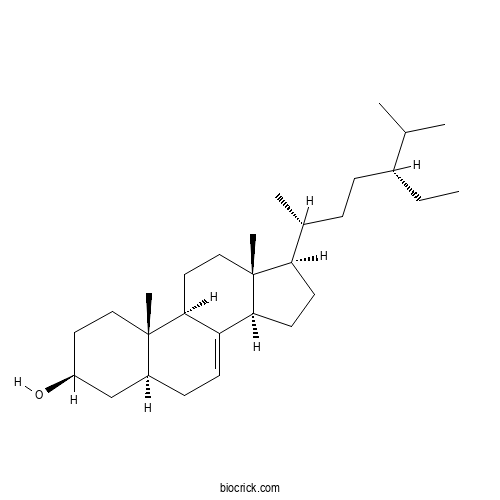
| Cas No. | 521-03-9 | SDF | File under preparation. |
| PubChem ID | 441837.0 | Appearance | Powder |
| Formula | C29H50O | M.Wt | 414.7 |
| Type of Compound | N/A | Storage | Desiccate at -20°C |
| Solubility | Soluble in Chloroform,Dichloromethane,Ethyl Acetate,DMSO,Acetone,etc. | ||
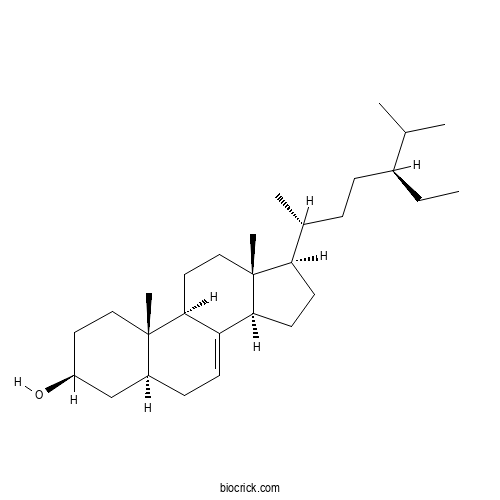
| Chemical Name | (3S,5S,9R,10S,13R,14R,17R)-17-[(2R,5R)-5-ethyl-6-methylheptan-2-yl]-10,13-dimethyl-2,3,4,5,6,9,11,12,14,15,16,17-dodecahydro-1H-cyclopenta[a]phenanthren-3-ol | ||
| SMILES | CCC(CCC(C)C1CCC2C1(CCC3C2=CCC4C3(CCC(C4)O)C)C)C(C)C | ||
| Standard InChIKey | YSKVBPGQYRAUQO-UZSYLJJSSA-N | ||
| Standard InChI | InChI=1S/C29H50O/c1-7-21(19(2)3)9-8-20(4)25-12-13-26-24-11-10-22-18-23(30)14-16-28(22,5)27(24)15-17-29(25,26)6/h11,19-23,25-27,30H,7-10,12-18H2,1-6H3/t20-,21-,22+,23+,25-,26+,27+,28+,29-/m1/s1 | ||
| General tips | For obtaining a higher solubility , please warm the tube at 37 ℃ and shake it in the ultrasonic bath for a while.Stock solution can be stored below -20℃ for several months. We recommend that you prepare and use the solution on the same day. However, if the test schedule requires, the stock solutions can be prepared in advance, and the stock solution must be sealed and stored below -20℃. In general, the stock solution can be kept for several months. Before use, we recommend that you leave the vial at room temperature for at least an hour before opening it. |
||
| About Packaging | 1. The packaging of the product may be reversed during transportation, cause the high purity compounds to adhere to the neck or cap of the vial.Take the vail out of its packaging and shake gently until the compounds fall to the bottom of the vial. 2. For liquid products, please centrifuge at 500xg to gather the liquid to the bottom of the vial. 3. Try to avoid loss or contamination during the experiment. |
||
| Shipping Condition | Packaging according to customer requirements(5mg, 10mg, 20mg and more). Ship via FedEx, DHL, UPS, EMS or other couriers with RT, or blue ice upon request. | ||
Quality Control & MSDS
3D structure
Package In Stock

Number of papers citing our products


Schottenol Dilution Calculator
Schottenol Molarity Calculator



| 1 mg | 5 mg | 10 mg | 20 mg | 25 mg | |
| 1 mM | 2.4114 mL | 12.0569 mL | 24.1138 mL | 48.2276 mL | 60.2845 mL |
| 5 mM | 0.4823 mL | 2.4114 mL | 4.8228 mL | 9.6455 mL | 12.0569 mL |
| 10 mM | 0.2411 mL | 1.2057 mL | 2.4114 mL | 4.8228 mL | 6.0285 mL |
| 50 mM | 0.0482 mL | 0.2411 mL | 0.4823 mL | 0.9646 mL | 1.2057 mL |
| 100 mM | 0.0241 mL | 0.1206 mL | 0.2411 mL | 0.4823 mL | 0.6028 mL |
| * Note: If you are in the process of experiment, it's necessary to make the dilution ratios of the samples. The dilution data above is only for reference. Normally, it's can get a better solubility within lower of Concentrations. | |||||
- 3-Hydroxy-5-methoxybenzoic acid
Catalog No.:BCX2491
CAS No.:19520-75-3
- 3,5-Dimethoxybenzoic acid
Catalog No.:BCX2490
CAS No.:1132-21-4
- 3,4-O-Dimethylgallic acid
Catalog No.:BCX2489
CAS No.:1916-08-1
- 2-Oxoglutaric acid
Catalog No.:BCX2488
CAS No.:328-50-7
- 3'-Hydroxyphenylacetic acid
Catalog No.:BCX2487
CAS No.:621-37-4
- Coclaurine hydrochloride
Catalog No.:BCX2486
CAS No.:3422-42-2
- α-Isopropylmalate
Catalog No.:BCX2485
CAS No.:3237-44-3
- Rhodomollein I
Catalog No.:BCX2484
CAS No.:126223-68-5
- Queretaroic acid 28-O-β-D-glucopyranosyl ester
Catalog No.:BCX2483
CAS No.:1389354-39-5
- Ampelopsin BF
Catalog No.:BCX2482
CAS No.:482304-83-6
- cis-Upunaphenol K
Catalog No.:BCX2481
CAS No.:879897-47-9
- Viniferol E
Catalog No.:BCX2480
CAS No.:870555-67-2
- Uridine 5′-diphosphate arabinoside disodium
Catalog No.:BCX2493
CAS No.:15839-78-8
- 3-Hydroxy-7,8,9-trimethoxypterocarpan
Catalog No.:BCX2494
CAS No.:2472377-49-2
- Hebeirubescensin I
Catalog No.:BCX2495
CAS No.:887333-31-5
- Chrysin 5-methyl ether
Catalog No.:BCX2496
CAS No.:33554-47-1
- Cincholic acid 3-O-β-D-quinovopyranoside
Catalog No.:BCX2497
CAS No.:111665-41-9
- Rubescensin J
Catalog No.:BCX2498
CAS No.:760948-09-2
- Indole-3-acetic acid N-β-D-xylopyranoside
Catalog No.:BCX2499
CAS No.:2506519-33-9
- N-(2-Hydroxy-3-methylbutyl)adenosine
Catalog No.:BCX2500
CAS No.:22662-01-7
- Obovatin methyl ether
Catalog No.:BCX2501
CAS No.:69640-78-4
- Xerophilusin XVI
Catalog No.:BCX2502
CAS No.:1316032-06-0
- Maoyecrystal G
Catalog No.:BCX2503
CAS No.:675603-40-4
- Cinnamyl 3,4-dimethoxycinnamate
Catalog No.:BCX2504
CAS No.:391682-57-8
Exploring the Impact of Extraction Methods on the Nutritional and Sensory Profiles of Argan Oil from Mostaganem Kernels.[Pubmed:42587983]
Foods. 2026 Aug 3;15(15):2724.
Argan oil (Argania spinosa L.) is a culturally and economically significant product in North Africa, yet little is known about how extraction practices shape its nutritional and sensory qualities. The present study compares mechanical cold pressing with solvent extraction (diethyl ether and petroleum ether) on roasted and unroasted kernels from Algerian argan trees. The comparison focused on lipid recovery, fatty acid composition, sterol profile, and volatile compounds as nutritional, functional, and sensory-related quality indicators. Diethyl ether extraction achieved the highest lipid recovery and was associated with higher relative proportions of oleic acid and beta-sitosterol, which may be relevant for oxidative-stability-related and compositional quality considerations. In contrast, mechanical pressing preserved the authentic sterolic profile, dominated by Schottenol (44.1%) and spinasterol (32.6%), characteristic of traditional argan oil. Roasting intensified Maillard-derived volatiles, notably pyrazines and furans, defining the roasted-nutty aroma of culinary-grade oils. The originality of this study lies in the integrated evaluation of extraction efficiency, fatty acid composition, sterol authenticity markers, and aroma-related volatile compounds in argan oil produced from Mostaganem kernels under roasted and unroasted conditions. These results reveal that extraction and pre-treatment are decisive levers for tailoring argan oil's nutritional, functional, and sensory attributes, providing practical guidance for selecting processing conditions according to the intended food, culinary, cosmetic, or neutral-aroma application. The findings also support process standardization, product differentiation, authenticity preservation, and the sustainable valorization of Algerian argan oil in global food systems.
Argan Oil: A Natural Bioactive Lipid Modulating Oxidative Stress and Inflammation.[Pubmed:40427397]
Antioxidants (Basel). 2025 Apr 25;14(5):515.
Nutrition is a key determinant in modulating disease risk, with numerous studies highlighting the role of antioxidants and lipids, particularly the micronutrient and fatty acid composition of natural oils and their bioactive metabolites. In this context, argan oil-a vegetable oil extracted from the kernels of Argania spinosa-has gained significant attention due to its well-balanced fatty acid profile, rich in oleic and linoleic acids, and its high levels of antioxidant compounds, including tocopherols, polyphenols, and phytosterols, particularly Schottenol and spinasterol. Thanks to its unique composition, argan oil exhibits protective properties against harmful biological processes, such as oxidative stress and inflammation, both of which play a significant role in various diseases. Preclinical studies, both in vitro and in vivo, have demonstrated that argan oil reduces oxidative stress by preventing DNA damage, protein carbonylation, and lipid peroxidation, while simultaneously increasing antioxidant defenses. Furthermore, it modulates inflammatory responses by decreasing pro-inflammatory biomarkers, increasing anti-inflammatory markers, and limiting immune cell infiltration across different tissues. These antioxidant and anti-inflammatory effects are thought to be linked to argan oil's ability to regulate key signaling pathways, such as Nrf-2 and NF-kappaB. Although direct evidence remains limited, studies suggest that its main bioactive components-fatty acid, gamma-tocopherol, ferulic acid, and campesterol-can influence these pathways, either by activating Nrf2 to boost antioxidant defenses or by inhibiting NF-kappaB to suppress inflammation. This review explores the antioxidant and anti-inflammatory properties of argan oil, drawing insights from a range of scientific studies to better understand its therapeutic potential.
Unveiling the role of MDH1 in breast cancer drug resistance through single-cell sequencing and schottenol intervention.[Pubmed:39818404]
Cell Signal. 2025 Mar;127:111608.
This study utilizes single-cell RNA sequencing data to reveal the transcriptomic characteristics of breast cancer and normal epithelial cells. Nine significant cell populations were identified through stringent quality control and batch effect correction. Further classification of breast cancer epithelial cells based on the PAM50 method and clinical subtypes highlighted significant heterogeneity between triple-negative breast cancer (TNBC) and non-triple-negative breast cancer (NTNBC). The study also analyzed myeloid cells and tumor-infiltrating lymphocytes (TILs) within the breast cancer immune microenvironment, identifying 14 TIL subpopulations and assessing their proportion variations across different patients. The CellChat tool revealed a complex cellular communication network within the tumor microenvironment, showing notable differences in communication intensity and patterns between TNBC and NTNBC patients. Additionally, the key regulatory role of the senescence-associated gene MDH1 in breast cancer was confirmed, and its impact on drug sensitivity was explored. Finally, it was discovered that the phytosterol Schottenol inhibits breast cancer cell proliferation by downregulating MDH1 expression and enhances sensitivity to paclitaxel. These findings provide new insights into MDH1 as a therapeutic target and suggest Schottenol as a potential strategy to overcome breast cancer drug resistance.
[Chemical constituents from petroleum ether fraction of Artemisia stolonifera].[Pubmed:39701760]
Zhongguo Zhong Yao Za Zhi. 2024 Oct;49(19):5229-5237.
The chemical constituents in the petroleum ether fraction of Artemisia stolonifera were investigated. Twenty compounds(1-20) were isolated from the petroleum ether fraction of A. stolonifera by silica gel, Sephadex LH-20, and ODS chromatography and semi-preparative HPLC. Based on physicochemical properties and spectral data, the structures of these compounds were identified as(7S,9S,10S)-9-hydroxy-7-allyl acetate-1-one(1), 1beta,4beta,7alpha-trihydroxy-8,9-eudesmene(2), oplodiol(3), 10alpha-hydroxycadin-4-en-15-al(4), loliolide(5), vanillin(6), vanillic acid(7), methoxyeugenol(8), ethyl 4-hydroxy-3-methoxybenzoate(9), ethyl 4-hydroxybenzoate(10),(E)-4-hydroxy-3-methyl-2-butenyl benzoate(11),(3R,6R,7E)-3-hydroxy-4,7-megastigmadien-9-one(12), hydroxydihydrobovolide(5-hydroxy-3,4-dimethy-5-pentyl-2(5H)-furanone(13),(R)-2-ethylhexyl 2H-1,2,3-triazole-4-carboxylate(14), eriodictyol-7,3'-dimethyl ether(15), progesterone(16), spinasterol(17), Schottenol(18), alpha-tocospiro A(19), and 3-[3'-(nona-1''-en-3'',5'',7''-trynyl)oxiran-2'-yl] propan-2-ol(20). Compound 1 was a new sesquiterpenoid, and compounds 2-5 and 7-20 were isolated from this plant for the first time. The antitumor activities of the compounds were studied. The results showed that compounds 16 and 19 displayed cytotoxic activity against MCF-R7 and B16 cells, with the IC_(50) values of(20.94+/-1.72) and(77.45+/-0.35) mumol.L~(-1) against MCF-7 cells and(33.89+/-2.98) and(23.42+/-0.31) mumol.L~(-1) against B16 cells, respectively. Compounds 11, 15, and 20 had cytotoxic activity against B16 cells, with the IC_(50) values of(88.13+/-6.38),(68.05+/-10.28), and(58.89+/-10.29) mumol.L~(-1), respectively.
Chemical and Biochemical Features of Spinasterol and Schottenol.[Pubmed:38036874]
Adv Exp Med Biol. 2024;1440:45-55.
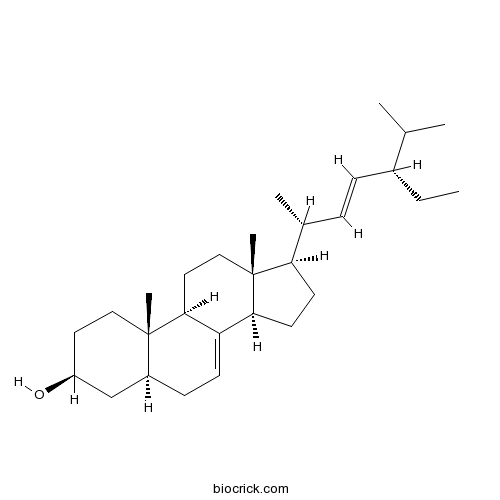
Phytosterols, which are produced in plants, are structurally similar to cholesterol. Their basic structures consist of a cyclo pentano-perhydrophenanthrene nucleus composed of 3 hexane rings and of a pentane ring with an alkyl side chain. There are around more than 250 phytosterols and related compounds that have been identified in natural resources. Among them, spinasterol and Schottenol, its dihydro analog, are often found in seeds, and consequently in seed oils, and in other botanical parts of some plant families such as Sapotaceae, Cactaceae, and Cucurbitaceae. Spinasterol and/or Schottenol has been identified in dietary and cosmetic argan oil, milk thistle seed oil, nigella seed oil, and pumkin seed oil. These phytosterols that have several bioactive properties make them potentially attractive molecules in pharmacology. Their chemical and biochemical features are summarized and the analytical methods used to characterize and analyze these compounds are presented.
Two Argan Oil Phytosterols, Schottenol and Spinasterol, Attenuate Oxidative Stress and Restore LPS-Dysregulated Peroxisomal Functions in Acox1(-/-) and Wild-Type BV-2 Microglial Cells.[Pubmed:36671029]
Antioxidants (Basel). 2023 Jan 11;12(1):168.
Oxidative stress and inflammation are the key players in neuroinflammation, in which microglia dysfunction plays a central role. Previous studies suggest that argan oil attenuates oxidative stress, inflammation, and peroxisome dysfunction in mouse brains. In this study, we explored the effects of two major argan oil (AO) phytosterols, Schottenol (Schot) and Spinasterol (Spina), on oxidative stress, inflammation, and peroxisomal dysfunction in two murine microglial BV-2 cell lines, wild-ype (Wt) and Acyl-CoA oxidase 1 (Acox1)-deficient cells challenged with LPS treatment. Herein, we used an MTT test to reveal no cytotoxicity for both phytosterols with concentrations up to 5 microM. In the LPS-activated microglial cells, cotreatment with each of these phytosterols caused a significant decrease in intracellular ROS production and the NO level released in the culture medium. Additionally, Schot and Spina were able to attenuate the LPS-dependent strong induction of Il-1beta and Tnf-alpha mRNA levels, as well as the iNos gene and protein expression in both Wt and Acox1(-/-) microglial cells. On the other hand, LPS treatment impacted both the peroxisomal antioxidant capacity and the fatty acid oxidation pathway. However, both Schot and Spina treatments enhanced ACOX1 activity in the Wt BV-2 cells and normalized the catalase activity in both Wt and Acox1(-/-) microglial cells. These data suggest that Schot and Spina can protect cells from oxidative stress and inflammation and their harmful consequences for peroxisomal functions and the homeostasis of microglial cells. Collectively, our work provides a compelling argument for the protective mechanisms of two major argan oil phytosterols against LPS-induced brain neuroinflammation.
Mechanism of Tripterygium wilfordii Hook.F.- Trichosanthes kirilowii Maxim decoction in treatment of diabetic kidney disease based on network pharmacology and molecular docking.[Pubmed:36386135]
Front Pharmacol. 2022 Oct 28;13:940773.
Background: Diabetic kidney disease (DKD) is the most common cause of end-stage renal disease. The effective treatment of DKD would rely on the incorporation of a multi-disciplinary. Studies have shown that Tripterygium wilfordii Hook.F. and Trichosanthes kirilowii Maxim have remarkable curative effects in treating DKD, but their combination mechanism has not been fully elucidated. Methods: We explored the mechanism of Tripterygium wilfordii Hook.F.-Trichosanthes kirilowii Maxim decoction (Leigongteng-Tianhuafen Decoction,LTD) in the treatment of DKD by network pharmacology and molecular docking. The main active components and action targets of LTD were collected from Traditional Chinese Medicine Systems Pharmacology Database and Analysis Platform (TCMSP) database. The speculative targets of DKD were obtained from GeneCards, DisGeNET, and Online Mendelian Inheritance in Man (OMIM) databases. Then, an herb-component-target network was constructed based on the above analyses. The biological function of targets was subsequently investigated, and a protein-protein interaction (PPI) network was constructed to identify hub targets of DKD. The gene ontology (GO) function enrichment analysis and kyoto encyclopedia of genes and genomes (KEGG) pathway enrichment analysis were performed by RStudio. Finally, molecular docking was performed by AutoDock Vina and PyMOL software to explore the interaction between compounds and targets. Furthermore, the DKD model of human renal tubular cells (HK-2) induced by high glucose (HG) was selected, and the predicted results were verified by western blot analysis and immunofluorescence. Results: A total of 31 active components of LTD were screened out, and 196 targets were identified based on the TCMSP database. A total of 3,481 DKD related targets were obtained based on GeneCards, DisGeNET, and OMIM databases. GO function enrichment analysis included 2,143, 50, and 167 GO terms for biological processes (BPs), cellular composition (CCs), and molecular functions (MFs), respectively. The top 10 enrichment items of BP annotations included response to lipopolysaccharide, response to molecule of bacterial origin, response to extracellular stimulus, etc. CC was mainly enriched in membrane raft, membrane microdomain, plasma membrane raft, etc. The MF of LTD analysis on DKD was predominately involved in nuclear receptor activity, ligand-activated transcription factor activity, RNA polymerase II-specific DNA-binding transcription factor binding, etc. The involvement signaling pathway of LTD in the treatment of DKD included AGE-RAGE signaling pathway in diabetic complications, IL-17 signaling pathway, insulin resistance, TNF signaling pathway, etc. Molecular docking results showed that kaempferol, triptolide, nobiletin, and Schottenol had a strong binding ability to PTGS2 and RELA. Furthermore, the in vitro experiments confirmed that LTD effectively decreased the expression of PTGS2, NF-kappaB, JNK, and AKT in the HG-induced DKD model. Conclusion: The findings of this study revealed that the therapeutic efficacy of LTD on DKD might be achieved by decreasing the expression of PTGS2, NF-kappaB, JNK, and AKT, which might improve insulin resistance, inflammation, and oxidative stress. These findings can provide ideas and supply potential therapeutic targets for DKD.
Effect of Moringa oleifera L. Leaf Powder Addition on the Phenolic Bioaccessibility and on In Vitro Starch Digestibility of Durum Wheat Fresh Pasta.[Pubmed:32422925]
Foods. 2020 May 14;9(5):628.
Fresh pasta was formulated by replacing wheat semolina with 0, 5, 10, and 15 g/100 g (w/w) of Moringa oleifera L. leaf powder (MOLP). The samples (i.e., M0, M5, M10, and M15 as a function of the substitution level) were cooked by boiling. The changes in the phenolic bioaccessibility and the in vitro starch digestibility were considered. On the cooked-to-optimum samples, by means of ultra-high-performance liquid chromatography-quadrupole time-of-flight (UHPLC-QTOF) mass spectrometry, 152 polyphenols were putatively annotated with the greatest content recorded for M15 pasta, being 2.19 mg/g dry matter (p < 0.05). Multivariate statistics showed that stigmastanol ferulate (VIP score = 1.22) followed by isomeric forms of kaempferol (VIP scores = 1.19) and other phenolic acids (i.e., Schottenol/sitosterol ferulate and 24-methylcholestanol ferulate) were the most affected compounds through the in vitro static digestion process. The inclusion of different levels of MOLP in the recipe increased the slowly digestible starch fractions and decreased the rapidly digestible starch fractions and the starch hydrolysis index of the cooked-to-optimum samples. The present results showed that MOLP could be considered a promising ingredient in fresh pasta formulation.
Argan Oil-Mediated Attenuation of Organelle Dysfunction, Oxidative Stress and Cell Death Induced by 7-Ketocholesterol in Murine Oligodendrocytes 158N.[Pubmed:29065513]
Int J Mol Sci. 2017 Oct 23;18(10):2220.
Argan oil is widely used in Morocco in traditional medicine. Its ability to treat cardiovascular diseases is well-established. However, nothing is known about its effects on neurodegenerative diseases, which are often associated with increased oxidative stress leading to lipid peroxidation and the formation of 7-ketocholesterol (7KC) resulting from cholesterol auto-oxidation. As 7KC induces oxidative stress, inflammation and cell death, it is important to identify compounds able to impair its harmful effects. These compounds may be either natural or synthetic molecules or mixtures of molecules such as oils. In this context: (i) the lipid profiles of dietary argan oils from Berkane and Agadir (Morocco) in fatty acids, phytosterols, tocopherols and polyphenols were determined by different chromatographic techniques; and (ii) their anti-oxidant and cytoprotective effects in 158N murine oligodendrocytes cultured with 7KC (25-50 microM; 24 h) without and with argan oil (0.1% v/v) or alpha-tocopherol (400 microM, positive control) were evaluated with complementary techniques of cellular and molecular biology. Among the unsaturated fatty acids present in argan oils, oleate (C18:1 n-9) and linoleate (C18:1 n-6) were the most abundant; the highest quantities of saturated fatty acids were palmitate (C16:0) and stearate (C18:0). Several phytosterols were found, mainly Schottenol and spinasterol (specific to argan oil), cycloartenol, beta-amyrin and citrostadienol. alpha- and gamma-tocopherols were also present. Tyrosol and protocatechic acid were the only polyphenols detected. Argan and extra virgin olive oils have many compounds in common, principally oleate and linoleate, and tocopherols. Kit Radicaux Libres (KRL) and ferric reducing antioxidant power (FRAP) tests showed that argan and extra virgin olive oils have anti-oxidant properties. Argan oils were able to attenuate the cytotoxic effects of 7KC on 158N cells: loss of cell adhesion, cell growth inhibition, increased plasma membrane permeability, mitochondrial, peroxisomal and lysosomal dysfunction, and the induction of oxiapoptophagy (OXIdation + APOPTOsis + autoPHAGY). Altogether, our data obtained in 158N oligodendrocytes provide evidence that argan oil is able to counteract the toxic effects of 7KC on nerve cells, thus suggesting that some of its compounds could prevent or mitigate neurodegenerative diseases to the extent that they are able to cross the blood-brain barrier.

Calcutta University

University of Minnesota

University of Maryland School of Medicine

University of Illinois at Chicago

The Ohio State University

University of Zurich

Harvard University

Colorado State University

Auburn University

Yale University

Worcester Polytechnic Institute

Washington State University

Stanford University

University of Leipzig

Universidade da Beira Interior

The Institute of Cancer Research

Heidelberg University

University of Amsterdam

University of Auckland

TsingHua University

The University of Michigan

Miami University

DRURY University

Jilin University

Fudan University

Wuhan University

Sun Yat-sen University

Universite de Paris

Deemed University

Auckland University

The University of Tokyo

Korea University



