
2-Ethylbutyric acidCAS# 1988-09-5 |
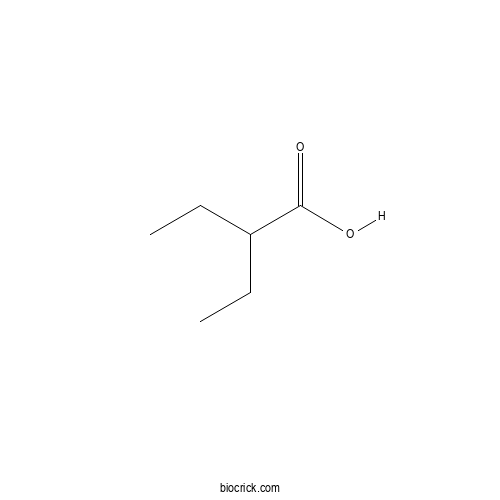
| Cas No. | 1988-09-5 | SDF | File under preparation. |
| PubChem ID | 6915.0 | Appearance | Liquid |
| Formula | C6H12O2 | M.Wt | 116.2 |
| Type of Compound | N/A | Storage | Desiccate at -20°C |
| Solubility | Soluble in Chloroform,Dichloromethane,Ethyl Acetate,DMSO,Acetone,etc. | ||
| Chemical Name | 2-ethylbutanoic acid | ||
| SMILES | CCC(CC)C(=O)O | ||
| Standard InChIKey | OXQGTIUCKGYOAA-UHFFFAOYSA-N | ||
| Standard InChI | InChI=1S/C6H12O2/c1-3-5(4-2)6(7)8/h5H,3-4H2,1-2H3,(H,7,8) | ||
| General tips | For obtaining a higher solubility , please warm the tube at 37 ℃ and shake it in the ultrasonic bath for a while.Stock solution can be stored below -20℃ for several months. We recommend that you prepare and use the solution on the same day. However, if the test schedule requires, the stock solutions can be prepared in advance, and the stock solution must be sealed and stored below -20℃. In general, the stock solution can be kept for several months. Before use, we recommend that you leave the vial at room temperature for at least an hour before opening it. |
||
| About Packaging | 1. The packaging of the product may be reversed during transportation, cause the high purity compounds to adhere to the neck or cap of the vial.Take the vail out of its packaging and shake gently until the compounds fall to the bottom of the vial. 2. For liquid products, please centrifuge at 500xg to gather the liquid to the bottom of the vial. 3. Try to avoid loss or contamination during the experiment. |
||
| Shipping Condition | Packaging according to customer requirements(5mg, 10mg, 20mg and more). Ship via FedEx, DHL, UPS, EMS or other couriers with RT, or blue ice upon request. | ||
Quality Control & MSDS
3D structure
Package In Stock

Number of papers citing our products


2-Ethylbutyric acid Dilution Calculator
2-Ethylbutyric acid Molarity Calculator
| 1 mg | 5 mg | 10 mg | 20 mg | 25 mg | |
| 1 mM | 8.6059 mL | 43.0293 mL | 86.0585 mL | 172.117 mL | 215.1463 mL |
| 5 mM | 1.7212 mL | 8.6059 mL | 17.2117 mL | 34.4234 mL | 43.0293 mL |
| 10 mM | 0.8606 mL | 4.3029 mL | 8.6059 mL | 17.2117 mL | 21.5146 mL |
| 50 mM | 0.1721 mL | 0.8606 mL | 1.7212 mL | 3.4423 mL | 4.3029 mL |
| 100 mM | 0.0861 mL | 0.4303 mL | 0.8606 mL | 1.7212 mL | 2.1515 mL |
| * Note: If you are in the process of experiment, it's necessary to make the dilution ratios of the samples. The dilution data above is only for reference. Normally, it's can get a better solubility within lower of Concentrations. | |||||
- 5-(4-Hydroxyphenyl)pentanoic acid
Catalog No.:BCX2468
CAS No.:4654-08-4
- Azadirachtin B
Catalog No.:BCX2467
CAS No.:106500-25-8
- Pyruvic acid
Catalog No.:BCX2466
CAS No.:127-17-3
- Isofouquierol
Catalog No.:BCX2465
CAS No.:53822-99-4
- Arecoline
Catalog No.:BCX2464
CAS No.:63-75-2
- (22R)-Hydroxycholesterol
Catalog No.:BCX2463
CAS No.:17954-98-2
- (±)-Tropic acid
Catalog No.:BCX2462
CAS No.:552-63-6
- 8-Methoxynaringenin
Catalog No.:BCX2461
CAS No.:94884-92-1
- Escin IVc
Catalog No.:BCX2460
CAS No.:249921-71-9
- Galangin 5-methyl ether
Catalog No.:BCX2459
CAS No.:104594-69-6
- Maltol glucoside
Catalog No.:BCX2458
CAS No.:20847-13-6
- Swertiajaponin 2''-O-rhamnoside
Catalog No.:BCX2457
CAS No.:75474-16-7
- 2-Ethylhexanoic acid
Catalog No.:BCX2470
CAS No.:149-57-5
- Propionic acid
Catalog No.:BCX2471
CAS No.:1979-09-4
- 11-Deoxymogrol
Catalog No.:BCX2472
CAS No.:2654048-89-0
- 2-Hydroxy-2-(2-methylpropyl)butanedioic acid
Catalog No.:BCX2473
CAS No.:60924-65-4
- Rhodojaponin VI
Catalog No.:BCX2474
CAS No.:37720-87-9
- Phytolaccagenic acid 28-O-β-D-glucopyranosyl ester
Catalog No.:BCX2475
CAS No.:288303-32-2
- Moracenin D
Catalog No.:BCX2476
CAS No.:78277-79-9
- Albafuran C
Catalog No.:BCX2477
CAS No.:84323-16-0
- Kuwanon X
Catalog No.:BCX2478
CAS No.:96819-92-0
- Vitisin C
Catalog No.:BCX2479
CAS No.:180580-73-8
- Viniferol E
Catalog No.:BCX2480
CAS No.:870555-67-2
- cis-Upunaphenol K
Catalog No.:BCX2481
CAS No.:879897-47-9
Phytotoxicity and hormesis in common mobile organic compounds in leachates of wood-derived biochars.[Pubmed:38799720]
Biochar. 2024;6(1):51.
Although addition of pyrolyzed organic materials (biochars) to soil generally results in increased growth and physiological performance of plants, neutral and negative responses have also commonly been detected. Toxicity of organic compounds generated during pyrolysis, sorbed by biochars, and then released into the soil solution, has been implicated as a possible mechanism for such negative effects. Conversely, water-soluble biochar constituents have also been suggested to have "hormetic" effects (positive effects on plants at low concentrations); however, no specific compounds responsible have been identified. We investigated the relative phytotoxicity-and possible hormetic effects-of 14 organic compounds common in aqueous extracts of freshly produced lignocellulosic biochars, using seed germination bioassays. Of the compounds examined, volatile fatty acids (VFAs: acetic, propionic, butyric, valeric, caproic, and 2-Ethylbutyric acids) and phenol, showed acute phytotoxicity, with germination-based ED50 values of 1-30 mmol L(-1), and 2-Ethylbutyric acid showed ED50 values of 0.1-1.0 mmol L(-1). Other compounds (benzene, benzoic acid, butanone, methyl salicylate, toluene, and 2,4-di-tert-butylphenol) showed toxic effects only at high concentrations close to solubility limits. Although phytotoxic at high concentrations, valeric and caproic acid also showed detectable hormetic effects on seedlings, increasing radicle extension by 5-15% at concentrations of ~ 0.01-0.1 mmol L(-1). These data support the hypothesis that VFAs are the main agents responsible for phytotoxic effects of lignocellulosic biochar leachates, but that certain VFAs also have hormetic effects at low concentrations and may contribute to positive effects of biochar leachates on early plant development in some cases. SUPPLEMENTARY INFORMATION: The online version contains supplementary material available at 10.1007/s42773-024-00339-w.
Quantification of short-chain fatty acids in human stool samples by LC-MS/MS following derivatization with aniline analogues.[Pubmed:36731355]
J Chromatogr B Analyt Technol Biomed Life Sci. 2023 Feb 15;1217:123618.
The gut microbiome produces a range of short chain fatty acids (SCFA) crucially linked with diet and nutrition, metabolism, gastrointestinal health and homeostasis. SCFA are primarily measured using gas or liquid chromatography-mass spectrometry (LC/MS) after undergoing chemical derivatization. Here we assess the merits of a derivatization protocol using aniline and two aniline analogues (3-phenoxyaniline and 4-(benzyloxy)aniline) for the targeted LC-MS/MS quantification of nine SCFA (acetic, propionic, butyric, valeric, caproic acid, isobutyric, isovaleric, 2-methylbutyric, and 2-Ethylbutyric acid). Evaluation of product ion spectra and optimization of MS detection conditions, provided superior detection sensitivity for 3-phenoxyaniline and 4-(benzyloxy)aniline compared to aniline. We developed a facile SCFA derivatization method using 3-phenoxyaniline under mild reaction conditions which allows for the simultaneous quantification of these SCFA in human stool samples in under eleven minutes using multiple reaction monitoring LC-MS/MS. The method was successfully validated and demonstrates intra- and inter-day accuracy (88.5-103% and 86.0-109%) and precision (CV of 0.55-7.00% and 0.33-9.55%) with recoveries (80.1-87.2% for LLOQ, 88.5-93.0% for ULOQ) and carry-over of (2.68-17.9%). Selectivity, stability and matrix effects were also assessed and satisfied validation criteria. Method applicability was demonstrated by analysing SCFA profiles in DNA-stabilized human stool samples from newly diagnosed colorectal cancer patients prior to surgery. The development of this improved method and its compatibility to measure SCFAs from DNA-stabilized stool will facilitate studies investigating the gut microbiome in health and disease.
WP1234-A Novel Anticancer Agent with Bifunctional Activity in a Glioblastoma Model.[Pubmed:36359318]
Biomedicines. 2022 Nov 3;10(11):2799.
Glioblastoma multiforme (GBM) is the most common primary malignant brain tumor in adults with a poor prognosis. Despite significant progress in drug development, the blood-brain barrier (BBB) continues to limit the use of novel chemotherapeutics. Thus, our attention has been focused on the design, synthesis, and testing of small-molecule anticancer agents that are able to penetrate the BBB. One such compound is the D-glucose analog, 2-deoxy-D-glucose (2-DG), which inhibits glycolysis and induces GBM cell death. 2-DG has already been tested in clinical trials but was not approved as a drug, in part due to inadequate pharmacokinetics. To improve the pharmacokinetic properties of 2-DG, a series of novel derivatives was synthesized. Herein, we report the biological effects of WP1234, a 2-Ethylbutyric acid 3,6-diester of 2-DG that can potentially release 2-ethylbutyrate and 2-DG inside the cells when metabolized. Using biochemical assays and examining cell viability, proliferation, protein synthesis, and apoptosis induction, we assessed the cytotoxic potential of WP1234. WP1234 significantly reduced the viability of GBM cells in a dose- and time-dependent manner. The lactate and ATP synthesis assays confirmed the inhibition of glycolysis elicited by released 2-DG. Furthermore, an evaluation of histone deacetylases (HDAC) activity revealed that the 2-ethylbutyrate action resulted in HDAC inhibition. Overall, these results demonstrated that WP1234 is a bifunctional molecule with promising anticancer potential. Further experiments in animal models and toxicology studies are needed to evaluate the efficacy and safety of this new 2-DG derivative.
New members of the polynuclear manganese family: MnMn single-molecule magnets and MnMn antiferromagnetic complexes. Synthesis and magnetostructural correlations.[Pubmed:32985628]
Dalton Trans. 2020 Oct 20;49(40):13970-13985.
The synthesis, crystal structures and magnetic properties are reported for three novel mixed-valence tetranuclear [MnII2MnIII2(HBuDea)2(BuDea)2(EBA)4] (1), [MnII2MnIII2(HBuDea)2(BuDea)2(DMBA)4] (2) and undecanuclear [MnII3MnIII8O4(OH)2(BuDea)6(DMBA)8] (3) clusters, where H2BuDea is N-butyldiethanolamine, HEBA is 2-Ethylbutyric acid and HDMBA is 2,2-dimethylbutyric acid. The compounds have been prepared through self-assembly reactions of manganese(ii) chloride with H2BuDea and respective carboxylic acid in methanol solution in air, affording 1 with HEBA, and 2 or 3 with HDMBA, depending on the experimental conditions. The single crystal X-ray analysis reveals that 1 and 2 have similar centrosymmetric structures based on the M4(mu3-O)2(mu-O)4 core, while 3 discloses the unprecedented M11(mu-O)4(mu3-O)12 one. The Mn4 complexes display single-molecule magnet (SMM) behavior with a S = 9 spin ground state and a high energy barrier Ueff/kB of up to 51 K. The magnetic properties of 2 are successfully modeled with JMnIII-MnIII/hc = 25.7 cm-1 and two JMnIII-MnII/hc constants of 3.1 and -0.93 cm-1 (data correspond to the H = -Js1.s2 formalism). The Mn11 cluster exhibits a paramagnetic behavior with dominant antiferromagnetic coupling. A possible influence of intermolecular effects and of different peripheries of the magnetic cores designed by using 2-ethylbutyrate (in 1) or 2,2-dimethylbutyrate (in 2) on the magnetic properties of 1 and 2 is discussed. The experimental magnetostructural correlations for the MnII2MnIII2(mu3-O)2(mu-O)4 cores, supported by broken symmetry DFT calculations, disclose the X-MnIIIMnIII angle and MnIII-O distance (where MnIII-X and MnIII-O are axial Jahn-Teller bonds) as the structural factors having the strongest influence on JMnIII-MnIII exchange coupling. It is shown that two JMnIII-MnII constants are necessary for the correct description of magnetic exchange couplings in the MnII2MnIII2(mu3-O)2(mu-O)4 tetranuclear unit.
RIFM fragrance ingredient safety assessment, 4-methylpentanoic acid, CAS Registry Number 646-07-1.[Pubmed:32640362]
Food Chem Toxicol. 2020 Oct 15;144 Suppl 1:111456.
The existing information supports the use of this material as described in this safety assessment. 4-Methylpentanoic acid was evaluated for genotoxicity, repeated dose toxicity, reproductive toxicity, local respiratory toxicity, phototoxicity/photoallergenicity, skin sensitization, and environmental safety. Data from read-across analog 2-Ethylbutyric acid (CAS # 88-09-5) show that 4-methylpentanoic acid is not expected to be genotoxic and provide a calculated margin of exposure (MOE) > 100 for the repeated dose toxicity and reproductive toxicity endpoints. The skin sensitization endpoint was completed using the dermal sensitization threshold (DST) for non-reactive materials (900 mug/cm(2)); exposure is below the DST. The phototoxicity/photoallergenicity endpoints were evaluated based on ultraviolet (UV) spectra; 4-methylpentanoic acid is not expected to be phototoxic/photoallergenic. The local respiratory toxicity endpoint was evaluated using the threshold of toxicological concern (TTC) for a Cramer Class I material, and the exposure to 4-methylpentanoic acid is below the TTC (1.4 mg/day). The environmental endpoints were evaluated; 4-methylpentanoic acid was found not to be persistent, bioaccumulative, and toxic (PBT) as per the International Fragrance Association (IFRA) Environmental Standards, and its risk quotients, based on its current volume of use in Europe and North America (i.e., Predicted Environmental Concentration/Predicted No Effect Concentration [PEC/PNEC]), are <1.
Determination of Short-Chain Fatty Acids in Mouse Feces by High-Performance Liquid Chromatography Using 2-Nitrophenylhydrazine as a Labeling Reagent.[Pubmed:31061330]
Biol Pharm Bull. 2019;42(5):845-849.
It has been suggested that imbalances in gut microbiota are related to diseases associated with metabolism, the central nervous system, etc. Therefore, analysis of short-chain fatty acids (SCFAs) produced by gut microbiota is very important as an indicator of causation, demonstrating the effects on the host due to changes in the gut microbiota. We developed a HPLC method for the determination of SCFAs in mouse feces. After homogenization, the SCFAs in mouse feces and 2-Ethylbutyric acid (internal standard) were derivatized with 2-nitrophenylhydrazine (2-NPH) in the presence of 1-(3-dimethylaminopropyl)-3-ethylcarbodiimide. The 2-NPH derivatives of SCFAs and the internal standard were separated on a reversed-phase column (octadecyl silyl column) by gradient elution using phosphoric acid (pH 2.5)-acetonitrile at 50 degrees C and detected by absorbance measurement at 400 nm. The recovery of the method was 90-115%, with a precision (relative standard deviation) of 1.3-7.7%. The determination of SCFAs by the present method can provide useful information for biological and clinical research.
Solid-phase microextraction in combination with GC-FID for quantification of the volatile free fatty acids in wastewater from constructed wetlands.[Pubmed:18718131]
J Chromatogr Sci. 2008 Aug;46(7):577-84.
A headspace solid-phase microextraction (HS-SPME) followed by gas chromatography coupled to flame ionization detector (GC-FID) is developed for the direct determination of volatile fatty acids (VFAs) in wastewater from constructed wetlands. Through the investigation on extraction behavior of different coatings for VFAs and the chromatographic behavior of VFAs in a Stabilwax-DA capillary column (30 mx0.32 mm i.d., 0.25 microm film thickness) using nitrogen as carrier gas, the polyacrylate fiber is selected as the satisfactory coating for VFAs analysis, and optimum chromatographic conditions are obtained. The oven temperature is programmed at 70 degrees C for 2 min, then a 4 degrees C/min rate until 180 degrees C, holding 2 min, and then a 20 degrees C/min rate until 200 degrees C, holding the final temperature for 3 min. The various parameters including extraction time, extraction temperature, pH value, ion strength, sample volume, and desorption conditions are investigated for the optimization of HS-SPME performance for VFAs in the wastewater. The experimental results show that the linear dynamic ranges are 10-45000 microg/L, and over two to four orders of magnitude depending on different acids. The detection limit (3sigma) for VFAs are low to microg/L levels and the relative standard deviations are less than 10%, and the recoveries are between 85% and 117%. By using 2-Ethylbutyric acid as internal standard, the proposed method is successfully applied to the determination of VFAs in wastewater from the constructed wetlands.
Development of a static headspace gas chromatographic procedure for the routine analysis of volatile fatty acids in wastewaters.[Pubmed:11860136]
J Chromatogr A. 2002 Feb 1;945(1-2):195-209.
An optimised procedure has been developed for the routine analysis of volatile fatty acids in wastewater matrices, using static headspace gas chromatography with flame ionisation detection. Factors such as sample volume, sample pre-treatment and the time and temperature of sample equilibration have been included in an optimisation model designed to provide maximum detector response for acetic, propionic, iso- and n-butyric and iso- and n-valeric acids in the concentration range 0-1000 mg/l. Optimal headspace conditions were observed when equilibrating at 85 degrees C for 30 min, using a 2.0 ml sample volume with the addition of 1.0 ml of NaHSO4 (62%, w/v) into standard 22.3 ml vials. 2-Ethylbutyric acid was used as an internal standard. The suitability of ordinary least squares regression and weighted least squares regression models for the purposes of calibration and quantification were investigated. A weighted least squares linear regression model applied to the heteroscedastic data provided lower detection limits, e.g. 3.7 and 3.3 mg/l for acetic and propionic acids.
Conformational studies on model dipeptides of Gly, L-Ala and their C alpha-substituted analogs.[Pubmed:7601610]
Int J Pept Protein Res. 1995 Apr;45(4):366-76.
As a part of the development of conformational guidelines for the design of metabolically altered peptidomimetics, we present conformational energy calculations on model dipeptide compounds with glycine (Gly), L-alanine (Ala), alpha-aminoisobutyric acid (Aib), L-tert-butylglycine (Tle), L-phenylglycine (Phg), (alpha, alpha)-diphenylglycine (D phi g), L-2-aminobutyric acid (Abu), 2-amino-2-Ethylbutyric acid (Deg), L-2-amino-2-vinylacetic acid (Ava) and (alpha, alpha)-divinylglycine (Dvg). The energy calculations have been made using molecular mechanics methods with a force field derived from MM2. The salient features are expressed in terms of conformational energy plots, drawn as a function of the backbone torsion angles phi(Ci'-1-Ni-Ci alpha i-Ci') and psi(Ni-Ci alpha -C'-N(i+1)). The low-energy structures of these compounds are qualitatively consistent with the X-ray crystal structure analyses of peptides and peptidomimetics. They are also in agreement with the results of the solution-phase studies carried out by NMR and IR techniques. The results obtained have important implications in the design of conformationally restricted peptidomimetics.

Calcutta University

University of Minnesota

University of Maryland School of Medicine

University of Illinois at Chicago

The Ohio State University

University of Zurich

Harvard University

Colorado State University

Auburn University

Yale University

Worcester Polytechnic Institute

Washington State University

Stanford University

University of Leipzig

Universidade da Beira Interior

The Institute of Cancer Research

Heidelberg University

University of Amsterdam

University of Auckland

TsingHua University

The University of Michigan

Miami University

DRURY University

Jilin University

Fudan University

Wuhan University

Sun Yat-sen University

Universite de Paris

Deemed University

Auckland University

The University of Tokyo

Korea University



