
Maltol glucosideCAS# 20847-13-6 |
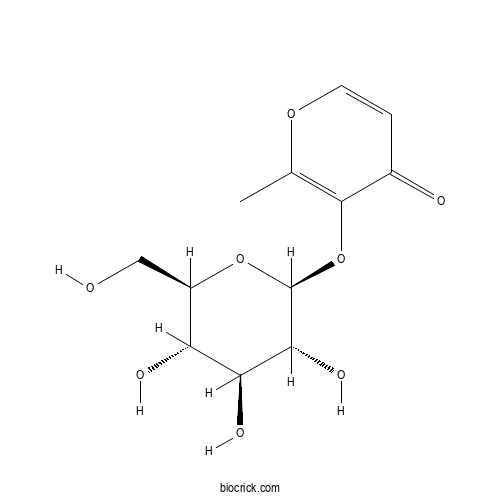
| Cas No. | 20847-13-6 | SDF | File under preparation. |
| PubChem ID | 5316639.0 | Appearance | Powder |
| Formula | C12H16O8 | M.Wt | 288.2 |
| Type of Compound | N/A | Storage | Desiccate at -20°C |
| Solubility | Soluble in Chloroform,Dichloromethane,Ethyl Acetate,DMSO,Acetone,etc. | ||
| Chemical Name | 2-methyl-3-[(2S,3R,4S,5S,6R)-3,4,5-trihydroxy-6-(hydroxymethyl)oxan-2-yl]oxypyran-4-one | ||
| SMILES | CC1=C(C(=O)C=CO1)OC2C(C(C(C(O2)CO)O)O)O | ||
| Standard InChIKey | YGSIRXHFAUFUEJ-GPTQDWHKSA-N | ||
| Standard InChI | InChI=1S/C12H16O8/c1-5-11(6(14)2-3-18-5)20-12-10(17)9(16)8(15)7(4-13)19-12/h2-3,7-10,12-13,15-17H,4H2,1H3/t7-,8-,9+,10-,12+/m1/s1 | ||
| General tips | For obtaining a higher solubility , please warm the tube at 37 ℃ and shake it in the ultrasonic bath for a while.Stock solution can be stored below -20℃ for several months. We recommend that you prepare and use the solution on the same day. However, if the test schedule requires, the stock solutions can be prepared in advance, and the stock solution must be sealed and stored below -20℃. In general, the stock solution can be kept for several months. Before use, we recommend that you leave the vial at room temperature for at least an hour before opening it. |
||
| About Packaging | 1. The packaging of the product may be reversed during transportation, cause the high purity compounds to adhere to the neck or cap of the vial.Take the vail out of its packaging and shake gently until the compounds fall to the bottom of the vial. 2. For liquid products, please centrifuge at 500xg to gather the liquid to the bottom of the vial. 3. Try to avoid loss or contamination during the experiment. |
||
| Shipping Condition | Packaging according to customer requirements(5mg, 10mg, 20mg and more). Ship via FedEx, DHL, UPS, EMS or other couriers with RT, or blue ice upon request. | ||
Quality Control & MSDS
3D structure
Package In Stock

Number of papers citing our products


Maltol glucoside Dilution Calculator
Maltol glucoside Molarity Calculator
| 1 mg | 5 mg | 10 mg | 20 mg | 25 mg | |
| 1 mM | 3.4698 mL | 17.3491 mL | 34.6981 mL | 69.3963 mL | 86.7453 mL |
| 5 mM | 0.694 mL | 3.4698 mL | 6.9396 mL | 13.8793 mL | 17.3491 mL |
| 10 mM | 0.347 mL | 1.7349 mL | 3.4698 mL | 6.9396 mL | 8.6745 mL |
| 50 mM | 0.0694 mL | 0.347 mL | 0.694 mL | 1.3879 mL | 1.7349 mL |
| 100 mM | 0.0347 mL | 0.1735 mL | 0.347 mL | 0.694 mL | 0.8675 mL |
| * Note: If you are in the process of experiment, it's necessary to make the dilution ratios of the samples. The dilution data above is only for reference. Normally, it's can get a better solubility within lower of Concentrations. | |||||
- Swertiajaponin 2''-O-rhamnoside
Catalog No.:BCX2457
CAS No.:75474-16-7
- Escin IVf
Catalog No.:BCX2456
CAS No.:249922-20-1
- Bisphenol A bis(2,3-dihydroxypropyl)ether
Catalog No.:BCX2455
CAS No.:5581-32-8
- Isodonhenrin D
Catalog No.:BCX2454
CAS No.:1392194-87-4
- Spirasine III
Catalog No.:BCX2453
CAS No.:112496-48-7
- Galanginin
Catalog No.:BCX2452
CAS No.:68592-14-3
- β-Hydroxy-2',4',5'-trimethoxychalcone
Catalog No.:BCX2451
CAS No.:861074-67-1
- Rabdoternin E
Catalog No.:BCX2450
CAS No.:155969-82-7
- Spiradine D
Catalog No.:BCX2449
CAS No.:20071-93-6
- Spiredine
Catalog No.:BCX2448
CAS No.:60062-45-5
- (10E,12Z)-9-Oxooctadeca-10,12-dienoic acid
Catalog No.:BCX2447
CAS No.:54232-59-6
- 3'-Deoxyhispolon
Catalog No.:BCX2446
CAS No.:117930-30-0
- Galangin 5-methyl ether
Catalog No.:BCX2459
CAS No.:104594-69-6
- Escin IVc
Catalog No.:BCX2460
CAS No.:249921-71-9
- 8-Methoxynaringenin
Catalog No.:BCX2461
CAS No.:94884-92-1
- (±)-Tropic acid
Catalog No.:BCX2462
CAS No.:552-63-6
- (22R)-Hydroxycholesterol
Catalog No.:BCX2463
CAS No.:17954-98-2
- Arecoline
Catalog No.:BCX2464
CAS No.:63-75-2
- Isofouquierol
Catalog No.:BCX2465
CAS No.:53822-99-4
- Pyruvic acid
Catalog No.:BCX2466
CAS No.:127-17-3
- Azadirachtin B
Catalog No.:BCX2467
CAS No.:106500-25-8
- 5-(4-Hydroxyphenyl)pentanoic acid
Catalog No.:BCX2468
CAS No.:4654-08-4
- 2-Ethylbutyric acid
Catalog No.:BCX2469
CAS No.:1988-09-5
- 2-Ethylhexanoic acid
Catalog No.:BCX2470
CAS No.:149-57-5
gamma-Pyrone compounds: flavonoids and maltol glucoside derivatives from Herniaria glabra L. collected in the Ternopil region of the Ukraine.[Pubmed:29783188]
Phytochemistry. 2018 Aug;152:213-222.
The phytochemical investigation of the whole plant extracts of Herniaria glabra L. (Caryophyllaceae) led to the identification and isolation of four known flavonoids, one known and three undescribed maltol derivatives, and benzyl beta-gentiobioside. The structures were established by extensive 1D and 2D NMR spectroscopic analyses, as well as HRESIMS data. For the first time in Herniaria genus, as well as in Caryophylaceae family the presence of apiorutin quercetin 3-O-[(D-apio-beta-d-furanosyl-(1 --> 2)-O-[-alpha-l-rhamnopyranosyl-(1 --> 6)]-beta-d-glucopyranoside] and licoagroside B maltol 3-O-[6-O-(3-hydroxy-3-methylglutaroyl)]-beta-d-glucopyranoside were revealed. Additionally, antioxidant actions of apiorutin, rutin, narcissin (isorhamentin 3-O-beta-d-rutinoside) and licoagroside B were assessed in human blood plasma, exposed to the peroxynitrite-induced oxidative stress in vitro. The isolates partly reduced oxidative (oxidation of thiol groups) and nitrative (tyrosine nitration) damage to blood plasma proteins, decreased plasma lipid peroxidation as well as enhanced the non-enzymatic antioxidant capacity of blood plasma. No cytotoxicity of the examined substances towards peripheral blood mononuclear cells was found.
[The Chemical Constituents of Uninvestigated Plants in Hiroshima Prefecture].[Pubmed:28154334]
Yakugaku Zasshi. 2017;137(2):215-220.
Recently, the investigation of bioactive constituents from natural products has been performed extensively around the world, yet many plants remain to be studied, even now. The author is especially interested in saponins, which are included in various natural products and Kampo medicines. Based on these study aims, we isolated the chemical constituents of Dianthus japonicus and Clethra barbinervis. The aerial parts of Dianthus japonicus were isolated into nine new (1-9) and seven known oleanane-type triterpene saponins. The structural elucidation of their chemical constituents was examined by several spectroscopic methods. Two new C-glycosyl flavones, two glycosidic derivative of anthranilic acid amides and a Maltol glucoside were also isolated from this plant. The isolated compounds were evaluated according to cytotoxic inhibition toward A549 cell lines. Compounds 7-9 showed moderate inhibitory activity. The isolation of a MeOH extract of Clethra barbinervis leaves led to three new triterpene glucosides, i.e. an ursane (ryobunin A, 22), a seco-ursane (ryobunin B, 23) and an oleanane-type glucoside (ryobunin C, 24), along with four known compounds.
Isolation of maltol glucoside from the floral nectar of New Zealand manuka (Leptospermum scoparium).[Pubmed:25529685]
Food Chem. 2015 May 1;174:306-9.
Maltol glucoside (3-(beta-D-glucopyranosyloxy)-2-methyl-4H-pyran-4-one), 1, was isolated from a preparation of the floral nectar from the New Zealand manuka tree (Leptospermum scoparium). 1 eluted just after dihydroxyacetone in HPLC of underivatized nectar and showed a UV absorbance maximum of 258 nm. The structure of 1 was confirmed by NMR and high resolution mass spectrometry.
Ethnobotany, phytochemistry, and bioactivity of the genus Turnera (Passifloraceae) with a focus on damiana--Turnera diffusa.[Pubmed:24468305]
J Ethnopharmacol. 2014 Mar 28;152(3):424-43.
ETHNOPHARMACOLOGICAL RELEVANCE: Half a dozen of the currently accepted 135 Turnera species are used in traditional medicine, most notably Turnera diffusa Willd. ex Schult. which is one of the most highly appreciated plant aphrodisiacs. Other traditional uses of Turnera L. species include the treatment of anaemia, bronchitis, cough, diabetes, fever, fungal disease, gastrointestinal complaints, pain, pulmonary and respiratory diseases, skin disorders, and women׳s health problems. Additionally, Turnera species are used as abortives, expectorants, and laxatives. PHYTOCHEMISTRY: Flavonoids (22 different compounds), Maltol glucoside, phenolics, cyanogenic glycosides (7 different compounds), monoterpenoids, sesquiterpenoids, triterpenoids, the polyterpene ficaprenol-11, fatty acids, and caffeine have been found in the genus Turnera. BIOACTIVITY: Bioactivities experimentally proven for members of the genus Turnera encompass antianxiety, antiaromatase, antibacterial including antimycobacterial, antidiabetic, antioxidant, adapatogenic, antiobesity, antispasmodic, cytotoxic, gastroprotective, hepatoprotective, and aphrodisiac activities. Most of these activities have so far been investigated only in chemical, cell based, or animal assays. In contrast, the antiobesity activity was also investigated in a study on healthy human subjects and with a herbal preparation containing among other ingredients Turnera diffusa leaves. Moreover, the enhancement of female sexual function was assessed in humans; again the product contained besides Turnera diffusa other potentially bioactive ingredients. However, with only few exceptions, most of the traditional uses and the experimentally verified bioactivities can currently not be related to a particular compound or compound class. A notable exception is the flavonoid apigenin, which was identified animal experiments as the antinociceptive principle of Turnera diffusa. CONCLUSION: In this review, the current knowledge on ethnobotanical uses of members of the genus Turnera, the secondary metabolites reported from Turnera, and experimentally documented bioactivities from Turnera extracts and pure compounds derived from Turnera extracts are compiled. Moreover, some of the most interesting avenues for future research projects are being discussed briefly. These include in particular the aphrodisiac activity of Turnera diffusa and the antibiotic activity potentiating effect of Turnera ulmifolia L. against aminoglycoside resistant bacteria.
Unusual secondary metabolites from Astragalus halicacabus LAM.[Pubmed:23847078]
Chem Biodivers. 2013 Jul;10(7):1328-34.
From the whole plant of Astragalus halicacabus (Sect. Halicacabus), a new cycloartane-type glycoside, (20R,24S)-3-O-[alpha-L-arabinopyranosyl-(1-->2)-beta-D-xylopyranosyl]-20,24-epoxy-16-O-beta-D-glucopyranosyl-3beta,6alpha,16beta,25-tetrahydroxycycloartane, and a new glycoside, 3-O-[beta-D-apiofuranosyl-(1-->2)-beta-D-glucopyranosyl]maltol were isolated together with seven known cycloartane-type glycosides, i.e., cyclocanthoside D, askendosides D, F, and G, cyclosieversioside G, cyclostipuloside A, elongatoside, and a known Maltol glucoside, 3-O-beta-D-glucopyranosylmaltol. The structures were elucidated by means of high-resolution mass spectrometry, and extensive 1D- and 2D-NMR spectroscopic analysis. This is the first phytochemical work on A. halicacabus, and a maltol glycoside was encountered for the first time in the Leguminosae family.
Dianthosaponins A-F, triterpene saponins, flavonoid glycoside, aromatic amide glucoside and gamma-pyrone glucoside from Dianthus japonicus.[Pubmed:21881258]
Chem Pharm Bull (Tokyo). 2011;59(9):1141-8.
From aerial parts of Dianthus japonicus, six new and seven known oleanane-type triterpene saponins were isolated. The structures of the new saponins, named dianthosaponins A-F, were elucidated by means of high resolution mass spectrometry, and extensive inspection of one- and two-dimensional NMR spectroscopic data. A new C-glycosyl flavone, a glycosidic derivative of anthranilic acid amide and a Maltol glucoside were also isolated.
Effects of eleven flavonoids from the osteoprotective fraction of Drynaria fortunei (KUNZE) J. SM. on osteoblastic proliferation using an osteoblast-like cell line.[Pubmed:18175973]
Chem Pharm Bull (Tokyo). 2008 Jan;56(1):46-51.
Drynaria fortunei (KUNZE) J. SM. (DFE) is one of the most frequently used traditional Chinese medicines prescribed for the treatment of osteoporosis in China. The present study was designed to investigate the osteoprotective constituents from Drynaria fortunei. The 60% ethanol extract of the rhizome of D. fortunei (DFE) was chromatographed on a D-101 macroporous resin column (psi 25x150 cm); three fractions (DFA eluted with water, DFB eluted with 30% and 50% ethanol, and DFC eluted with 95% ethanol) were obtained and their osteoprotective activity as examined both in vivo and in vitro. DFB showed significant activity on both the proliferation of UMR106 cells and promoting bone mineral density (BMD) in ovariectomized (OVX) mice. A bioactivity-guided method led to the isolation of 11 flavonoids from this fraction (DFB) with antiosteoporotic activity, including two new compounds, kaempferol 3-O-beta-D-glucopyranoside-7-O-alpha-L-arabinofuranoside (1) and (R)-5,7,3',5'-tetrahydroxy-flavanone 7-O-neohesperidoside (2), along with nine known ones: three flavanones (3-5), one flavone (7), one flavonol (6), two chromones (8, 10), Maltol glucoside (9), and (-)-epicatechin (11). Compounds 4-11 are reported for the first time from this genus. We investigated the proliferative effects of the 11 compounds in the UMR106 osteoblastic cell line in vitro. All compounds exhibited the proliferative activity in the UMR106 cells at most of the concentrations tested. Most compounds are reported for the first time from the Drynaria genus and this was the first study of their proliferative activity in osteoblast-like cells. The main peaks in the HPLC fingerprint of the active fraction (DFB) were also identified.

Calcutta University

University of Minnesota

University of Maryland School of Medicine

University of Illinois at Chicago

The Ohio State University

University of Zurich

Harvard University

Colorado State University

Auburn University

Yale University

Worcester Polytechnic Institute

Washington State University

Stanford University

University of Leipzig

Universidade da Beira Interior

The Institute of Cancer Research

Heidelberg University

University of Amsterdam

University of Auckland

TsingHua University

The University of Michigan

Miami University

DRURY University

Jilin University

Fudan University

Wuhan University

Sun Yat-sen University

Universite de Paris

Deemed University

Auckland University

The University of Tokyo

Korea University



