
Vanicoside ACAS# 155179-22-9 |
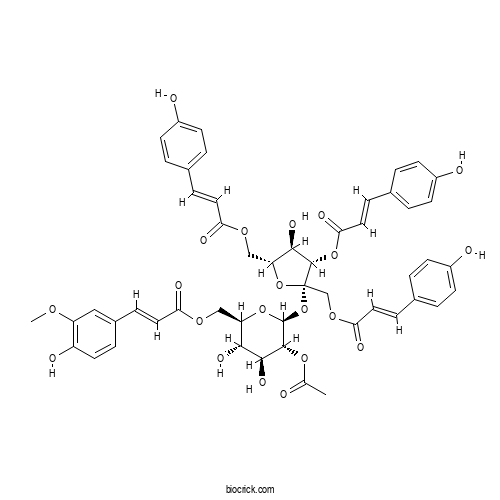
| Cas No. | 155179-22-9 | SDF | File under preparation. |
| PubChem ID | 44575681.0 | Appearance | Powder |
| Formula | C51H50O21 | M.Wt | 998.9 |
| Type of Compound | N/A | Storage | Desiccate at -20°C |
| Solubility | Soluble in Chloroform,Dichloromethane,Ethyl Acetate,DMSO,Acetone,etc. | ||
| Chemical Name | [(2R,3R,4S,5S)-5-[(2S,3R,4S,5S,6R)-3-acetyloxy-4,5-dihydroxy-6-[[(E)-3-(4-hydroxy-3-methoxyphenyl)prop-2-enoyl]oxymethyl]oxan-2-yl]oxy-3-hydroxy-4-[(E)-3-(4-hydroxyphenyl)prop-2-enoyl]oxy-5-[[(E)-3-(4-hydroxyphenyl)prop-2-enoyl]oxymethyl]oxolan-2-yl]methyl (E)-3-(4-hydroxyphenyl)prop-2-enoate | ||
| SMILES | CC(=O)OC1C(C(C(OC1OC2(C(C(C(O2)COC(=O)C=CC3=CC=C(C=C3)O)O)OC(=O)C=CC4=CC=C(C=C4)O)COC(=O)C=CC5=CC=C(C=C5)O)COC(=O)C=CC6=CC(=C(C=C6)O)OC)O)O | ||
| Standard InChIKey | RNXDQKHOEWIRNH-FSZFHJIYSA-N | ||
| Standard InChI | InChI=1S/C51H50O21/c1-29(52)68-48-47(63)45(61)39(26-65-42(58)23-13-33-9-20-37(56)38(25-33)64-2)69-50(48)72-51(28-67-43(59)22-11-31-5-16-35(54)17-6-31)49(70-44(60)24-12-32-7-18-36(55)19-8-32)46(62)40(71-51)27-66-41(57)21-10-30-3-14-34(53)15-4-30/h3-25,39-40,45-50,53-56,61-63H,26-28H2,1-2H3/b21-10+,22-11+,23-13+,24-12+/t39-,40-,45-,46-,47+,48-,49+,50+,51+/m1/s1 | ||
| General tips | For obtaining a higher solubility , please warm the tube at 37 ℃ and shake it in the ultrasonic bath for a while.Stock solution can be stored below -20℃ for several months. We recommend that you prepare and use the solution on the same day. However, if the test schedule requires, the stock solutions can be prepared in advance, and the stock solution must be sealed and stored below -20℃. In general, the stock solution can be kept for several months. Before use, we recommend that you leave the vial at room temperature for at least an hour before opening it. |
||
| About Packaging | 1. The packaging of the product may be reversed during transportation, cause the high purity compounds to adhere to the neck or cap of the vial.Take the vail out of its packaging and shake gently until the compounds fall to the bottom of the vial. 2. For liquid products, please centrifuge at 500xg to gather the liquid to the bottom of the vial. 3. Try to avoid loss or contamination during the experiment. |
||
| Shipping Condition | Packaging according to customer requirements(5mg, 10mg, 20mg and more). Ship via FedEx, DHL, UPS, EMS or other couriers with RT, or blue ice upon request. | ||
Quality Control & MSDS
3D structure
Package In Stock

Number of papers citing our products


Vanicoside A Dilution Calculator
Vanicoside A Molarity Calculator


| 1 mg | 5 mg | 10 mg | 20 mg | 25 mg | |
| 1 mM | 1.0011 mL | 5.0055 mL | 10.011 mL | 20.022 mL | 25.0275 mL |
| 5 mM | 0.2002 mL | 1.0011 mL | 2.0022 mL | 4.0044 mL | 5.0055 mL |
| 10 mM | 0.1001 mL | 0.5006 mL | 1.0011 mL | 2.0022 mL | 2.5028 mL |
| 50 mM | 0.02 mL | 0.1001 mL | 0.2002 mL | 0.4004 mL | 0.5006 mL |
| 100 mM | 0.01 mL | 0.0501 mL | 0.1001 mL | 0.2002 mL | 0.2503 mL |
| * Note: If you are in the process of experiment, it's necessary to make the dilution ratios of the samples. The dilution data above is only for reference. Normally, it's can get a better solubility within lower of Concentrations. | |||||
- Evofolin B
Catalog No.:BCX2664
CAS No.:138171-64-9
- Shancigusin D
Catalog No.:BCX2663
CAS No.:1174157-28-8
- 12β,17β-Dihydroxyandrosta-1,4-dien-3-one
Catalog No.:BCX2662
CAS No.:80227-48-1
- 12β,17β-Dihydroxyandrosta-1,4,6-trien-3-one
Catalog No.:BCX2661
CAS No.:88378-70-5
- 1-(4-Hydroxybenzyl)-4-methoxypenanthrene-2,7-diol
Catalog No.:BCX2660
CAS No.:133740-30-4
- 3-Hydroxy-2-(4-hydroxy-3-methoxyphenyl)-1-(4-hydroxyphenyl)propan-1-one
Catalog No.:BCX2659
CAS No.:3037164-85-2
- Baigene C methyl ether
Catalog No.:BCX2658
CAS No.:263746-22-1
- 2-epi-Baigene C methyl ether
Catalog No.:BCX2657
CAS No.:263746-21-0
- Fukanedone III
Catalog No.:BCX2656
CAS No.:219595-68-3
- Fukanedone II
Catalog No.:BCX2655
CAS No.:219595-70-7
- Ferulacoumarin C
Catalog No.:BCX2654
CAS No.:263746-12-9
- 5-O-Methylshanciguol
Catalog No.:BCX2653
CAS No.:87530-27-6
- Idescarpin
Catalog No.:BCX2666
CAS No.:188557-53-1
- Dshamirone
Catalog No.:BCX2667
CAS No.:62561-19-7
- 3-O-Methylshancigusin D
Catalog No.:BCX2668
CAS No.:2086662-46-4
- Acernikol
Catalog No.:BCX2669
CAS No.:623584-31-6
- Iturin A3
Catalog No.:BCX2670
CAS No.:64642-38-2
- Iturin A4
Catalog No.:BCX2671
CAS No.:83777-00-8
- Iturin A6
Catalog No.:BCX2672
CAS No.:83777-02-0
- Iturin A7
Catalog No.:BCX2673
CAS No.:83777-03-1
- Juglanoside E
Catalog No.:BCX2674
CAS No.:725265-67-8
- Gymconopin D
Catalog No.:BCX2675
CAS No.:847670-85-3
- Bulbocol
Catalog No.:BCX2676
CAS No.:210231-51-9
- 7,4'-Dihydroxy-3'-methoxyflavan
Catalog No.:BCX2677
CAS No.:95587-88-5
Reynoutria Rhizomes as a Natural Source of SARS-CoV-2 Mpro Inhibitors-Molecular Docking and In Vitro Study.[Pubmed:34451839]
Pharmaceuticals (Basel). 2021 Jul 29;14(8):742.
More than a year has passed since the world began to fight the novel severe acute respiratory syndrome coronavirus 2 (SARS-CoV-2) responsible for the Coronavirus disease 2019 (COVID-19) pandemic, and still it spreads around the world, mutating at the same time. One of the sources of compounds with potential antiviral activity is Traditional Chinese Medicinal (TCM) plants used in China in the supportive treatment of COVID-19. Reynoutria japonica is important part of the Shu Feng Jie Du Granule/Capsule-TCM herbal formula, recommended by China Food and Drug Administration (CFDA) for treatment of patients with H1N1- and H5N9-induced acute lung injury and is also used in China to treat COVID-19, mainly combined with other remedies. In our study, 25 compounds from rhizomes of R. japonica and Reynoutria sachalinensis (related species), were docked into the binding site of SARS-CoV-2 main protease. Next, 11 of them (Vanicoside A, vanicoside B, resveratrol, piceid, emodin, epicatechin, epicatechin gallate, epigallocatechin gallate, procyanidin B2, procyanidin C1, procyanidin B2 3,3'-di-O-gallate) as well as extracts and fractions from rhizomes of R. japonica and R. sachalinensis were tested in vitro using a fluorescent peptide substrate. Among the tested phytochemicals the best results were achieved for Vanicoside A and vanicoside B with moderate inhibition of SARS-CoV-2 Mpro, IC(50) = 23.10 microM and 43.59 microM, respectively. The butanol fractions of plants showed the strongest inhibition of SARS-CoV-2 Mpro (IC(50) = 4.031 microg/mL for R. sachalinensis and IC(50) = 7.877 microg/mL for R. japonica). As the main constituents of butanol fractions, besides the phenylpropanoid disaccharide esters (e.g., vanicosides), are highly polymerized procyanidins, we suppose that they could be responsible for their strong inhibitory properties. As inhibition of SARS-CoV-2 main protease could prevent the replication of the virus our research provides data that may explain the beneficial effects of R. japonica on COVID-19 and identify the most active compounds worthy of more extensive research.
Cytotoxic Effect of Vanicosides A and B from Reynoutria sachalinensis Against Melanotic and Amelanotic Melanoma Cell Lines and in silico Evaluation for Inhibition of BRAFV600E and MEK1.[Pubmed:32610527]
Int J Mol Sci. 2020 Jun 29;21(13):4611.
Vanicosides A and B are the esters of hydroxycinnamic acids with sucrose, occurring in a few plant species from the Polygonaceae family. So far, vanicosides A and B have not been evaluated for anticancer activity against human malignant melanoma. In this study, we tested these two natural products, isolated from Reynoutria sachalinensis rhizomes, against two human melanoma cell lines (amelanotic C32 cell line and melanotic A375 cell line, both bearing endogenous BRAFV600E mutation) and two normal human cell lines-keratinocytes (HaCaT) and the primary fibroblast line. Additionally, a molecular docking of Vanicoside A and vanicoside B with selected targets involved in melanoma progression was performed. Cell viability was studied using an MTT assay. A RealTime-Glo Annexin V Apoptosis and Necrosis assay was used for monitoring programmed cell death (PCD). Vanicoside A demonstrated strong cytotoxicity against the amelanotic C32 cell line (viability of the C32 cell line was decreased to 55% after 72 h incubation with 5.0 microM of Vanicoside A), significantly stronger than vanicoside B. This stronger cytotoxic activity can be attributed to an additional acetyl group in Vanicoside A. No significant differences in the cytotoxicity of vanicosides were observed against the less sensitive A375 cell line. Moreover, vanicosides caused the death of melanoma cells at concentrations from 2.5 to 50 microM, without harming the primary fibroblast line. The keratinocyte cell line (HaCaT) was more sensitive to vanicosides than fibroblasts, showing a clear decrease in viability after incubation with 25 microM of Vanicoside A as well as a significant phosphatidylserine (PS) exposure, but without a measurable cell death-associated fluorescence. Vanicosides induced an apoptotic death pathway in melanoma cell lines, but because of the initial loss of cell membrane integrity, an additional cell death mechanism might be involved like permeability transition pore (PTP)-mediated necrosis that needs to be explored in the future. Molecular docking indicated that both compounds bind to the active site of the BRAFV600E kinase and MEK-1 kinase; further experiments on their specific inhibitory activity of these targets should be considered.
Polygonumins A, a newly isolated compound from the stem of Polygonum minus Huds with potential medicinal activities.[Pubmed:29523802]
Sci Rep. 2018 Mar 9;8(1):4202.
Polygonumins A, a new compound, was isolated from the stem of Polygonum minus. Based on NMR results, the compound's structure is identical to that of Vanicoside A, comprising four phenylpropanoid ester units and a sucrose unit. The structure differences were located at C-3'''''. The cytotoxic activity of polygonumins A was evaluated on several cancer cell lines by a cell viability assay using tetrazolium dye 3-(4,5-dimethylthiazol-2-yl)-2,5-diphenyltetrazolium bromide (MTT). The compound showed the highest antiproliferative (p < 0.05) activities against K562 (Human Leukaemia Cell Line), MCF7 (Human breast adenocarcinoma cell line), and HCT116 (Colorectal cancer cells) cells. Cytotoxic studies against V79-4 cells were carried out and showed that polygonumins A was toxic at 50 microg/ml, suggesting that this compound may be used as an anticancer drug without affecting normal cells. Polygonumins A also showed promising activity as an HIV-1 protease inhibitor with 56% relative inhibition. Molecular docking results indicated that the compound possesses high binding affinity towards the HIV protease over the low binding free energy range of -10.5 to -11.3 kcal/mol. P. minus is used in Malaysian traditional medicine for the treatment of tumour cells. This is the first report on the use of P. minus as an HIV-1 protease inhibitor.
beta-Glucosidase inhibitory activities of phenylpropanoid glycosides, vanicoside A and B from Polygonum sachalinense rhizome.[Pubmed:16828242]
Fitoterapia. 2006 Sep;77(6):456-9.
The phenylpropanoid glycosides, Vanicoside A and B, isolated from rhizomes of giant knotweed (Polygonum sachalinense) showed beta-glucosidase inhibitory activity, with IC(50) values of 59.8 and 48.3 mug/ml (59.9 and 50.5 muM), respectively. In contrast, p-coumaric acid and ferulic acid, corresponding to phenylpropanoyl moieties of vanicosides, exhibited very little inhibition.
Antimicrobial substances from rhizomes of the giant knotweed Polygonum sachalinense against the fish pathogen Photobacterium damselae subsp. piscicida.[Pubmed:15787242]
Z Naturforsch C J Biosci. 2005 Jan-Feb;60(1-2):39-44.
The antimicrobial compounds against the fish pathogen Photobacterium damselae subsp. piscicida were isolated from Polygonum sachalinense rhizomes. The structures of the antimicrobial compounds 1 and 2 were determined by 1H and 13C NMR, 2D-NMR (COSY, HSQC, HMBC and ROESY) and FAB-MS to be phenylpropanoid glycosides, Vanicoside A and B, respectively. Both compounds have feruloyl and p-coumaroyl groups bonded to a sucrose moiety in their structures. Vanicoside A also has an acetyl group in the sucrose moiety. The MIC values for Vanicoside A and B against Ph. damselae subsp. piscicida DPp-1 were 32 and 64 microg/ml, respectively. The antimicrobial activities of these vanicosides were modest, in contrast to higher activities (MICs at < 4 microg/ml) of antibiotics, florphenicol, ampicillin and amoxicillin, which have been generally used for treating pasteurellosis. The activities of the vanicosides, however, were higher than those (MICs at 256 microg/ml) of ferulic acid and p-coumaric acid. It was suggested that the structure of phenylpropanoids esterified with sucrose was essential for higher antimicrobial activity of vanicosides and also acetylation of sucrose might affect the activity against the bacterium.
New sucrose phenylpropanoid esters from Polygonum perfoliatum.[Pubmed:10978204]
J Nat Prod. 2000 Aug;63(8):1094-7.
Five diferuloyl esters of sucrose, 6'-acetyl-3,6-diferuloylsucrose (helonioside B) (1); 2',4',6'-triacetyl-3,6-diferuloylsucrose (2); 1, 2',4',6'-tetraacetyl-3,6-diferuloylsucro se (3); 1,2',6'-triacetyl-3, 6-diferuloylsucrose (4); and 2',6'-diacetyl-3,6-diferuloylsucrose (5), were isolated, along with the 1,3,6-tri-p-coumaroyl-6'-feruloylsucroses, Vanicoside A and vanicoside B, from the whole plant of Polygonum perfoliatum by various chromatographic methods. The structures of these phenylpropanoid glycosides were determined on the basis of their NMR and mass spectroscopic data. Compound 1 is a known compound, but 2-5 are new members of this class.
Vanicosides C-F, new phenylpropanoid glycosides from Polygonum pensylvanicum.[Pubmed:9644060]
J Nat Prod. 1998 Jun 26;61(6):762-6.
The isolation of the protein kinase C inhibitors, Vanicoside A (1) and vanicoside B (2), from Polygonum pensylvanicum prompted continued interest in the active principles of this plant. A new, more efficient isolation procedure has been developed to facilitate separation of homologues of vanicosides A and B from the complex extract. Several new phenylpropanoid glycosides have since been isolated. The structures of these principles were determined to be 2'-O-acetylhydropiperoside (4), 6'-O-p-coumarylhydropiperoside (5), 4'-O-acetylVanicoside A (6), and 3'-O-acetylvanicoside B (7) using negative ion FABMS, 1H NMR, and 2D NMR techniques.
Vanicosides A and B, protein kinase C inhibitors from Polygonum pensylvanicum.[Pubmed:8176400]
J Nat Prod. 1994 Feb;57(2):236-42.
Two new protein kinase C inhibitory glycosides, vanicosides A [1] and B [2] were isolated from Polygonum pensylvanicum (Polygonaceae) by chromatographic techniques guided by bioassays for PKC inhibition. The structures of these glycosides were established primarily by analysis of 1H- and homonuclear correlated nmr and high-resolution fab mass spectra of 1 and 2 and the derived octaacetate, 3. Both glycosides were found to have p-coumaryl esters at the 1, 3, and 6 carbons of sucrose and a feruloyl ester at the 6' carbon. Vanicoside A [1] also had an acetate group at the 2' carbon.

Calcutta University

University of Minnesota

University of Maryland School of Medicine

University of Illinois at Chicago

The Ohio State University

University of Zurich

Harvard University

Colorado State University

Auburn University

Yale University

Worcester Polytechnic Institute

Washington State University

Stanford University

University of Leipzig

Universidade da Beira Interior

The Institute of Cancer Research

Heidelberg University

University of Amsterdam

University of Auckland

TsingHua University

The University of Michigan

Miami University

DRURY University

Jilin University

Fudan University

Wuhan University

Sun Yat-sen University

Universite de Paris

Deemed University

Auckland University

The University of Tokyo

Korea University



