
4-Hydroxy-1-tetraloneCAS# 21032-12-2 |
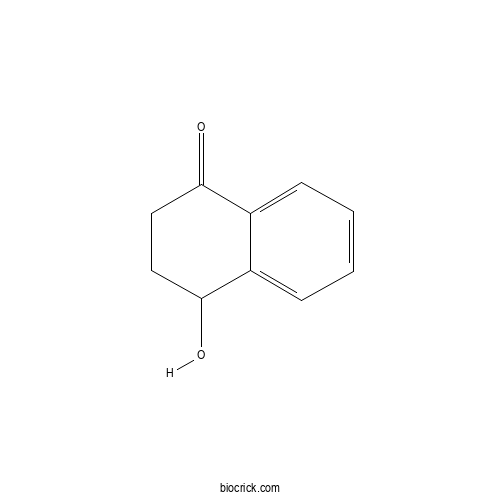
| Cas No. | 21032-12-2 | SDF | File under preparation. |
| PubChem ID | 152325.0 | Appearance | Oil |
| Formula | C10H10O2 | M.Wt | 162.2 |
| Type of Compound | N/A | Storage | Desiccate at -20°C |
| Solubility | Soluble in Chloroform,Dichloromethane,Ethyl Acetate,DMSO,Acetone,etc. | ||
| Chemical Name | 4-hydroxy-3,4-dihydro-2H-naphthalen-1-one | ||
| SMILES | C1CC(=O)C2=CC=CC=C2C1O | ||
| Standard InChIKey | BGPJTIXJFAGUIF-UHFFFAOYSA-N | ||
| Standard InChI | InChI=1S/C10H10O2/c11-9-5-6-10(12)8-4-2-1-3-7(8)9/h1-4,9,11H,5-6H2 | ||
| General tips | For obtaining a higher solubility , please warm the tube at 37 ℃ and shake it in the ultrasonic bath for a while.Stock solution can be stored below -20℃ for several months. We recommend that you prepare and use the solution on the same day. However, if the test schedule requires, the stock solutions can be prepared in advance, and the stock solution must be sealed and stored below -20℃. In general, the stock solution can be kept for several months. Before use, we recommend that you leave the vial at room temperature for at least an hour before opening it. |
||
| About Packaging | 1. The packaging of the product may be reversed during transportation, cause the high purity compounds to adhere to the neck or cap of the vial.Take the vail out of its packaging and shake gently until the compounds fall to the bottom of the vial. 2. For liquid products, please centrifuge at 500xg to gather the liquid to the bottom of the vial. 3. Try to avoid loss or contamination during the experiment. |
||
| Shipping Condition | Packaging according to customer requirements(5mg, 10mg, 20mg and more). Ship via FedEx, DHL, UPS, EMS or other couriers with RT, or blue ice upon request. | ||
Quality Control & MSDS
3D structure
Package In Stock

Number of papers citing our products


4-Hydroxy-1-tetralone Dilution Calculator
4-Hydroxy-1-tetralone Molarity Calculator
| 1 mg | 5 mg | 10 mg | 20 mg | 25 mg | |
| 1 mM | 6.1652 mL | 30.8261 mL | 61.6523 mL | 123.3046 mL | 154.1307 mL |
| 5 mM | 1.233 mL | 6.1652 mL | 12.3305 mL | 24.6609 mL | 30.8261 mL |
| 10 mM | 0.6165 mL | 3.0826 mL | 6.1652 mL | 12.3305 mL | 15.4131 mL |
| 50 mM | 0.1233 mL | 0.6165 mL | 1.233 mL | 2.4661 mL | 3.0826 mL |
| 100 mM | 0.0617 mL | 0.3083 mL | 0.6165 mL | 1.233 mL | 1.5413 mL |
| * Note: If you are in the process of experiment, it's necessary to make the dilution ratios of the samples. The dilution data above is only for reference. Normally, it's can get a better solubility within lower of Concentrations. | |||||
- 4'-Demethylisopicropodophyllone
Catalog No.:BCX2562
CAS No.:93780-85-9
- N-(2-Hydroxy-2-phenylethyl)benzamide
Catalog No.:BCX2561
CAS No.:116126-03-5
- Isopicropodophyllone
Catalog No.:BCX2560
CAS No.:55515-07-6
- (-)-7'-epi-Lyoniresinol 9'-O-glucoside
Catalog No.:BCX2559
CAS No.:162681-51-8
- Escuside
Catalog No.:BCX2558
CAS No.:478182-19-3
- Xylopinine
Catalog No.:BCX2557
CAS No.:523-02-4
- Rubescensin C
Catalog No.:BCX2556
CAS No.:81661-34-9
- Plantainoside A
Catalog No.:BCX2555
CAS No.:136172-59-3
- Methyl (2E,6E)-10,11-dihydroxy-3,7,11-trimethyldodeca-2,6-dienoate
Catalog No.:BCX2554
CAS No.:36999-94-7
- Polylauioid G
Catalog No.:BCX2553
CAS No.:2332539-57-6
- 5'-Methoxydimethylmatairesinol
Catalog No.:BCX2552
CAS No.:64767-71-1
- 1,10-epi-Pyrethrosin
Catalog No.:BCX2551
CAS No.:88199-06-8
- Linarinic acid
Catalog No.:BCX2564
CAS No.:481710-98-9
- 6,7-Di-O-acetylbarbatin A
Catalog No.:BCX2565
CAS No.:1015776-94-9
- 5,8-Dihydroxy-4-methoxy-α-tetralone
Catalog No.:BCX2566
CAS No.:868834-51-9
- (-)-Sclerone
Catalog No.:BCX2567
CAS No.:1932527-53-1
- (±)-Yangambin
Catalog No.:BCX2568
CAS No.:14759-14-9
- Brevianamide K
Catalog No.:BCX2569
CAS No.:1174538-66-9
- 7-Methoxy-9-oxo-de-O-methyllasiodiplodin
Catalog No.:BCX2570
CAS No.:196874-06-3
- 7-Methoxy-9-oxo-de-O-methyllasiodiplodin
Catalog No.:BCX2571
CAS No.:196874-05-2
- Funingenoside O
Catalog No.:BCX2572
CAS No.:744229-50-3
- Epipodophyllotoxin glucoside
Catalog No.:BCX2573
CAS No.:22352-79-0
- 2-O-Methylbrevianamide M
Catalog No.:BCX2574
CAS No.:3025731-58-9
- Anhydromevalonolactone
Catalog No.:BCX2575
CAS No.:2381-87-5
Chemical Constituents of the Ethyl Acetate Extract from Diaphragma juglandis Fructus and Their Inhibitory Activity on Nitric Oxide Production In Vitro.[Pubmed:29286331]
Molecules. 2017 Dec 29;23(1):72.
Diaphragma juglandis fructus contains various bioactive constituents. Fourteen compounds were isolated from Diaphragma juglandis fructus by preparative high performance liquid chromatography (pre-HPLC) and high-speed counter-current chromatography (HSCCC). Their structures were identified by nuclear magnetic resonance (NMR) and electrospray ionization mass spectrometry (ESI-MS). Compounds (+)-dehydrovomifoliol (12), (6R,9R)-9-hydroxymegastigman-4-en-3-one (13) and (6R,9S)-9-hydroxymegastigman-4-en-3-one (14) are found from Juglans regia L. for the first time. Compounds dihydrophaseic acid (2), blumenol B (3) and (4S)-4-Hydroxy-1-tetralone (11) are isolated from Diaphragma juglandis fructus for the first time. The anti-inflammatory effects of isolated compounds were evaluated by an in vitro model of lipopolysaccharide (LPS)-stimulated RAW 264.7 macrophages. Compounds gallic acid (1), ethyl gallate (9) and (+)-dehydrovomifoliol (12) exhibited inhibitory activity on the nitric oxide production of RAW 264.7 at a concentration of 25 muM. The result indicated that the combination HSCCC with pre-HPLC is an effective way for compound separation and purification. And Diaphragma juglandis fructus constituents have the potential for the treatment of inflammatory-related diseases.
Characterization of indigenous Rhodococcus sp. 602, a strain able to accumulate triacylglycerides from naphthyl compounds under nitrogen-starved conditions.[Pubmed:20144706]
Res Microbiol. 2010 Apr;161(3):198-207.
An indigenous bacterium (strain 602) isolated in this study from a polluted soil sample collected in Patagonia (Argentina) was investigated in relation to its metabolic responses under unbalanced growth conditions. This strain was identified as Rhodococcus sp. by molecular analyses. Strain 602 showed the ability to degrade a wide range of compounds and to synthesize triacylglycerols under nitrogen-limiting conditions. Cells were also able to accumulate triacylglycerols during cultivation on naphthalene and naphthyl-1-dodecanoate. Triacylglycerols produced by resting cells in the presence of naphthyl-1-dodecanoate contained only short-chain length fatty acids (from C(8) to C(12)), suggesting an initial attack of the substrate by an esterase releasing 1-naphthol and dodecanoic acid, which was subsequently degraded by beta-oxidation. On the other hand, naphthalene seemed to be degraded by a mono-oxygenase yielding 1-naphthol, which was then transformed to 4-Hydroxy-1-tetralone and to other possible metabolic intermediates. On the basis of the results obtained, a pathway involved in the metabolism of both aromatic compounds under nitrogen starvation by strain 602 is proposed. The results also demonstrated that Rhodococcus sp. 602 maintains its metabolic activity even in the absence of a nitrogen source. Intracellular triacylglycerols may help cells to maintain their catabolic activities under these growth-restricting conditions.
Diastereoselective and enantioselective reduction of tetralin-1,4-dione.[Pubmed:19043623]
Beilstein J Org Chem. 2008;4:37.
BACKGROUND: The chemistry of tetralin-1,4-dione, the stable tautomer of 1,4-dihydroxynaphthalene, has not been explored previously. It is readily accessible and offers interesting opportunities for synthesis. RESULTS: The title reactions were explored. L-Selectride reduced the diketone to give preferentially the cis-diol (d.r. 84 : 16). Red-Al gave preferentially the trans-diol (d.r. 13 : 87). NaBH(4), LiAlH(4), and BH(3) gave lower diastereoselectivities (yields: 76-98%). Fractional crystallization allowed isolation of the cis-diol and the trans-diol (55% and 66% yield, respectively). Borane was used to cleanly give the mono-reduction product. Highly enantioselective CBS reductions afforded the trans-diol (72% yield, 99% ee) and the mono-reduction product (81%, 95% ee). CONCLUSION: Diastereoselective and enantioselective reductions of the unexplored tetralin-1,4-dione provides a very convenient entry into a number of synthetically highly attractive 1,4-tetralindiols and 4-Hydroxy-1-tetralone.
Secondary metabolites from the roots of Engelhardia roxburghiana and their antitubercular activities.[Pubmed:17418287]
Phytochemistry. 2007 May;68(9):1338-43.
Engelharquinone (1), engelharquinone epoxide (2), engelharolide (3), and engelhardic acid (4), were isolated as naturally occurring products from a plant source, Engelhardia roxburghiana together with 20 previously known compounds, four of which were hitherto not known as plant constituents. Their structures were identified by means of spectroscopic analysis. A biological evaluation showed that three of the previously isolated antitubercular constituents [(-)-4-Hydroxy-1-tetralone, 3-methoxyjuglone and engelhardione] and engelharquinone (1) exhibited moderate antitubercular activity against Mycobacterium tuberculosis 90-221387.
Antitubercular constituents from the roots of Engelhardia roxburghiana.[Pubmed:15729627]
Planta Med. 2005 Feb;71(2):171-5.
Three new compounds, engelhardione, (-)-5-hydroxy-4-methoxy-1-tetralone, and 3-methoxycarbonyl-1,5-dihydroxyanthraquinone, together with twelve known compounds have been isolated from the roots of Engelhardia roxburghiana. The structures of these new compounds were determined through spectral analyses. Engelhardione, 3-methoxyjuglone, and (-)-4-Hydroxy-1-tetralone showed antitubercular activities with MIC values=3.125, 3.125, and 6.25 microg/mL against Mycobacterium tuberculosis 90-221,387, respectively, and with MIC values=0.2, 0.2, and 4.0 microg/mL against M. tuberculosis H37Rv, individually.
Antileishmanial activity of a tetralone isolated from Ampelocera edentula, a Bolivian plant used as a treatment for cutaneous leishmaniasis.[Pubmed:8134421]
Planta Med. 1994 Feb;60(1):8-12.
The stem bark of Ampelocera edentula Kuhlm. (Ulmaceae) is used by the Chimanes Indians from Bolivia for the treatment of cutaneous leishmaniasis caused by the protozoan Leishmania braziliensis. A chloroform extract of the stem barks was found to be active against extracellular forms of Leishmania ssp. and Trypanosoma cruzi at 50 micrograms/ml. Bioassay-guided fractionation of this extract allowed us to isolate one active compound. Its structure was elucidated by spectral and chemical studies as 4-Hydroxy-1-tetralone. BALB/c mice infected with L. amazonensis (PH8) or L. venezuelensis were treated one day after the parasitic infection with 4-Hydroxy-1-tetralone (25 mg/kg/day) or with reference drug, Glucantime (56 mg Sbv/kg/day) for 14 days. Lesion development was the criteria used to evaluate the disease severity. 4-Hydroxy-1-tetralone was slightly less effective than the reference drug against L. amazonensis or L. venezuelensis. Single treatment near the site of infection, 14 days after infection with L. amazonensis, with 4-Hydroxy-1-tetralone (50 mg/kg) was more effective than Glucantime (112 mg/kg). This study is, to our knowledge, the first to show the activity of a tetralone for the experimental treatment of New World cutaneous leishmaniasis.
Stereochemistry and evidence for an arene oxide-NIH shift pathway in the fungal metabolism of naphthalene.[Pubmed:6406078]
Chem Biol Interact. 1983 Apr-May;44(1-2):119-32.
The mechanism of naphthalene oxidation by the filamentous fungus, Cunninghamella elegans is described. C. elegans oxidized naphthalene predominately to trans-1,2-dihydroxy-1,2-dihydroxy-1,2-dihydronaphthalene. A trans configuration was assigned for the dihydrodiol by nuclear magnetic resonance (NMR) spectroscopy at 500 MHz which showed a large coupling constant (J1,2) of 11.0 Hz. Comparison of the circular dichroism spectrum of the fungal trans-1,2-dihydroxy-1,2-dihydronaphthalene to that formed by mammalian enzyme systems indicated that the fungal dihydrodiol contained 76% (+)-(1S,2S)-dihydrodiol as the predominant enantiomer. Other naphthalene metabolites formed by C. elegans were identified as 1-naphthol, 2-naphthol and 4-Hydroxy-1-tetralone. Incubation of C. elegans with naphthalene and 18O2 indicated that the trans-1,2-dihydroxy-1,2-dihydronaphthalene contained one atom of molecular oxygen which indicated a monooxygenase catalyzed reaction while similar incubations with naphthalene and H182O indicated that the other oxygen atom in trans-1,2-dihydroxy-1,2-dihydronaphthalene was derived from water. Mass spectral analysis of the acid-catalyzed dehydration products of the dihydrodiol indicated that the naphthalene dihydrodiol forms via the addition of water at the C-2 position of naphthalene-1,2-oxide. Fungal metabolism of [1-2H]naphthalene yielded 1-naphthol which retained 78% of the deuterium. NMR analysis of the deuterated 1-naphthol indicated an NIH shift mechanism in which deuterium migrated from the C-1 position to the C-2 position. The above results indicate that naphthalene-1,2-oxide is an intermediate in the fungal metabolism of naphthalene and that the fungal enzymes are highly stereo-selective in the formation of trans-1,2-dihydroxy-1,2-dihydronaphthalene.
Glucuronide and sulfate conjugation in the fungal metabolism of aromatic hydrocarbons.[Pubmed:7103474]
Appl Environ Microbiol. 1982 May;43(5):1070-5.
Cunninghamella elegans oxidized naphthalene to ethyl acetate-soluble and water-soluble metabolites. Experiments with [14C]-naphthalene indicated that 21% of the substrate was converted into metabolites. The ratio of organic-soluble metabolites to water-soluble metabolites was 76:24. The major ethyl acetate-soluble naphthalene metabolites were trans-1,2-dihydroxy-1,2-dihydro-naphthalene, 4-Hydroxy-1-tetralone, and 1-naphthol. Enzymatic treatment of the aqueous phase with either arylsulfatase or beta-glucuronidase released metabolites of naphthalene that were extractable with ethyl acetate. In both cases, the major metabolite was 1-naphthol. The ratio of water-soluble sulfate conjugates to water-soluble glucuronide conjugates was 1:1. Direct analysis of the aqueous phase by high-pressure liquid and thin-layer chromatographic and mass spectrometric techniques indicated that 1-naphthyl sulfate and 1-naphthyl glucuronic acid were major water-soluble metabolites formed from the fungal metabolism of naphthalene. C. elegans oxidized biphenyl primarily to 4-hydroxy biphenyl. Deconjugation experiments with biphenyl water-soluble metabolites indicated that the glucuronide and sulfate ester of 4-hydroxy biphenyl were metabolites. The data demonstrate that sulfation and glucuronidation are major pathways in the metabolism of aromatic hydrocarbons by fungi.
Fungal transformation of naphthalene.[Pubmed:678019]
Arch Microbiol. 1978 May 30;117(2):135-43.
Eighty-six species of fungi belonging to sixty-four genera were examined for their ability to metabolize naphthalene. Analysis by thin-layer and high pressure liquid chromatography revealed that naphthalene metabolism occurred in forty-seven species belonging to thirty-four genera from the major fungal taxa. All organisms tested from the order Mucorales oxidized naphthalene with species of Cunninghamella, Syncephalastrum and Mucor showing the greatest activity. Significant metabolism was also observed with Neurospora crassa, Claviceps paspali and four species of Psilocybe. The predominant metabolite formed by most organisms was 1-naphthol. Other products identified were, 4-Hydroxy-1-tetralone, trans-1,2-dihydroxy-1,2-dihydronaphthalene, 2-naphthol, 1,2-and 1,4-naphthoquinone.
Metabolism of naphthalene by Cunninghamella elegans.[Pubmed:921262]
Appl Environ Microbiol. 1977 Oct;34(4):363-70.
Cunninghamella elegans grown on Sabouraud dextrose broth in the presence of naphthalene produced six metabolites. Each product was isolated and identified by conventional chemical techniques. The major metabolites were 1-naphthol (67.9%) and 4-Hydroxy-1-tetralone (16.7%). Minor products isolated were 1,4-naphthoquinone (2.8%), 1,2-naphthoquinone (0.2%), 2-naphthol (6.3%), and trans-1,2-dihydroxy-1,2-dihydronaphthalene (5.3%). C. elegans oxidized both 1-naphthol and 1,4-naphthoquinone to 4-Hydroxy-1-tetralone. The results suggest that C. elegans oxidizes naphthalene by a sequence of reactions similar to those reported for the mammalian metabolism of this hydrocarbon.

Calcutta University

University of Minnesota

University of Maryland School of Medicine

University of Illinois at Chicago

The Ohio State University

University of Zurich

Harvard University

Colorado State University

Auburn University

Yale University

Worcester Polytechnic Institute

Washington State University

Stanford University

University of Leipzig

Universidade da Beira Interior

The Institute of Cancer Research

Heidelberg University

University of Amsterdam

University of Auckland

TsingHua University

The University of Michigan

Miami University

DRURY University

Jilin University

Fudan University

Wuhan University

Sun Yat-sen University

Universite de Paris

Deemed University

Auckland University

The University of Tokyo

Korea University



