
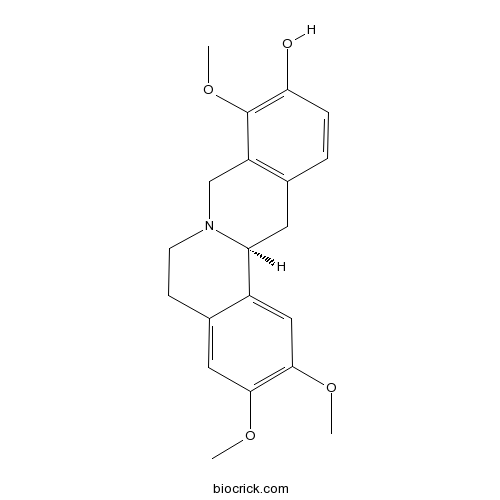
XylopinineCAS# 523-02-4 |
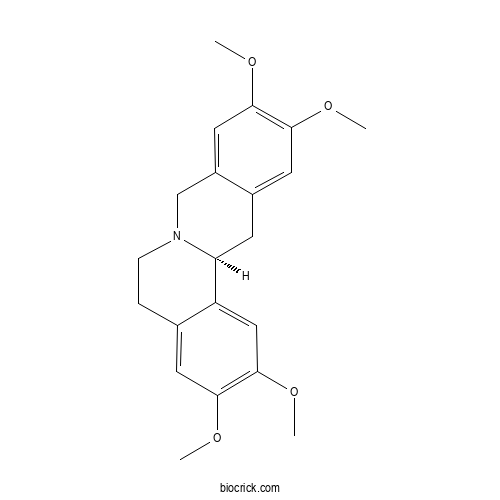
| Cas No. | 523-02-4 | SDF | File under preparation. |
| PubChem ID | 226520.0 | Appearance | Powder |
| Formula | C21H25NO4 | M.Wt | 355.4 |
| Type of Compound | N/A | Storage | Desiccate at -20°C |
| Solubility | Soluble in Chloroform,Dichloromethane,Ethyl Acetate,DMSO,Acetone,etc. | ||
| Chemical Name | (13aS)-2,3,10,11-tetramethoxy-6,8,13,13a-tetrahydro-5H-isoquinolino[2,1-b]isoquinoline | ||
| SMILES | COC1=C(C=C2C3CC4=CC(=C(C=C4CN3CCC2=C1)OC)OC)OC | ||
| Standard InChIKey | YOAUKNYXWBTMMF-KRWDZBQOSA-N | ||
| Standard InChI | InChI=1S/C21H25NO4/c1-23-18-8-13-5-6-22-12-15-10-20(25-3)19(24-2)9-14(15)7-17(22)16(13)11-21(18)26-4/h8-11,17H,5-7,12H2,1-4H3/t17-/m0/s1 | ||
| General tips | For obtaining a higher solubility , please warm the tube at 37 ℃ and shake it in the ultrasonic bath for a while.Stock solution can be stored below -20℃ for several months. We recommend that you prepare and use the solution on the same day. However, if the test schedule requires, the stock solutions can be prepared in advance, and the stock solution must be sealed and stored below -20℃. In general, the stock solution can be kept for several months. Before use, we recommend that you leave the vial at room temperature for at least an hour before opening it. |
||
| About Packaging | 1. The packaging of the product may be reversed during transportation, cause the high purity compounds to adhere to the neck or cap of the vial.Take the vail out of its packaging and shake gently until the compounds fall to the bottom of the vial. 2. For liquid products, please centrifuge at 500xg to gather the liquid to the bottom of the vial. 3. Try to avoid loss or contamination during the experiment. |
||
| Shipping Condition | Packaging according to customer requirements(5mg, 10mg, 20mg and more). Ship via FedEx, DHL, UPS, EMS or other couriers with RT, or blue ice upon request. | ||
Quality Control & MSDS
3D structure
Package In Stock

Number of papers citing our products


Xylopinine Dilution Calculator
Xylopinine Molarity Calculator

| 1 mg | 5 mg | 10 mg | 20 mg | 25 mg | |
| 1 mM | 2.8137 mL | 14.0687 mL | 28.1373 mL | 56.2746 mL | 70.3433 mL |
| 5 mM | 0.5627 mL | 2.8137 mL | 5.6275 mL | 11.2549 mL | 14.0687 mL |
| 10 mM | 0.2814 mL | 1.4069 mL | 2.8137 mL | 5.6275 mL | 7.0343 mL |
| 50 mM | 0.0563 mL | 0.2814 mL | 0.5627 mL | 1.1255 mL | 1.4069 mL |
| 100 mM | 0.0281 mL | 0.1407 mL | 0.2814 mL | 0.5627 mL | 0.7034 mL |
| * Note: If you are in the process of experiment, it's necessary to make the dilution ratios of the samples. The dilution data above is only for reference. Normally, it's can get a better solubility within lower of Concentrations. | |||||
- Rubescensin C
Catalog No.:BCX2556
CAS No.:81661-34-9
- Plantainoside A
Catalog No.:BCX2555
CAS No.:136172-59-3
- Methyl (2E,6E)-10,11-dihydroxy-3,7,11-trimethyldodeca-2,6-dienoate
Catalog No.:BCX2554
CAS No.:36999-94-7
- Polylauioid G
Catalog No.:BCX2553
CAS No.:2332539-57-6
- 5'-Methoxydimethylmatairesinol
Catalog No.:BCX2552
CAS No.:64767-71-1
- 1,10-epi-Pyrethrosin
Catalog No.:BCX2551
CAS No.:88199-06-8
- threo-1,2-Bis(4-hydroxy-3-methoxyphenyl)-1-methoxypropan-3-ol
Catalog No.:BCX2550
CAS No.:110995-81-8
- (±)-Regiolone
Catalog No.:BCX2549
CAS No.:62332-73-4
- N-Methyl-N-phenethylbenzamide
Catalog No.:BCX2548
CAS No.:73355-77-8
- 4-Megastigmene-3,9-dione
Catalog No.:BCX2547
CAS No.:74233-41-3
- Drypetesin B
Catalog No.:BCX2546
CAS No.:1909225-87-1
- 14-Acetoxycostunolide
Catalog No.:BCX2545
CAS No.:2755714-73-7
- Escuside
Catalog No.:BCX2558
CAS No.:478182-19-3
- (-)-7'-epi-Lyoniresinol 9'-O-glucoside
Catalog No.:BCX2559
CAS No.:162681-51-8
- Isopicropodophyllone
Catalog No.:BCX2560
CAS No.:55515-07-6
- N-(2-Hydroxy-2-phenylethyl)benzamide
Catalog No.:BCX2561
CAS No.:116126-03-5
- 4'-Demethylisopicropodophyllone
Catalog No.:BCX2562
CAS No.:93780-85-9
- 4-Hydroxy-1-tetralone
Catalog No.:BCX2563
CAS No.:21032-12-2
- Linarinic acid
Catalog No.:BCX2564
CAS No.:481710-98-9
- 6,7-Di-O-acetylbarbatin A
Catalog No.:BCX2565
CAS No.:1015776-94-9
- 5,8-Dihydroxy-4-methoxy-α-tetralone
Catalog No.:BCX2566
CAS No.:868834-51-9
- (-)-Sclerone
Catalog No.:BCX2567
CAS No.:1932527-53-1
- (±)-Yangambin
Catalog No.:BCX2568
CAS No.:14759-14-9
- Brevianamide K
Catalog No.:BCX2569
CAS No.:1174538-66-9
P(4)O(10)/TfOH-assisted one-pot access to 8-oxoprotoberberines.[Pubmed:41701479]
Org Biomol Chem. 2026 Mar 4;24(9):1915-1919.
This study describes an efficient one-pot strategy for the synthesis of a series of thirteen 8-oxoprotoberberine alkaloids through a cascade process involving carbonyl activation and regioselective cyclization. The synthesis demonstrates P(4)O(10)/TfOH-mediated annulation as a key step to obtain the tetracyclic scaffold from homophthalic acids and phenethylamines. The developed protocol provides a simplified and practical approach for accessing multisubstituted protoberberine scaffolds with excellent structural diversity. The synthetic utility of this methodology is demonstrated through the successful preparation of the natural product Xylopinine via sequential reduction of an 8-oxoprotoberberine intermediate, thereby offering a concise and versatile route to biologically relevant protoberberine analogues.
Enantioselective Complexation of Xylopinine: A Cyclodextrin-Assisted CE and NMR Study.[Pubmed:41096673]
Int J Mol Sci. 2025 Sep 26;26(19):9405.
Tetrahydroprotoberberine alkaloids (THPBs) are bioactive natural products bearing stereogenic centers that frequently exhibit enantiomer-specific pharmacological effects. Xylopinine (XPN), a representative THPB, shows cytotoxic, antimicrobial, and antimalarial activity in vitro, and displays pronounced stereoselectivity in vivo, with the naturally occurring (S)-enantiomer emphasizing the need for reliable enantioselective analysis. In this study, we present the synthesis of racemic XPN from norlaudanosine, and its first comprehensive cyclodextrin-assisted capillary electrophoresis screening dedicated to the enantioseparation of XPN. Sulfated- and sulfobutyl-ether-beta-cyclodextrin (S-beta-CyD, SBE-beta-CyD) provided efficient resolution (R(s) > 3), while heptakis-(6-deoxy-6-(2-carboxyethyl)thio)-beta-CyD (subetadex, SBX) yielded outstanding separation (R(s) > 9). The enantiomer migration order was consistently R,S, except when using SBE-beta-CyD, which showed the inverse sequence. Chiral HPLC using a Chiralpak AD column in polar organic mode with methanol modified with 0.1% diethylamine as mobile phase enabled the semi-preparative isolation of XPN enantiomers, with the (S)-enantiomer exceeding 95% purity. The absolute configuration was confirmed by circular dichroism spectroscopy. (1)H NMR titration and 2D rotating-frame nuclear Overhauser effect correlation spectroscopy (ROESY) consistently revealed multi-site recognition of XPN by SBX, supporting the inclusion of both aromatic rings (A and D).
Aza-[4 + 2]-cycloaddition of benzocyclobutenones into isoquinolinone derivatives enabled by photoinduced regio-specific C-C bond cleavage.[Pubmed:39738103]
Nat Commun. 2024 Dec 30;15(1):10866.
The activation of C-C bond of benzocyclobutenones under mild reaction conditions remains a challenge. We herein report a photoinduced catalyst-free regio-specific C1-C8 bond cleavage of benzocyclobutenones, enabling the generation of versatile ortho-quinoid ketene methides for aza-[4 + 2]-cycloaddition with imines, which offers a facile route to isoquinolinone derivatives, including seven family members of protoberberine alkaloids, gusanlung A, B, D, 8-oxotetrahydroplamatine, tetrahydrothalifendine, tetrahydropalmatine, and Xylopinine. Furthermore, the catalytic enantioselective version of this strategy is also realized by merging synergistic photocatalysis and chiral Lewis acid catalysis. Mechanistic studies provide compelling evidence to rationalize the photoisomerization/cycloaddition cascade process.
Cobalt-Catalyzed Enantioselective C-H Annulation of Benzylamines with Alkynes: Application to the Modular and Asymmetric Syntheses of Bioactive Molecules.[Pubmed:38104268]
J Am Chem Soc. 2023 Nov 15;145(45):24499-24505.
The transition metal-catalyzed enantioselective C-H functionalization strategy has revolutionized the logic of natural product synthesis. However, previous applications have heavily relied on the use of noble metal catalysts such as rhodium and palladium. Herein, we report the efficient synthesis of C(1)-chiral 1,2-dihydroisoquinolines (DHIQs) via enantioselective C-H/N-H annulation of picolinamides with alkynes catalyzed by a more sustainable and cheaper 3d metal catalyst, cobalt(II) acetate tetrahydrate. A wide range of enantiomerically enriched DHIQs were obtained in good yields with excellent enantioselectivities (up to 98% yield and >99% ee). The robustness and synthetic potential of this method were demonstrated by the modular and asymmetric syntheses of several tetrahydroisoquinoline alkaloids, including (S)-norlaudanosine, (S)-laudanosine, (S)-Xylopinine, (S)-sebiferine, and (S)-cryptostyline II, and the asymmetric syntheses of key intermediates of (+)-solifenacin, FR115427, and (+)-NPS R-568.
Visible Light Driven Metal-Free Photoredox Catalyzed alpha-benzylation and alpha-oxygenation of N-substituted Tetrahydroisoquinolines: Applications to Synthesis of Natural Products.[Pubmed:36073541]
Chem Asian J. 2022 Nov 16;17(22):e202200878.
Herein, visible light mediated organophoto redox catalysed simple and convenient method for the alpha-benzylation and alpha-oxygenation of tertiary amines is demonstrated. Synthesis of novel thiophenol based donor acceptor organophotoredox catalysts 4 a-4 d were investigated along with commercial catalyst 4-CzIPN (4 e). A diverse biologically active alpha-benzylated tetrahydroisoquinolines and natural products such as (+/-)-Norlaudanosine, (+/-)-laudanosine and (+/-)-Xylopinine have been synthesized under the optimized conditions in yields ranging from from 62-91%. Exploitation of synthesized alpha-benzylated compound using present phtoredox catalyzed conditions gave rise to dehydyrogenative benzylic oxidation product under oxygen atmosphere which is known to display biologically and structurally important properties. Also, various N-protected tertiary amines were found to be suitable for the alpha-oxygenation reactions using catalyst 4 e and resulted in good yields (61-85%).
Total Synthesis of (-)-Canadine, (-)-Rotundine, (-)-Sinactine, and (-)-Xylopinine Using a Last-Step Enantioselective Ir-Catalyzed Hydrogenation.[Pubmed:34076443]
J Org Chem. 2021 Jun 18;86(12):8143-8153.
A concise asymmetric total synthesis of a group of tetrahydroprotoberberine alkaloids, (-)-canadine, (-)-rotundine, (-)-sinactine, and (-)-Xylopinine, has been accomplished in three steps from the commercially available corresponding disubstituted phenylethylamine and disubstituted benzaldehyde. Our synthesis toward these four alkaloids took advantage of the following strategy: in the first step, we achieved an efficient and sustainable synthesis of secondary amine hydrochlorides via a fully continuous flow; in the second step, we developed a Pictet-Spengler reaction/Friedel-Crafts hydroxyalkylation/dehydration cascade for the construction of the dihydroprotoberberine core structure (ABCD-ring); and in the last step, Ir-catalyzed enantioselective hydrogenation was employed for the introduction of the desired stereochemistry at the C-14 position in the tetrahydroprotoberberine alkaloids. This work significantly expedites the asymmetric synthesis of the entire tetrahydroprotoberberine alkaloid family as well as a more diverse set of structurally related non-natural analogues.
General and Efficient Copper-Catalyzed Oxazaborolidine Complex in Transfer Hydrogenation of Isoquinolines under Mild Conditions.[Pubmed:32875258]
ACS Omega. 2020 Aug 13;5(33):21219-21225.
A general and efficient method for copper-catalyzed transfer hydrogenation of isoquinolines with an oxazaborolidine-BH(3) complex, under mild reaction conditions, is successfully developed. A broad range of isoquinolines has been reduced to the corresponding products with 61-85% yields. The method is applied to the synthesis of biologically active tetrahydrosioquinoline alkaloid (+/-)-norlaudanosine in 62% yield, which is the key precursor for the preparation of (+/-)-laudanosine, (+/-)-N-methyl-laudanosine, and (+/-)-Xylopinine in one or two steps.
Synthesis of Tetrahydroisoquinoline Alkaloids and Related Compounds through the Alkylation of Anodically Prepared alpha-Amino Nitriles.[Pubmed:27410716]
J Org Chem. 2016 Aug 5;81(15):6721-39.
alpha-Amino nitrile 2a was conveniently prepared in two individual steps from chiral hexafluorophosphate salt isoquinolinium (-)-8b including anodic cyanation as an efficient means to activate the sp(3) C1-H bond of the THIQ nucleus. The lithiation of 2a was carried out in THF at -80 degrees C in the presence of LDA to produce a stable alpha-amino carbanion which was condensed on a large variety of alkyl halides. The resulting quaternary alpha-amino nitriles were subjected to a stereoselective reductive decyanation in ethanol in the presence of NaBH4 as the hydride donor to yield N-Boc-1-alkyl-THIQs (+)-10a-g in up to 97:3 er's after removal of the chiral auxiliary group. Examination of the ORTEP view of THIQ (+)-1f revealed that the newly created stereogenic center had an absolute S configuration. Likewise, (-)-Xylopinine was synthesized in four workup steps in an overall 63% yield from alpha-amino nitrile (+)-2b. In this process, crystallization of an enantioenriched mixture (90:10) of (-)-norlaudanosine with 1 equiv of (-)-N-acetyl-l-leucine afforded the leucinate salt (+)-13 (99:1 dr). Similarly, (+)-salsolidine was displaced from its (-)-DBTA salt (-)-12 in 99:1 er, which was determined by proton and carbon NMR spectroscopy in the presence of thiophosphinic acid (+)-14 as the chiral solvating agent.
Cytotoxic Alkaloids from the Stem of Xylopia laevigata.[Pubmed:27399666]
Molecules. 2016 Jul 8;21(7):890.
Xylopia laevigata (Annonaceae), known locally as "meiu" or "pindaiba", is widely used in folk medicine in Northeastern Brazil. In the present work, we performed phytochemical analyses of the stem of X. laevigata, which led to the isolation of 19 alkaloids: (-)-roemerine, (+)-anonaine, lanuginosine, (+)-glaucine, (+)-xylopine, oxoglaucine, (+)-norglaucine, asimilobine, (-)-Xylopinine, (+)-norpurpureine, (+)-N-methyllaurotetanine, (+)-norpredicentrine, (+)-discretine, (+)-calycinine, (+)-laurotetanine, (+)-reticuline, (-)-corytenchine, (+)-discretamine and (+)-flavinantine. The in vitro cytotoxic activity toward the tumor cell lines B16-F10 (mouse melanoma), HepG2 (human hepatocellular carcinoma), K562 (human chronic myelocytic leukemia) and HL-60 (human promyelocytic leukemia) and non-tumor peripheral blood mononuclear cells (PBMCs) was tested using the Alamar Blue assay. Lanuginosine, (+)-xylopine and (+)-norglaucine had the highest cytotoxic activity. Additionally, the pro-apoptotic effects of lanuginosine and (+)-xylopine were investigated in HepG2 cells using light and fluorescence microscopies and flow cytometry-based assays. Cell morphology consistent with apoptosis and a marked phosphatidylserine externalization were observed in lanuginosine- and (+)-xylopine-treated cells, suggesting induction of apoptotic cell death. In addition, (+)-xylopine treatment caused G(2)/M cell cycle arrest in HepG2 cells. These data suggest that X. laevigata is a potential source for cytotoxic alkaloids.
Ethnobotany, phytochemistry and pharmacology of Stephania rotunda Lour.[Pubmed:24768769]
J Ethnopharmacol. 2014 Jul 3;154(3):537-63.
ETHNOPHARMACOLOGICAL RELEVANCE: Stephania rotunda Lour. (Menispermaceae) is an important traditional medicinal plant that is grown in Southeast Asia. The stems, leaves, and tubers have been used in the Cambodian, Lao, Indian and Vietnamese folk medicine systems for years to treat a wide range of ailments, including asthma, headache, fever, and diarrhoea. AIM OF THE REVIEW: To provide an up-to-date, comprehensive overview and analysis of the ethnobotany, phytochemistry, and pharmacology of Stephania rotunda for its potential benefits in human health, as well as to assess the scientific evidence of traditional use and provide a basis for future research directions. MATERIAL AND METHODS: Peer-reviewed articles on Stephania rotunda were acquired via an electronic search of the major scientific databases (Pubmed, Google Scholar, and ScienceDirect). Data were collected from scientific journals, theses, and books. RESULTS: The traditional uses of Stephania rotunda were recorded in countries throughout Southeast Asia (Cambodia, Vietnam, Laos, and India). Different parts of Stephania rotunda were used in traditional medicine to treat about twenty health disorders. Phytochemical analyses identified forty alkaloids. The roots primarily contain l-tetrahydropalmatine (l-THP), whereas the tubers contain cepharanthine and Xylopinine. Furthermore, the chemical composition differs from one region to another and according to the harvest period. The alkaloids exhibited approximately ten different pharmacological activities. The main pharmacological activities of Stephania rotunda alkaloids are antiplasmodial, anticancer, and immunomodulatory effects. Sinomenine, cepharanthine, and l-stepholidine are the most promising components and have been tested in humans. The pharmacokinetic parameters have been studied for seven compounds, including the three most promising compounds. The toxicity has been evaluated for liriodenine, roemerine, cycleanine, l-tetrahydropalmatine, and oxostephanine. CONCLUSION: Stephania rotunda is traditionally used for the treatment of a wide range of ailments. Pharmacological investigations have validated different uses of Stephania rotunda in folk medicine. The present review highlights the three most promising compounds of Stephania rotunda, which could constitute potential leads in various medicinal fields, including malaria and cancer.
Synthesis of alkaloids by Stevens rearrangement of nitrile-stabilized ammonium ylides: (+/-)-laudanosine, (+/-)-laudanidine, (+/-)-armepavine, (+/-)-7-methoxycryptopleurine, and (+/-)-xylopinine.[Pubmed:23634947]
J Org Chem. 2013 May 17;78(10):4985-92.
The Stevens rearrangement of nitrile-stabilized ammonium ylides in conjunction with the reductive removal of the nitrile function permits the facile construction of alpha-branched amines from alpha-aminonitriles. We employed this reaction sequence for the preparation of (+/-)-laudanosine, (+/-)-laudanidine and (+/-)-armepavine, (+/-)-7-methoxycryptopleurine, and (+/-)-Xylopinine from two closely related and readily accessible bicyclic alpha-aminonitriles. The final products were obtained in high to almost quantitative yields (71-98%) from the quaternary ammonium salts obtained by N-alkylation of these starting materials.
New antiplasmodial alkaloids from Stephania rotunda.[Pubmed:23127648]
J Ethnopharmacol. 2013 Jan 9;145(1):381-5.
ETHNOPHARMACOLOGICAL RELEVANCE: Stephania rotunda Lour. (Menispermaceae) is a creeper growing in many countries of Asia and commonly found in the mountainous areas of Cambodia. As a folk medicine, it has been mainly used for the treatment of fever and malaria. The pharmacological activity is mostly due to alkaloids. Thus the aim of this study is to isolate new bioactive alkaloids from Stephania rotunda and to evaluate their in vitro antiplasmodial activity. MATERIALS AND METHODS: Alkaloids were isolated and identified from dichloromethane and aqueous extracts using a combination of flash chromatography, high performance liquid chromatography, mass spectrometry and nuclear magnetic resonance. The purified compounds were tested for in vitro antiplasmodial activity on chloroquine-resistant W2 strain of Plasmodium falciparum. RESULTS: A new aporphine alkaloid named vireakine (2) along with two known alkaloids stephanine (1) and pseudopalmatine (8), described for the first time in Stephania rotunda, and together five known alkaloids tetrahydropalmatine (3), Xylopinine (4), roemerine (5), cepharanthine (6) and palmatine (7) were isolated and identified. The structure of the new alkaloid was established on the basis of 1D and 2D NMR experiments and mass spectrometry. The compounds were evaluated for their in vitro antiplasmodial and cytotoxic activities. All tested compounds showed significant antiplasmodial activities with IC(50) ranged from 1.2 muM to 52.3 muM with a good selectivity index for pseudopalmatine with IC(50) of 2.8 muM against W2 strain of Plasmodium falciparum and IC(50)>25 muM on K562S cells. CONCLUSIONS: This study provides evidence to support the use of Stephania rotunda for the treatment of malaria and/or fever by the healers. Alkaloids of the tuber exhibited antiplasmodial activity and particularly cepharanthine and pseudopalmatine.
HPLC analysis of Stephania rotunda extracts and correlation with antiplasmodial activity.[Pubmed:22566106]
Phytother Res. 2013 Feb;27(2):278-84.
Stephania rotunda (Menispermaceae), a creeper commonly found in the mountainous areas of Cambodia, has been mainly used for the treatment of fever and malaria. Thus, the aim of this study is to investigate the chemical composition and antiplasmodial activity of different samples of S. rotunda and compare their antiplasmodial activity with their alkaloid content. Sixteen samples from different parts (roots, stem, and tuber) of S. rotunda were collected from four regions of Cambodia (Battambang, Pailin, Siem Reap, and Kampot). Reversed-phase HPLC was used to determine the content of three bioactive alkaloids (cepharanthine, tetrahydropalmatine, and Xylopinine). These three alkaloids have been found in all samples from Battambang and Pailin (samples I-IX), whereas only tetrahydropalmatine was present in samples from Siem Reap and Kampot (samples X-XVI). The analyzed extracts were evaluated for their antiplasmodial activity on W2 strain of Plasmodium falciparum. Among them, 13 extracts were significantly active with inhibitory concentration 50 (IC(50) ) from 1.2 to 3.7 microg/mL and 2 extracts were moderately active (IC(50) = 6.1 and 10 microg/mL, respectively), whereas sample XI was not active (IC(50) = 19.6 microg/mL). A comparison between antiplasmodial activity and concentration of the three bioactive alkaloids in S. rotunda extracts has been realized.
Asymmetric synthesis of (S)-(-)-xylopinine. Use of the sulfinyl group as an ipso director in aromatic SE.[Pubmed:21563765]
J Org Chem. 2011 Jun 17;76(12):5036-41.
Optically pure (S)-(-)-Xylopinine 2 was prepared in three steps in 52% overall yield. Thus, condensation of the carbanion derived from (S)-4 with the (S)-(E)-sulfinylimine 5 gave a 2:1 mixture of tetrahydroisoquinolines 6a and 6b, differing only in configuration at sulfur. N-Desulfinylation of this mixture gave the diastereomeric sulfoxides which, without separation, were converted into (S)-(-)-Xylopinine (2) with loss of the sulfinyl moieties under Pictet-Spengler conditions. This unprecedented ipso electrophilic substitution of a sulfinyl group may have synthetic implications beyond that described in this work.
Simultaneous HPLC determination of three bioactive alkaloids in the Asian medicinal plant Stephania rotunda.[Pubmed:20614814]
Nat Prod Commun. 2010 Jun;5(6):877-82.
A reliable high-performance liquid chromatography (HPLC) method coupled with photodiode array detection has been developed and validated for the determination of three major alkaloids: cepharanthine, tetrahydropalmatine and Xylopinine in Stephania rotunda Lour. (Menispermaceae) collected in Cambodia. The chromatographic separation was carried out on a Symmetry C8 column (250 mm x 4.6 mm, 5 microm, Waters), with an isocratic solvent system of 25 mM potassium phosphate buffer (pH 3.5) - acetonitrile. UV detection was performed at 282 nm. Good linear behavior over the investigated concentration ranges was observed with values of r2 > 0.9964 for all the analytes. The method was reproducible with intra- and inter-day variations of less than 3.91%. The mean recoveries of the analytes ranged from 95.7 to 104.6%. The proposed method was linear, accurate, precise and specific. The validated method was successfully applied to quantify the three alkaloids in various parts of Stephania rotunda and in tubers collected from different Cambodian regions. The results indicated that the developed HPLC method could be used for the quality control of S. rotunda.

Calcutta University

University of Minnesota

University of Maryland School of Medicine

University of Illinois at Chicago

The Ohio State University

University of Zurich

Harvard University

Colorado State University

Auburn University

Yale University

Worcester Polytechnic Institute

Washington State University

Stanford University

University of Leipzig

Universidade da Beira Interior

The Institute of Cancer Research

Heidelberg University

University of Amsterdam

University of Auckland

TsingHua University

The University of Michigan

Miami University

DRURY University

Jilin University

Fudan University

Wuhan University

Sun Yat-sen University

Universite de Paris

Deemed University

Auckland University

The University of Tokyo

Korea University



