
Brevianamide KCAS# 1174538-66-9 |
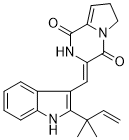
| Cas No. | 1174538-66-9 | SDF | File under preparation. |
| PubChem ID | N/A | Appearance | Yellow powder |
| Formula | C21H21N3O2 | M.Wt | 347.4 |
| Type of Compound | N/A | Storage | Desiccate at -20°C |
| Solubility | Soluble in Chloroform,Dichloromethane,Ethyl Acetate,DMSO,Acetone,etc. | ||
| General tips | For obtaining a higher solubility , please warm the tube at 37 ℃ and shake it in the ultrasonic bath for a while.Stock solution can be stored below -20℃ for several months. We recommend that you prepare and use the solution on the same day. However, if the test schedule requires, the stock solutions can be prepared in advance, and the stock solution must be sealed and stored below -20℃. In general, the stock solution can be kept for several months. Before use, we recommend that you leave the vial at room temperature for at least an hour before opening it. |
||
| About Packaging | 1. The packaging of the product may be reversed during transportation, cause the high purity compounds to adhere to the neck or cap of the vial.Take the vail out of its packaging and shake gently until the compounds fall to the bottom of the vial. 2. For liquid products, please centrifuge at 500xg to gather the liquid to the bottom of the vial. 3. Try to avoid loss or contamination during the experiment. |
||
| Shipping Condition | Packaging according to customer requirements(5mg, 10mg, 20mg and more). Ship via FedEx, DHL, UPS, EMS or other couriers with RT, or blue ice upon request. | ||
Quality Control & MSDS
Package In Stock

Number of papers citing our products


Brevianamide K Dilution Calculator
Brevianamide K Molarity Calculator
| 1 mg | 5 mg | 10 mg | 20 mg | 25 mg | |
| 1 mM | 2.8785 mL | 14.3926 mL | 28.7853 mL | 57.5705 mL | 71.9632 mL |
| 5 mM | 0.5757 mL | 2.8785 mL | 5.7571 mL | 11.5141 mL | 14.3926 mL |
| 10 mM | 0.2879 mL | 1.4393 mL | 2.8785 mL | 5.7571 mL | 7.1963 mL |
| 50 mM | 0.0576 mL | 0.2879 mL | 0.5757 mL | 1.1514 mL | 1.4393 mL |
| 100 mM | 0.0288 mL | 0.1439 mL | 0.2879 mL | 0.5757 mL | 0.7196 mL |
| * Note: If you are in the process of experiment, it's necessary to make the dilution ratios of the samples. The dilution data above is only for reference. Normally, it's can get a better solubility within lower of Concentrations. | |||||
- (±)-Yangambin
Catalog No.:BCX2568
CAS No.:14759-14-9
- (-)-Sclerone
Catalog No.:BCX2567
CAS No.:1932527-53-1
- 5,8-Dihydroxy-4-methoxy-α-tetralone
Catalog No.:BCX2566
CAS No.:868834-51-9
- 6,7-Di-O-acetylbarbatin A
Catalog No.:BCX2565
CAS No.:1015776-94-9
- Linarinic acid
Catalog No.:BCX2564
CAS No.:481710-98-9
- 4-Hydroxy-1-tetralone
Catalog No.:BCX2563
CAS No.:21032-12-2
- 4'-Demethylisopicropodophyllone
Catalog No.:BCX2562
CAS No.:93780-85-9
- N-(2-Hydroxy-2-phenylethyl)benzamide
Catalog No.:BCX2561
CAS No.:116126-03-5
- Isopicropodophyllone
Catalog No.:BCX2560
CAS No.:55515-07-6
- (-)-7'-epi-Lyoniresinol 9'-O-glucoside
Catalog No.:BCX2559
CAS No.:162681-51-8
- Escuside
Catalog No.:BCX2558
CAS No.:478182-19-3
- Xylopinine
Catalog No.:BCX2557
CAS No.:523-02-4
- 7-Methoxy-9-oxo-de-O-methyllasiodiplodin
Catalog No.:BCX2570
CAS No.:196874-06-3
- 7-Methoxy-9-oxo-de-O-methyllasiodiplodin
Catalog No.:BCX2571
CAS No.:196874-05-2
- Funingenoside O
Catalog No.:BCX2572
CAS No.:744229-50-3
- Epipodophyllotoxin glucoside
Catalog No.:BCX2573
CAS No.:22352-79-0
- 2-O-Methylbrevianamide M
Catalog No.:BCX2574
CAS No.:3025731-58-9
- Anhydromevalonolactone
Catalog No.:BCX2575
CAS No.:2381-87-5
- Brevianamide X
Catalog No.:BCX2576
CAS No.:2315237-30-8
- Isoarctigenin
Catalog No.:BCX2577
CAS No.:119030-66-9
- Liriodendritol
Catalog No.:BCX2578
CAS No.:22006-88-8
- Ethyl α-D-fructofuranoside
Catalog No.:BCX2579
CAS No.:81024-99-9
- (E)-1-(3,4-Dimethoxyphenyl)buta-1,3-diene
Catalog No.:BCX2580
CAS No.:75560-74-6
- N-Formylanonaine
Catalog No.:BCX2581
CAS No.:83459-45-4
Anti-Neuroinflammatory Effects of Prenylated Indole Alkaloids from the Antarctic Fungus Aspergillus sp. Strain SF-7367.[Pubmed:39860162]
Molecules. 2025 Jan 13;30(2):294.
Inflammation has always been considered a trigger or consequence of neurodegenerative diseases, and the inhibition of inflammation in the central nervous system can effectively protect nerve cells. Several studies have indicated that various natural products inhibit neuroinflammation. Among these, Antarctic fungal metabolites have pharmacological activities and a developmental value. Therefore, this study aimed to evaluate the anti-neuroinflammatory activity of an Antarctic fungus belonging to Aspergillus (strain SF-7367). Secondary metabolites of SF-7367 were isolated using high-performance liquid chromatography followed by validation of their anti-inflammatory effects in lipopolysaccharide-stimulated BV2 microglia and RAW264.7 macrophages. Chemical analysis of metabolites from the fungal strain revealed five known compounds: epideoxybrevianamide E (1), brevianamide V/W (2), Brevianamide K (3), brevianamide Q (4), and brevianamide R (5). Among these compounds, Brevianamide K showed significant anti-inflammatory activity against both cell types. Results of Western blotting and molecular docking showed that Brevianamide K could regulate the activation of nuclear factor kappa-light-chain-enhancer of activated B cell (NF-kappaB) signaling. This indicates that Brevianamide K present in Aspergillus sp. (strain SF-7367) can inhibit inflammatory responses by reducing lipopolysaccharide-induced nuclear translocation of NF-kappaB (p65). These findings suggest that Aspergillus sp. (strain SF-7367) and Brevianamide K are candidate agents for treating neurodegenerative diseases.
Hydroxylation with Unusual Stereoinversion Catalyzed by an Fe(II) /2-OG Dependent Oxidase and 3,6-Diene-2,5-diketopiperazine Formation in the Biosynthesis of Brevianamide K.[Pubmed:36750406]
Angew Chem Int Ed Engl. 2023 Mar 27;62(14):e202216989.
Natural products with the 3,6-diene-2,5-diketopiperazine core are widely distributed in nature; however, the biosynthetic mechanism of 3,6-diene-2,5-diketopiperazine in fungi remains to be further elucidated. Through heterologous expression and biochemical investigation of an Fe(II) /2-oxoglutarate-dependent oxidase (AspE) and a heme-dependent P450 enzyme (AspF), we report that AspE, AspF and subsequent dehydration account for the formation of the 3,6-diene-2,5-diketopiperazine substructure of Brevianamide K from Aspergillus sp. SK-28, a symbiotic fungus of mangrove plant Kandelia candel. More interestingly, in-depth investigation of the enzymatic mechanism showed that AspE promotes hydroxylation of brevianamide Q with unprecedented stereoinversion through hydrogen atom abstraction and water nucleophilic attack from the opposite face of the resultant iminium cation intermediate.
Diketopiperazine and Diphenylether Derivatives from Marine Algae-Derived Aspergillus versicolor OUCMDZ-2738 by Epigenetic Activation.[Pubmed:30583513]
Mar Drugs. 2018 Dec 22;17(1):6.
A chemical-epigenetic method was used to enhance the chemodiversity of a marine algicolous fungus. Apart from thirteen known compounds, (+)-brevianamide R ((+)-3), (‒)-brevianamide R ((‒)-3), (+)-brevianamide Q ((+)-4), (‒)-brevianamide Q ((‒)-4), brevianamide V ((+)-5), brevianamide W ((‒)-5), Brevianamide K (6), diorcinol B (7), diorcinol C (8), diorcinol E (9), diorcinol J (10), diorcinol (11), 4-methoxycarbonyldiorcinol (12), two new compounds, (+)- and (‒)-brevianamide X ((+)- and (‒)- 2)), as well as a new naturally occurring one, 3-[6-(2-methylpropyl)-2-oxo-1H-pyrazin-3-yl]propanamide (1), were isolated from chemical-epigenetic cultures of Aspergillus versicolor OUCMDZ-2738 with 10 microM vorinostat (SAHA). Compared to cultures in the same medium without SAHA, compounds 1(-)4, 8, 9, 11, and 12 were solely observed under SAHA condition. The structures of these compounds were elucidated based on spectroscopic analysis, specific rotation analysis, ECD, and X-ray crystallographic analysis. (+/-)-3, (+/-)-4, and (+/-)-5 were further resolved into the corresponding optically pure enantiomers and their absolute configurations were determined for the first time. Compounds 11 and 12 showed selective antibacterial against Pseudomonas aeruginosa with a minimum inhibitory concentration (MIC) of 17.4 and 13.9 muM, respectively. Compound 10 exhibited better alpha-glucosidase inhibitory activity than the assay control acarbose with IC(50) values of 117.3 and 255.3 muM, respectively.
Secondary metabolites from an algicolous Aspergillus versicolor strain.[Pubmed:22363226]
Mar Drugs. 2012 Jan;10(1):131-139.
Two new compounds, asperversin A (1) and 9xi-O-2(2,3-dimethylbut-3-enyl)brevianamide Q (2), and nine known compounds, Brevianamide K (3), brevianamide M (4), aversin (5), 6,8-di-O-methylnidurufin (6), 6,8-di-O-methylaverufin (7), 6-O-methylaverufin (8), 5alpha,8alpha-epidioxyergosta-6,22-dien-3beta-ol (9), ergosta-7,22-diene-3beta,5alpha,6beta-triol (10), and 6beta-methoxyergosta-7,22-diene-3beta,5alpha-diol (11), were obtained from the culture of Aspergillus versicolor, an endophytic fungus isolated from the marine brown alga Sargassum thunbergii. The structures of these compounds were established by spectroscopic techniques. Compounds 4, 7 and 8 exhibited antibacterial activities against Escherichia coli and Staphyloccocus aureus, and 7 also showed lethality against brine shrimp (Artemia salina) with an LC(5)(0) value of 0.5 mug/mL.
Brevianamide J, a new indole alkaloid dimer from fungus Aspergillus versicolor.[Pubmed:19627104]
Org Lett. 2009 Aug 20;11(16):3714-7.
Brevianamide J (1), a new indole alkaloid dimer, was isolated together with four new diketopiperazine alkaloids (Brevianamide K-N, 2-5) from the solid-state fermented culture of Aspergillus versicolor. Their structures were elucidated on the basis of spectral data. X-ray crystallographic analysis confirmed the structures of 1 and 4.

Calcutta University

University of Minnesota

University of Maryland School of Medicine

University of Illinois at Chicago

The Ohio State University

University of Zurich

Harvard University

Colorado State University

Auburn University

Yale University

Worcester Polytechnic Institute

Washington State University

Stanford University

University of Leipzig

Universidade da Beira Interior

The Institute of Cancer Research

Heidelberg University

University of Amsterdam

University of Auckland

TsingHua University

The University of Michigan

Miami University

DRURY University

Jilin University

Fudan University

Wuhan University

Sun Yat-sen University

Universite de Paris

Deemed University

Auckland University

The University of Tokyo

Korea University



