
N-FormylanonaineCAS# 83459-45-4 |
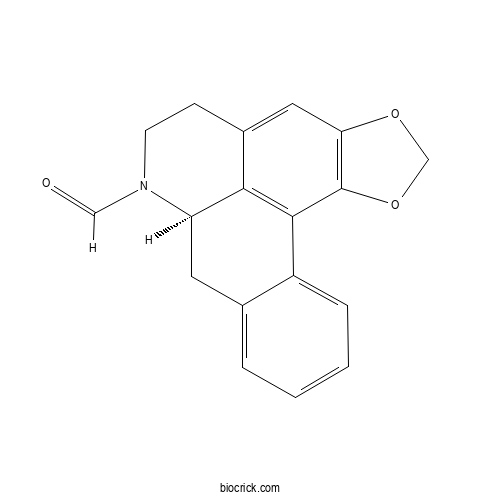
| Cas No. | 83459-45-4 | SDF | File under preparation. |
| PubChem ID | 158516.0 | Appearance | Powder |
| Formula | C18H15NO3 | M.Wt | 293.3 |
| Type of Compound | N/A | Storage | Desiccate at -20°C |
| Solubility | Soluble in Chloroform,Dichloromethane,Ethyl Acetate,DMSO,Acetone,etc. | ||
| Chemical Name | (12R)-3,5-dioxa-11-azapentacyclo[10.7.1.02,6.08,20.014,19]icosa-1(20),2(6),7,14,16,18-hexaene-11-carbaldehyde | ||
| SMILES | C1CN(C2CC3=CC=CC=C3C4=C2C1=CC5=C4OCO5)C=O | ||
| Standard InChIKey | UNKDZOMBELOPQZ-CQSZACIVSA-N | ||
| Standard InChI | InChI=1S/C18H15NO3/c20-9-19-6-5-12-8-15-18(22-10-21-15)17-13-4-2-1-3-11(13)7-14(19)16(12)17/h1-4,8-9,14H,5-7,10H2/t14-/m1/s1 | ||
| General tips | For obtaining a higher solubility , please warm the tube at 37 ℃ and shake it in the ultrasonic bath for a while.Stock solution can be stored below -20℃ for several months. We recommend that you prepare and use the solution on the same day. However, if the test schedule requires, the stock solutions can be prepared in advance, and the stock solution must be sealed and stored below -20℃. In general, the stock solution can be kept for several months. Before use, we recommend that you leave the vial at room temperature for at least an hour before opening it. |
||
| About Packaging | 1. The packaging of the product may be reversed during transportation, cause the high purity compounds to adhere to the neck or cap of the vial.Take the vail out of its packaging and shake gently until the compounds fall to the bottom of the vial. 2. For liquid products, please centrifuge at 500xg to gather the liquid to the bottom of the vial. 3. Try to avoid loss or contamination during the experiment. |
||
| Shipping Condition | Packaging according to customer requirements(5mg, 10mg, 20mg and more). Ship via FedEx, DHL, UPS, EMS or other couriers with RT, or blue ice upon request. | ||
Quality Control & MSDS
3D structure
Package In Stock

Number of papers citing our products


N-Formylanonaine Dilution Calculator
N-Formylanonaine Molarity Calculator


| 1 mg | 5 mg | 10 mg | 20 mg | 25 mg | |
| 1 mM | 3.4095 mL | 17.0474 mL | 34.0948 mL | 68.1896 mL | 85.237 mL |
| 5 mM | 0.6819 mL | 3.4095 mL | 6.819 mL | 13.6379 mL | 17.0474 mL |
| 10 mM | 0.3409 mL | 1.7047 mL | 3.4095 mL | 6.819 mL | 8.5237 mL |
| 50 mM | 0.0682 mL | 0.3409 mL | 0.6819 mL | 1.3638 mL | 1.7047 mL |
| 100 mM | 0.0341 mL | 0.1705 mL | 0.3409 mL | 0.6819 mL | 0.8524 mL |
| * Note: If you are in the process of experiment, it's necessary to make the dilution ratios of the samples. The dilution data above is only for reference. Normally, it's can get a better solubility within lower of Concentrations. | |||||
- (E)-1-(3,4-Dimethoxyphenyl)buta-1,3-diene
Catalog No.:BCX2580
CAS No.:75560-74-6
- Ethyl α-D-fructofuranoside
Catalog No.:BCX2579
CAS No.:81024-99-9
- Liriodendritol
Catalog No.:BCX2578
CAS No.:22006-88-8
- Isoarctigenin
Catalog No.:BCX2577
CAS No.:119030-66-9
- Brevianamide X
Catalog No.:BCX2576
CAS No.:2315237-30-8
- Anhydromevalonolactone
Catalog No.:BCX2575
CAS No.:2381-87-5
- 2-O-Methylbrevianamide M
Catalog No.:BCX2574
CAS No.:3025731-58-9
- Epipodophyllotoxin glucoside
Catalog No.:BCX2573
CAS No.:22352-79-0
- Funingenoside O
Catalog No.:BCX2572
CAS No.:744229-50-3
- 7-Methoxy-9-oxo-de-O-methyllasiodiplodin
Catalog No.:BCX2571
CAS No.:196874-05-2
- 7-Methoxy-9-oxo-de-O-methyllasiodiplodin
Catalog No.:BCX2570
CAS No.:196874-06-3
- Brevianamide K
Catalog No.:BCX2569
CAS No.:1174538-66-9
- (E)-4-(3,4-Dimethoxyphenyl)but-3-en-1-yl acetate
Catalog No.:BCX2582
CAS No.:69768-98-5
- 5-(3-Hydroxyphenyl)dihydrofuran-2(3H)-one
Catalog No.:BCX2583
CAS No.:1270584-13-8
- trans-Cassumunene
Catalog No.:BCX2584
CAS No.:76318-79-1
- Cassumunene
Catalog No.:BCX2585
CAS No.:73573-81-6
- Methyl 4-acetamidobutanoate
Catalog No.:BCX2586
CAS No.:32039-11-5
- Juglanin B
Catalog No.:BCX2587
CAS No.:958365-42-9
- Gymnetinoside B
Catalog No.:BCX2588
CAS No.:1588477-86-4
- 3-Methoxy-N-acetylnornantenine
Catalog No.:BCX2589
CAS No.:53452-28-1
- 4'-Demethylpodophyllotoxin 7-O-glucoside
Catalog No.:BCX2590
CAS No.:40505-30-4
- α-Peltatin 5-O-glucoside
Catalog No.:BCX2591
CAS No.:11024-58-1
- Pinoresinol monomethyl ether
Catalog No.:BCX2592
CAS No.:95404-51-6
- Ferulacoumarin A
Catalog No.:BCX2593
CAS No.:263746-19-6
Alkaloidal constituents of Tinospora crispa.[Pubmed:21213972]
Nat Prod Commun. 2010 Nov;5(11):1747-50.
Phytochemical investigations of the stems of Tinospora crispa led to the isolation of one new aporphine alkaloid, N-formylasimilobine 2-O-beta-D-glucopyranoside (1), along with six known alkaloids, N-formylasimilobine 2-O-beta-D-glucopyranosyl-(1 --> 2)-beta-D-glucopyranoside (2) (tinoscorside A), N-Formylanonaine (3), N-formyldehydroanonaine (4), N-formylnomuciferine (5), N-demethyl-N-formyldehydronornuciferine (6), magnoflorine (7), paprazine (8), N-trans-feruloyltyramine (9), and cytidine (10). The structure of new compound 1 was deduced on the basis of spectroscopic data.
(-)-N-Formylanonaine from Michelia alba as a human tyrosinase inhibitor and antioxidant.[Pubmed:20584613]
Bioorg Med Chem. 2010 Jul 15;18(14):5241-7.
Tyrosinase is the first and rate limiting enzyme in the synthesis of melanin pigments for coloring hair, skin, and eyes. As reported in this study, a natural product, (-)-N-Formylanonaine isolated from the leaves of Michelia alba D.C. (Magnolianceae), was found to inhibit mushroom tyrosinase with an IC50 of 74.3 microM and to have tyrosinase and melanin reducing activities in human epidermal melanocytes without apparent cytotoxicity to human cells, superior to the known tyrosinase inhibitors, such as kojic acid and 1-phenyl-2-thiourea (PTU). Based on homology modeling, the compound binds the active site by coordinating with two Cu2+ ions. In addition, the compound had antioxidation activities in tests for scavenging 1,1-diphenyl-2-picrylhydrazyl (DPPH), reducing power, and chelating metal ions. To our knowledge, this is the first study to reveal the bioactivities of (-)-N-Formylanonaine from this plant species.
Chemical constituents from the leaves of Michelia alba.[Pubmed:20306361]
Nat Prod Res. 2010 Mar;24(5):398-406.
(-)-N-Formylanonaine (1), (-)-oliveroline (2), (+)-nornuciferine (3), lysicamine (4), (+)-cyperone (5), (+)-epi-yangambin (6), ficaprenol-10 (7), pheophytin a (8), aristophyll C (9) and michephyll A (10) were isolated from the leaves of Michelia alba DC (Magnoliaceae). Among them, 10 is a new compound. The structures of these compounds were characterised and identified by spectral analyses. We have also presented the antioxidation activity of 10.
Antiplatelet activities of aporphine alkaloids isolated from leaves of Magnolia obovata.[Pubmed:12677533]
Planta Med. 2003 Mar;69(3):267-9.
Five aporphine alkaloids, N-acetylanonaine ( 1), N-acetylxylopine ( 2), N-Formylanonaine ( 3), liriodenine ( 4), and lanuginosine ( 5) as the antiplatelet constituents, were isolated from the methanol extract of leaves of Magnolia obovata. This is the first reported occurrence of 2 and 3 from genus Magnolia and 5 was isolated from this plant for the first time. Compounds 1, 2 and 3 showed 60 approximately 264-fold stronger inhibitory effects than acetylsalicylic acid (ASA) to rat platelet aggregation induced by collagen, epinephrine, arachidonic acid (AA), or U46619.

Calcutta University

University of Minnesota

University of Maryland School of Medicine

University of Illinois at Chicago

The Ohio State University

University of Zurich

Harvard University

Colorado State University

Auburn University

Yale University

Worcester Polytechnic Institute

Washington State University

Stanford University

University of Leipzig

Universidade da Beira Interior

The Institute of Cancer Research

Heidelberg University

University of Amsterdam

University of Auckland

TsingHua University

The University of Michigan

Miami University

DRURY University

Jilin University

Fudan University

Wuhan University

Sun Yat-sen University

Universite de Paris

Deemed University

Auckland University

The University of Tokyo

Korea University



