
AnhydromevalonolactoneCAS# 2381-87-5 |
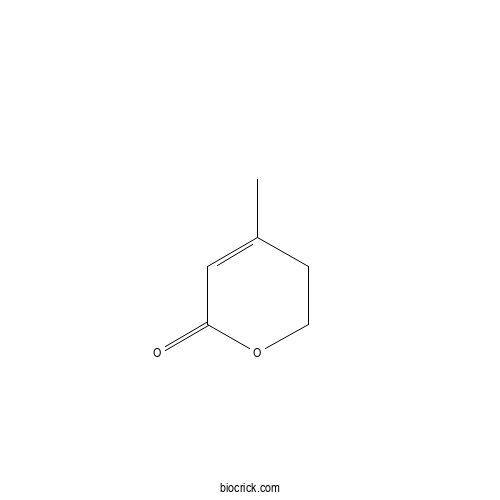
| Cas No. | 2381-87-5 | SDF | File under preparation. |
| PubChem ID | 557445.0 | Appearance | Powder |
| Formula | C6H8O2 | M.Wt | 112.1 |
| Type of Compound | N/A | Storage | Desiccate at -20°C |
| Solubility | Soluble in Chloroform,Dichloromethane,Ethyl Acetate,DMSO,Acetone,etc. | ||
| Chemical Name | 4-methyl-2,3-dihydropyran-6-one | ||
| SMILES | CC1=CC(=O)OCC1 | ||
| Standard InChIKey | RPEASMBMVIKUTH-UHFFFAOYSA-N | ||
| Standard InChI | InChI=1S/C6H8O2/c1-5-2-3-8-6(7)4-5/h4H,2-3H2,1H3 | ||
| General tips | For obtaining a higher solubility , please warm the tube at 37 ℃ and shake it in the ultrasonic bath for a while.Stock solution can be stored below -20℃ for several months. We recommend that you prepare and use the solution on the same day. However, if the test schedule requires, the stock solutions can be prepared in advance, and the stock solution must be sealed and stored below -20℃. In general, the stock solution can be kept for several months. Before use, we recommend that you leave the vial at room temperature for at least an hour before opening it. |
||
| About Packaging | 1. The packaging of the product may be reversed during transportation, cause the high purity compounds to adhere to the neck or cap of the vial.Take the vail out of its packaging and shake gently until the compounds fall to the bottom of the vial. 2. For liquid products, please centrifuge at 500xg to gather the liquid to the bottom of the vial. 3. Try to avoid loss or contamination during the experiment. |
||
| Shipping Condition | Packaging according to customer requirements(5mg, 10mg, 20mg and more). Ship via FedEx, DHL, UPS, EMS or other couriers with RT, or blue ice upon request. | ||
Quality Control & MSDS
3D structure
Package In Stock

Number of papers citing our products


Anhydromevalonolactone Dilution Calculator
Anhydromevalonolactone Molarity Calculator
| 1 mg | 5 mg | 10 mg | 20 mg | 25 mg | |
| 1 mM | 8.9206 mL | 44.603 mL | 89.2061 mL | 178.4121 mL | 223.0152 mL |
| 5 mM | 1.7841 mL | 8.9206 mL | 17.8412 mL | 35.6824 mL | 44.603 mL |
| 10 mM | 0.8921 mL | 4.4603 mL | 8.9206 mL | 17.8412 mL | 22.3015 mL |
| 50 mM | 0.1784 mL | 0.8921 mL | 1.7841 mL | 3.5682 mL | 4.4603 mL |
| 100 mM | 0.0892 mL | 0.446 mL | 0.8921 mL | 1.7841 mL | 2.2302 mL |
| * Note: If you are in the process of experiment, it's necessary to make the dilution ratios of the samples. The dilution data above is only for reference. Normally, it's can get a better solubility within lower of Concentrations. | |||||
- 2-O-Methylbrevianamide M
Catalog No.:BCX2574
CAS No.:3025731-58-9
- Epipodophyllotoxin glucoside
Catalog No.:BCX2573
CAS No.:22352-79-0
- Funingenoside O
Catalog No.:BCX2572
CAS No.:744229-50-3
- 7-Methoxy-9-oxo-de-O-methyllasiodiplodin
Catalog No.:BCX2571
CAS No.:196874-05-2
- 7-Methoxy-9-oxo-de-O-methyllasiodiplodin
Catalog No.:BCX2570
CAS No.:196874-06-3
- Brevianamide K
Catalog No.:BCX2569
CAS No.:1174538-66-9
- (±)-Yangambin
Catalog No.:BCX2568
CAS No.:14759-14-9
- (-)-Sclerone
Catalog No.:BCX2567
CAS No.:1932527-53-1
- 5,8-Dihydroxy-4-methoxy-α-tetralone
Catalog No.:BCX2566
CAS No.:868834-51-9
- 6,7-Di-O-acetylbarbatin A
Catalog No.:BCX2565
CAS No.:1015776-94-9
- Linarinic acid
Catalog No.:BCX2564
CAS No.:481710-98-9
- 4-Hydroxy-1-tetralone
Catalog No.:BCX2563
CAS No.:21032-12-2
- Brevianamide X
Catalog No.:BCX2576
CAS No.:2315237-30-8
- Isoarctigenin
Catalog No.:BCX2577
CAS No.:119030-66-9
- Liriodendritol
Catalog No.:BCX2578
CAS No.:22006-88-8
- Ethyl α-D-fructofuranoside
Catalog No.:BCX2579
CAS No.:81024-99-9
- (E)-1-(3,4-Dimethoxyphenyl)buta-1,3-diene
Catalog No.:BCX2580
CAS No.:75560-74-6
- N-Formylanonaine
Catalog No.:BCX2581
CAS No.:83459-45-4
- (E)-4-(3,4-Dimethoxyphenyl)but-3-en-1-yl acetate
Catalog No.:BCX2582
CAS No.:69768-98-5
- 5-(3-Hydroxyphenyl)dihydrofuran-2(3H)-one
Catalog No.:BCX2583
CAS No.:1270584-13-8
- trans-Cassumunene
Catalog No.:BCX2584
CAS No.:76318-79-1
- Cassumunene
Catalog No.:BCX2585
CAS No.:73573-81-6
- Methyl 4-acetamidobutanoate
Catalog No.:BCX2586
CAS No.:32039-11-5
- Juglanin B
Catalog No.:BCX2587
CAS No.:958365-42-9
Stress Driven Discovery of Natural Products From Actinobacteria with Anti-Oxidant and Cytotoxic Activities Including Docking and ADMET Properties.[Pubmed:34768863]
Int J Mol Sci. 2021 Oct 22;22(21):11432.
Elicitation through abiotic stress, including chemical elicitors like heavy metals, is a new technique for drug discovery. In this research, the effect of heavy metals on actinobacteria Streptomyces sp. SH-1312 for secondary metabolite production, with strong pharmacological activity, along with pharmacokinetics profile, was firstly investigated. The optimum metal stress conditions consisted of actinobacteria strain Streptomyces sp. SH-1312 with addition of mix metals (Co(2+) + Zn(2+)) ions at 0.5 mM in Gause's medium. Under these conditions, the stress metabolite Anhydromevalonolactone (MVL) was produced, which was absent in the normal culture of strain and other metals combinations. Furthermore, the stress metabolite was also evaluated for its anti-oxidant and cytotoxic activities. The compound exhibited remarkable anti-oxidant activities, recording the IC(50) value of 19.65 +/- 5.7 microg/mL in DPPH, IC(50) of 15.49 +/- 4.8 against NO free radicals, the IC(50) value of 19.65 +/- 5.22 microg/mL against scavenging ability, and IC(50) value of 19.38 +/- 7.11 microg/mL for iron chelation capacity and the cytotoxic activities against PC3 cell lines were recorded with IC(50) values of 35.81 +/- 4.2 microg/mL after 24 h, 23.29 +/- 3.8 microg/mL at 48 h, and 16.25 +/- 6.5 microg/mL after 72 h. Further mechanistic studies have revealed that the compound MVL has shown its pharmacological efficacy by upregulation of P53 and BAX while downregulation of BCL-2 expression, indicating that MVL is following apoptosis in varying degrees. To better understand the pharmacological properties of MVL, in this work, the absorption, distribution, metabolism, excretion, and toxicity (ADMET) were also evaluated. During ADMET predictions, MVL has displayed a safer profile in case of hepatotoxicity, cytochrome inhibition and also displayed as non-cardiotoxic. The compound MVL showed good binding energy in the molecular docking studies, and the results revealed that MVL bind in the active region of the target protein of P53 and BAX. This work triumphantly announced a prodigious effect of heavy metals on actinobacteria with fringe benefits as a key tool of MVL production with a strong pharmacological and pharmacokinetic profile.
Poly(isoprenecarboxylates) from Glucose via Anhydromevalonolactone.[Pubmed:27933217]
ACS Macro Lett. 2016 Oct 18;5(10):1128-1131.
A short and efficient synthesis of a series of isoprenecarboxylic acid esters (ICAEs) and their corresponding polymers is presented. The base-catalyzed eliminative ring-opening of Anhydromevalonolactone (3) provides isoprenecarboxylic acid (6-H), which was further transformed to the ICAEs. Reversible addition-fragmentation chain-transfer (RAFT) polymerization was used to synthesize high molecular weight (>100 kg mol(-1)) poly(isoprenecarboxylates) with dispersities (D) of ca. 1.5. The glass transition temperatures (T(g)) and entanglement molecular weights (M(e)) of the poly(isoprenecarboxylates) were determined and showed similar trends to the T(g) and M(e) values for analogous poly(acrylate esters). These new glucose-derived materials could provide a sustainable alternative to poly(acrylates).
Assessing medium constituents for optimal heterologous production of anhydromevalonolactone in recombinant Aspergillus oryzae.[Pubmed:25006541]
AMB Express. 2014 Jun 27;4:52.
Anhydromevalonolactone (AMVL) is a bioactive natural product that arises from a molecular biology technique using Aspergillus oryzae as a heterologous host. AMVL has been used as a precursor for the synthesis of insect pest control reagents and has numerous applications in the biotechnological and medical industries. In this study, the Plackett-Burman Design and the Central Composite Design, which offer efficient and feasible approaches, were complemented to screen significant parameters and identify the optimal values for maximum AMVL production. The results suggested that sucrose, NaNO3, yeast extract and K2HPO4 were the key factors affecting AMVL production in a complex medium, whereas the major components required for a defined medium were NaNO3, K2HPO4, KH2PO4 and trace elements. These factors were subsequently optimized using the response surface methodology. Under optimal conditions, a maximum AMVL production of 250 mg/L in the complex medium and 200 mg/L in the defined medium was achieved, which represents an increase of approximately 3-4-fold compared to the commonly used malt extract medium.

Calcutta University

University of Minnesota

University of Maryland School of Medicine

University of Illinois at Chicago

The Ohio State University

University of Zurich

Harvard University

Colorado State University

Auburn University

Yale University

Worcester Polytechnic Institute

Washington State University

Stanford University

University of Leipzig

Universidade da Beira Interior

The Institute of Cancer Research

Heidelberg University

University of Amsterdam

University of Auckland

TsingHua University

The University of Michigan

Miami University

DRURY University

Jilin University

Fudan University

Wuhan University

Sun Yat-sen University

Universite de Paris

Deemed University

Auckland University

The University of Tokyo

Korea University



