
Linarinic acidCAS# 481710-98-9 |
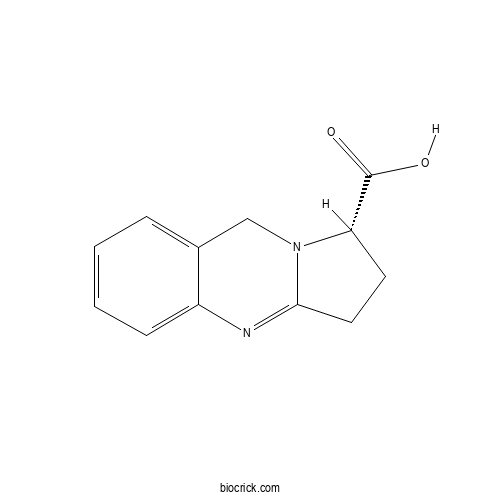
| Cas No. | 481710-98-9 | SDF | File under preparation. |
| PubChem ID | 11586561.0 | Appearance | Powder |
| Formula | C12H12N2O2 | M.Wt | 216.2 |
| Type of Compound | N/A | Storage | Desiccate at -20°C |
| Solubility | Soluble in Chloroform,Dichloromethane,Ethyl Acetate,DMSO,Acetone,etc. | ||
| Chemical Name | (1S)-1,2,3,9-tetrahydropyrrolo[2,1-b]quinazoline-1-carboxylic acid | ||
| SMILES | C1CC2=NC3=CC=CC=C3CN2C1C(=O)O | ||
| Standard InChIKey | GZQYCHREXLDRDI-JTQLQIEISA-N | ||
| Standard InChI | InChI=1S/C12H12N2O2/c15-12(16)10-5-6-11-13-9-4-2-1-3-8(9)7-14(10)11/h1-4,10H,5-7H2,(H,15,16)/t10-/m0/s1 | ||
| General tips | For obtaining a higher solubility , please warm the tube at 37 ℃ and shake it in the ultrasonic bath for a while.Stock solution can be stored below -20℃ for several months. We recommend that you prepare and use the solution on the same day. However, if the test schedule requires, the stock solutions can be prepared in advance, and the stock solution must be sealed and stored below -20℃. In general, the stock solution can be kept for several months. Before use, we recommend that you leave the vial at room temperature for at least an hour before opening it. |
||
| About Packaging | 1. The packaging of the product may be reversed during transportation, cause the high purity compounds to adhere to the neck or cap of the vial.Take the vail out of its packaging and shake gently until the compounds fall to the bottom of the vial. 2. For liquid products, please centrifuge at 500xg to gather the liquid to the bottom of the vial. 3. Try to avoid loss or contamination during the experiment. |
||
| Shipping Condition | Packaging according to customer requirements(5mg, 10mg, 20mg and more). Ship via FedEx, DHL, UPS, EMS or other couriers with RT, or blue ice upon request. | ||
Quality Control & MSDS
3D structure
Package In Stock

Number of papers citing our products


Linarinic acid Dilution Calculator
Linarinic acid Molarity Calculator
| 1 mg | 5 mg | 10 mg | 20 mg | 25 mg | |
| 1 mM | 4.6253 mL | 23.1267 mL | 46.2535 mL | 92.5069 mL | 115.6337 mL |
| 5 mM | 0.9251 mL | 4.6253 mL | 9.2507 mL | 18.5014 mL | 23.1267 mL |
| 10 mM | 0.4625 mL | 2.3127 mL | 4.6253 mL | 9.2507 mL | 11.5634 mL |
| 50 mM | 0.0925 mL | 0.4625 mL | 0.9251 mL | 1.8501 mL | 2.3127 mL |
| 100 mM | 0.0463 mL | 0.2313 mL | 0.4625 mL | 0.9251 mL | 1.1563 mL |
| * Note: If you are in the process of experiment, it's necessary to make the dilution ratios of the samples. The dilution data above is only for reference. Normally, it's can get a better solubility within lower of Concentrations. | |||||
- 4-Hydroxy-1-tetralone
Catalog No.:BCX2563
CAS No.:21032-12-2
- 4'-Demethylisopicropodophyllone
Catalog No.:BCX2562
CAS No.:93780-85-9
- N-(2-Hydroxy-2-phenylethyl)benzamide
Catalog No.:BCX2561
CAS No.:116126-03-5
- Isopicropodophyllone
Catalog No.:BCX2560
CAS No.:55515-07-6
- (-)-7'-epi-Lyoniresinol 9'-O-glucoside
Catalog No.:BCX2559
CAS No.:162681-51-8
- Escuside
Catalog No.:BCX2558
CAS No.:478182-19-3
- Xylopinine
Catalog No.:BCX2557
CAS No.:523-02-4
- Rubescensin C
Catalog No.:BCX2556
CAS No.:81661-34-9
- Plantainoside A
Catalog No.:BCX2555
CAS No.:136172-59-3
- Methyl (2E,6E)-10,11-dihydroxy-3,7,11-trimethyldodeca-2,6-dienoate
Catalog No.:BCX2554
CAS No.:36999-94-7
- Polylauioid G
Catalog No.:BCX2553
CAS No.:2332539-57-6
- 5'-Methoxydimethylmatairesinol
Catalog No.:BCX2552
CAS No.:64767-71-1
- 6,7-Di-O-acetylbarbatin A
Catalog No.:BCX2565
CAS No.:1015776-94-9
- 5,8-Dihydroxy-4-methoxy-α-tetralone
Catalog No.:BCX2566
CAS No.:868834-51-9
- (-)-Sclerone
Catalog No.:BCX2567
CAS No.:1932527-53-1
- (±)-Yangambin
Catalog No.:BCX2568
CAS No.:14759-14-9
- Brevianamide K
Catalog No.:BCX2569
CAS No.:1174538-66-9
- 7-Methoxy-9-oxo-de-O-methyllasiodiplodin
Catalog No.:BCX2570
CAS No.:196874-06-3
- 7-Methoxy-9-oxo-de-O-methyllasiodiplodin
Catalog No.:BCX2571
CAS No.:196874-05-2
- Funingenoside O
Catalog No.:BCX2572
CAS No.:744229-50-3
- Epipodophyllotoxin glucoside
Catalog No.:BCX2573
CAS No.:22352-79-0
- 2-O-Methylbrevianamide M
Catalog No.:BCX2574
CAS No.:3025731-58-9
- Anhydromevalonolactone
Catalog No.:BCX2575
CAS No.:2381-87-5
- Brevianamide X
Catalog No.:BCX2576
CAS No.:2315237-30-8
Design, synthesis, and evaluation of the pharmacological activity of novel NMDA receptor antagonists based on the germacrone scaffold.[Pubmed:39793403]
Bioorg Med Chem. 2025 Mar 1;119:118063.
The NMDA receptor has long attracted researchers' attention due to its potential as a drug target and its central role in the central nervous system. The NMDA receptor is a ligand-gated and voltage-dependent ion channel widely distributed in the central nervous system. In this study, we employed a drug design strategy combining "molecular assembly" and "combinatorial chemistry." By reducing the carbonyl group of germacrone to a hydroxyl group and esterifying it with alanine and Linarinic acid, we successfully obtained nine novel germacrone derivatives through two rounds of structural optimization. We evaluated the neuroprotective activity of these nine derivatives using the MTT assay. The results revealed that compound C1 exhibited particularly outstanding activity, achieving a cell protection rate of 29.63 +/- 1.56 % at a concentration of 0.05 muM, outperforming the positive control drug, ifenprodil. Further experiments on NMDA-induced Ca(2+) influx verified that the action site of compound C1 was the NMDA receptor, and demonstrated its superior antagonistic effect on the NMDA receptor compared to germacrone and ifenprodil. Additionally, molecular docking studies and ADMET property predictions were conducted for compound C1. The results showed that compound C1 tightly bound to the active site of the NMDA receptor and possessed favorable pharmacokinetic properties. In conclusion, compound C1, characterized by a germacrone-Linarinic acid structure, not only exhibits strong antagonistic effects on the NMDA receptor but also demonstrates excellent pharmacokinetic properties, indicating its potential for further development as a therapeutic drug for central nervous system diseases.
Allergy-preventive effects of linarinic acid and its tetrahydropyrrolo[2,1-b]quinazoline derivatives isolated from Linaria vulgaris.[Pubmed:29468577]
J Nat Med. 2018 Mar;72(2):582-587.
Linarinic acid, (-)-1,2,3,9-tetrahydropyrrolo[2,1-b]quinazoline-1-carboxylic acid (4a), was isolated from the ethanol extract of Linaria vulgaris Mill. In our previous study, a series of tetrahydropyrrolo[2,1-b]quinazoline derivatives 4b, 4c, 5a, 5b, 6a and 6b that were structurally related to 4a and evaluated as neuroprotective agents were synthesized. The aim of the present study was to investigate the novel features of these compounds. We examined their allergy-preventive effects using an in vivo assay system we developed previously, that monitors a decrease in blood flow in the tail vein of mice subjected to sensitization with hen egg-white lysozyme. We observed that 4a and its three derivatives, amide (6a), ester (5a), bromine (4b), and alcohol substituent (6b), showed significant allergy-preventive activities. The study confirmed the allergy-preventive activity of tetrahydropyrrolo[2,1-b]quinazoline derivatives by comprehensively monitoring the specific blood flow decrease occurring in the induction phase of allergy. This finding may aid in the development of new agents for the treatment of allergic diseases such as atopic dermatitis, allergic asthma, and hay fever.
Investigation of Linarinic acid and one of its derivatives against cerebral ischemia in mice.[Pubmed:32104326]
Asian J Pharm Sci. 2017 Mar;12(2):165-171.
The study aims to investigate the effects of (-)-Linarinic acid (LA) and one of its derivatives (LA(d)) on brain injury induced by ischemia. Malonaldehyde (MDA) is determined as an index for lipid peroxidation both in vitro and vivo. Mice were pre-treated with LA and LA(d) for 3 d. Thereafter, they were induced to have incomplete cerebral ischemia with both bilateral carotid artery occlusion and hypotension (BCAOH). In the first part of the in vivo experiment, mice were divided into four groups: sham (control), ischemia, ischemia + LA (200 mg/kg, i.g.) and ischemia + LA(d) (200 mg/kg, i.g.). In the second part, the dose-response of LA(d) was investigated at 100, 200 and 400 mg/kg i.g., respectively. A modified neurological severity score was developed for evaluating behavioral deficits of the mice with ischemia. Brains of the mice were excised in order to determinate MDA after ischemia for 6 h. Survival time, survival rate, neurological injury score and MDA level in brains were observed. Results were: 1) The data in vitro showed that both LA and LA(d) could inhibit the generation of MDA. IC(50) values obtained by Probit analysis were 2.9 mM for LA(d) and 4.88 mM for LA; 2) BCAOH could significantly shorten the survival span, reduce the survival rate and cause neurological deficits, which were associated with high level of lipid hydroperoxide production in cerebral tissues; 3) LA(d) decreased lipid peroxidation and improved the neurological outcome more than LA. It is concluded that LA(d) offers a better neuroprotection than LA against brain damage caused by cerebral ischemia.
Synthesis and biological evaluation of (--)-linarinic acid derivatives as neuroprotective agents against OGD-induced cell damage.[Pubmed:22441681]
Arch Pharm (Weinheim). 2012 Jun;345(6):423-30.
A series of novel (-)-1,2,3,9-tetrahydropyrrolo[2,1-b]quinazoline-1-carboxylic acid derivatives were designed and synthesized. All of the prepared compounds were screened for their neuroprotective effects using an in vitro oxygen glucose deprivation (OGD) model of ischemic stroke. Some of the target compounds exhibited moderate to excellent protective potency. In particular, compounds 9d, 9e, 9g, and 9h showed significant protective effects in the SH-SY(5) Y cell line at all three concentrations tested.

Calcutta University

University of Minnesota

University of Maryland School of Medicine

University of Illinois at Chicago

The Ohio State University

University of Zurich

Harvard University

Colorado State University

Auburn University

Yale University

Worcester Polytechnic Institute

Washington State University

Stanford University

University of Leipzig

Universidade da Beira Interior

The Institute of Cancer Research

Heidelberg University

University of Amsterdam

University of Auckland

TsingHua University

The University of Michigan

Miami University

DRURY University

Jilin University

Fudan University

Wuhan University

Sun Yat-sen University

Universite de Paris

Deemed University

Auckland University

The University of Tokyo

Korea University



