
IsopicropodophylloneCAS# 55515-07-6 |
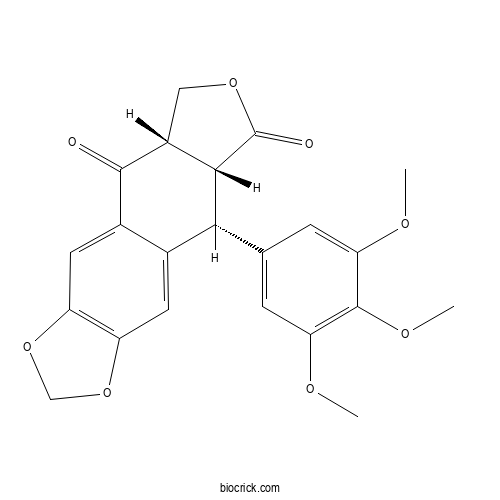
| Cas No. | 55515-07-6 | SDF | File under preparation. |
| PubChem ID | 11189106.0 | Appearance | Powder |
| Formula | C22H20O8 | M.Wt | 412.4 |
| Type of Compound | N/A | Storage | Desiccate at -20°C |
| Solubility | Soluble in Chloroform,Dichloromethane,Ethyl Acetate,DMSO,Acetone,etc. | ||
| Chemical Name | (5aS,8aR,9R)-9-(3,4,5-trimethoxyphenyl)-5a,6,8a,9-tetrahydro-[2]benzofuro[5,6-f][1,3]benzodioxole-5,8-dione | ||
| SMILES | COC1=CC(=CC(=C1OC)OC)C2C3C(COC3=O)C(=O)C4=CC5=C(C=C24)OCO5 | ||
| Standard InChIKey | ISCQYPPCSYRZOT-ZNOIYHFQSA-N | ||
| Standard InChI | InChI=1S/C22H20O8/c1-25-16-4-10(5-17(26-2)21(16)27-3)18-11-6-14-15(30-9-29-14)7-12(11)20(23)13-8-28-22(24)19(13)18/h4-7,13,18-19H,8-9H2,1-3H3/t13-,18-,19+/m1/s1 | ||
| General tips | For obtaining a higher solubility , please warm the tube at 37 ℃ and shake it in the ultrasonic bath for a while.Stock solution can be stored below -20℃ for several months. We recommend that you prepare and use the solution on the same day. However, if the test schedule requires, the stock solutions can be prepared in advance, and the stock solution must be sealed and stored below -20℃. In general, the stock solution can be kept for several months. Before use, we recommend that you leave the vial at room temperature for at least an hour before opening it. |
||
| About Packaging | 1. The packaging of the product may be reversed during transportation, cause the high purity compounds to adhere to the neck or cap of the vial.Take the vail out of its packaging and shake gently until the compounds fall to the bottom of the vial. 2. For liquid products, please centrifuge at 500xg to gather the liquid to the bottom of the vial. 3. Try to avoid loss or contamination during the experiment. |
||
| Shipping Condition | Packaging according to customer requirements(5mg, 10mg, 20mg and more). Ship via FedEx, DHL, UPS, EMS or other couriers with RT, or blue ice upon request. | ||
Quality Control & MSDS
3D structure
Package In Stock

Number of papers citing our products


Isopicropodophyllone Dilution Calculator
Isopicropodophyllone Molarity Calculator
-
 PicropodopyllotoxoneCatalog No.: BCN7574CAS No.: 477-48-5
-
 PodophyllotoxinoneCatalog No.: BCN8063CAS No.: 477-49-6
-
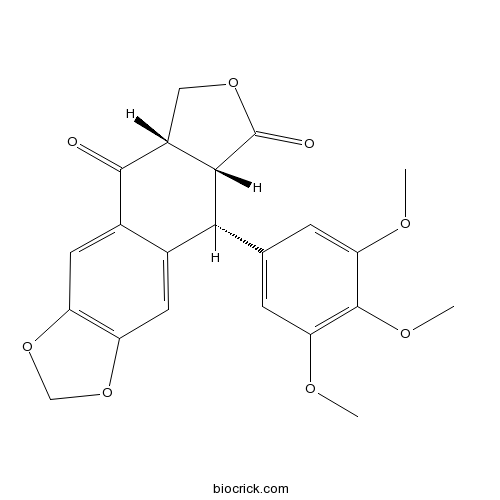 IsopicropodophylloneCatalog No.: BCN8316CAS No.: 60660-50-6
-
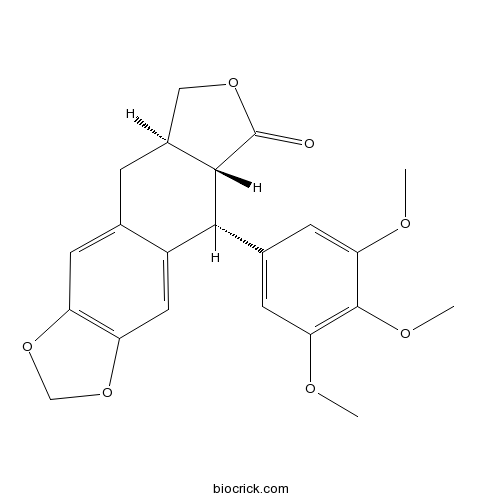 DeoxypodophyllotoxinCatalog No.: BCN1182CAS No.: 19186-35-7
-
 PicropodophyllotoxinCatalog No.: BCN2585CAS No.: 17434-18-3
-
 PodophyllotoxinCatalog No.: BCN5957CAS No.: 518-28-5
-
 IsoanthricinCatalog No.: BCN3531CAS No.: 17301-70-5
-
 5-Hydroxy-9-(3,4,5-trimethoxyphenyl)-5a,6,8a,9-tetrahydro-5H-[2]benzofuro[5,6-f][1,3]benzodioxol-8-oneCatalog No.: BCC8350CAS No.: 4354-76-1
-
 (-)-EpipodophyllotoxinCatalog No.: BCX0796CAS No.: 4375-07-9
-
 Furo[3',4':6,7]naphtho[2,3-d]-1,3-dioxol-6(5aH)-one,5,8,8a,9-tetrahydro-5-(3,4,5-trimethoxyphenyl)- (9CI)Catalog No.: BCX0958CAS No.: 69222-20-4
-
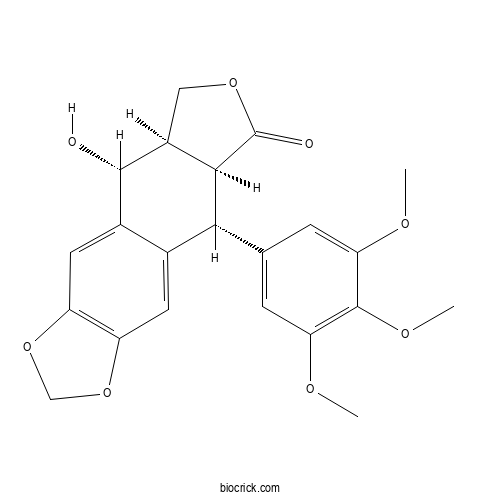 PicropodophyllinCatalog No.: BCX2262CAS No.: 477-47-4
| 1 mg | 5 mg | 10 mg | 20 mg | 25 mg | |
| 1 mM | 2.4248 mL | 12.1242 mL | 24.2483 mL | 48.4966 mL | 60.6208 mL |
| 5 mM | 0.485 mL | 2.4248 mL | 4.8497 mL | 9.6993 mL | 12.1242 mL |
| 10 mM | 0.2425 mL | 1.2124 mL | 2.4248 mL | 4.8497 mL | 6.0621 mL |
| 50 mM | 0.0485 mL | 0.2425 mL | 0.485 mL | 0.9699 mL | 1.2124 mL |
| 100 mM | 0.0242 mL | 0.1212 mL | 0.2425 mL | 0.485 mL | 0.6062 mL |
| * Note: If you are in the process of experiment, it's necessary to make the dilution ratios of the samples. The dilution data above is only for reference. Normally, it's can get a better solubility within lower of Concentrations. | |||||
- (-)-7'-epi-Lyoniresinol 9'-O-glucoside
Catalog No.:BCX2559
CAS No.:162681-51-8
- Escuside
Catalog No.:BCX2558
CAS No.:478182-19-3
- Xylopinine
Catalog No.:BCX2557
CAS No.:523-02-4
- Rubescensin C
Catalog No.:BCX2556
CAS No.:81661-34-9
- Plantainoside A
Catalog No.:BCX2555
CAS No.:136172-59-3
- Methyl (2E,6E)-10,11-dihydroxy-3,7,11-trimethyldodeca-2,6-dienoate
Catalog No.:BCX2554
CAS No.:36999-94-7
- Polylauioid G
Catalog No.:BCX2553
CAS No.:2332539-57-6
- 5'-Methoxydimethylmatairesinol
Catalog No.:BCX2552
CAS No.:64767-71-1
- 1,10-epi-Pyrethrosin
Catalog No.:BCX2551
CAS No.:88199-06-8
- threo-1,2-Bis(4-hydroxy-3-methoxyphenyl)-1-methoxypropan-3-ol
Catalog No.:BCX2550
CAS No.:110995-81-8
- (±)-Regiolone
Catalog No.:BCX2549
CAS No.:62332-73-4
- N-Methyl-N-phenethylbenzamide
Catalog No.:BCX2548
CAS No.:73355-77-8
- N-(2-Hydroxy-2-phenylethyl)benzamide
Catalog No.:BCX2561
CAS No.:116126-03-5
- 4'-Demethylisopicropodophyllone
Catalog No.:BCX2562
CAS No.:93780-85-9
- 4-Hydroxy-1-tetralone
Catalog No.:BCX2563
CAS No.:21032-12-2
- Linarinic acid
Catalog No.:BCX2564
CAS No.:481710-98-9
- 6,7-Di-O-acetylbarbatin A
Catalog No.:BCX2565
CAS No.:1015776-94-9
- 5,8-Dihydroxy-4-methoxy-α-tetralone
Catalog No.:BCX2566
CAS No.:868834-51-9
- (-)-Sclerone
Catalog No.:BCX2567
CAS No.:1932527-53-1
- (±)-Yangambin
Catalog No.:BCX2568
CAS No.:14759-14-9
- Brevianamide K
Catalog No.:BCX2569
CAS No.:1174538-66-9
- 7-Methoxy-9-oxo-de-O-methyllasiodiplodin
Catalog No.:BCX2570
CAS No.:196874-06-3
- 7-Methoxy-9-oxo-de-O-methyllasiodiplodin
Catalog No.:BCX2571
CAS No.:196874-05-2
- Funingenoside O
Catalog No.:BCX2572
CAS No.:744229-50-3
Identification of lignans and related compounds in Anthriscus sylvestris by LC-ESI-MS/MS and LC-SPE-NMR.[Pubmed:21889175]
Phytochemistry. 2011 Dec;72(17):2172-9.
The aryltetralin lignan deoxypodophyllotoxin is much more widespread in the plant kingdom than podophyllotoxin. The latter serves as a starting compound for the production of cytostatic drugs like etoposide. A better insight into the occurrence of deoxypodophyllotoxin combined with detailed knowledge of its biosynthestic pathway(s) may help to develop alternative sources for podophyllotoxin. Using HPLC combined with electrospray tandem mass spectrometry and NMR spectroscopy techniques, we found nine lignans and five related structures in roots of Anthriscus sylvestris (L.) Hoffm. (Apiaceae), a common wild plant in temperate regions of the world. Podophyllotoxone, deoxypodophyllotoxin, yatein, anhydropodorhizol, 1-(3'-methoxy-4',5'-methylenedioxyphenyl)1-xi-methoxy-2-propene, and 2-butenoic acid, 2-methyl-4-[[(2Z)-2-methyl-1-oxo-2-buten-1-yl]oxy]-, (2E)-3-(7-methoxy-1,3-benzodioxol-5-yl)-2-propen-1-yl ester, (2Z)- were the major compounds. alpha-Peltatin, podophyllotoxin, beta-peltatin, Isopicropodophyllone, beta-peltatin-a-methylether, (Z)-2-angeloyloxymethyl-2-butenoic acid, anthriscinol methylether, and anthriscrusin were present in lower concentrations. alpha-Peltatin, beta-peltatin, Isopicropodophyllone, podophyllotoxone, and beta-peltatin-a-methylether have not been previously reported to be present in A. sylvestris. Based on our findings we propose a hypothetical biosynthetic pathway of aryltetralin lignans in A. sylvestris.
[Study on lignans from Diphylleia sinensis].[Pubmed:8010016]
Yao Xue Xue Bao. 1993;28(9):690-4.
A new lignan along with eight known lignans and a flavonoid were isolated from the rhizomes of Diphylleia sinensis Li.. Their structures were elucidated on the basis of chemical and spectral analysis. The new lignan, compound IX, was named as picropodophyllin-1-ethyl ether (IX). The eight known lignans were identified as podophyllotoxin (I), Isopicropodophyllone (II), dehydropodophyllotoxin (III), diphyllin (IV), picropodophyllin (V), podophyllotoxone (VI), 4'-demethylpodophyllotoxin (VII) and picropodophyllin glucoside (VIII). Compounds II, VI, VII and VIII were found for the first time from the rhizome of this plant. The flavonoid was identified as kaempferol.
[Studies on the TLC scanning determination of lignans in Diphylleia sinensis Li].[Pubmed:1299145]
Yao Xue Xue Bao. 1992;27(12):934-8.
A simple, sensitive and accurate method for the separation and determination of the lignans: podophylltoxone (I), Isopicropodophyllone (II), picropodophyllone (III), dehydropodophyllotoxin (IV), picropodophyllin (V), podophyllotoxin (VI), 4'-demethylpodophyllotoxin (VII) and diphyllin (VIII) is described. The sample solution was applied at a point 1 cm from the bottom edge of the HPTLC silica gel plate (10 cm x 10 cm), dichloromethane-diethyl ether (4:1) was used as the developing solvent. The plate was saturated for 30 min and then developed twice for 9.5 cm using ascending technique. The plate was sprayed with 2.5% ammonium ceric sulphate--20% nitric acid and toasted for 15 min at 120 degrees C, then fumigated with ammonia solution for 20 min at room temperature to intensify the spot color. The spots were scanned with a Shimadzu CS-930 TLC scanner. The contents of eight lignans in Diphylleia sinensis was calculated by comparison with standards spotted on the same plate. The standard curves were linear in the range of 0.48-2.52 micrograms for the eight lignans. The method has been applied to the analysis of various samples and can be used for the quality control of Diphylleia sinensis, podophyllum and dysosma preparations used in clinic.
[Chemical constituents of Dysosma aurantiocaulis (H.-M.) Hu and Dysosma pleianthum Woods].[Pubmed:2558670]
Zhongguo Zhong Yao Za Zhi. 1989 Jul;14(7):420-1, 447.
Roots of D. aurantiocaulis and D. pleianthum contain ten lignans: picropodophyllin, podophyllotoxin, 4'-demethylpodophyllotoxin, diphyllin, dehydropodophyllotoxin, podophyllotoxone, picropodophyllone, Isopicropodophyllone, 4'-demethylpodophyllotoxone and dysosmajol; two anthraquinones: physcion and dysoanthraquinone. A HPLC method for the identification of aryltetralin lignans is described.

Calcutta University

University of Minnesota

University of Maryland School of Medicine

University of Illinois at Chicago

The Ohio State University

University of Zurich

Harvard University

Colorado State University

Auburn University

Yale University

Worcester Polytechnic Institute

Washington State University

Stanford University

University of Leipzig

Universidade da Beira Interior

The Institute of Cancer Research

Heidelberg University

University of Amsterdam

University of Auckland

TsingHua University

The University of Michigan

Miami University

DRURY University

Jilin University

Fudan University

Wuhan University

Sun Yat-sen University

Universite de Paris

Deemed University

Auckland University

The University of Tokyo

Korea University



