
Brevianamide XCAS# 2315237-30-8 |
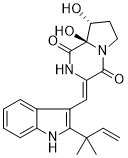
| Cas No. | 2315237-30-8 | SDF | File under preparation. |
| PubChem ID | N/A | Appearance | Powder |
| Formula | C21H23N3O4 | M.Wt | 381.4 |
| Type of Compound | N/A | Storage | Desiccate at -20°C |
| Solubility | Soluble in Chloroform,Dichloromethane,Ethyl Acetate,DMSO,Acetone,etc. | ||
| General tips | For obtaining a higher solubility , please warm the tube at 37 ℃ and shake it in the ultrasonic bath for a while.Stock solution can be stored below -20℃ for several months. We recommend that you prepare and use the solution on the same day. However, if the test schedule requires, the stock solutions can be prepared in advance, and the stock solution must be sealed and stored below -20℃. In general, the stock solution can be kept for several months. Before use, we recommend that you leave the vial at room temperature for at least an hour before opening it. |
||
| About Packaging | 1. The packaging of the product may be reversed during transportation, cause the high purity compounds to adhere to the neck or cap of the vial.Take the vail out of its packaging and shake gently until the compounds fall to the bottom of the vial. 2. For liquid products, please centrifuge at 500xg to gather the liquid to the bottom of the vial. 3. Try to avoid loss or contamination during the experiment. |
||
| Shipping Condition | Packaging according to customer requirements(5mg, 10mg, 20mg and more). Ship via FedEx, DHL, UPS, EMS or other couriers with RT, or blue ice upon request. | ||
Quality Control & MSDS
Package In Stock

Number of papers citing our products


Brevianamide X Dilution Calculator
Brevianamide X Molarity Calculator
| 1 mg | 5 mg | 10 mg | 20 mg | 25 mg | |
| 1 mM | 2.6219 mL | 13.1096 mL | 26.2192 mL | 52.4384 mL | 65.548 mL |
| 5 mM | 0.5244 mL | 2.6219 mL | 5.2438 mL | 10.4877 mL | 13.1096 mL |
| 10 mM | 0.2622 mL | 1.311 mL | 2.6219 mL | 5.2438 mL | 6.5548 mL |
| 50 mM | 0.0524 mL | 0.2622 mL | 0.5244 mL | 1.0488 mL | 1.311 mL |
| 100 mM | 0.0262 mL | 0.1311 mL | 0.2622 mL | 0.5244 mL | 0.6555 mL |
| * Note: If you are in the process of experiment, it's necessary to make the dilution ratios of the samples. The dilution data above is only for reference. Normally, it's can get a better solubility within lower of Concentrations. | |||||
- Anhydromevalonolactone
Catalog No.:BCX2575
CAS No.:2381-87-5
- 2-O-Methylbrevianamide M
Catalog No.:BCX2574
CAS No.:3025731-58-9
- Epipodophyllotoxin glucoside
Catalog No.:BCX2573
CAS No.:22352-79-0
- Funingenoside O
Catalog No.:BCX2572
CAS No.:744229-50-3
- 7-Methoxy-9-oxo-de-O-methyllasiodiplodin
Catalog No.:BCX2571
CAS No.:196874-05-2
- 7-Methoxy-9-oxo-de-O-methyllasiodiplodin
Catalog No.:BCX2570
CAS No.:196874-06-3
- Brevianamide K
Catalog No.:BCX2569
CAS No.:1174538-66-9
- (±)-Yangambin
Catalog No.:BCX2568
CAS No.:14759-14-9
- (-)-Sclerone
Catalog No.:BCX2567
CAS No.:1932527-53-1
- 5,8-Dihydroxy-4-methoxy-α-tetralone
Catalog No.:BCX2566
CAS No.:868834-51-9
- 6,7-Di-O-acetylbarbatin A
Catalog No.:BCX2565
CAS No.:1015776-94-9
- Linarinic acid
Catalog No.:BCX2564
CAS No.:481710-98-9
- Isoarctigenin
Catalog No.:BCX2577
CAS No.:119030-66-9
- Liriodendritol
Catalog No.:BCX2578
CAS No.:22006-88-8
- Ethyl α-D-fructofuranoside
Catalog No.:BCX2579
CAS No.:81024-99-9
- (E)-1-(3,4-Dimethoxyphenyl)buta-1,3-diene
Catalog No.:BCX2580
CAS No.:75560-74-6
- N-Formylanonaine
Catalog No.:BCX2581
CAS No.:83459-45-4
- (E)-4-(3,4-Dimethoxyphenyl)but-3-en-1-yl acetate
Catalog No.:BCX2582
CAS No.:69768-98-5
- 5-(3-Hydroxyphenyl)dihydrofuran-2(3H)-one
Catalog No.:BCX2583
CAS No.:1270584-13-8
- trans-Cassumunene
Catalog No.:BCX2584
CAS No.:76318-79-1
- Cassumunene
Catalog No.:BCX2585
CAS No.:73573-81-6
- Methyl 4-acetamidobutanoate
Catalog No.:BCX2586
CAS No.:32039-11-5
- Juglanin B
Catalog No.:BCX2587
CAS No.:958365-42-9
- Gymnetinoside B
Catalog No.:BCX2588
CAS No.:1588477-86-4
Total synthesis of brevianamides X, Y and Z.[Pubmed:41090652]
Chem Commun (Camb). 2025 Nov 7;61(90):17637-17640.
Brevianamides X (1) and Y (2) are relatively new members of the bicyclo[2.2.2]diazaoctane alkaloid family, whose biosynthetic origins remain unresolved. We report the asymmetric total synthesis of (+)-brevianamides Y (2), Z (16) and (+/-) Brevianamide X (1) through a hydroxyproline-guided cascade. Oxidation timing governs divergence, affording concise routes and underscoring hydroxyproline as a privileged scaffold.
Diketopiperazine and Diphenylether Derivatives from Marine Algae-Derived Aspergillus versicolor OUCMDZ-2738 by Epigenetic Activation.[Pubmed:30583513]
Mar Drugs. 2018 Dec 22;17(1):6.
A chemical-epigenetic method was used to enhance the chemodiversity of a marine algicolous fungus. Apart from thirteen known compounds, (+)-brevianamide R ((+)-3), (‒)-brevianamide R ((‒)-3), (+)-brevianamide Q ((+)-4), (‒)-brevianamide Q ((‒)-4), brevianamide V ((+)-5), brevianamide W ((‒)-5), brevianamide K (6), diorcinol B (7), diorcinol C (8), diorcinol E (9), diorcinol J (10), diorcinol (11), 4-methoxycarbonyldiorcinol (12), two new compounds, (+)- and (‒)-Brevianamide X ((+)- and (‒)- 2)), as well as a new naturally occurring one, 3-[6-(2-methylpropyl)-2-oxo-1H-pyrazin-3-yl]propanamide (1), were isolated from chemical-epigenetic cultures of Aspergillus versicolor OUCMDZ-2738 with 10 microM vorinostat (SAHA). Compared to cultures in the same medium without SAHA, compounds 1(-)4, 8, 9, 11, and 12 were solely observed under SAHA condition. The structures of these compounds were elucidated based on spectroscopic analysis, specific rotation analysis, ECD, and X-ray crystallographic analysis. (+/-)-3, (+/-)-4, and (+/-)-5 were further resolved into the corresponding optically pure enantiomers and their absolute configurations were determined for the first time. Compounds 11 and 12 showed selective antibacterial against Pseudomonas aeruginosa with a minimum inhibitory concentration (MIC) of 17.4 and 13.9 muM, respectively. Compound 10 exhibited better alpha-glucosidase inhibitory activity than the assay control acarbose with IC(50) values of 117.3 and 255.3 muM, respectively.
Dual Induction of New Microbial Secondary Metabolites by Fungal Bacterial Co-cultivation.[Pubmed:28744271]
Front Microbiol. 2017 Jul 11;8:1284.
The frequent re-isolation of known compounds is one of the major challenges in drug discovery. Many biosynthetic genes are not expressed under standard culture conditions, thus limiting the chemical diversity of microbial compounds that can be obtained through fermentation. On the other hand, the competition during co-cultivation of two or more different microorganisms in most cases leads to an enhanced production of constitutively present compounds or an accumulation of cryptic compounds that are not detected in axenic cultures of the producing strain under different fermentation conditions. Herein, we report the dual induction of newly detected bacterial and fungal metabolites by the co-cultivation of the marine-derived fungal isolate Aspergillus fumigatus MR2012 and two hyper-arid desert bacterial isolates Streptomyces leeuwenhoekii strain C34 and strain C58. Co-cultivation of the fungal isolate MR2012 with the bacterial strain C34 led to the production of luteoride D, a new luteoride derivative and pseurotin G, a new pseurotin derivative in addition to the production of terezine D and 11-O-methylpseurotin A which were not traced before from this fungal strain under different fermentation conditions. In addition to the previously detected metabolites in strain C34, the lasso peptide chaxapeptin was isolated under co-culture conditions. The gene cluster for the latter compound had been identified through genome scanning, but it had never been detected before in the axenic culture of strain C34. Furthermore, when the fungus MR2012 was co-cultivated with the bacterial strain C58, the main producer of chaxapeptin, the titre of this metabolite was doubled, while additionally the bacterial metabolite pentalenic acid was detected and isolated for the first time from this strain, whereas the major fungal metabolites that were produced under axenic culture were suppressed. Finally, fermentation of the MR2012 by itself led to the isolation of the new diketopiperazine metabolite named Brevianamide X.

Calcutta University

University of Minnesota

University of Maryland School of Medicine

University of Illinois at Chicago

The Ohio State University

University of Zurich

Harvard University

Colorado State University

Auburn University

Yale University

Worcester Polytechnic Institute

Washington State University

Stanford University

University of Leipzig

Universidade da Beira Interior

The Institute of Cancer Research

Heidelberg University

University of Amsterdam

University of Auckland

TsingHua University

The University of Michigan

Miami University

DRURY University

Jilin University

Fudan University

Wuhan University

Sun Yat-sen University

Universite de Paris

Deemed University

Auckland University

The University of Tokyo

Korea University



