
Multiple Sclerosis
Multiple sclerosis (MS) is a chronic autoimmune, inflammatory disease of the central nervous system (CNS), which causes damage to myelin and axons, resulting in neurological symptoms such as partial loss of sight, paresthesias and ataxia.
Multiple Sclerosis Products Targets
- STAT (10)
- Voltage-gated Potassium (KV) Channel (38)
- Integrin Receptor (15)
- Others (29)
- Complement (2)
- Vitamin D Receptor (10)
- PORCN (4)
- beta-catenin (13)
- Casein Kinase 1 (7)
- AMPA Receptor (45)
- GPR55 (8)
- CB2 Receptor (6)
- CB1 Receptor (17)
- NMDA Receptor (87)
- Kainate Receptor (22)
- Chemokine CXC Receptor (9)
- Chemokine CC Receptor (13)
- TRPM (8)
- Tankyrase (5)
- ROS and Other Gaseous Donor (8)
- Nrf2 (5)
- ITK (2)
- ASK1 (2)
- Acid-Sensing Ion Channel (3)
- Calcium-Activated Potassium (KCa) Channel (19)
- Inward Rectifier Potassium (Kir) Channel (21)
- NCX (5)
- Retinoid X Receptor (13)
- Cytokine (15)
Products for Multiple Sclerosis - Page 21
- Cat.No. Product Name Information/Activity
-
BCC7554
Tetraethylammonium chloride
Non-selective K<sup>+</sup> channel blocker

-
BCC7784
UK 78282 hydrochloride
136647-02-4

-
BCC7232
XE 991 dihydrochloride
XE 991 dihydrochloride, a Kv7 (KCNQ) channels blocker, potently inhibits Kv7.1 (KCNQ1), Kv7.2 (KCNQ2), Kv7.2 + Kv7.3 (KCNQ3) channel, and M-current with IC50s of 0.75 µM, 0.71 µM, 0.6 μM, and 0.98 µM, respectively.

-
BCC4907
Fluticasone propionate
Fluticasone propionate is a high affinity, selective GR (glucocorticoid receptor) agonist which is derived from fluticasone used to treat asthma and allergic rhinitis.

-
BCC7026
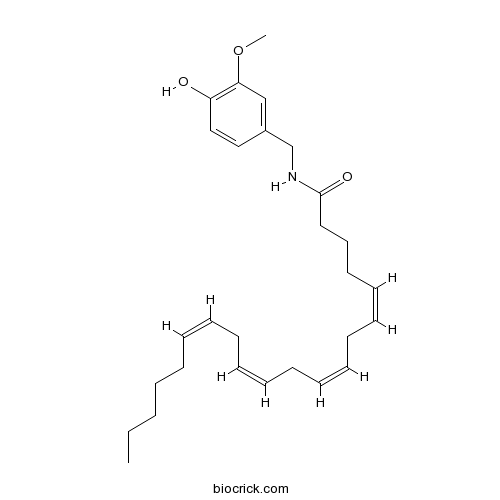
Arvanil
128007-31-8
-
BCC5756
Noladin ether
222723-55-9

-
BCC6827
Oleamide
Oleamide is an endogenous fatty acid amide which can be synthesized de novo in the mammalian nervous system, and has been detected in human plasma.

-
BCC4412
AM251
AM251 is a selective cannabinoid 1 (CB1) receptor antagonist with an IC50 of 8 nM, also acts as a potent GPR55 agonist with an EC50 of 39 nM.

-
BCC6944
AM 281
Potent, selective CB<sub>1</sub> antagonist/inverse agonist

-
BCC1082
CP-945598 HCl
Otenabant Hydrochloride is a potent and selective cannabinoid receptor CB1 antagonist with Ki of 0.7 nM, exhibits 10,000-fold greater selectivity against human CB2 receptor.