Parkinson's Disease Research
Parkinson's disease (PD) is a degenerative disease of the central nervous system that often impairs motor skills, speech, and other functions. Symptoms of the disease include resting tremor, bradykinesia and rigidity. The primary symptoms are the result of decreased stimulation of the motor cortex by the basal ganglia, normally caused by the insufficient formation and action of dopamine, which is produced in the dopaminergic neurons of the brain. Symptoms of the disease appear once 50-80% of dopamine neurons have died. Parkinson's disease is both chronic and progressive.
Parkinson's Disease Research Products Targets
- Adenosine A2B Receptor (7)
- Adenosine A2A Receptor (11)
- Caspase (9)
- Bcl-2 Family (13)
- Voltage-gated Calcium Channel (CaV) (38)
- GABAB Receptor (28)
- Others (23)
- Cyclooxygenase (24)
- D4 Receptor (12)
- STIM-Orai Channel (4)
- Ryanodine Receptor (6)
- Hsp90 (10)
- Hsp70 (4)
- 5-HT7 Receptor (11)
- 5-HT6 Receptor (14)
- 5-ht5 Receptor (2)
- 5-HT4 Receptor (17)
- Glutamate (Metabotropic) Group III Receptor (26)
- Glutamate (Metabotropic) Group II Receptor (33)
- Glutamate (Metabotropic) Group I Receptor (54)
- AMPA Receptor (45)
- GABAA-ρ Receptor (8)
- GABAA Receptor (66)
- Nicotinic (α7) Receptor (25)
- Nicotinic (α4β2) Receptor (14)
- D3 Receptor (12)
- LRRK2 (4)
- Catechol O-Methyltransferase (3)
- Vesicular Monoamine Transporter (4)
- NMDA Receptor (87)
- Kainate Receptor (22)
- IP3 Receptor (2)
- D2 Receptor (14)
- D1 and D5 Receptor (16)
- Trk Receptor (13)
- Trace Amine 1 Receptor (2)
- Adenosine A3 Receptor (8)
- Adenosine A1 Receptor (12)
- Monoamine Oxidase (10)
- M5 Receptor (2)
- M4 Receptor (3)
- M3 Receptor (4)
- M2 Receptor (5)
- M1 Receptor (8)
- Adrenergic α2 Receptor (33)
- Adrenergic α1 Receptor (22)
- Adrenergic β3 Receptor (12)
- Adrenergic β2 Receptor (6)
- Adrenergic β1 Receptor (7)
- Protein Arginine Methyltransferase (2)
Products for Parkinson's Disease Research - Page 31
- Cat.No. Product Name Information/Activity
-
BCC5226
UK 14,304
Brimonidine (UK 14304) is a full α2-adrenergic receptor (α2-AR) agonist.

-
BCC7336
A 80426 mesylate
152148-64-6

-
BCC6851
ARC 239 dihydrochloride
55974-42-0

-
BCC7521
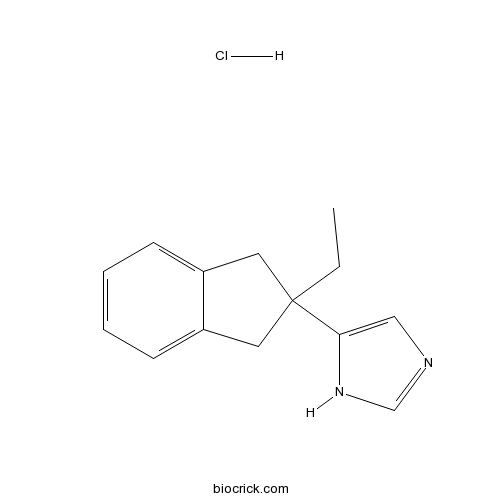
Atipamezole hydrochloride
Atipamezole hydrochloride is a synthetic α2-adrenoceptor antagonist with a Ki of 1.6 nM.
-
BCC6948
BRL 44408 maleate
681806-46-2

-
BCC6797
Efaroxan hydrochloride
89197-00-2

-
BCC6798
Idazoxan hydrochloride
Idazoxan hydrochloride (RX 781094 hydrochloride) is an α2-adrenoceptor antagonist and is also a imidazoline receptors (IRs) antagonist competitively antagonized the centrally induced hypotensive effect of imidazoline-like drugs (IMs). Idazoxan hydrochloride also improves motor symptoms in Parkinson’s disease, L-DOPA-induced dyskinesias, and experimental Parkinsonism.

-
BCC6875
Imiloxan hydrochloride
81167-22-8

-
BCC7449
JP 1302 dihydrochloride
JP1302 dihydrochloride is a selective, high affinity antagonist of the alpha2C-adrenoceptor (α2C-adrenoceptor), with a Kb value (antagonist activity) of 16 nM and a Ki (binding affinity) value of 28 nM.

-
BCC4923
Mirtazapine
Mirtazapine is a 5-HT receptor inhibitor. Mirtazapine is a potent and orally active noradrenergic and specific serotonergic antidepressant (NaSSA) agent by blocking 5-HT2 and 5-HT3 receptors.