Arrhythmia Research
An arrhythmia (also known as cardiac dysrhythmia) is defined as an irregular heartbeat, and results from abnormal electrical activity in the heart. There are various different types of arrhythmia, often resulting in a heartbeat that is too fast (tachycardia) or too slow (bradycardia). Atrial and ventricular fibrillation, which are the most common cardiac arrhythmias, account for 10-20% of all deaths among adults in the Western world. The incidence of atrial fibrillation increases with age; it not only affects cardiac function, but also increases the risk of stroke and may worsen heart failure.
Arrhythmia Research Products Targets
- Voltage-gated Sodium (NaV) Channel (30)
- Voltage-gated Potassium (KV) Channel (38)
- Voltage-gated Calcium Channel (CaV) (38)
- Epithelial Sodium Channel (3)
- STIM-Orai Channel (4)
- Ryanodine Receptor (6)
- IP3 Receptor (2)
- Acid-Sensing Ion Channel (3)
- Calcium-Activated Potassium (KCa) Channel (19)
- Inward Rectifier Potassium (Kir) Channel (21)
- HCN Channel (4)
- Adrenergic β3 Receptor (12)
- Adrenergic β2 Receptor (6)
- Adrenergic β1 Receptor (7)
Products for Arrhythmia Research - Page 3
- Cat.No. Product Name Information/Activity
-
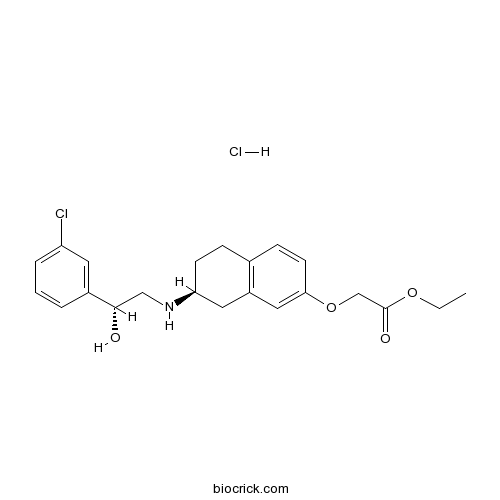
BCC7833
SR 58611A hydrochloride
Amibegron hydrochloride is a selective β3-adrenoceptor agonist, with an EC50 of 3.5 nM for β-adrenoceptor in rat colon; Amibegron hydrochloride has anxiolytic and antidepressant activity.
-
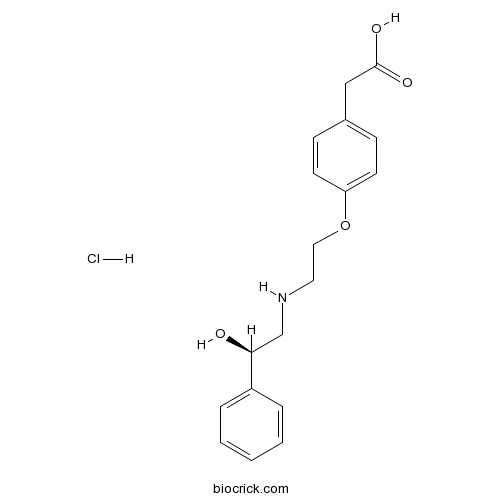
BCC5878
ZD 2079
178600-17-4
-
BCC6852
ZD 7114 hydrochloride
129689-28-7

-
BCC7475
L-748,337
244192-94-7

-
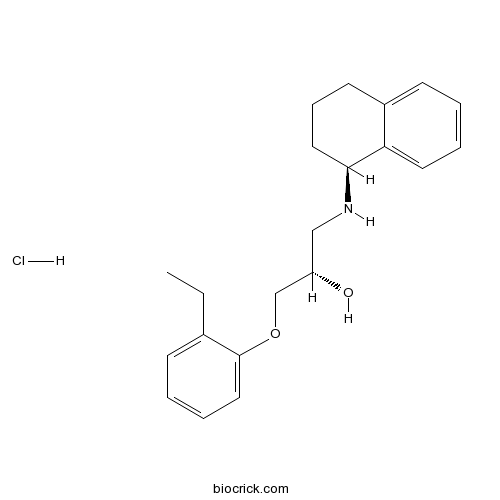
BCC7094
SR 59230A hydrochloride
SR59230A hydrochloride is a potent, selective, and blood-brain barrier penetrating β3-adrenergic receptor antagonist with IC50s of 40, 408, and 648 nM for β3, β1, and β2 receptors, respectively.
-
BCC2399
Cesium chloride
Potassium channel blocker; neuroprotective
-
BCC6639
YS-035 hydrochloride
89805-39-0

-
BCC7286
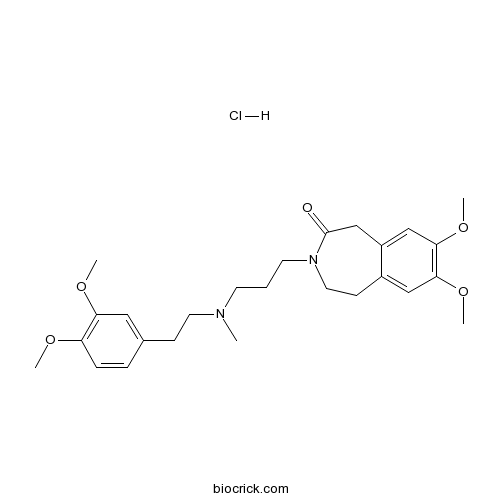
Zatebradine hydrochloride
Zatebradine (UL-FS-49 (free base)) is a potent inhibitor of hyperpolarization-activated cyclic nucleotide-gated (HCN) channels with an IC50 values 1.96 µM. Zatebradine blocks the slow inward current through human HCN1, HCN2, HCN3 and HCN4 channels, with IC50 values of 1.83 µM, 2.21 µM, 1.90 µM and 1.88 µM, respectively.
-
BCC6884
ZD 7288
ZD7288 is a selective hyperpolarization-activated cyclic nucleotide-gated (HCN) channel blocker.

-
BCC6978
2-APB
2-Aminoethyl diphenylborinate (2-APB) is a cell-permeable inhibitor of IP3R. 2-Aminoethyl diphenylborinate also inhibits the store-operated Ca2+ (SOC) channel and activates some TRP channels (V1, V2 and V3).