Addiction Research
According to the World Health Organization (WHO), addiction is 'a chronic disease of the central nervous system that is characterized by a loss of control over impulsive behavior that leads to compulsive drug seeking and taking, and to relapses even after months of abstinence'. Addiction is a complex neuroadaptive process, where drugs of abuse alter cellular and molecular aspects of neural function. The brain circuits mediating the various behavioral effects of these drugs are rendered more, or less, responsive to those effects.
Addiction Research Products Targets
- Others (13)
- D4 Receptor (12)
- 5-HT7 Receptor (11)
- 5-HT6 Receptor (14)
- 5-ht5 Receptor (2)
- 5-HT4 Receptor (17)
- NOP Receptor (21)
- Mu-Opioid Receptors (15)
- Kappa Opioid Receptors (14)
- AMPA Receptor (45)
- GABAA-ρ Receptor (8)
- GABAA Receptor (66)
- GPR55 (8)
- CB2 Receptor (6)
- CB1 Receptor (17)
- Nicotinic (α7) Receptor (25)
- Nicotinic (α4β2) Receptor (14)
- D3 Receptor (12)
- NMDA Receptor (87)
- Kainate Receptor (22)
- D2 Receptor (14)
- D1 and D5 Receptor (16)
- Glutamate Transporter (18)
- Dopamine Transporter (20)
- CRF2 Receptor (3)
- CRF1 Receptor (5)
- 5-HT Transporter (30)
- Delta opioid receptor (16)
Products for Addiction Research - Page 6
- Cat.No. Product Name Information/Activity
-
BCC6565
L-(-)-threo-3-Hydroxyaspartic acid
7298-99-9

-
BCC6804
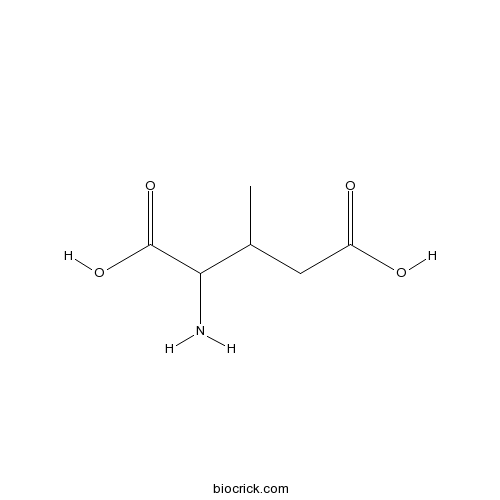
(±)-threo-3-Methylglutamic acid
63088-04-0
-
BCC6873
MPDC
MPDC is a potent and competitive inhibitor of the Na+-dependent high-affinity glutamate transporter in forebrain synaptosomes.

-
BCC6595
L-trans-2,4-PDC
64769-66-0

-
BCC6840
SYM 2081
SYM 2081 is a high-affinity ligand and potent, selective agonist of kainate receptors, inhibits [3H]-kainate binding with an IC50 of 35 nM, almost 3000- and 200-fold selectivity for kainate receptors over AMPA and NMDA receptors respectively.

-
BCC5735
DL-TBOA
DL-TBOA is a potent non-transportable inhibitor of excitatory amino acid transporters with IC50s of 70 μM, 6 μM and 6 μM for excitatory amino acid transporter-1 (EAAT1), EAAT2 and EAAT3, respectively. DL-TBOA inhibits the uptake of [14C]glutamate in COS-1 cells expressing the human EAAT1 and EAAT2 with Ki valuesof 42 μM and 5.7 μM, respectively. DL-TBOA blocks EAAT4 and EAAT5 in a competitive manner with Ki values of 4.4 μM and 3.2 μM, respectively.

-
BCC5919
TFB-TBOA
480439-73-4

-
BCC7692
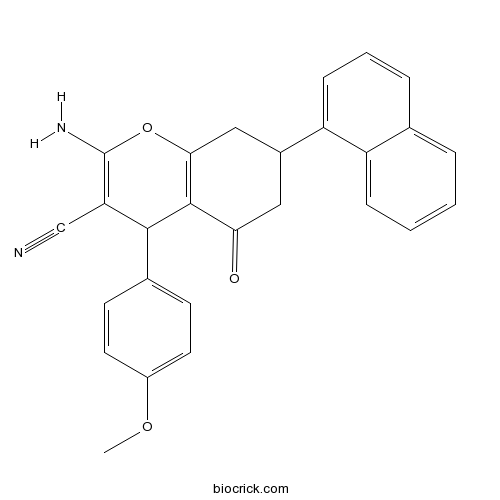
UCPH 101
UCPH-101 is an excitatory amino acid transporter subtype 1 (EAAT1) inhibitor with an IC50 of 0.66 μM.
-
BCC7442
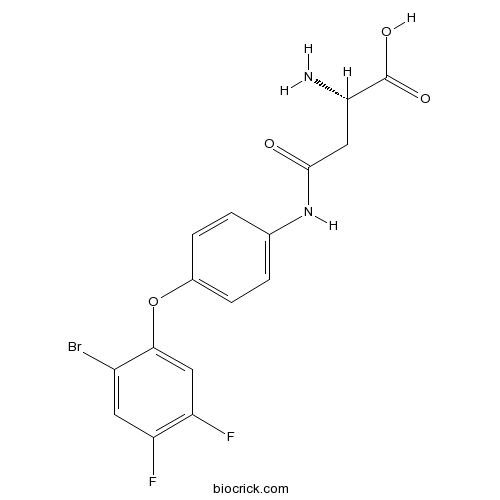
WAY 213613
WAY-213613 is a potent, selective nonsubstrate reuptake inhibitor of GLT-1/EAAT2 with IC50 of 85 nM EAAT2. It displays 59- and 44-fold selectivity over EAAT1 and EAAT3 (IC50s are 5 and 3.8 μM, respectively). WAY-213613 shows no activity at ionotropic and metabotropic glutamate receptors. It is a potential tool for the elucidation of EAAT2 function.
-
BCC5896
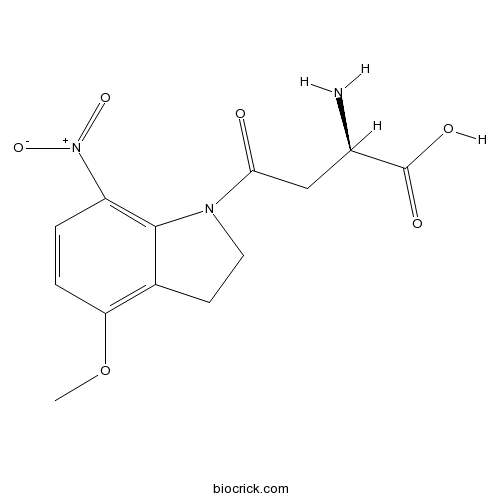
MNI-caged-D-aspartate
845555-94-4