
Parkinson's Disease Research
Parkinson's disease (PD) is a degenerative disease of the central nervous system that often impairs motor skills, speech, and other functions. Symptoms of the disease include resting tremor, bradykinesia and rigidity. The primary symptoms are the result of decreased stimulation of the motor cortex by the basal ganglia, normally caused by the insufficient formation and action of dopamine, which is produced in the dopaminergic neurons of the brain. Symptoms of the disease appear once 50-80% of dopamine neurons have died. Parkinson's disease is both chronic and progressive.
Parkinson's Disease Research Products Targets
- Adenosine A2B Receptor (7)
- Adenosine A2A Receptor (11)
- Caspase (9)
- Bcl-2 Family (13)
- Voltage-gated Calcium Channel (CaV) (38)
- GABAB Receptor (28)
- Others (23)
- Cyclooxygenase (24)
- D4 Receptor (12)
- STIM-Orai Channel (4)
- Ryanodine Receptor (6)
- Hsp90 (10)
- Hsp70 (4)
- 5-HT7 Receptor (11)
- 5-HT6 Receptor (14)
- 5-ht5 Receptor (2)
- 5-HT4 Receptor (17)
- Glutamate (Metabotropic) Group III Receptor (26)
- Glutamate (Metabotropic) Group II Receptor (33)
- Glutamate (Metabotropic) Group I Receptor (54)
- AMPA Receptor (45)
- GABAA-ρ Receptor (8)
- GABAA Receptor (66)
- Nicotinic (α7) Receptor (25)
- Nicotinic (α4β2) Receptor (14)
- D3 Receptor (12)
- LRRK2 (4)
- Catechol O-Methyltransferase (3)
- Vesicular Monoamine Transporter (4)
- NMDA Receptor (87)
- Kainate Receptor (22)
- IP3 Receptor (2)
- D2 Receptor (14)
- D1 and D5 Receptor (16)
- Trk Receptor (13)
- Trace Amine 1 Receptor (2)
- Adenosine A3 Receptor (8)
- Adenosine A1 Receptor (12)
- Monoamine Oxidase (10)
- M5 Receptor (2)
- M4 Receptor (3)
- M3 Receptor (4)
- M2 Receptor (5)
- M1 Receptor (8)
- Adrenergic α2 Receptor (33)
- Adrenergic α1 Receptor (22)
- Adrenergic β3 Receptor (12)
- Adrenergic β2 Receptor (6)
- Adrenergic β1 Receptor (7)
- Protein Arginine Methyltransferase (2)
Products for Parkinson's Disease Research - Page 71
- Cat.No. Product Name Information/Activity
-
BCC7623
(±)-LY 395756
852679-66-4

-
BCC6758
MAP4
157381-42-5

-
BCC6925
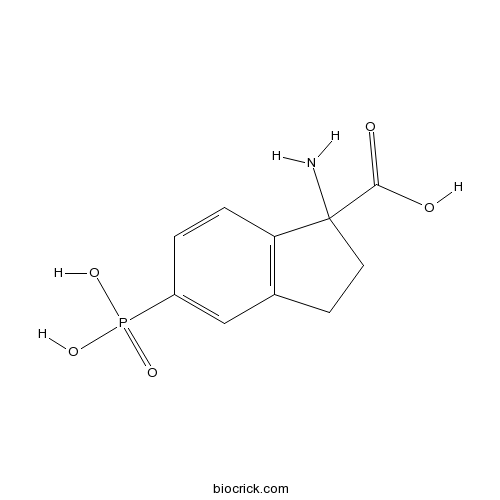
(RS)-APICA
170847-18-4
-
BCC6871
EGLU
EGLU ((2S)-α-Ethylglutamic acid; (2S)-α-EGLU) is a potent and competitive mGluR-2 receptor antagonist. EGLU interacts with (lS,3S)-ACPD-sensitive site with a Kd value of 66 μM. EGLU is an antidepressant agent.

-
BCC1724
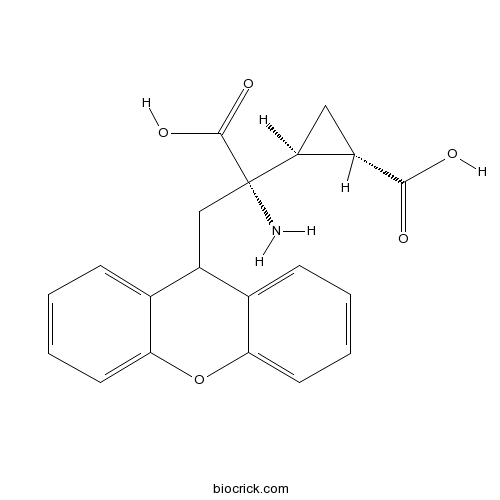
LY341495
LY341495 is a metabotropic glutamate receptor (mGluR) antagonist with IC50s of 2.9 nM, 10 nM, 170 nM for mGluR-2, mGluR-3, mGluR-8, respectively.
-
BCC6819
MSPG
169209-64-7

-
BCC6820
MTPG
169209-66-9

-
BCC7513
Ro 64-5229
246852-46-0

-
BCC7849
BINA
Biphenylindanone A (BINA) is a selective human mGluR2 (hmGluR2) potentiator for the treatment of many neurological disorders.

-
BCC7824
CBiPES hydrochloride
856702-40-4