
Isorhamnetin-3-O-neohespeidosideCAS# 55033-90-4 |

| Cas No. | 55033-90-4 | SDF | File under preparation. |
| PubChem ID | 11664505 | Appearance | Yellow powder |
| Formula | C28H32O16 | M.Wt | 624.54 |
| Type of Compound | Flavonoids | Storage | Desiccate at -20°C |
| Synonyms | Calendoflavoside; 3,4',5,7-Tetrahydroxy 3'-methoxyflavone 3-neohesperidoside | ||
| Solubility | Soluble in DMSO and methan | ||
| Chemical Name | 3-[(2S,3R,4S,5S,6R)-4,5-dihydroxy-6-(hydroxymethyl)-3-[(2S,3R,4R,5R,6S)-3,4,5-trihydroxy-6-methyloxan-2-yl]oxyoxan-2-yl]oxy-5,7-dihydroxy-2-(4-hydroxy-3-methoxyphenyl)chromen-4-one | ||
| SMILES | CC1C(C(C(C(O1)OC2C(C(C(OC2OC3=C(OC4=CC(=CC(=C4C3=O)O)O)C5=CC(=C(C=C5)O)OC)CO)O)O)O)O)O | ||
| Standard InChIKey | QHLKSZBFIJJREC-SPSUIZEHSA-N | ||
| Standard InChI | InChI=1S/C28H32O16/c1-9-18(33)21(36)23(38)27(40-9)44-26-22(37)19(34)16(8-29)42-28(26)43-25-20(35)17-13(32)6-11(30)7-15(17)41-24(25)10-3-4-12(31)14(5-10)39-2/h3-7,9,16,18-19,21-23,26-34,36-38H,8H2,1-2H3/t9-,16+,18-,19+,21+,22-,23+,26+,27-,28-/m0/s1 | ||
| General tips | For obtaining a higher solubility , please warm the tube at 37 ℃ and shake it in the ultrasonic bath for a while.Stock solution can be stored below -20℃ for several months. We recommend that you prepare and use the solution on the same day. However, if the test schedule requires, the stock solutions can be prepared in advance, and the stock solution must be sealed and stored below -20℃. In general, the stock solution can be kept for several months. Before use, we recommend that you leave the vial at room temperature for at least an hour before opening it. |
||
| About Packaging | 1. The packaging of the product may be reversed during transportation, cause the high purity compounds to adhere to the neck or cap of the vial.Take the vail out of its packaging and shake gently until the compounds fall to the bottom of the vial. 2. For liquid products, please centrifuge at 500xg to gather the liquid to the bottom of the vial. 3. Try to avoid loss or contamination during the experiment. |
||
| Shipping Condition | Packaging according to customer requirements(5mg, 10mg, 20mg and more). Ship via FedEx, DHL, UPS, EMS or other couriers with RT, or blue ice upon request. | ||
Quality Control & MSDS
3D structure
Package In Stock

Number of papers citing our products

| Description | Isorhamnetin 3-O-neohesperoside is the major active substance of Puhuang, a traditional herb medicine widely used in clinical practice to tackle many chronic diseases. It has significant biological and pharmacological activities, including antioxidant, antiatherogenic and antimicrobial effects. |
| Structure Identification | J Chromatogr B Analyt Technol Biomed Life Sci. 2015 Jan 1;974:131-7.Measurement of hydroxysafflor yellow A in human urine by liquid chromatography-tandem mass spectrometry.[Pubmed: 25463208]
|

Isorhamnetin-3-O-neohespeidoside Dilution Calculator
Isorhamnetin-3-O-neohespeidoside Molarity Calculator
-
 Isorhamnetin 3-sophoroside-7-rhamnosideCatalog No.: BCN1446CAS No.: 41328-75-0
-
 TyphaneosideCatalog No.: BCN4994CAS No.: 104472-68-6
-
 Quercetin 3-O-neohesperidosideCatalog No.: BCN8837CAS No.: 32453-36-4
-
 Kaempferol 3-neohesperidosideCatalog No.: BCN5245CAS No.: 32602-81-6
-
 Kaempferol-3-O-glucorhamnosideCatalog No.: BCN2830CAS No.: 40437-72-7
-
 Isorhamnetin-3-O-beta-D-GlucosideCatalog No.: BCN1247CAS No.: 5041-82-7
-
 Isorhamnetin-3-O-galactosideCatalog No.: BCC8190CAS No.: 6743-92-6
-
 Isorhamnetin 3-glucoside-7-rhamnosideCatalog No.: BCN1528CAS No.: 17331-71-4
-
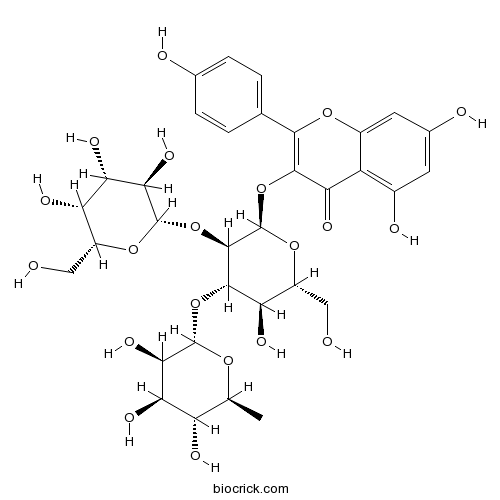 Camelliaside ACatalog No.: BCN3871CAS No.: 135095-52-2
-
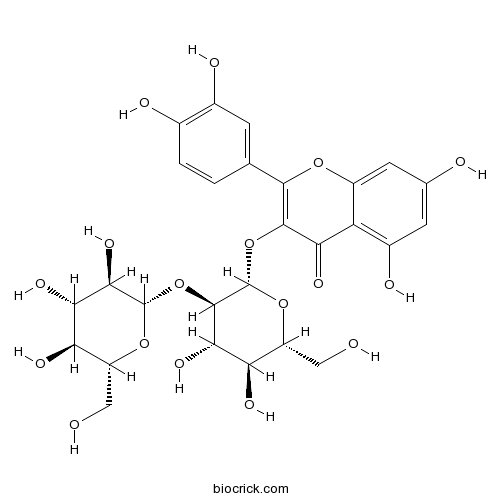 Quercetin-3-O-sophorosideCatalog No.: BCN2771CAS No.: 18609-17-1
-
 Quercetin 3-glucosyl-(1->2)-galactosideCatalog No.: BCX0122CAS No.: 95043-15-5
-
 Multinoside ACatalog No.: BCX2030CAS No.: 59262-54-3
-
 MauritianinCatalog No.: BCN2932CAS No.: 109008-28-8
-
 Kaempferol 3-O-(2''-O-glucosyl)rutinosideCatalog No.: BCX0251CAS No.: 55696-58-7
-
 Quercetin 3-O-sophoroside-7-O-rhamnosideCatalog No.: BCN8871CAS No.: 64828-40-6
-
 NarcissosideCatalog No.: BCN1263CAS No.: 604-80-8
-
 Isorhamnetin 3-robinobiosideCatalog No.: BCN8693CAS No.: 53584-69-3
-
 AstragalosideCatalog No.: BCN5959CAS No.: 17429-69-5
-
 Kaempferol 3-O-beta-sophorosideCatalog No.: BCN3336CAS No.: 19895-95-5
-
 PanasenosideCatalog No.: BCN8554CAS No.: 31512-06-8
-
 Ternatumoside IICatalog No.: BCN0755CAS No.: 1473419-87-2
-
 AlcesefolisideCatalog No.: BCN2933CAS No.: 124151-38-8
-
 Quercetin 3-O-rutinoside-1-2-O-rhamnosideCatalog No.: BCN8820CAS No.: 55696-57-6
-
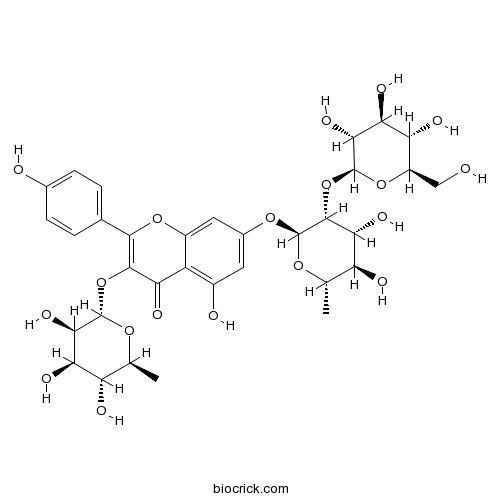 GrosvenorinCatalog No.: BCN1262CAS No.: 156980-60-8
-
 Kaempferol 3-sophoroside-7-rhamnosideCatalog No.: BCN1306CAS No.: 93098-79-4
-
 Isorhamnetin 3-O-apiosyl (1->2)[rhamnosyl (1->6)]glucosideCatalog No.: BCX2105CAS No.: 165605-18-5
-
 Isorhamnetin-3-O-rutinoside-7-O-glucosideCatalog No.: BCX0005CAS No.: 55481-91-9
-
 Isorhamnetin 3,7-O-diglucosideCatalog No.: BCN8828CAS No.: 6758-51-6
-
 ClitorinCatalog No.: BCN8695CAS No.: 55804-74-5
-
 TamarixinCatalog No.: BCN0692CAS No.: 27542-39-8
-
 Quercetin 3-O-[2-O-(6-O-E-feruloyl)-beta-D-glucopyranosyl]-beta-D-galactopyranosideCatalog No.: BCN1439CAS No.: 448948-20-7
| 1 mg | 5 mg | 10 mg | 20 mg | 25 mg | |
| 1 mM | 1.6012 mL | 8.0059 mL | 16.0118 mL | 32.0236 mL | 40.0295 mL |
| 5 mM | 0.3202 mL | 1.6012 mL | 3.2024 mL | 6.4047 mL | 8.0059 mL |
| 10 mM | 0.1601 mL | 0.8006 mL | 1.6012 mL | 3.2024 mL | 4.0029 mL |
| 50 mM | 0.032 mL | 0.1601 mL | 0.3202 mL | 0.6405 mL | 0.8006 mL |
| 100 mM | 0.016 mL | 0.0801 mL | 0.1601 mL | 0.3202 mL | 0.4003 mL |
| * Note: If you are in the process of experiment, it's necessary to make the dilution ratios of the samples. The dilution data above is only for reference. Normally, it's can get a better solubility within lower of Concentrations. | |||||
- (±)-Cloprostenol sodium salt
Catalog No.:BCC7315
CAS No.:55028-72-3
- NAADP tetrasodium salt
Catalog No.:BCC7808
CAS No.:5502-96-5
- Naphazoline HCl
Catalog No.:BCC4331
CAS No.:550-99-2
- Lupanine
Catalog No.:BCN5736
CAS No.:550-90-3
- Afrormosine
Catalog No.:BCN3312
CAS No.:550-79-8
- trans-Triprolidine hydrochloride
Catalog No.:BCC6742
CAS No.:550-70-9
- Angustifoline
Catalog No.:BCN3205
CAS No.:550-43-6
- Embelin
Catalog No.:BCN2678
CAS No.:550-24-3
- Busulfan
Catalog No.:BCC3742
CAS No.:55-98-1
- Hexamethonium Bromide
Catalog No.:BCC4561
CAS No.:55-97-0
- 1-Phenylbiguanide hydrochloride
Catalog No.:BCC6870
CAS No.:55-57-2
- Atropine sulfate
Catalog No.:BCN2716
CAS No.:55-48-1
- Dammar-20(21)-en-3,24,25-triol
Catalog No.:BCN5734
CAS No.:55050-69-6
- 2,6,4'-Trihydroxy-4-methoxybenzophenone
Catalog No.:BCN7588
CAS No.:55051-85-9
- Protodioscin
Catalog No.:BCN6274
CAS No.:55056-80-9
- Diversoside
Catalog No.:BCN7537
CAS No.:55062-36-7
- Acitretin
Catalog No.:BCC1189
CAS No.:55079-83-9
- Andrographolide
Catalog No.:BCN5735
CAS No.:5508-58-7
- Skullcapflavone II
Catalog No.:BCN3188
CAS No.:55084-08-7
- 5,6,7-Trimethoxycoumarin
Catalog No.:BCN7590
CAS No.:55085-47-7
- Nalmefene - d3
Catalog No.:BCC6093
CAS No.:55096-26-9
- EVP-6124 hydrochloride
Catalog No.:BCC1567
CAS No.:550999-74-1
- EVP-6124
Catalog No.:BCC1566
CAS No.:550999-75-2
- 3-Butylidenephthalide
Catalog No.:BCN6345
CAS No.:551-08-6
Measurement of hydroxysafflor yellow A in human urine by liquid chromatography-tandem mass spectrometry.[Pubmed:25463208]
J Chromatogr B Analyt Technol Biomed Life Sci. 2015 Jan 1;974:131-7.
A rapid and specific high performance liquid chromatography-tandem mass spectrometry (LC-MS/MS) was developed for the quantification of hydroxysafflor yellow A (HSYA) in human urine with Isorhamnetin-3-O-neohespeidoside as internal standard (IS). HSYA and IS were extracted from urine samples by simple solid-phase extraction and separated on an Agilent Zorbax SB C18 column (4.6 mm x 150 mm, 5 mum) with the mobile phase of 0.2 mM ammonium acetate: methanol (30/70, v/v) at a flow rate of 0.4 mL/min. Polar endogenous interferences eluted in 0.1-2.5 min were switched into waste channel by the Valve Valco, to reduce the possible matrix effect for MS detection in each run. The MS detection of analytes was performed on a tandem mass spectrometer equipped with an electrospray ionization source in negative mode using multiple-reaction monitoring. The MS/MS ion transitions monitored were m/z 611.3-->491.2 for HSYA and m/z 623.2-->299.2 for IS. The method was fully validated for selectivity, sensitivity, linearity, precision, accuracy, recovery, matrix effect and stability, and then was applied to the urinary excretion study of injectable powder of pure HSYA in healthy Chinese volunteers for the first time. The results suggested that urine was the main excretion way of HSYA in healthy volunteers, further demonstrating the feasibility and necessity of our current method.

Calcutta University

University of Minnesota

University of Maryland School of Medicine

University of Illinois at Chicago

The Ohio State University

University of Zurich

Harvard University

Colorado State University

Auburn University

Yale University

Worcester Polytechnic Institute

Washington State University

Stanford University

University of Leipzig

Universidade da Beira Interior

The Institute of Cancer Research

Heidelberg University

University of Amsterdam

University of Auckland

TsingHua University

The University of Michigan

Miami University

DRURY University

Jilin University

Fudan University

Wuhan University

Sun Yat-sen University

Universite de Paris

Deemed University

Auckland University

The University of Tokyo

Korea University



