Nociception
Nociception is the sensory process that provides the signals that lead to pain. This occurs through nociceptors, primary sensory neurons that are activated by stimuli that cause tissue damage. Stimuli can include tissue injury, extremes of heat and noxious chemicals. Unlike other sensory neurons that detect vision or taste, nociceptors are located all around the body, particularly under the skin, however, they are notably absent from the brain.
Nociception Products Targets
- Others (20)
- Nucleoside Transporter (5)
- Glycine Transporter (6)
- GABA (10)
- Cannabinoid Transporter (10)
- Acetylcholine Transporter (1)
- D4 Receptor (12)
- 5-HT7 Receptor (11)
- 5-HT6 Receptor (14)
- 5-ht5 Receptor (2)
- 5-HT4 Receptor (17)
- NK2 Receptor (7)
- NK1 Receptor (15)
- NOP Receptor (21)
- Mu-Opioid Receptors (15)
- Kappa Opioid Receptors (14)
- Glutamate (Metabotropic) Group III Receptor (26)
- Glutamate (Metabotropic) Group II Receptor (33)
- Glutamate (Metabotropic) Group I Receptor (54)
- AMPA Receptor (45)
- GABAA-ρ Receptor (8)
- GABAA Receptor (66)
- GPR55 (8)
- CB2 Receptor (6)
- CB1 Receptor (17)
- Voltage-gated Sodium (NaV) Channels (30)
- Voltage-gated Potassium (KV) Channels (38)
- Voltage-gated Calcium Channels (CaV) (38)
- Neurotensin Receptors (7)
- Glycine Receptors (6)
- Fatty Acid Amide Hydrolase (15)
- Cyclooxygenases (24)
- Bradykinin Receptors (12)
- D3 Receptor (12)
- NK3 Receptor (5)
- Vesicular Monoamine Transporter (4)
- NMDA Receptor (87)
- Kainate Receptor (22)
- D2 Receptor (14)
- D1 and D5 Receptor (16)
- Glutamate Transporter (18)
- Dopamine Transporter (20)
- Histamine H4 Receptor (12)
- Histamine H3 Receptor (22)
- Histamine H2 Receptor (10)
- Histamine H1 Receptor (17)
- Adrenergic Transporter (23)
- 5-HT Transporter (30)
- NO donors and precursors (9)
- nNOS (5)
- iNOS (11)
- eNOS (1)
- M5 Receptor (2)
- M4 Receptor (3)
- M3 Receptor (4)
- M2 Receptor (5)
- M1 Receptor (8)
- Delta opioid receptor (16)
- Adrenergic α2 Receptor (33)
- Adrenergic α1 Receptor (22)
- Adrenergic β3 Receptor (12)
- Adrenergic β2 Receptor (6)
- Adrenergic β1 Receptor (7)
Products for Nociception - Page 14
- Cat.No. Product Name Information/Activity
-
BCC7709
Margatoxin
Margatoxin, an alpha-KTx scorpion toxin, is a high affinity inhibitor of Kv1.3 (Kd=11.7 pM). Margatoxin inhibits the Kv1.2 (Kd=6.4 pM) and Kv1.1 (Kd=4.2 nM). Margatoxin, a 39 amino-acid-long peptide, is isolated from the venom of the scorpion Centruroides margaritatus and widely used in ion channel research.

-
BCC7927
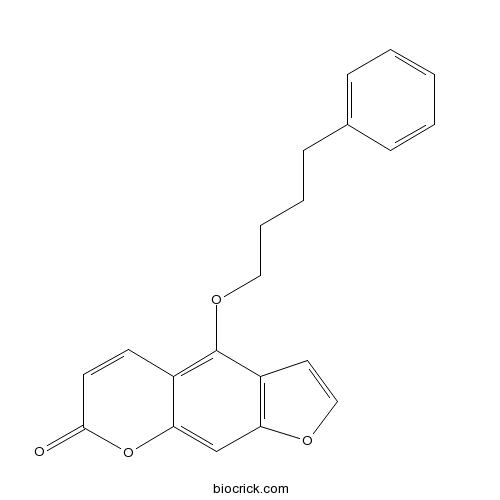
Psora 4
Potent K<sub>V</sub>1.3 channel blocker
-
BCC6044
RuBi-4AP
851956-02-0

-
BCC5990
ShK-Dap22
220384-25-8

-
BCC3866
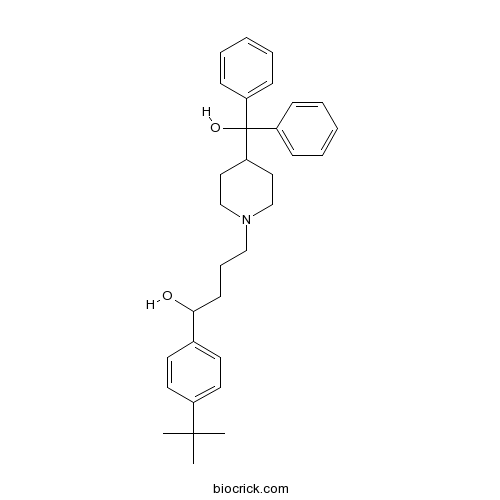
Terfenadine
Terfenadine ((±)-Terfenadine) is a potent open-channel blocker of hERG with an IC50 of 204 nM. Terfenadine, an H1 histamine receptor antagonist, acts as a potent apoptosis inducer in melanoma cells through modulation of Ca2+ homeostasis. Terfenadine induces ROS-dependent apoptosis, simultaneously activates Caspase-4, -2, -9.
-
BCC7554
Tetraethylammonium chloride
Non-selective K<sup>+</sup> channel blocker

-
BCC7784
UK 78282 hydrochloride
136647-02-4

-
BCC7232
XE 991 dihydrochloride
XE 991 dihydrochloride, a Kv7 (KCNQ) channels blocker, potently inhibits Kv7.1 (KCNQ1), Kv7.2 (KCNQ2), Kv7.2 + Kv7.3 (KCNQ3) channel, and M-current with IC50s of 0.75 µM, 0.71 µM, 0.6 μM, and 0.98 µM, respectively.

-
BCC4907
Fluticasone propionate
Fluticasone propionate is a high affinity, selective GR (glucocorticoid receptor) agonist which is derived from fluticasone used to treat asthma and allergic rhinitis.

-
BCC7515
Veratridine
Veratridine (3-Veratroylveracevine), a alkaloid derived from plants in the family Liliaceae, is a sodium channel agonist. Veratridine inhibits the peak current of Nav1.7, with an IC50 of 18.39 µM.