Parkinson's Disease Research
Parkinson's disease (PD) is a degenerative disease of the central nervous system that often impairs motor skills, speech, and other functions. Symptoms of the disease include resting tremor, bradykinesia and rigidity. The primary symptoms are the result of decreased stimulation of the motor cortex by the basal ganglia, normally caused by the insufficient formation and action of dopamine, which is produced in the dopaminergic neurons of the brain. Symptoms of the disease appear once 50-80% of dopamine neurons have died. Parkinson's disease is both chronic and progressive.
Parkinson's Disease Research Products Targets
- Adenosine A2B Receptor (7)
- Adenosine A2A Receptor (11)
- Caspase (9)
- Bcl-2 Family (13)
- Voltage-gated Calcium Channel (CaV) (38)
- GABAB Receptor (28)
- Others (23)
- Cyclooxygenase (24)
- D4 Receptor (12)
- STIM-Orai Channel (4)
- Ryanodine Receptor (6)
- Hsp90 (10)
- Hsp70 (4)
- 5-HT7 Receptor (11)
- 5-HT6 Receptor (14)
- 5-ht5 Receptor (2)
- 5-HT4 Receptor (17)
- Glutamate (Metabotropic) Group III Receptor (26)
- Glutamate (Metabotropic) Group II Receptor (33)
- Glutamate (Metabotropic) Group I Receptor (54)
- AMPA Receptor (45)
- GABAA-ρ Receptor (8)
- GABAA Receptor (66)
- Nicotinic (α7) Receptor (25)
- Nicotinic (α4β2) Receptor (14)
- D3 Receptor (12)
- LRRK2 (4)
- Catechol O-Methyltransferase (3)
- Vesicular Monoamine Transporter (4)
- NMDA Receptor (87)
- Kainate Receptor (22)
- IP3 Receptor (2)
- D2 Receptor (14)
- D1 and D5 Receptor (16)
- Trk Receptor (13)
- Trace Amine 1 Receptor (2)
- Adenosine A3 Receptor (8)
- Adenosine A1 Receptor (12)
- Monoamine Oxidase (10)
- M5 Receptor (2)
- M4 Receptor (3)
- M3 Receptor (4)
- M2 Receptor (5)
- M1 Receptor (8)
- Adrenergic α2 Receptor (33)
- Adrenergic α1 Receptor (22)
- Adrenergic β3 Receptor (12)
- Adrenergic β2 Receptor (6)
- Adrenergic β1 Receptor (7)
- Protein Arginine Methyltransferase (2)
Products for Parkinson's Disease Research - Page 41
- Cat.No. Product Name Information/Activity
-
BCC6849
SCH 23390 hydrochloride
SCH-23390 hydrochloride (R-(+)-SCH-23390 hydrochloride) is a potent and selective dopamine D1-like receptor antagonist with Kis of 0.2 nM and 0.3 nM for the D1 and D5 receptor, respectively. SCH-23390 hydrochloride is a potent and high efficacy human 5-HT2C receptor agonist with a Ki of 9.3 nM. SCH-23390 hydrochloride also binds with high affinity to the 5-HT2 and 5-HT1C receptors. SCH-23390 hydrochloride inhibits G protein-coupled inwardly rectifying potassium (GIRK) channels with an IC50 of 268 nM.

-
BCC7317
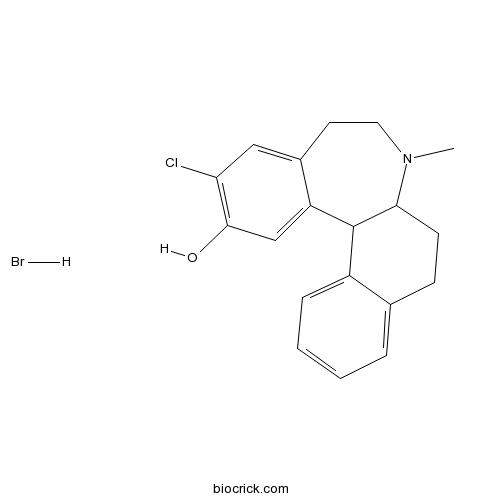
SCH 39166 hydrobromide
1227675-51-5
-
BCC7121
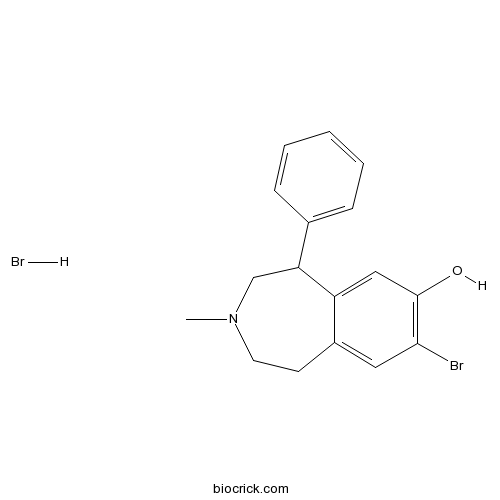
SKF 83566 hydrobromide
108179-91-5
-
BCC5034
Aripiprazole
Aripiprazole (OPC-14597) is a human 5-HT1A receptor partial agonist with a Ki of 4.2 nM.

-
BCC7818
GSK 789472 hydrochloride
1257326-24-1

-
BCC1908
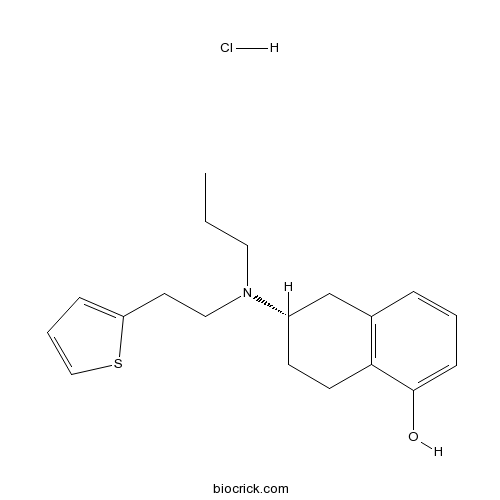
Rotigotine hydrochloride
Rotigotine Hydrochloride (N-0923 Hydrochloride) is a full agonist of dopamine receptor, a partial agonist of the 5-HT1A receptor, and an antagonist of the α2B-adrenergic receptor, with Ki of 0.71 nM, 4-15 nM, and 83 nM for the dopamine D3 receptor and D2, D5, D4 receptors, and dopamine D1 receptor.
-
BCC4112
Sumanirole maleate
Sumanirole maleate (U-95666E; PNU-95666E) is a highly selective D2 receptor full agonist with an ED50 of about 46 nM. Sumanirole was developed for the treatment of Parkinson's disease and restless leg syndrome.

-
BCC6886
L-741,626
L-741626 is a selective D2 dopamine receptor antagonist, with the Ki values of 2.4, 100 and 220 nM for human D2, D3 and D4 receptors respectively.

-
BCC7385
Melperone hydrochloride
1622-79-3

-
BCC5042
Olanzapine
Olanzapine is a selective monoaminergic antagonist with high affinity binding to serotonin H1, 5HT2A/2C, 5HT3, 5HT6 (Ki=7, 4, 11, 57, and 5 nM, respectively), dopamine D1-4 (Ki=11 to 31 nM), muscarinic M1-5 (Ki=1.9-25 nM), and adrenergic α1 receptors (Ki=19 nM). Olanzapine is an atypical antipsychotic.