Epilepsy Research
Epilepsy is a group of neurological conditions consisting of recurrent, usually unprovoked epileptic seizures. Epileptic seizures have recently been defined as "a transient occurrence of signs and/or symptoms due to abnormal, excessive or synchronous neuronal activity in the brain". Epilepsy is one of the most common disorders of the brain, with one in 10 people suffering at least one seizure in their lifetime. There are over 40 different types of epilepsy, each of which presents with its own unique combination of seizure type, typical age of onset, EEG findings, treatment, and prognosis.
Epilepsy Research Products Targets
- NHE (3)
- Monocarboxylate Transporter (3)
- VEGFR (16)
- FGFR (5)
- Voltage-gated Sodium (NaV) Channel (30)
- Voltage-gated Potassium (KV) Channel (38)
- Voltage-gated Calcium Channel (CaV) (38)
- Others (13)
- Epithelial Sodium Channel (3)
- STIM-Orai Channel (4)
- Ryanodine Receptor (6)
- Glutamate (Metabotropic) Group III Receptor (26)
- Glutamate (Metabotropic) Group II Receptor (33)
- Glutamate (Metabotropic) Group I Receptor (54)
- AMPA Receptor (45)
- GABAA-ρ Receptor (8)
- GABAA Receptor (66)
- NMDA Receptor (87)
- Kainate Receptor (22)
- IP3 Receptor (2)
- Gap Channel (7)
- Trk Receptor (13)
- Acid-Sensing Ion Channel (3)
- Calcium-Activated Potassium (KCa) Channel (19)
- Inward Rectifier Potassium (Kir) Channel (21)
- Sodium and Potassium ATPase (3)
- KCC2 (1)
- H+-ATPase (3)
- H+,K+-ATPase (4)
- Chloride Channel (17)
- NCX (5)
- Ca2+-ATPase (7)
- NKCC (2)
- Cytokine (15)
Products for Epilepsy Research - Page 7
- Cat.No. Product Name Information/Activity
-
BCC6078
(E)-FeCP-oxindole
884338-18-5

-
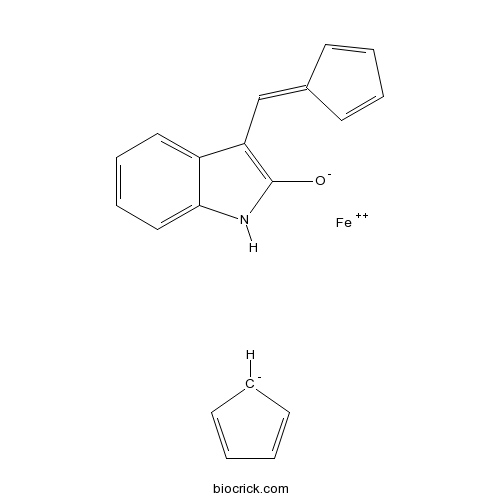
BCC6079
(Z)-FeCP-oxindole
1137967-28-2
-
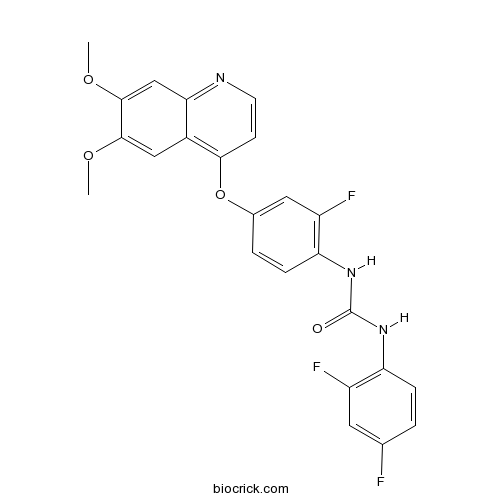
BCC1116
Ki8751
Ki8751 is a potent VEGFR2 inhibitor with an IC50 of 0.9 nM.
-
BCC7073
SU 4312
5812-07-7

-
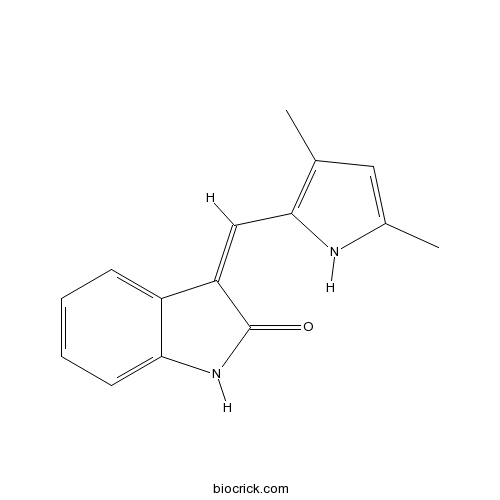
BCC1974
SU5416
Semaxinib (SU5416) is a potent and selective inhibitor of VEGFR (Flk-1/KDR) with an IC50 of 1.23 μM.
-
BCC3664
Sunitinib malate
Sunitinib Malate (SU 11248 Malate) is a multi-targeted receptor tyrosine kinase inhibitor with IC50s of 80 nM and 2 nM for VEGFR2 and PDGFRβ, respectively. Sunitinib Malate, an ATP-competitive inhibitor, effectively inhibits autophosphorylation of Ire1α by inhibiting autophosphorylation and consequent RNase activation.

-
BCC2005
Toceranib
Toceranib phosphate (SU11654 phosphate) is an orally active receptor tyrosine kinase (RTK) inhibitor, and it potently inhibits PDGFR, VEGFR, and Kit with Kis of 5 and 6 nM for PDGFRβ and Flk-1/KDR, respectively. Toceranib phosphate (SU11654 phosphate) has antitumor and antiangiogenic activity, and used in the treatment of canine mast cell tumors.

-
BCC1264
Cabozantinib (XL184, BMS-907351)
Cabozantinib is a potent multiple receptor tyrosine kinases (RTKs) inhibitor that inhibits VEGFR2, c-Met, Kit, Axl and Flt3 with IC50s of 0.035, 1.3, 4.6, 7 and 11.3 nM, respectively.

-
BCC5098
ZM 323881 HCl
ZM323881 hydrochloride is a potent and selective VEGFR2 inhibitor with an IC50 of less than 2 nM.

-
BCC6978
2-APB
2-Aminoethyl diphenylborinate (2-APB) is a cell-permeable inhibitor of IP3R. 2-Aminoethyl diphenylborinate also inhibits the store-operated Ca2+ (SOC) channel and activates some TRP channels (V1, V2 and V3).