Epilepsy Research
Epilepsy is a group of neurological conditions consisting of recurrent, usually unprovoked epileptic seizures. Epileptic seizures have recently been defined as "a transient occurrence of signs and/or symptoms due to abnormal, excessive or synchronous neuronal activity in the brain". Epilepsy is one of the most common disorders of the brain, with one in 10 people suffering at least one seizure in their lifetime. There are over 40 different types of epilepsy, each of which presents with its own unique combination of seizure type, typical age of onset, EEG findings, treatment, and prognosis.
Epilepsy Research Products Targets
- NHE (3)
- Monocarboxylate Transporter (3)
- VEGFR (16)
- FGFR (5)
- Voltage-gated Sodium (NaV) Channel (30)
- Voltage-gated Potassium (KV) Channel (38)
- Voltage-gated Calcium Channel (CaV) (38)
- Others (13)
- Epithelial Sodium Channel (3)
- STIM-Orai Channel (4)
- Ryanodine Receptor (6)
- Glutamate (Metabotropic) Group III Receptor (26)
- Glutamate (Metabotropic) Group II Receptor (33)
- Glutamate (Metabotropic) Group I Receptor (54)
- AMPA Receptor (45)
- GABAA-ρ Receptor (8)
- GABAA Receptor (66)
- NMDA Receptor (87)
- Kainate Receptor (22)
- IP3 Receptor (2)
- Gap Channel (7)
- Trk Receptor (13)
- Acid-Sensing Ion Channel (3)
- Calcium-Activated Potassium (KCa) Channel (19)
- Inward Rectifier Potassium (Kir) Channel (21)
- Sodium and Potassium ATPase (3)
- KCC2 (1)
- H+-ATPase (3)
- H+,K+-ATPase (4)
- Chloride Channel (17)
- NCX (5)
- Ca2+-ATPase (7)
- NKCC (2)
- Cytokine (15)
Products for Epilepsy Research - Page 4
- Cat.No. Product Name Information/Activity
-
BCC4961
Suplatast Tosylate
Suplatast Tosilate (IPD 1151T) is a Th2 cytokine inhibitor that attenuates IL-2, IL-5 and IL-13 production and has no effect on IFN-γ production.

-
BCC2248
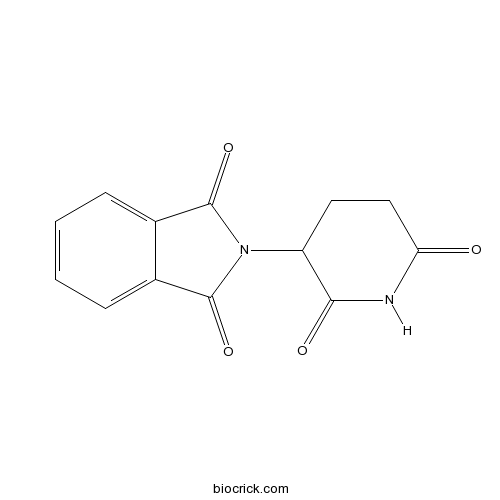
Thalidomide
Thalidomide is initially promoted as a sedative, inhibits cereblon (CRBN), a part of the cullin-4 E3 ubiquitin ligase complex CUL4-RBX1-DDB1, with a Kd of ∼250 nM, and has immunomodulatory, anti-inflammatory and anti-angiogenic cancer properties.
-
BCC2522
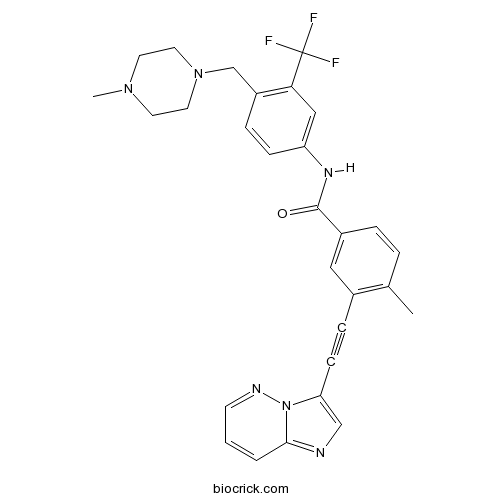
Ponatinib (AP24534)
Ponatinib (AP24534) is an orally active multi-targeted kinase inhibitor with IC50s of 0.37 nM, 1.1 nM, 1.5 nM, 2.2 nM, and 5.4 nM for Abl, PDGFRα, VEGFR2, FGFR1, and Src, respectively.
-
BCC7765
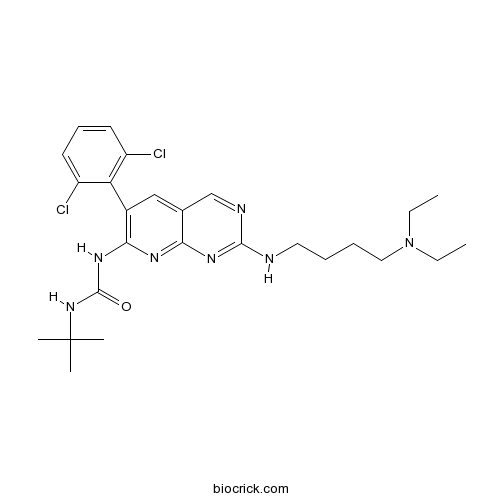
PD 161570
PD-161570 is a potent and ATP-competitive human FGF-1 receptor inhibitor with an IC50 of 39.9 nM and a Ki of 42 nM. PD-161570 also inhibits the PDGFR, EGFR and c-Src tyrosine kinases with IC50 values of 310 nM, 240 nM, and 44 nM, respectively. PD-161570 inhibits PDGF-stimulated autophosphorylation and FGF-1 receptor phosphorylation with IC50s of 450 nM and 622 nM, respectively.
-
BCC3662
PD 173074
PD173074 is a potent FGFR1 inhibitor with an IC50 of 25 nM and also inhibits VEGFR2 with an IC50 of 100-200 nM, showing 1000-fold selectivity for FGFR1 over PDGFR and c-Src.

-
BCC1970
SU 5402
SU 5402 is a potent multi-targeted receptor tyrosine kinase inhibitor with IC50 of 20 nM, 30 nM, and 510 nM for VEGFR2, FGFR1, and PDGFRβ, respectively.

-
BCC2508
TSU-68 (SU6668,Orantinib)
Orantinib (SU6668; TSU-68) is a multi-targeted receptor tyrosine kinase inhibitor with Kis of 2.1 μM, 8 nM and 1.2 μM for Flt-1, PDGFRβ and FGFR1, respectively.

-
BCC3931
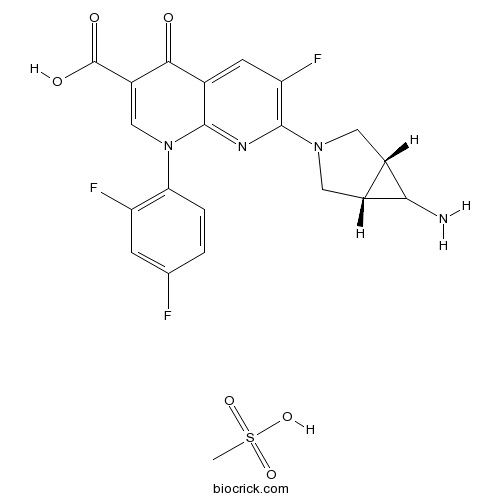
Trovafloxacin mesylate
Trovafloxacin mesylate is a broad-spectrum quinolone antibiotic with potent activity against Gram-positive, Gram-negative and anaerobic organisms. Trovafloxacin mesylate blocks the DNA gyrase and topoisomerase IV activity. Trovafloxacin mesylate is also a potent, selective and orally active pannexin 1 channel (PANX1) inhibitor with an IC50 of 4 μM for PANX1 inward current. Trovafloxacin mesylate does not inhibit connexin 43 gap junction or PANX2. Trovafloxacin mesylate leads to dysregulated fragmentation of apoptotic cells by inhibiting PANX1.
-
BCC1245
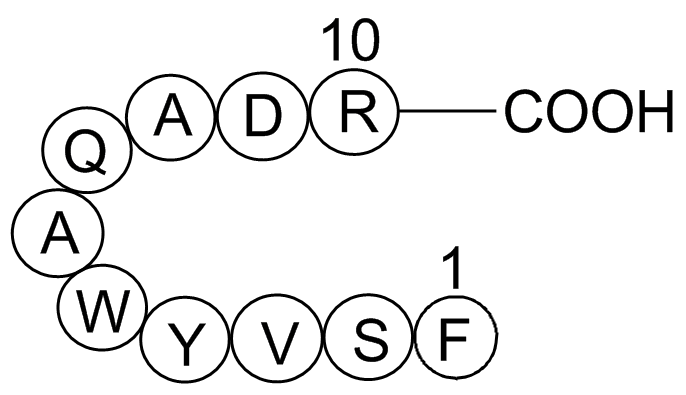
10Panx
Panx-1 mimetic inhibitory peptide; blocks pannexin-1 gap junctions

-
BCC1246
Scrambled 10Panx
Scrambled version of <sup>10</sup>Panx, Panx-1 mimetic inhibitory peptide