Huntington's Disease Research
Huntington's disease is a neurodegenerative disease characterized by cognitive decline and motor dysfunction. It is a genetic disorder which results in the production of mutant huntingtin protein (mHtt). This protein aggregates in the cell cytoplasm and nucleus, affecting cellular function.
Huntington's Disease Research Products Targets
- Adenosine A2A Receptor (11)
- Caspase (9)
- Ubiquitin-activating Enzyme E1 (3)
- Ubiquitin E2 Conjugating Enzyme (3)
- Ubiquitin E3 Ligase (10)
- Deubiquitinating Enzyme (12)
- Hsp90 (10)
- Hsp70 (4)
- Glutamate (Metabotropic) Group III Receptor (26)
- Glutamate (Metabotropic) Group II Receptor (33)
- Glutamate (Metabotropic) Group I Receptor (54)
- Vesicular Monoamine Transporter (4)
- Sir 2-like Family Deacetylase (9)
- Post-Translational Modification (11)
- NMDA Receptor (87)
- Kainate Receptor (22)
- IP3 Receptor (2)
- ERK (6)
- D2 Receptor (14)
- D1 and D5 Receptor (16)
- Calpain (7)
- Trk Receptor (13)
- Autophagy (44)
- Antioxidant (19)
- Glutamate Transporter (18)
- Dopamine Transporter (20)
- Cathepsin (9)
- Mitochondrial Permeability Transition Pore (3)
- Proteasome (5)
- Histone Deacetylase (19)
- Histone Acetyltransferase (4)
Products for Huntington's Disease Research - Page 18
- Cat.No. Product Name Information/Activity
-
BCC4546
C646
C646 is a selective and competitive histone acetyltransferase p300 inhibitor with Ki of 400 nM, and is less potent for other acetyltransferases.

-
BCC5623
Garcinol
Garcinol, a polyisoprenylated benzophenone harvested from Garcinia indica, exerts anti-cholinesterase properties towards acetyl cholinesterase (AChE) and butyrylcholinesterase (BChE) with IC50s of 0.66 µM and 7.39 µM, respectively. Garcinol also inhibits histone acetyltransferases (HATs, IC50= 7 μM) and p300/CPB-associated factor (PCAF, IC50 = 5 μM). Garcinol has anti-inflammatory and anti-cancer activity.

-
BCC8000
L002
L002 is a potent, cell permeable, reversible and specific acetyltransferase p300 (KAT3B) inhibitor with an IC50 of 1.98 μM. L002 binds the acetyl-CoA pocket and competitively inhibits the FATp300 catalytic domain, blocks histone acetylation and p53 acetylation, and inhibits STAT3 activation. L002 has the potential for hypertension‐induced cardiac hypertrophy and fibrogenesis treatment.
-
BCC3597
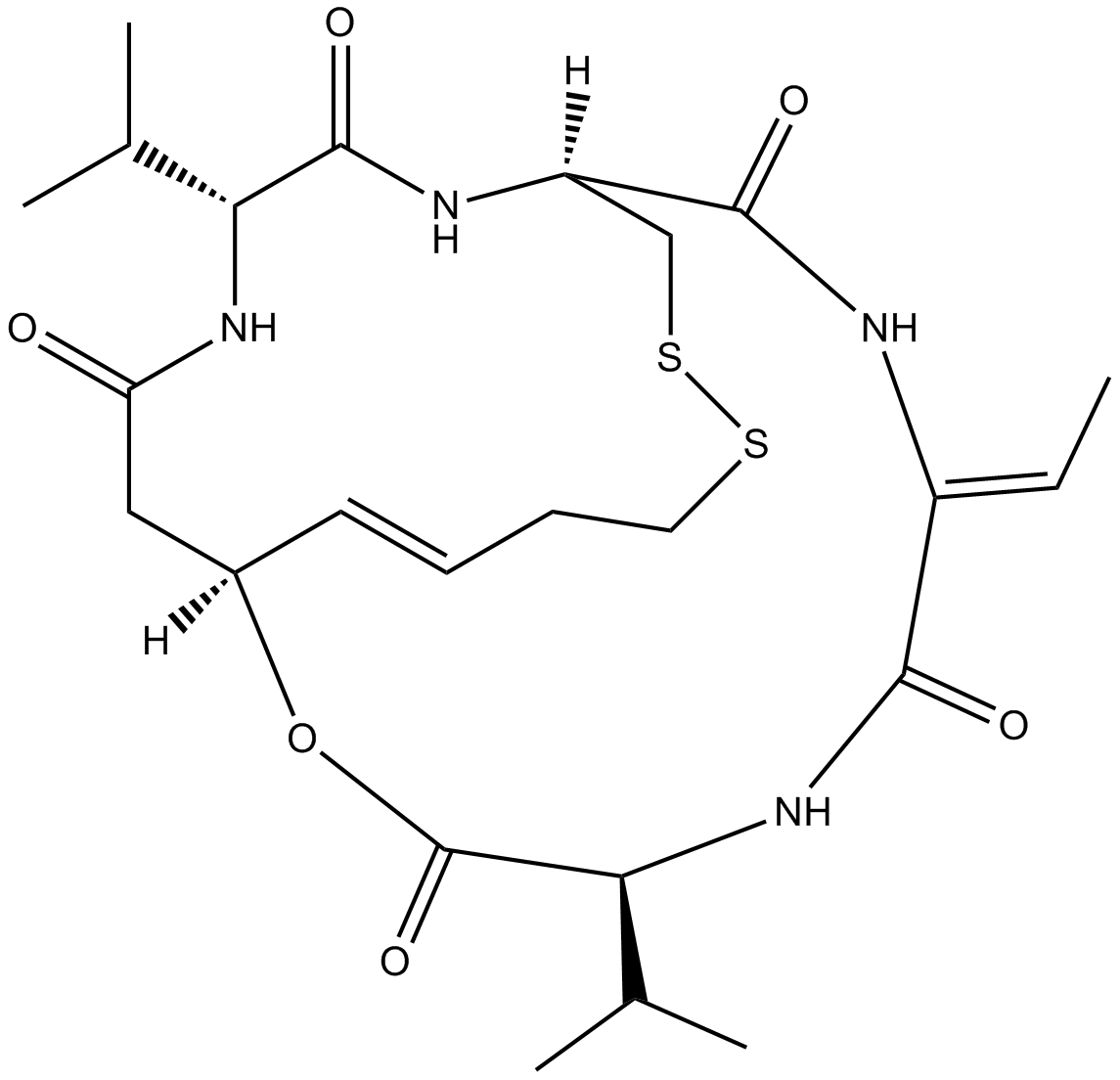
Romidepsin (FK228, depsipeptide)
Romidepsin (FK 228) is a Histone deacetylase (HDAC) inhibitor with anti-tumor activities. Romidepsin (FK 228) inhibits HDAC1, HDAC2, HDAC4, and HDAC6 with IC50s of 36 nM, 47 nM, 510 nM and 1.4 μM, respectively. Romidepsin (FK 228) is produced by Chromobacterium violaceum, induces cell G2/M phase arrest and apoptosis.
-
BCC2421
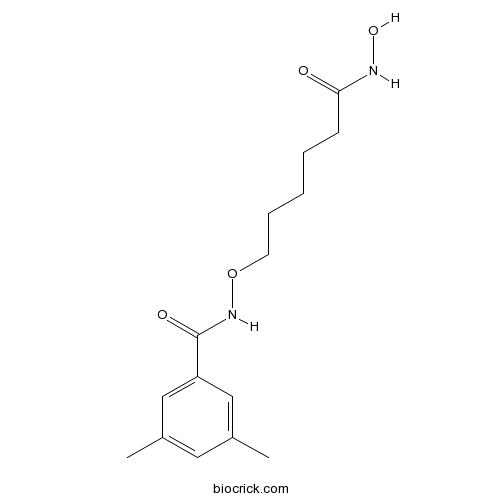
LMK 235
LMK-235 is a potent and selective HDAC4/5 inhibitor, inhibits HDAC5, HDAC4, HDAC6, HDAC1, HDAC2, HDAC11 and HDAC8, with IC50s of 4.22 nM, 11.9 nM, 55.7 nM, 320 nM, 881 nM, 852 nM and 1278 nM, respectively, and is used in cancer research.
-
BCC2162
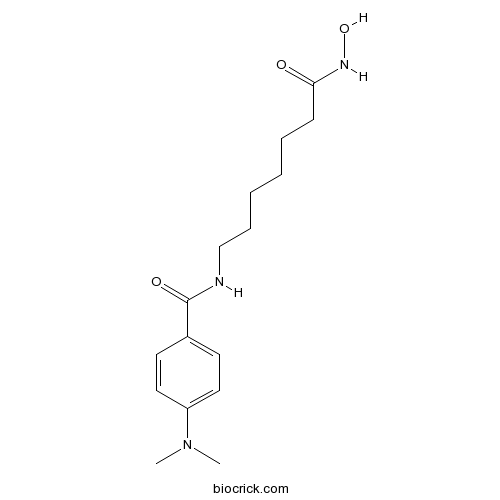
M344
M344 (D 237) is an inhibitor of histone deacetylase (IC50=100 nM) and an inducer of terminal cell fifferentiation.
-
BCC2151
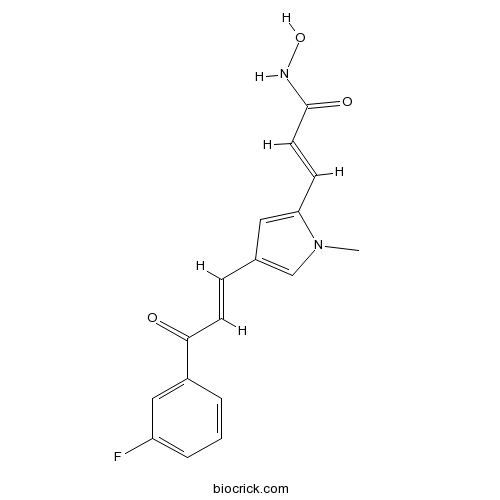
MC1568
MC1568 is a selective class II (IIa) histone deacetylas (HDAC II) inhibitor, used for cancer research.
-
BCC2422
NCH 51
PTACH (NCH-51) is a SAHA-based novel inhibitor of human HDAC. PTACH exerts potent growth inhibition against various human cancer cells, with EC50 values ranging from 1 to 10 μM.

-
BCC2423
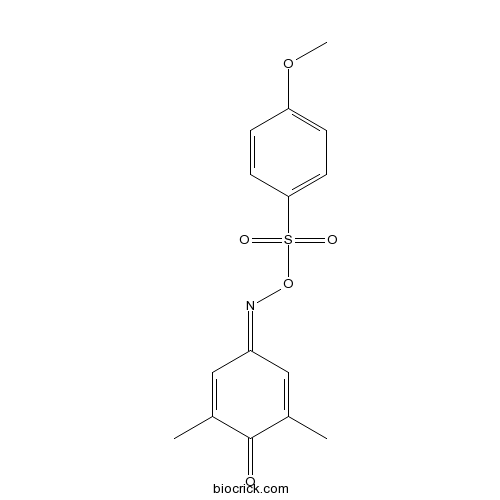
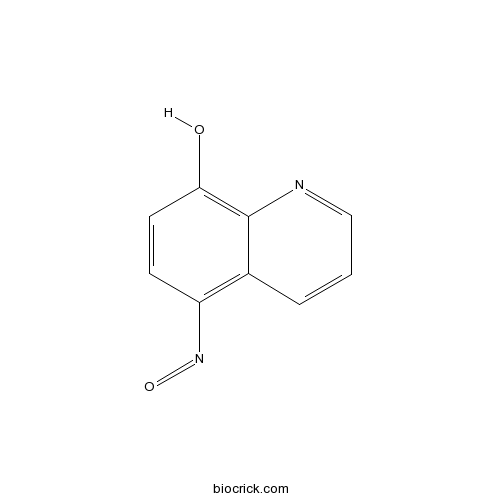
NSC 3852
Histone deacetylase inhibitor
-
BCC2148
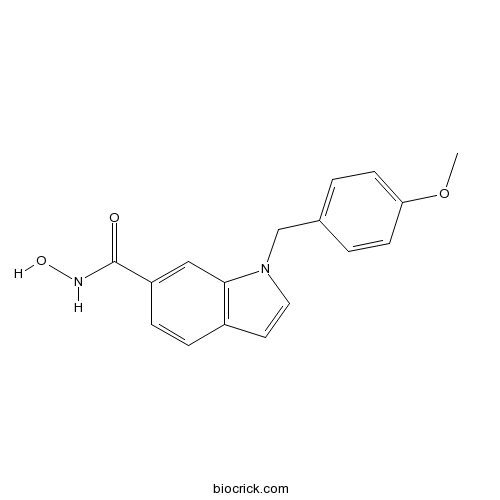
PCI-34051
PCI-34051 is a potent and selective HDAC8 inhibitor with IC50 of 10 nM, with >200-fold selectivity over the other HDAC isoforms.