Nociception
Nociception is the sensory process that provides the signals that lead to pain. This occurs through nociceptors, primary sensory neurons that are activated by stimuli that cause tissue damage. Stimuli can include tissue injury, extremes of heat and noxious chemicals. Unlike other sensory neurons that detect vision or taste, nociceptors are located all around the body, particularly under the skin, however, they are notably absent from the brain.
Nociception Products Targets
- Others (20)
- Nucleoside Transporter (5)
- Glycine Transporter (6)
- GABA (10)
- Cannabinoid Transporter (10)
- Acetylcholine Transporter (1)
- D4 Receptor (12)
- 5-HT7 Receptor (11)
- 5-HT6 Receptor (14)
- 5-ht5 Receptor (2)
- 5-HT4 Receptor (17)
- NK2 Receptor (7)
- NK1 Receptor (15)
- NOP Receptor (21)
- Mu-Opioid Receptors (15)
- Kappa Opioid Receptors (14)
- Glutamate (Metabotropic) Group III Receptor (26)
- Glutamate (Metabotropic) Group II Receptor (33)
- Glutamate (Metabotropic) Group I Receptor (54)
- AMPA Receptor (45)
- GABAA-ρ Receptor (8)
- GABAA Receptor (66)
- GPR55 (8)
- CB2 Receptor (6)
- CB1 Receptor (17)
- Voltage-gated Sodium (NaV) Channels (30)
- Voltage-gated Potassium (KV) Channels (38)
- Voltage-gated Calcium Channels (CaV) (38)
- Neurotensin Receptors (7)
- Glycine Receptors (6)
- Fatty Acid Amide Hydrolase (15)
- Cyclooxygenases (24)
- Bradykinin Receptors (12)
- D3 Receptor (12)
- NK3 Receptor (5)
- Vesicular Monoamine Transporter (4)
- NMDA Receptor (87)
- Kainate Receptor (22)
- D2 Receptor (14)
- D1 and D5 Receptor (16)
- Glutamate Transporter (18)
- Dopamine Transporter (20)
- Histamine H4 Receptor (12)
- Histamine H3 Receptor (22)
- Histamine H2 Receptor (10)
- Histamine H1 Receptor (17)
- Adrenergic Transporter (23)
- 5-HT Transporter (30)
- NO donors and precursors (9)
- nNOS (5)
- iNOS (11)
- eNOS (1)
- M5 Receptor (2)
- M4 Receptor (3)
- M3 Receptor (4)
- M2 Receptor (5)
- M1 Receptor (8)
- Delta opioid receptor (16)
- Adrenergic α2 Receptor (33)
- Adrenergic α1 Receptor (22)
- Adrenergic β3 Receptor (12)
- Adrenergic β2 Receptor (6)
- Adrenergic β1 Receptor (7)
Products for Nociception - Page 4
- Cat.No. Product Name Information/Activity
-
BCC5948
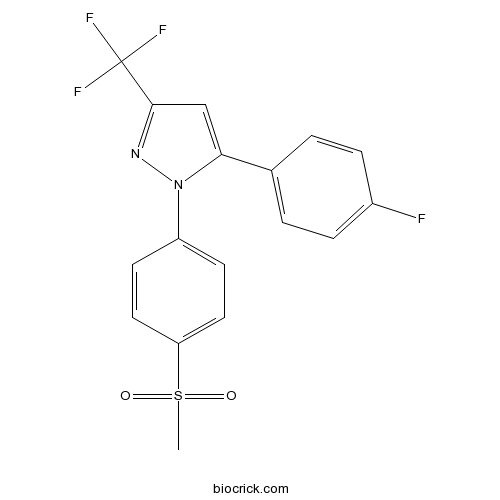
SC 58125
162054-19-5
-
BCC7809
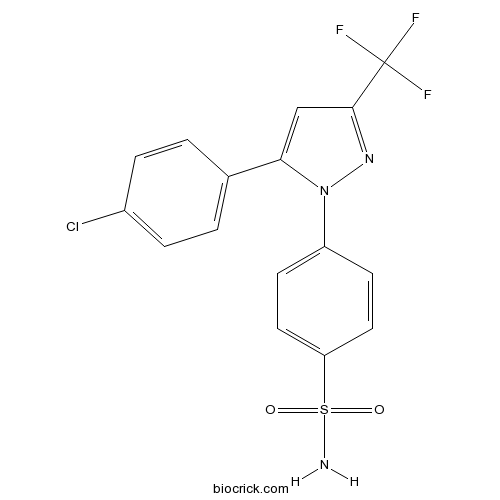
SC 236
170569-86-5
-
BCC4861
Sulindac
Sulindac (MK-231) is a non-steroidal antiinflammatory agent, acts as a COX-2 inhibitor, and inhibits overexpression of COX-2.

-
BCC7391
Talniflumate
66898-62-2

-
BCC7419
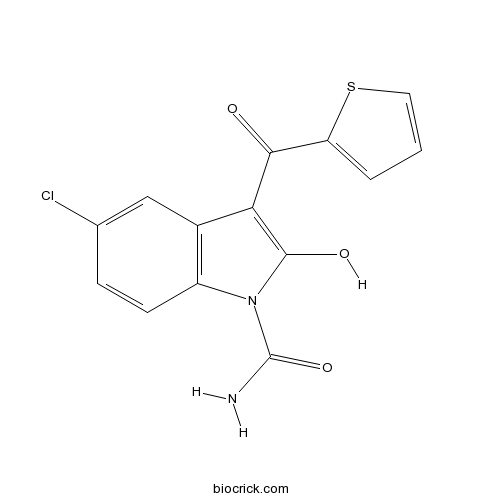
Tenidap
Tenidap, a non-steroidal anti-inflammatory drug, is a selective COX-1 inhibitor, with IC50 values of 0.03 µM and 1.2 µM for COX-1 and COX-2, respectively. Tenidap has anti-inflammatory and antirheumatic properties. Tenidap is also a specific SLC26A3 inhibitor.
-
BCC4441
Valdecoxib
Valdecoxib is a highly potent and selective inhibitor of COX-2, with IC50s of 5 nM and 140 μM for COX-2 and COX-1, respeceively. Valdecoxib can be used in the research of arthritis and pain.

-
BCC7075
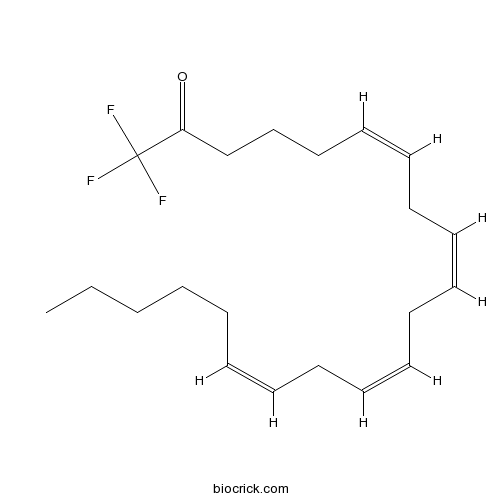
AACOCF3
Phospholipase A<sub>2</sub> inhibitor
-
BCC7675
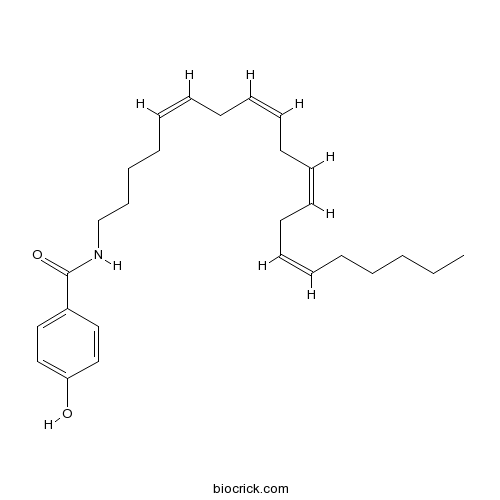
AM 1172
FAAH inhibitor; also anandamide uptake inhibitor and CB receptor partial agonist
-
BCC7500
Arachidonyl serotonin
187947-37-1

-
BCC2315
JNJ-1661010
JNJ-1661010 (Takeda-25) a potent and selective fatty acid amide hydrolase (FAAH) inhibitor with IC50s of 34 and 33 nM for rat FAAH and human FAAH, respectively. JNJ-1661010 can cross the blood-brain barrier and used as broad-spectrum analgesics.