
Intracellular Signaling
Cell signaling (cell signalling in British English) is part of any communication process that governs basic activities of cells and coordinates all cell actions. The ability of cells to perceive and correctly respond to their microenvironment is the basis of development, tissue repair, and immunity, as well as normal tissue homeostasis. Errors in signaling interactions and cellular information processing are responsible for diseases such as cancer, autoimmunity, and diabetes. By understanding cell signaling, diseases may be treated more effectively and, theoretically, artificial tissues may be created.
Intracellular Signaling Products Targets
- Cdc25 Phosphatase (2)
- STAT (10)
- PI 3-kinase (22)
- JAK (10)
- PFKFB3 (3)
- Hexokinases (1)
- Protein Kinase G (3)
- NFKB and IKB (30)
- Others (3)
- Cyclooxygenase (24)
- IRAK (1)
- PORCN (4)
- beta-catenin (13)
- PPARγ (16)
- PPARδ (5)
- PPARα (7)
- Inositol Phosphatase (3)
- MYC (1)
- Sphingosine Kinase (2)
- RSK (4)
- Protein Kinase D (3)
- Polo-like Kinase (5)
- Pim Kinase (4)
- PERK (2)
- Phosphoinositide-dependent Kinase 1 (5)
- P21-activated Kinases (2)
- Myosin Light Chain Kinase (4)
- mTOR (14)
- Monopolar Spindle 1 Kinase (2)
- Mnk (2)
- MK2 (2)
- MEK (9)
- LIMK (3)
- Focal Adhesion Kinase (4)
- DNA-Dependent Protein Kinase (6)
- Diacylglycerol Kinase (2)
- Death-Associated Protein Kinase (1)
- Checkpoint Kinase (3)
- Casein Kinase 2 (3)
- Casein Kinase 1 (7)
- Bruton's Tyrosine Kinase (3)
- ATM and ATR Kinase (3)
- Akt (Protein Kinase B) (11)
- Adeonsine Kinase (2)
- Abl Kinase (9)
- Hsp90 (10)
- Hsp70 (4)
- Protein Kinase A (9)
- Protein Kinase C (29)
- Calmodulin-Dependent Kinase (8)
- LRRK2 (4)
- ERK (6)
- DYRK (3)
- Estrogen and Related Receptor (33)
- Tankyrase (5)
- ITK (2)
- ASK1 (2)
- Syk Kinase (4)
- Src Kinase (21)
- Raf Kinase (7)
- IαB Kinase (6)
- p38 MAPK (16)
- Janus N-terminal Kinase (12)
- Androgen Receptor (11)
- Glycogen Synthase Kinase 3 (20)
- AMPK (7)
- Rho-Kinases (9)
- AP-1 (2)
- SREBP (2)
- NUAK (2)
- Telomerase (3)
- Retinoid X Receptor (13)
- Retinoic Acid Receptor (22)
- Proteasome (5)
- Phospholipase (16)
- Lipase (4)
- G Protein (Small) (23)
- Hedgehog Signaling (15)
- DNA Topoisomerase (12)
- DNA, RNA and Protein Synthesis (46)
- Protein Tyrosine Phosphatases (5)
- Protein serine and threonine phosphatase (16)
- Histone Deacetylase (19)
- Aurora Kinase (9)
- Cyclin-Dependent Protein Kinase (21)
Products for Intracellular Signaling - Page 55
- Cat.No. Product Name Information/Activity
-
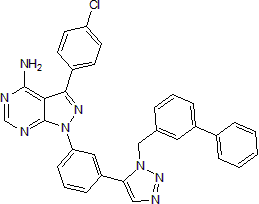
BCC6253
KB SRC 4
KB SRC 4 is a potent, and highly selective c-Src inhibitor, with a Ki of 44 nM and a Kd of 86 nM, and shows no inhibition on c-Abl up to 125 μM; KB SRC 4 has antitumor activity.
-
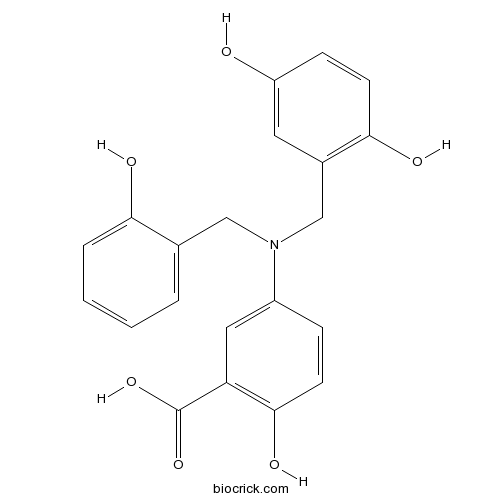
BCN1808
Lavendustin A
Lavendustin A (RG-14355), isolated from Streptomyces Griseolavendus, is a potent, specific and ATP-competitive inhibitor of tyrosine kinase, with an IC50 of 11 ng/mL for EGFR-associated tyrosine kinase. It suppresses VEGF-induced angiogenesis and blocks the induction of LTPGABA-A.
-
BCC5895
Lyn peptide inhibitor
222018-18-0

-
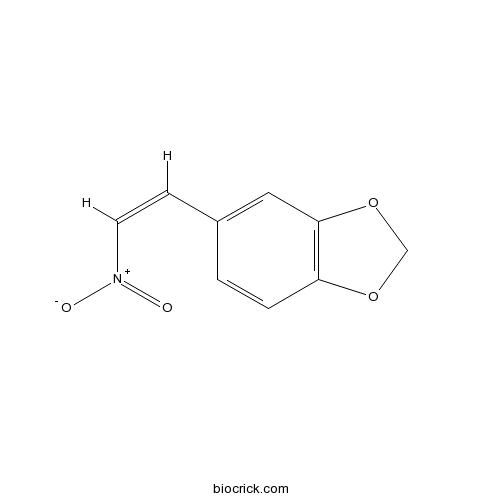
BCC3943
MNS
MNS is a potent and selective inhibitor of Src and Syk tyrosine kinases.
-
BCC3630
PP 1
PP1 is a potent, and Src family-selective tyrosine kinase inhibitor with IC50 of 5 and 6 nM for Lck and Fyn, respectively.

-
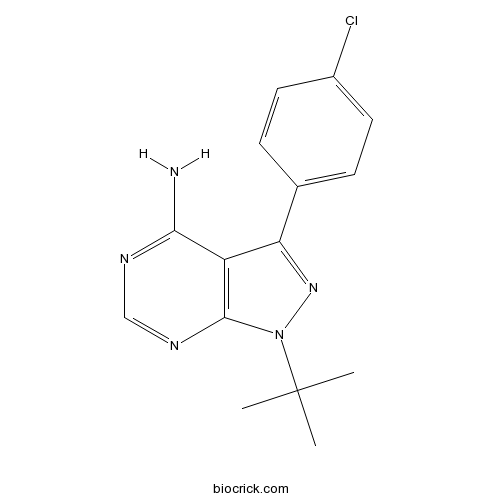
BCC3631
PP 2 (AG 1879)
PP2 is a reversible and ATP-competitive Src family kinases inhibitor with IC50s of 4 and 5 nM for Lck and Fyn, respectively.
-
BCC7486
PP 3
5334-30-5

-
BCC5851
pp60 c-src (521-533) (phosphorylated)
149299-77-4

-
BCC7733
Src I1
Src Inhibitor 1 is a potent and selective dual site Src tyrosine kinase inhibitor with IC50 values of 44 nM for Src and 88nM for Lck.

-
BCC1689
Lck Inhibitor
Lck Inhibitor is a new class of compounds that are potent inhibitors of Lck with an IC50 value of 7 nM.